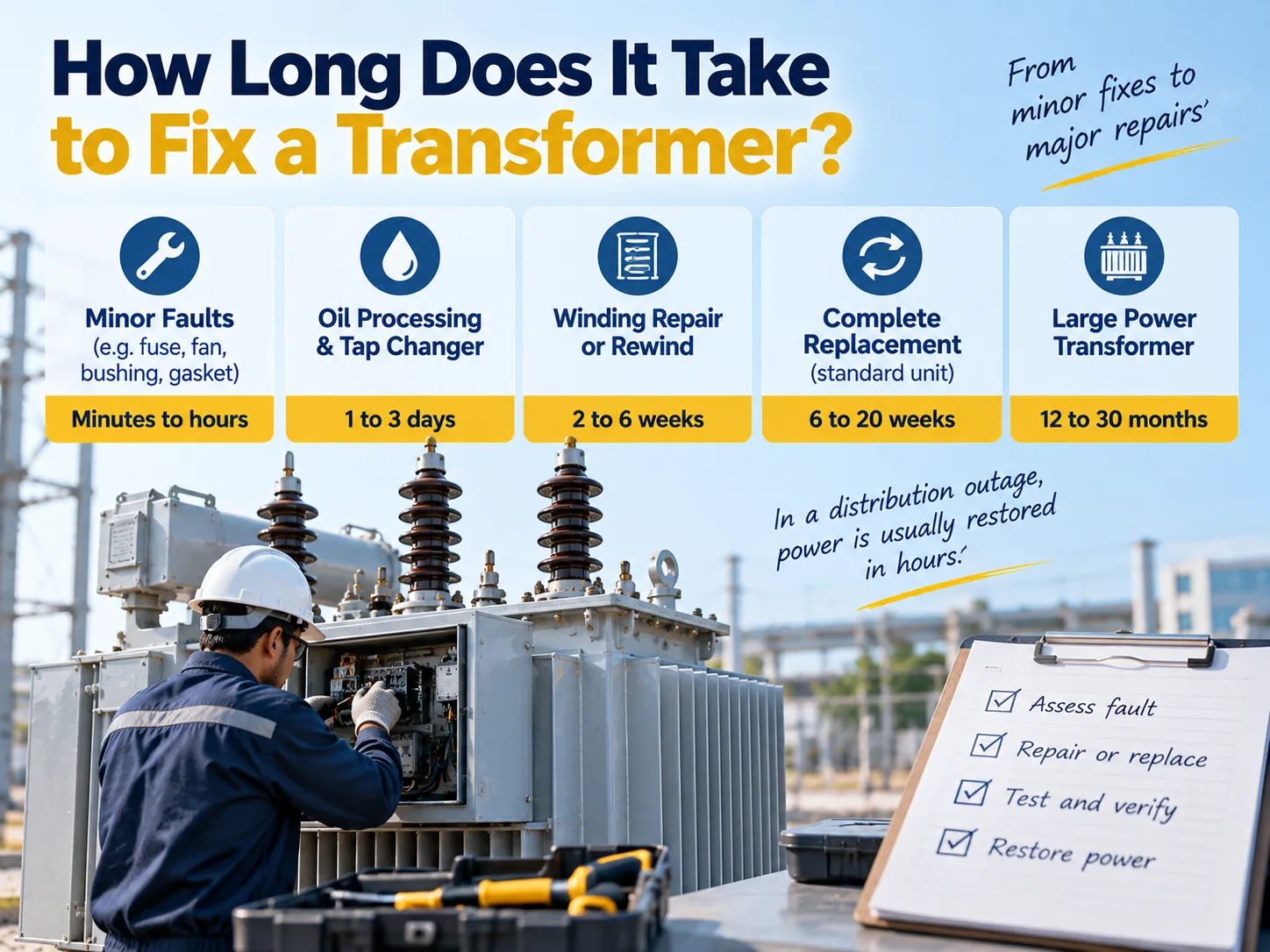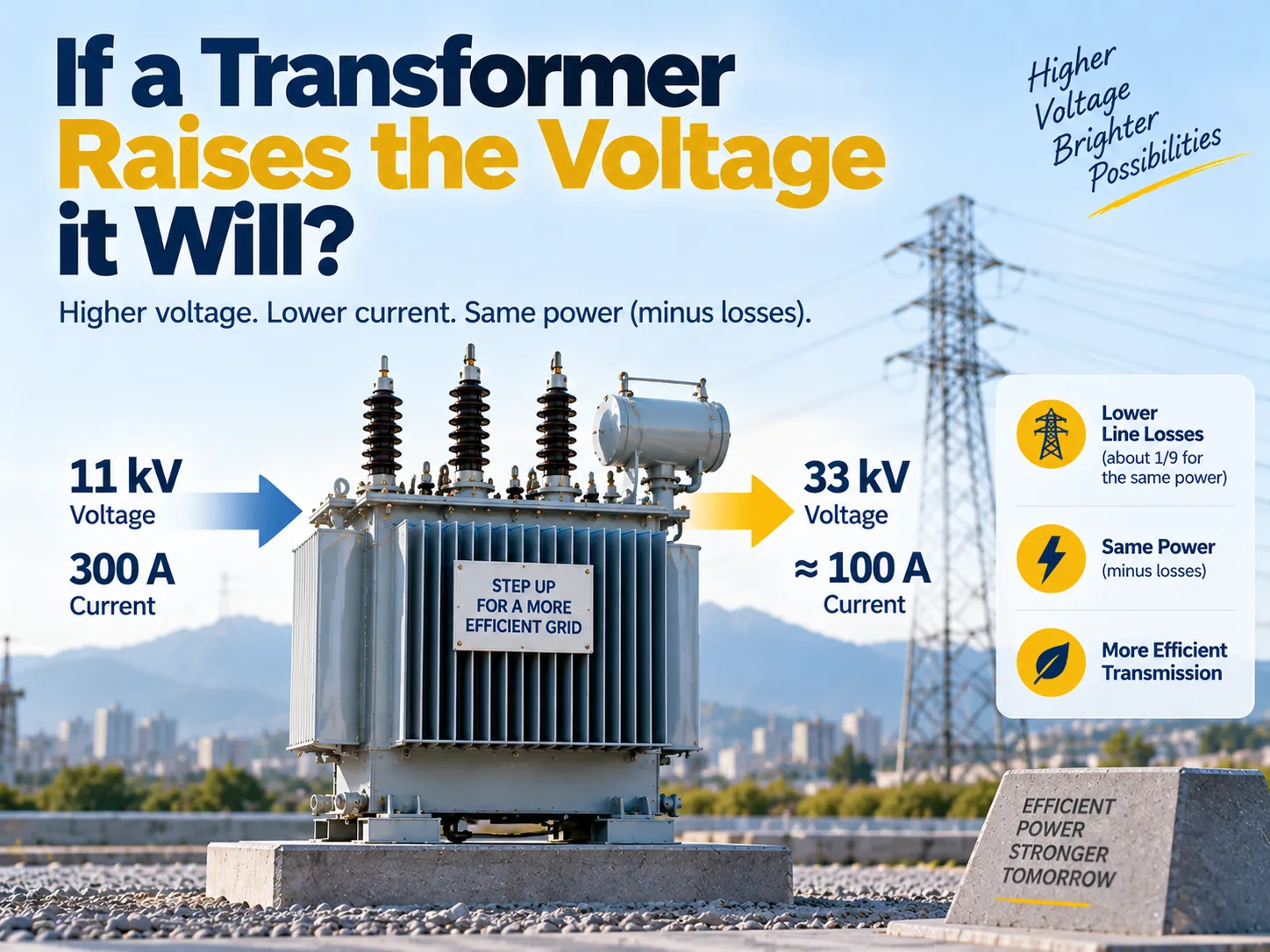

Manufacturing plants for drinks might be among the most difficult places to supply electricity. The amount of electricity needed is obtained through electric motors in conveyor systems, filling machines, capping machines, refrigerators with large electric power consumption, wash-down chemicals that destroy the other equipment case, compressors, steam and hot water cleaning systems and it is important to emphasize that production processes cannot withstand intervals of over 5 seconds without electricity. What is important is what type of equipment needs to be supplied with electricity and that all of this equipment needs to be connected to any kind of electricity supply.
The paper discusses the general information about such issues as medium voltage switchgear, medium voltage transformers, low voltage power supply, motor control and starting devices used in the beverage industry and examines the suppliers in the market (for instance, positions of RUY Power) and acceptance of this equipment.
Straightforward answer: Electricity is supplied to the beverage industry from a medium voltage source at around 11 kV, 13.8 kV, or 33 kV in the distribution switchboard, allowing the installation of approximately 1000-2500 kVa transformers for the decrease of medium voltage to an acceptable level and subsequently equipping the beverage production with all necessary equipment such as low voltage switchboards, interchange controllers, capacitors, etc. A kitchen consumes power of about 200-400 A in a three-phase power supply, while bottling and packaging lines operate in the range of 1-4 MW of power with about 40-60% of the electricity for refrigeration purposes. RUY Power designs equipment for such consumption such as KYN28-12 isolating switchgears along with armored switchgear and low voltage switchboards with OEM and ODM production.
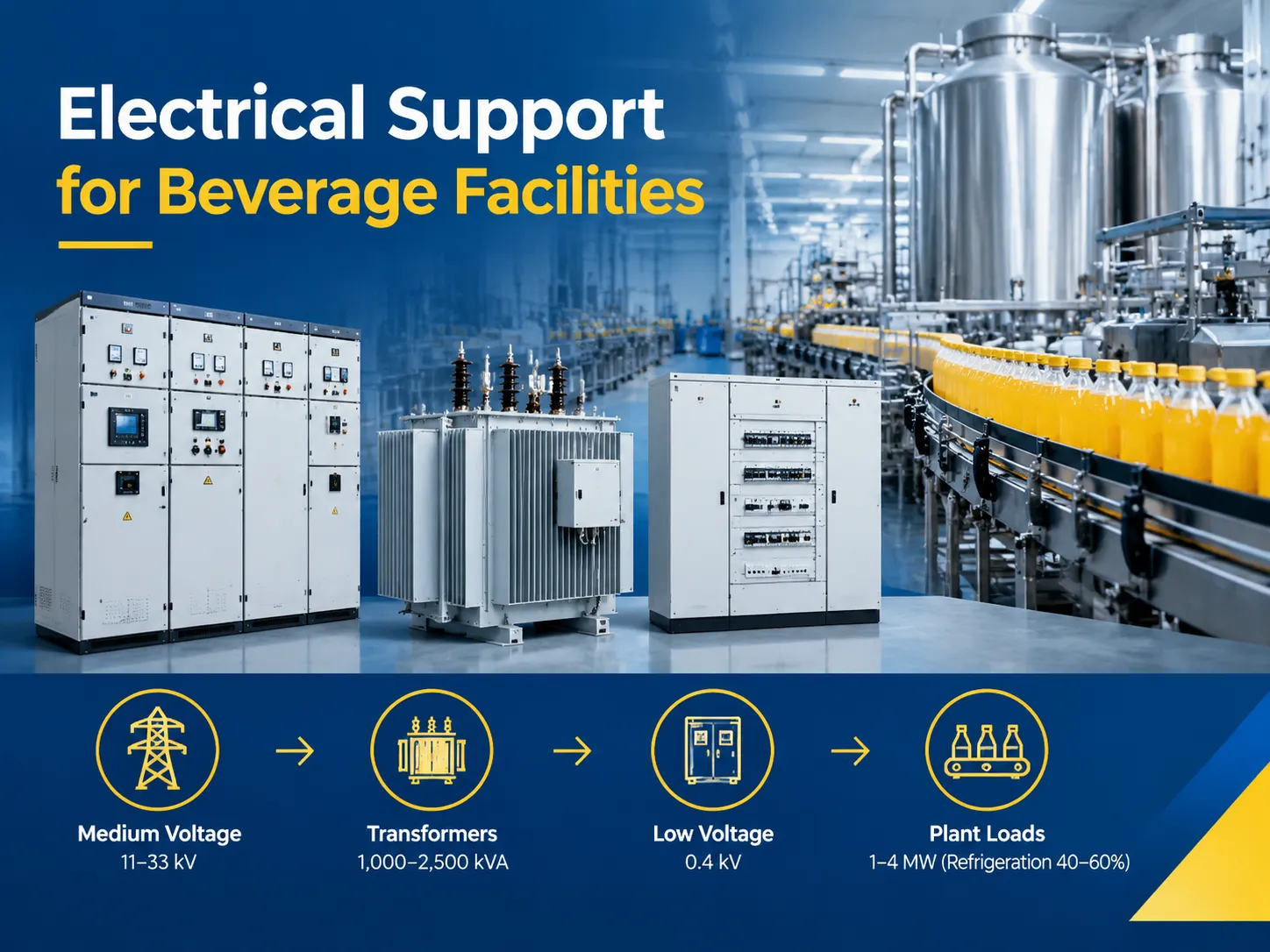
What “Electrical Support” Means Inside a Beverage Plant
The term is ambiguous and creates unnecessary expenses for people. It refers to four different items: equipment, design, installation, and maintenance. All four of them must be suitably acquired for the beverage unit, but each is usually sourced from a different vendor.
| Layer | What it includes | Who supplies it | Typical scope |
|---|---|---|---|
| Utility interface | Incoming metering, protection, MV switchgear | Switchgear manufacturer | 11–40.5 kV |
| Voltage transformation | Oil-immersed or dry-type transformers, box substations | Transformer manufacturer | 630–2,500 kVA |
| Low-voltage distribution | Main switchboard, sub-distribution, MCCs | LV assembly manufacturer | 0.4–0.69 kV |
| Power quality | Capacitor banks, detuned filters, APFC panels | Compensation specialist | 50–400 kvar |
| Process control | PLCs, VFDs, instrumentation, networks | Automation supplier | Line-level |
| Field devices | Washdown-rated sockets, panels, sensors | Device manufacturer | IP66 / NEMA 4X |
| Engineering and EPC | Load studies, protection coordination, installation | Engineering firm, licensed contractor | Whole facility |
| Maintenance | Testing, thermography, spares, protection calibration | Service organisation | Annual |
Nearly every electrical failure in a project can be attributed to a gap in this table rather than a failure of a particular part. The most familiar gap is when the switchgear package is sourced from one vendor, transformers from a different vendor, and the settings are set up by nobody, causing the upstream breaker to switch off before the downstream one, and leading to the entire facility being switched off due to a single motor problem.
The Load Profile: Why Beverage Plants Are Unusual
The loading provided by beverages differs from that of the office. Beverage loading goes through a series of motors & hence motor actions differ from how a load using resistive and electronic principles operates.
While running the bottling or canning lines, several different between 1 and 75 kW motors, having been induced using inverters, are involved. Refrigeration options, be it glycol chillers, Ammonia Compressors, and CO2 systems, continue to run and are responsible for around 40%-60% of total plant power consumption. The compressed air adds about 10 to 15% to total consumption. The CIP system runs intermittently. Due to this kind of load, its characteristics show power factor and distortion to be low.
This leads to two outcomes. First, the power factor of the plant is found to be around 0.75 to 0.85, meaning you have to pay for the current you have not used. You end up paying a utility penalty as well. Second, the power distortion produced by the VFD is enough to exceed the 5% limit of IEEE or local authorities.
A better solution appears to lie in applying the power factor correction practices using detuned reactors, because capacitor bank on the network with the VFD distortion will increase 5th and 7th distortions to high magnitudes and eventually fail in a couple of years.A low-voltage capacitor compensation cabinet with detuned reactors and automatic switching keeps the power factor above 0.95 and survives the harmonic environment. Budget 50–400 kvar for a mid-sized plant, staged in automatic steps so it tracks the load rather than switching the whole bank at once.
One important value to take into account, when designing the entire electrical part, is the energy intensity of the equipment. A modern brewery requires about 8 to 20 kWh of electric energy per hectolitre of packaged beer, depending on the type of packing used and the heat recovery. A brewery producing 500,000 hectolitres of beer in a year would consume about 4 to 10 GW of electricity and would usually have its maximum energy demand between 1 and 2 MW.
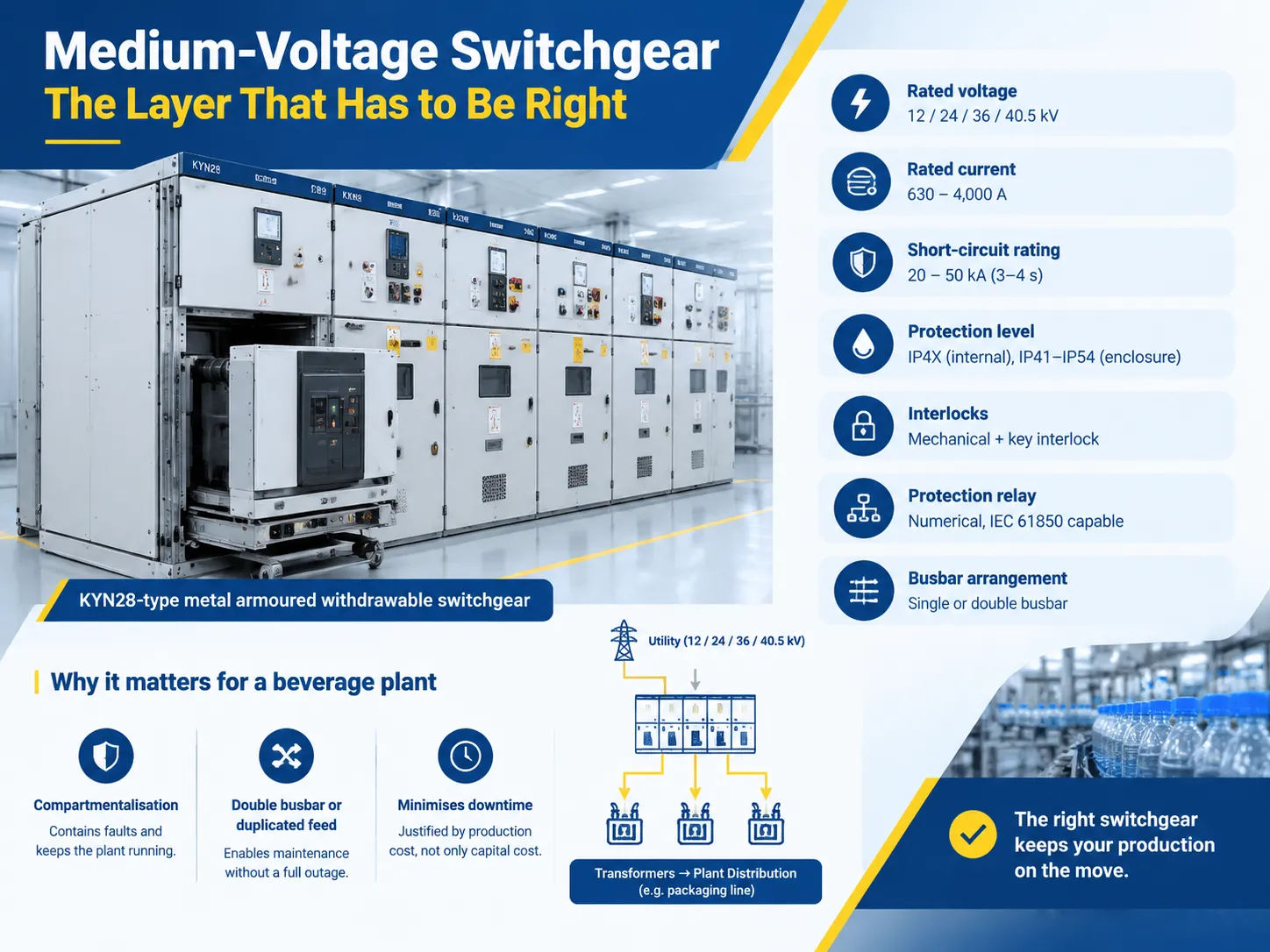
Medium-Voltage Switchgear: The Layer That Has to Be Right
Most beverage companies receive their power or supply at medium voltage due to the fact that the utility does not deliver anything above 2 MW at low voltage. Thus, a switchgear with a voltage rating of 12 kV, 15 kV, 24 kV, or 36 kV is required depending on the country and some larger plants may require a switchgear with voltage rating 40.5 kV.
The most used design in the markets of IEC is the metal-clad, withdrawable switchgear and KYN28 cubicles remain the more suitable model. With the help of a vacuum circuit breaker, the switchgear becomes withdrawable and does not need to be taken offline for maintenance. Due to the presence of compartments in the switchgear, a fault occuring in the cable area does not affect the breaker or bus bar. In case of any power failure in the beverage production line, it is possible to provide electricity to the rest of the power system.
| Parameter | Typical specification | Why it matters in a beverage plant |
|---|---|---|
| Rated voltage | 12 / 24 / 36 / 40.5 kV | Set by the utility, not by the plant |
| Rated current | 630–4,000 A busbar | Must cover future line additions |
| Short-circuit rating | 20–50 kA for 3–4 s | Upstream capacity is often understated at design stage |
| Degree of protection | IP4X internal, IP41–IP54 enclosure | Washdown and humid environments |
| Interlocks | Mechanical plus key interlock | Prevents live working errors |
| Protection relay | Numerical, IEC 61850 capable | Enables plant-wide protection coordination |
| Busbar arrangement | Single or double busbar | Double busbar allows maintenance without a shutdown |
This information is poorly explained when we look at the junction of the incoming electrical system and the internal distribution of the facility. A facility that receives its power supply at 12,000 volts with a single bus bar does not have any means of safety-skipping the maintenance operation on its switchgear. A beverage facility with production in continuous operations 24/6 or 24/7 usually opts for either a double bus bar or a switchgear power supply, which can be easily justified on the basis of the economic effect created by eliminating the downtime. A 12 kV metal armoured withdrawable switchgear lineup with a proper relay scheme is the standard building block for that architecture in IEC markets. In North America, the counterpart is a 15 kV metal-clad switchgear in compliance with IEEE C37.20.2 and UL 891 or with UL 1558 for the low-voltage area, and one cannot interchange between the two — the choice of standards must be based on the utility and the inspection system used.
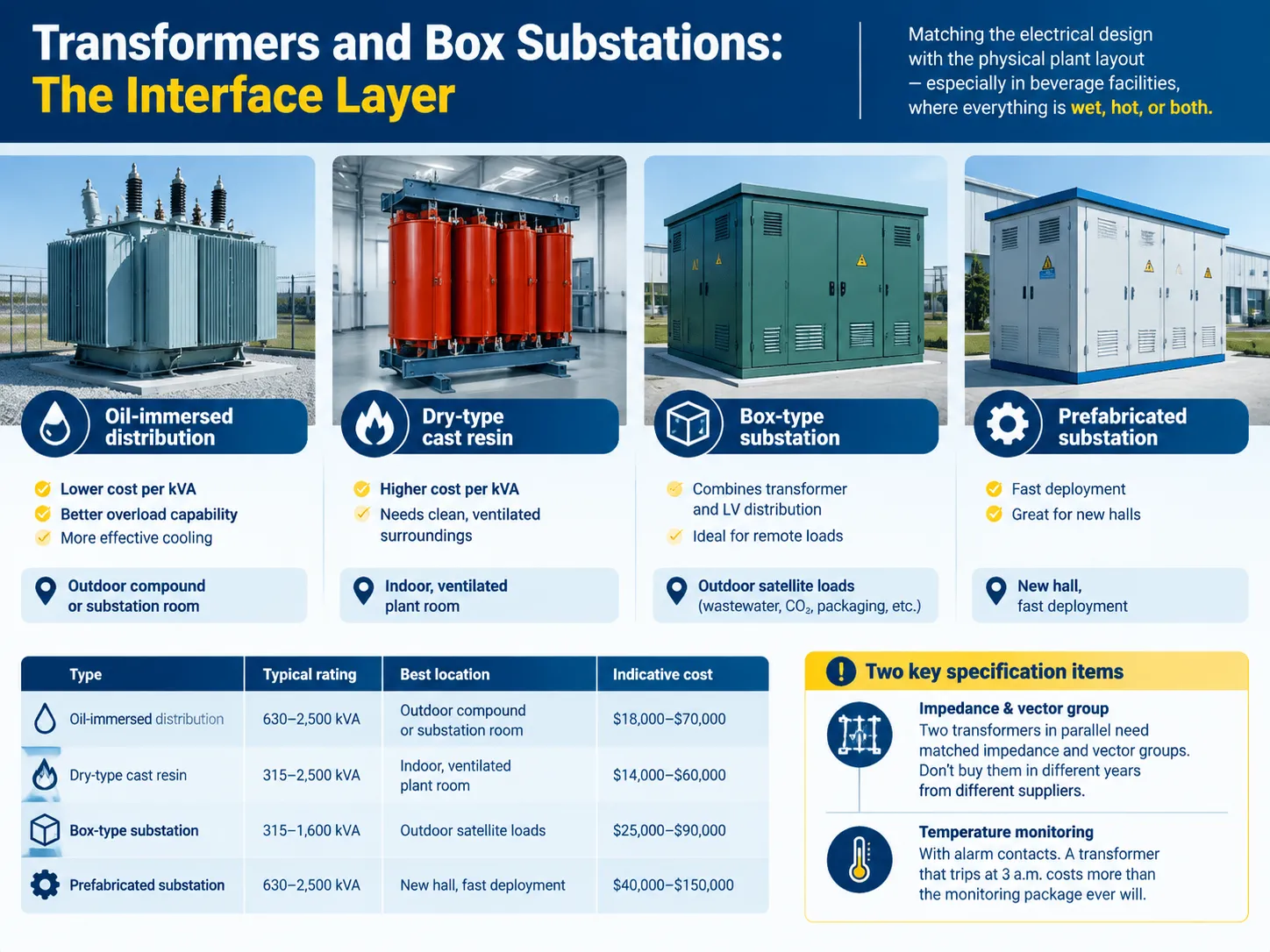
Transformers and Box Substations: The Interface Layer
Transformers serve as a connection point between the electrical design of the system and the way that equipment is laid out in the plant. This is especially true given the constraints in space in a beverage plant, where the system must be able to withstand wet and hot conditions.
Outdoor applications involve large transformers such as oil transformers that may provide the perfect solution for any job at hand, as they are cheaper and more efficient. However, their only limitation is the restricted access due to oil containment and fire separation being required.
If an application concerns the interior of the plant, it is better to opt for dry-type transformers. They cost more, but their service life is not limited if they operate in a proper environment, as their efficiency may be reduced if they are used in humid places with no ventilation.
Box-type substations fit transformers and low-voltage distribution systems in one structure composed of three compartments – high voltage incoming, transformer, and low voltage outgoing. This helps to save both time and money on the work of the plant.A combined transformer box substation in a 630 kVA class is the scale most beverage plants use for these satellite loads, with the advantage that a single outdoor unit replaces a substation building.
| Type | Typical rating | Best location | Indicative cost |
|---|---|---|---|
| Oil-immersed distribution | 630–2,500 kVA | Outdoor compound or substation room | $18,000–$70,000 |
| Dry-type cast resin | 315–2,500 kVA | Indoor, ventilated plant room | $14,000–$60,000 |
| Box-type substation | 315–1,600 kVA | Outdoor satellite loads | $25,000–$90,000 |
| Prefabricated substation | 630–2,500 kVA | New hall, fast deployment | $40,000–$150,000 |
There are two items in specifications that are always overlooked but will cost money in the future. First, impedance and vector group: to be able to join two transformers in parallel, you need to have matching impedance and vector group which is usually impossible to achieve when they are obtained from different manufacturers and in different years. Second, thermal protection with alarm contacts – it is more costly to deal with a transformer tripping off due to overheating in the middle of the night than to buy a monitoring system.
Low-Voltage Distribution, Motor Control and Washdown Devices
The low-voltage side is where the facility exists in reality. Every beverage factory has three basic needs from this portion of the electrical system: a main switchboard through which the power passes, motor control centers to regulate processes in the factory, and several field distribution points that are suitable for washdown.
- Main switchboard: It should be made to carry the full current output of the transformer with a little extra margin. If a transformer has a capacity of 1,600 kVA and an output of 0.4 kV, then a switchboard should be rated for around 2300 A for continuous current flow. This means that the busbar system needs to be rated for either 3200 A or 4000 A. Depending on the design of the switchboard, it is possible to replace a faulty breaker without interrupting the electricity supply to the facility.
- Motor control centers: A factory with 80-200 motors should preferably have structured MCCs instead of conventional starter panels. The system of replaceable MCC sections allows for quick repairs. In essence, the time it takes to restart a production line can determine the profitability of the factory. A low-voltage withdrawable switchgear assembly built to IEC 61439 is the standard platform in IEC markets, with the equivalent UL 845 MCC in North America.
- Washdown-rated field equipment: This is the only aspect that sets beverage plants apart from all other industrial facilities. Conventional enclosures made of sheet steel and IP20 junction boxes are not capable of handling these high-pressure foam cleansers that are used every day. Equipment should have at least IP66-level dust and water protection, NEMA 4X level of contamination-free capability, 316-grade stainless steel components, inclined surfaces allowing water to drain off rather than pool, and seals resistant to alkali and acids.
| Requirement | Ordinary industrial | Beverage plant |
|---|---|---|
| Enclosure rating | IP54 / NEMA 12 | IP66–IP69K / NEMA 4X |
| Material | Painted steel | 316 stainless or GRP |
| Cable entry | Standard glands | Sealed, liquid-tight, corrosion resistant |
| Field sockets | IP44 industrial | IP66 with hinged lid, interlocked |
| Documentation | Electrical drawings | Drawings plus washdown procedure notes |
Five Suppliers Who Support Beverage Facilities
No single manufacturer fulfills the entirety of the table above. For the most part, beverage projects result in three, four relationships of supply. Below is who does what, including our position.
- RUY Power (ruy-power.com) makes the medium-voltage, low-voltage and transformer layer: 12 kV and 40.5 kV metal-armoured switchgear, solid insulated and ring main units, box-type and pre-fabricated substations, oil-immersed and dry-type transformers, 0.4 kV withdrawable and fixed switchgear, distribution boxes and PV grid-connected cabinets. We supply on OEM and ODM terms, which means that the beverage plant, EPC contractor or panel Builder can take our equipment under their own brand, with changed busbar configurations, relay diagrams, and enclosure finishing. There are honest limitations: we are the machinery layer and not the engineering company and not the installer as well. We can’t do the protection coordination study and can’t bring the process into operation. What we do is deliver the switchgear and transformers according to the requirements, with type test reports, and help in fulfilling the OEM scope.
- Schneider Electric is the most popular one-supplier choice for a beverage plant since it covers medium voltage, low voltage, power control, and automation in a single portfolio. This richness is a big advantage of greenfield projects since there is one protection philosophy, one commissioning team, and one warranty conversation. The drawback is the price and some amount of component lock-in.
- ABB competes in the same segment with a particular strength in drives and motors, which is crucial if it comes to a plant where VFDs are the majority of the load. If your OEMs use ABB drives, it will solve the spare parts issue easily to unify electrical distribution with ABB hardware.
- Rockwell Automation is the default option when the process control philosophy is Rockwell. If the whole plant uses the same control standard for many lines, the integration is worth paying for.
- Siemens plays a similar role if the plant automation is based on Siemens, which is a popular specification among European beverage plants, both for process automation and medium-voltage equipment.
Apart from those five categories, two other categories are also significant. Engineering and EPC companies conduct load studies, short-circuit studies and protection coordination studies and arc flash studies, which is something that a manufacturer cannot accomplish. The local licensed electrical contractor is responsible for equipment installation, which is responsible for about 70% of electrical quality issues.
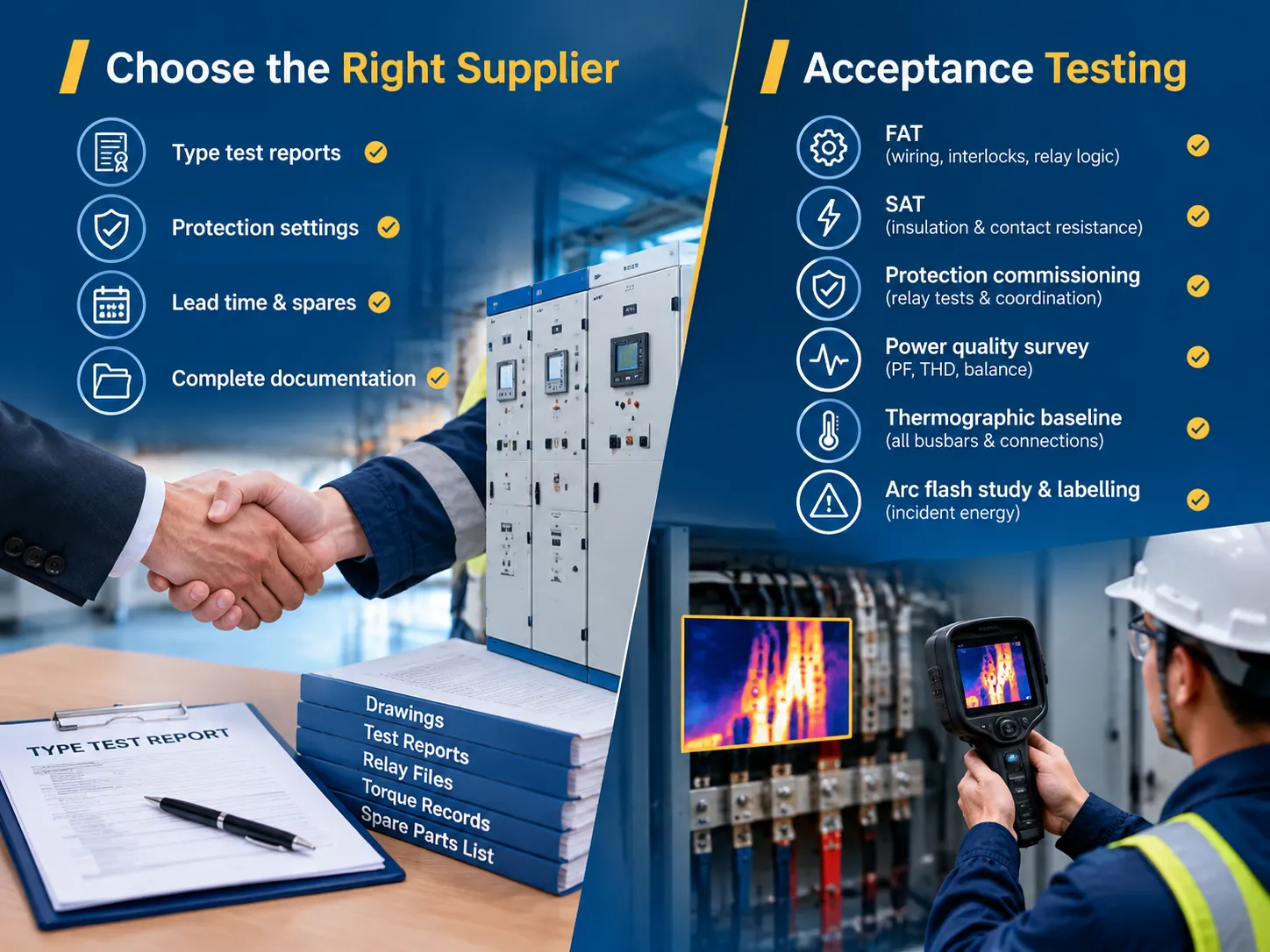
How to Select a Supplier and How to Accept What Arrives
The selection process can be narrowed down to 4 questions, and the answers to each are verifiable.
Is the manufacturer able to issue type test reports, not just certificates of conformity? In the case of medium voltage switchgear, IEC 62271-200 type testing confirms that the design was subject to short-circuit testing at an accredited laboratory. A certificate of conformity is only a self-declaration. With respect to low-voltage switchgear assemblies, IEC 61439 verification does the same job, either through testing or through calculations — it is important to know what was done as the testing method will involve more entails a cost but is more relevant.
Who is responsible for the protection settings? If switchgear manufacturer or transformer manufacturer assumes that the plants electrical engineer is responsible for coordination of relays, this can lead to nuisance tripping, or even worse, fault of equipment beyond what is required, leading to more serious consequences for the plant. One responsible person must be appointed who will be responsible for coordination work, and document it.
What is the lead time, including spares? Medium voltage switchgear lead time is 20-40 weeks, while the transformers lead time is 16-30 weeks. It is also important to find out how much time it takes to manufacture replacement circuit breaker truck, since this determines the equipment downtime at year 5, rather than the delivery date.
What documentation is included in the package? You need drawings, test reports, rail configurations, torque records and spare list. If switchgear is supplied without relay configuration files the entire installation can be rendered unusable.
Acceptance testing is the other half, and it is done in two stages.
| Stage | What is tested | Acceptance criterion |
|---|---|---|
| Factory acceptance test (FAT) | Wiring, interlocks, relay logic, primary injection | Witnessed and signed before shipment |
| Site acceptance test (SAT) | Insulation resistance, contact resistance, trip tests | Documented per cubicle |
| Protection commissioning | Secondary injection of every relay, coordination check | Relay curve verified against the study |
| Power quality survey | Power factor, THD, voltage balance under load | PF ≥0.95, THD within IEEE 519 / local limit |
| Thermographic baseline | All busbar and connection points under load | Imaging record for future comparison |
| Arc flash study and labelling | Incident energy at each panel | Labels fitted before energisation |
The thermographic baseline is the most commonly rejected item among clients that they later wish they had acquired. This investment costs multiple thousands of dollars but provides valuable baseline images that allow for comparisons in case something turns out to be hot in the future.
Maintenance, Spares and What Happens at 3 a.m.
The support of electrical equipment is not something that is done only once. A beverage facility runs 6,000-8,000 hours in 12 months in a humid and chemically aggressive environment therefore its electrical machinery becomes inefficient faster than the equipment of a dry production company.
The maintenance program that ensures the avoidance of failures consists of the following short actions: annual thermographic survey of all switchgear and busbar connections under load, testing of relays every two-four years, oil analysis every year for oil-filled transformers, motor insulation resistance testing with the proper service interval, checking the torque of busbar connections after the first year of usage. Moreover, it is necessary to inspect the seals and the steel parts in a wet washdown environment because the seals break before the electrical appliances.
The list of the must-have spare parts is even shorter to be kept on the site and is limited to only one spare circuit breaker truck for each type of switchgear, all fuses of different sizes needed for different circuits, one spare VFD of the most popular rating and a pack of seals and hinges required for field cases. In practice, a planned service relationship is the cheaper route: RUY Power’s after-sales and service support covers commissioning assistance, spares and technical response for the equipment we supply, which is the layer where a manufacturer can actually help. The correct option for a facility-wide program is to purchase from a service organization that has the relay testing equipment and thermographic devices. It is better to have the contract already established before experiencing any unexpected breakdowns then to do so later.
FAQ
How many amps does a commercial kitchen need?
In general, complete service commercial kitchen requires a three-phase supply of 200–400 A at either 208Y/120 V or 400 V. However, larger institutions might need up to 600 A. The current level required depends on how much cooking the kitchen has to perform with electric and gas appliances. The specifics depend on what equipment needs what amount of current. Ranges need 40–60 A, fryers require 30–50 A, convection ovens 30–40 A, commercial dishwashers 30–50 A, walk-in coolers 15–25 A, and hood exhaust fans take 15–30 A. As electric equipment cannot operate continuously, just summing up the figures would not give accurate load calculations, but diversity requires some justification, considering that all kitchen equipment operates simultaneously during certain periods of time. If a kitchen is provided with a beverage service unit, the loads should be evaluated separately, because even a small malfunction in the kitchen might interrupt the package production process.
What equipment is needed for a food and beverage service?
The electrical infrastructure within the system comprises medium voltage incoming supply along with switchgears rated at 12-40.5 kV, transformers ranging from 630 to 2500 kVA, low voltage main switchboards adapted as per the transformer output, motor control centers for the control of the equipment, power factor control using detuned filters, and distribution which meets wash down requirements like IP66 or NEMA 4X. Additionally, there are certain kinds of equipment required by a beverage company that belong to the non-electrical part, such as refrigeration equipment, filling and conveyor systems, CIP systems, and the system with which control of all operations in the company. One should also take into account some additional aspects that are usually neglected like the space allocated for electrical rooms, ventilation of dry type transformers, fire separation for oil transformers, and the arc flash study and labelling preparation process.
What are basic electrical safety rules?
The necessary measures for all operations should be to de-energize the equipment whenever applicable, and in situations when this is not possible, to gain a working permit with the use of special PPE gear. All electrical sources that are going to be used should be locked/tagged out prior to any machine operation and voltage tests should be conducted. In addition, it is very vital to perform maintenance as well as testing of any residual current and ground fault protection system in the line that is connected to the wet zone. Each machinery, conveyor, vessels, and piping must have its bonding and earthing done since beverage manufacturing is a wet zone. Additionally, the arc flash study should be completed in order to mark the panels and categorize the level of incident energy and PPEs required. In USA, safety requirements are proposed with the help of OSHA 1910 Subpart S and NFPA 70E whereas in Europe they are in accordance to the national implementation of EN 50110.
What equipment is used in the beverage industry?
The electrical equipment used in the beverage sector can be separated into four classifications. The first is electricity distribution equipment which is composed of the medium voltage switchgear, transformers, main switchboard, sub-distribution board, and containerized substations, closely followed by the equipment that consists of motor and drive components, motor control centers of different types, variable frequency drives, soft starters, and a motor with the power rate in the range of 1-75 kW for each machine that is sitting in the filling line. The third class is equipment for voltage quality control, which includes cabinet capacitor compensation with detuned filters, harmonic filters and, now more often, active filters in the instances where there are lots of VFDs. The fourth kind of equipment is control and monitoring hardware like PLCs, industrial networks, wattmeters, and SCADA. Furthermore, every plant needs wash-down provision namely rated sockets, switches, and enclosures to or above IP66 otherwise NEMA 4X standards and necessary in case of presence of power generation infrastructure when the required equipment will be synchronizing switchgear and automatic transfer equipment. RUY Power is a supplier of the first type of equipment, namely switch gear, substations, transformers and low voltage assemblies in the context of OEM and ODM supplying business.
References
- IEC — IEC 62271-200 AC Metal-Enclosed Switchgear and Controlgear
- IEC — IEC 61439 Low-Voltage Switchgear and Controlgear Assemblies
- IEC — IEC 60076 Power Transformers
- NFPA 70 — National Electrical Code, Articles 430, 450 and 422
- NFPA 70E — Standard for Electrical Safety in the Workplace
- OSHA — 29 CFR 1910.147 Control of Hazardous Energy (Lockout/Tagout)
- UL Solutions — UL 845 Motor Control Centres and UL 1558 Switchgear
- U.S. Department of Energy — Industrial Motor Systems and Energy Efficiency
- U.S. Environmental Protection Agency — ENERGY STAR Industrial Energy Guidance
- U.S. FDA — Food Facility Regulation and Sanitation Guidance
Conclusion
The supply of electricity is a sophisticated problem with several layers of complexity. First, it is necessary to determine the mediums of medium voltage switchgear and transformers, which must be calculated by taking weeks of 20 to 40 weeks for the switchgear and 16 to 30 weeks for transformers to finish. After the process has been completed, the low voltage distribution and motor control and compensation work can commence, which will depend on the load profile of about 40% to 60% of refrigeration, which makes use of inverter-driven motors but also need wash down rated field layer. It has to be mentioned that the wash down rated field layer is very important for the beverage production but not for other industrial facilities, where the regular equipment IP54 stops working after 2 years.