
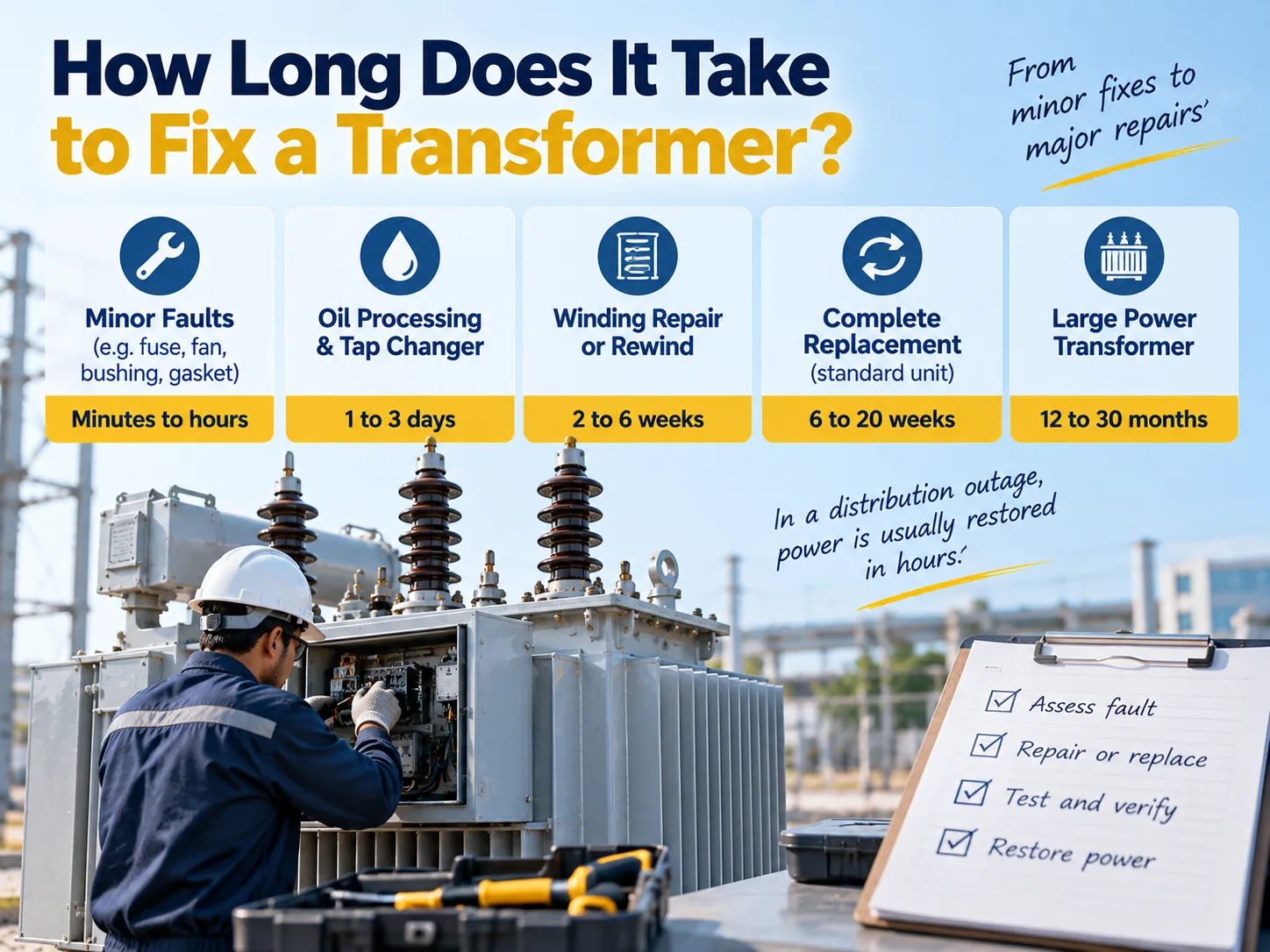
A sincere response is contingent upon the particular reasons for the failure. Disconnecting a faulty fan is accomplished in a day of work. Rewinding a distribution transformer can take several weeks. Replacing a large power transformer requires much longer than assembling an entire substation, as it takes at least a year and half to two years to manufacture the equipment for electrical machines with capacity above 100 MVA. One should not conclude that the situation is a project in itself but, instead, treat it in terms of different projects, thus learning how to identify those.
Several forms of faults can be fixed in a matter of minutes or hours, as is the case when replacing a fuse, a fan, a bushing, or an o-ring. The only factor that delays the repair of a defect is the oil treatment and tap changer repairs, which take one to three days. Rewinding repair or replacement will take two to six weeks and transport time. Meanwhile a total replacement will require even longer time of anywhere from several days to weeks if there is a spare unit already on the market and from six to twenty weeks for a new typical distribution transformer.
Repair Time by Fault Type
The ranges below are commonly accepted for liquid-immersed transformers (distribution and medium power) and exclude any transport time to/from a repair workshop. Use them for planning meetings and follow them up with the actual number given in the quotation from a workshop before fixing the date.
| Fault | Typical repair time | What it involves |
|---|---|---|
| Protective fuse or breaker operation, no damage | Minutes to a few hours | Fault location, insulation tests, re-energisation |
| Cooling fan or oil pump failure | A few hours | Fan or pump replacement, function check on the cooling control circuit |
| Failed bushing | Half a day to one day | Oil draining below bushing level, bushing replacement, oil top-up, tests |
| Oil leak or gasket failure | Half a day to two days | Depressurise, reseal, refill and process the oil |
| Moisture or contamination in oil | One to three days | Oil filtration or drying under vacuum, plus a repeat dielectric and moisture test |
| Tap changer contact wear or mechanism fault | One to three days | Diverter switch inspection on an off-circuit unit; up to several days for an on-load changer |
| Loose internal connection or a single damaged joint | A few days | Tank opening, repair, re-drying where the core has been exposed |
| Winding insulation failure requiring a rewind | About two to six weeks | Dismantle, rewind, dry, re-impregnate, reassemble, full routine and type testing |
| Core damage | Usually not economic | Core replacement rarely costs less than a new unit |
| External damage from lightning, flood, impact or animals | One day to several weeks | Depends on whether the damage is confined to bushings and accessories or reaches the active part |
The biggest shocks from that table come courtesy of two entries in it. Oil processing may be easily dismissed because it looks easy, but all of the steps like filtration and vacuum drying have to be performed in order to avoid leftover moisture accumulating within the oil. When a process has to be repeated and tested again, it leads to delays too. The rewind is not the same as repair in usual terms. The module will have to be disassembled to hit the active part of the device and every single component will have to be dried and tested afterwards, which is why rewinds take weeks instead of days.
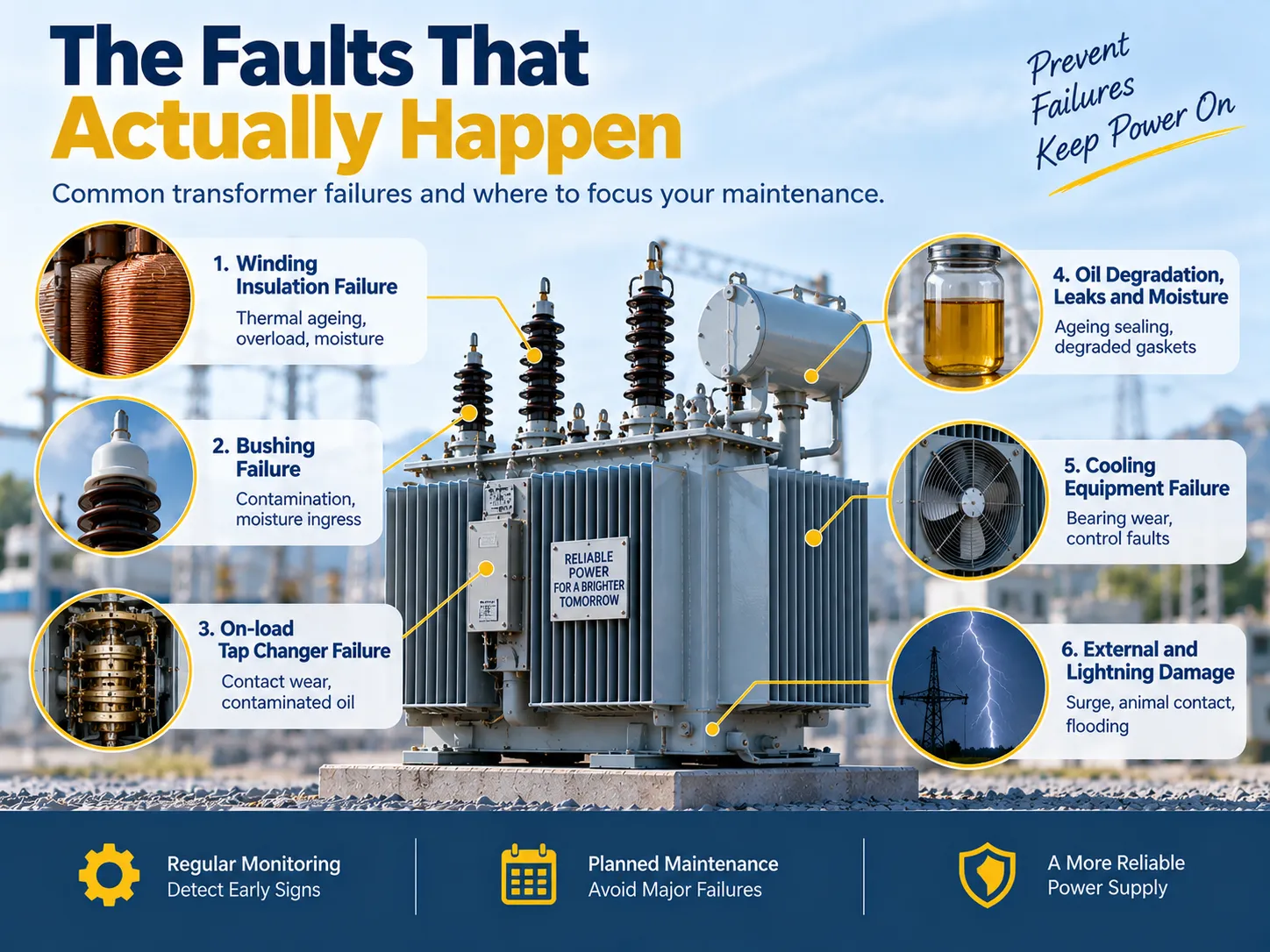
The Faults That Actually Happen
Statistics of failures in the industry is relatively stable and this information is important as it can guide maintenance activity.
| Rank | Failure mode | Usual root cause | Repairable in situ? |
|---|---|---|---|
| 1 | Winding insulation failure | Thermal ageing, sustained overload, moisture, transient overvoltage | No; workshop rewind or replacement |
| 2 | Bushing failure | Mechanical damage, contamination, moisture ingress | Usually yes |
| 3 | On-load tap changer failure | Contact wear and contaminated diverter oil from frequent operation | Often yes, in the workshop |
| 4 | Oil degradation, leaks and moisture | Ageing sealing, degraded gaskets, poor breather maintenance | Yes |
| 5 | Cooling equipment failure | Bearing wear, control circuit faults | Yes |
| 6 | External and lightning damage | Inadequate surge protection, animal contact, flooding | Sometimes |
What is pertinent from the commercial perspective is the fact that first four types of failures are progressive in nature. Insulation will fail after years of thermal and moisture degradation, oil is deteriorated slowly, while contacts of a tap changer wear gradually. Each of them signaled their failure before occurrence through oil analysis, temperature monitoring or gas analysis thus enabling people take measures to avoid unplanned six-weeks-rewind instead of just two days maintenance.
How Long the Power Stays Off
The amount of time for repairing an electricity outage and the outage time itself is not the same. The latter is the number which is important for customers. Utility companies prepare for outages but not the repairs, hence it is improbable for a distribution failure to leave without power for the entire repair duration.
| Situation | Typical outage duration | How supply comes back |
|---|---|---|
| Fault cleared by protection, transformer undamaged | Minutes to a couple of hours | Patrol, test and reclosing |
| Transformer failed, spare available | A few hours, often within the same working day | Swap the unit, restore the failed one to the works later |
| Transformer failed, crane and traffic management required | One to two days | Scheduled replacement with access arrangements |
| Transformer failed, no spare and no alternative supply | Weeks | Temporary rerouting, mobile substation, or waiting for a new unit |
| Transmission or large power transformer | Days to weeks initially | Load transfer and rerouting first, permanent replacement over many months |
In the fourth line, it shows how the spare strategy is justified. On a network with many units of the same capacity, having a spare transformer turns an outage of several weeks for every unit of that kind into a same-day substitution. The justification for the cost of the spare is often much easier than the justification for the outage.
Repair or Replace?
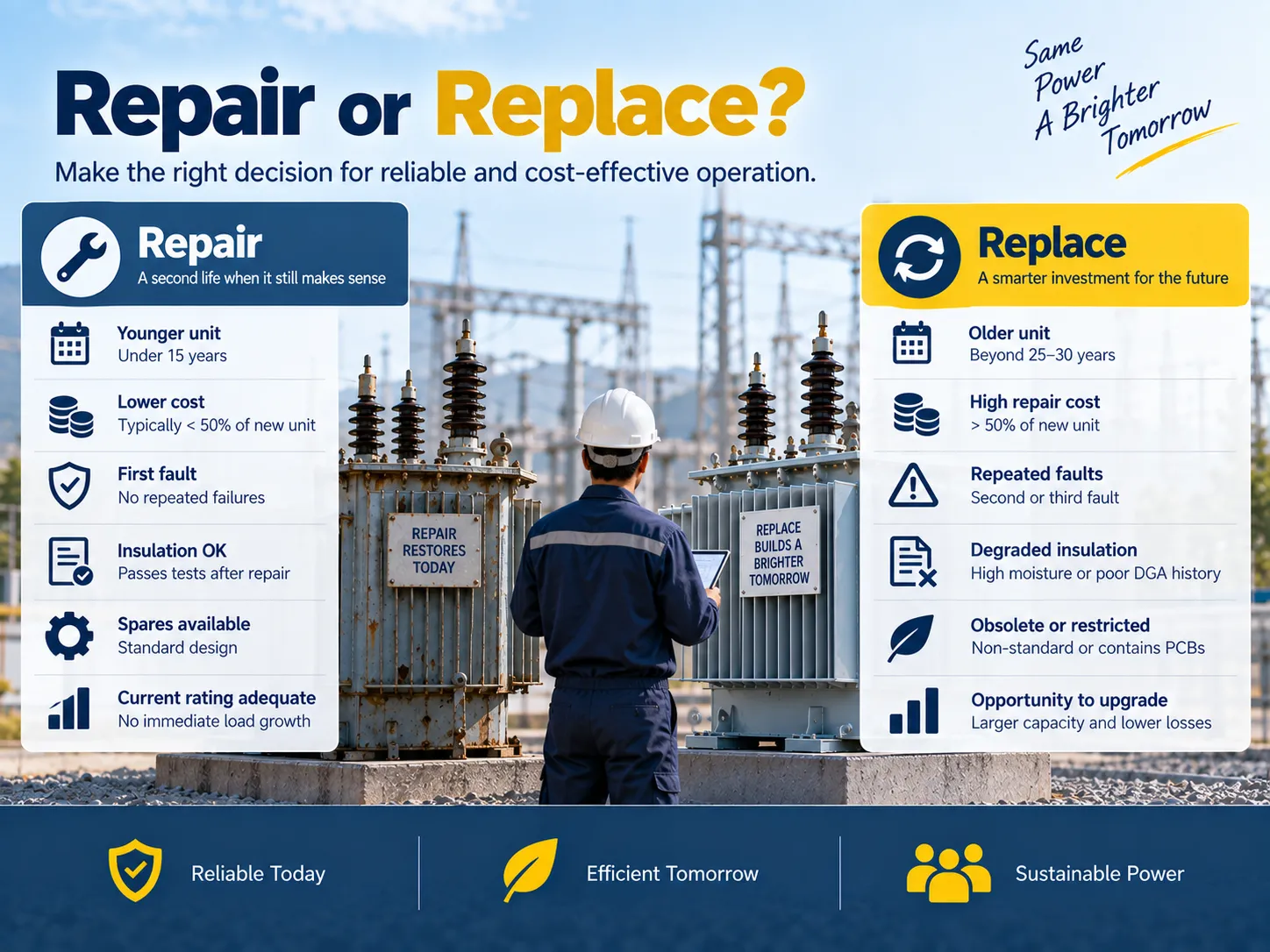
After the fault is identified, the choice is normally made based on limited criteria. The below table demonstrates how most utilities and industrial players implement this in practice.
| Signal | Leans towards repair | Leans towards replace |
|---|---|---|
| Age of the unit | Under fifteen years | Beyond design life, typically twenty-five to thirty years |
| Quoted repair cost | Under about half the cost of a new unit | Above about half, or approaching the price of a new unit |
| Failure history | First significant fault | Second or third fault, especially repeat internal failures |
| Insulation condition | Insulation tests acceptable after the fault is cleared | Degraded insulation, high moisture, poor dissolved gas history |
| Efficiency | Losses are reasonable for its age | No-load loss high enough that replacement pays back over the remaining life |
| Regulatory status | Compliant | Contains PCBs or materials that are now restricted |
| Spares and standards | Components still available | Non-standard design or obsolete accessories |
| Load growth | Present rating still adequate | Load has grown and the replacement can be sized up at the same time |
There are two points usually missed in this issue. First, a repair restores the fault and not the depreciation. So, a unit repaired at twenty years still contains oil, seals, and accessories that are twenty years old. Secondly, we should consider replacement an opportunity. If the use of the unit has increased, a low-loss modern unit may be more cost-effective than the repair.
What Drives the Cost and the Clock
In terms of variance of quotes for the same fault, four factors come into play: Transport and site access for large units is paramount in importance because a distribution transformer can be transported with a flat truck and a small crane whereas a power transformer requires specialized haulage, permissions and route surveys; Workshop capacity matters when the order book is full; Component availability governs simple faults, as a bushing that has to be manufactured as opposed to one that can just be taken out from stocks turns a repair job from being completed within a working day to five weeks at best; Testing time is mandatory since every repair operation is followed by routine tests, such as insulation resistance, ratio, winding resistance, oil dielectric strength, and temperature rise test.
The above is the reason why it is preferable to buy equipment from a manufacturer whose testing procedure can be subject to audit.RUY Power manufactures 12 kV distribution equipment in package form, including the YB□-12/0.4 prefabricated substation for indoor and outdoor networks from 50 to 1,600 kVA.
The ZGS13-H-630/10 American box-type combined transformer covers the overhead-fed version of the same duty, with the transformer, fuse protection and metering assembled as one unit before it leaves the works.
Both run standardised production, inspection at each stage and testing before despatch, as described on our manufacturing page.
If a machine leaves the manufacturing plant with proof of its testing background, it gives every subsequent diagnosis a head start and every repair estimate a more precise outlook.
How to Avoid Needing Repairs
Normal actions can prevent the bulk of costly repairs, and these preventative measures can often be done cheaply compared with actual repairs.
| Measure | Frequency | What it prevents |
|---|---|---|
| Oil dielectric strength and moisture test | Annually, or six-monthly for critical units | Moisture-driven insulation failure |
| Dissolved gas analysis | Annually, or online monitoring on critical units | Undetected internal fault development |
| Infrared thermographic survey | Annually, at full load where possible | Loose connections, hot joints, bushing problems |
| Breather silica gel check and oil top-up | Quarterly visual | Moisture ingress and low oil level |
| Tap changer inspection and diverter oil change | Per manufacturer interval, shortened for frequently operated units | Contact wear and tap changer failure |
| Cooling fan and pump service | Annually | Overheating from a degraded cooling system |
| Load monitoring and overload control | Continuous | Accelerated thermal ageing of the insulation |
| Surge arrester inspection | Annually | Lightning and switching overvoltage damage |
| Animal guards, cable sealing and vegetation control | Annually | External flashover and short circuits |
| Protection setting review | Every two to three years, or after any network change | Delayed clearing that turns a minor fault into a major one |
The load point is especially worth mentioning because it is the most common self-inflicted cause. Performance-wise, a transformer that runs continuously over its rated limit degrades at a much faster pace. A good general rule is that insulation life will be halved for every increase of between 6 and 8 K of temperature, meaning an overloaded transformer can lose several years of lifetime during the summer. Therefore, as a general guideline, having the continuous load running at a maximum of 80 percent of the rating is the best way to go.
A Sensible Spares Strategy
Basically, spares transform an uncertain outage into one that has been planned, and the calculations are quite straightforward and simple. Just check how many machines you have for each rating and voltage category, how long it takes to replace the machines, and the cost of the outage that matches the time you will have to wait. As a rule, any rating with more than one machine in operation and where the outage cost is greater than the price of a spare can be used to identify prospects.
Generally speaking, there are three levels of spares. The first one is the one for those rated as absolutely critical in terms of costs. The second one is the kit that includes spare parts such as bushings, seals, oil, fans, pressure gauges, and measuring devices. Finally, the last type does not cost anything but allows eliminating the delay that changes a two-day repair into a two-week one.
FAQ
Is it easy to fix a blown transformer?
It truly depends on the part of the transformer which has blown. If no damage is experienced by the internal parts of the transformer due to the protective mechanism, then this fault location has to be located and the insulation test performed. The fault could be the blow bushing that could be replaced on the same day, however in case there is a fault in winding insulation, rewinding will be needed in special workshop, which typically takes about 2-6 weeks.
How long will power be out if a transformer blew?
It is typically only a few hours, especially for power distribution systems, since electricity companies keep the spare transformers and can redirect power flow to the damaged farm. The normal sequence of actions in significant cases would be the following: diagnostics that takes just a couple of hours, then the cable is changed, or the truck or hoist has to be used for replacement of the component. In rare cases when the unit is special, the downtime can vary from weeks.
When should a transformer be replaced instead of repaired?
If the quoted repair cost is more than half the price of the new unit. If the transformer has broken down more than one time. If the electrical test results and gas analysis point out that there could be something more serious going on. If the unit is older than 25-30 years. If the transformer has some materials that are not allowed to be used like PCBs.
What happens when a transformer blows out?
The blown inner fault results in the arcing and the oil vaporization and gas generation. Protection systems should react fast although in reality the explosion will distort the shape of the device, move a pressure release element and break insulation. The oil is even going to change its color, is going to be burnt and soot is going to appear on the connection. Even if the transformer looks ok outside, it can be still damaged and metal and oil samples should be taken to the laboratory for testing.
Can a transformer be repaired on site?
Generally, auxilliary works like gaskets and bushings replacement and oil cleaning and drying are performed. More intensive works like the tank opening and exposing of the core are usually performed at the shop.
References
- International Energy Agency — Electricity grid investment and equipment supply chain analysis
- International Electrotechnical Commission — IEC 60076 series, Power transformers, including routine and type test requirements
- NFPA — NFPA 70B, Recommended Practice for Electrical Equipment Maintenance
- IEEE Standards Association — IEEE C57.104, Guide for the interpretation of gases generated in oil-immersed transformers
- US Department of Energy — Grid equipment reliability and transformer supply resources
Conclusion
There are certain factors that determine how long exactly a transformer will be out of service – among them is the type of failure rather than the size of the transformer. In case something goes wrong outside the oil compartment, the repair will take only a couple of hours or one day if needed. If, however, any problem is related to the oil, the repair will require anywhere from one to three days. The longest repair time is always connected to the coiling of the transformers, which can take weeks. When it comes to replacing the defective part, the maximum repair time will depend on how long the manufacturing of the transformer itself will take and could be many years in case of bulky equipment.
In conclusion, we can note three things. The first one is that the time spent on repairing and the duration of the outage are not the same concepts because the electric supply can be restored very quickly while the process of repair takes years. The second thing we found out during the research is that the decision concerning a repair or replacement of the faulty unit should be made on several grounds such as the analyzer cost, transformer age, but the damage rate should also be considered. Finally, we should make additional investments into such preventive measures as oil analysis, thermography, and load monitoring to reduce the number of possible breakdowns and minimize rewinding.