
At the end of its useful life, a transformer is not junk. It consists of a steel shell, copper, laminated electrical steel, and some hundreds of liters of insulating oil, each of which has a value that can be tapped into. If the oil has become contaminated, however, the transformer’s contents can be classified as hazardous waste, requiring costly disposal in which the disposal costs often exceed the value of the metals contained in the transformer. This issue is what makes recycling worthwhile, and it is the second part of this statement which surprises many people.
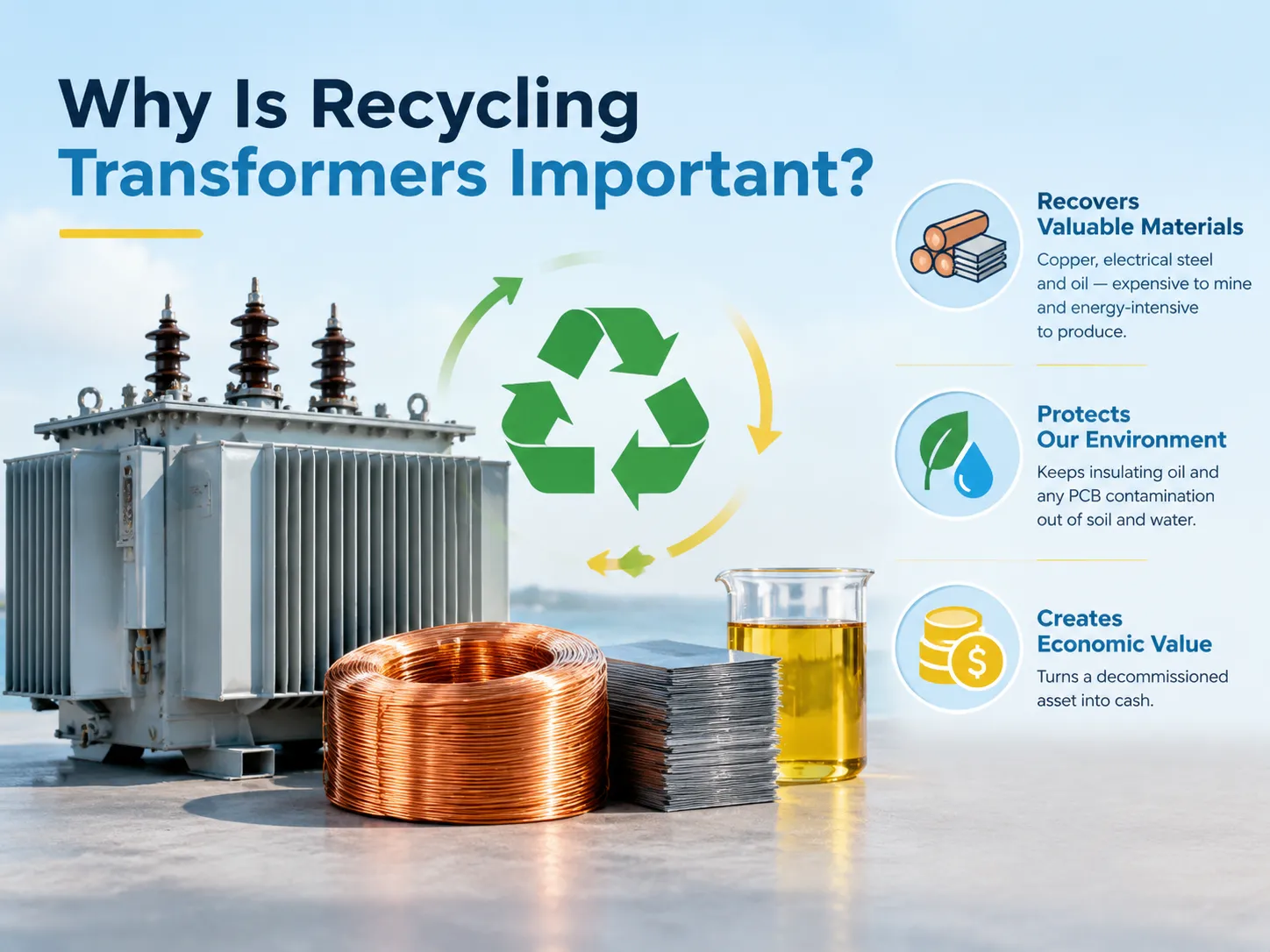
As a short answer, there are three significant reasons why transformer recycling is important as recycling results in the recovery of copper, electrical steel, and oil of significant costs and energy lost during mining, recycling also protects any contaminated oil and PCB from getting into the soil or water, and recycling turns a decommissioned asset into cash. In most cases, copper plays a key role in the recycling value of transformers; the recycling price of oil-filled transformers at the moment range from about USD 3,000 to USD 4,500. In case a transformer successfully passes insulation and oil testings, its value as an operational unit will be 30 – 50% more than its scrap value.
What Is Actually Inside a Transformer
A transformer can be recovered in three parts, and the share of recovery associated with each of them varies significantly by design. Therefore, knowing which transformer you have will determine whether it is a saleable item or a liability.
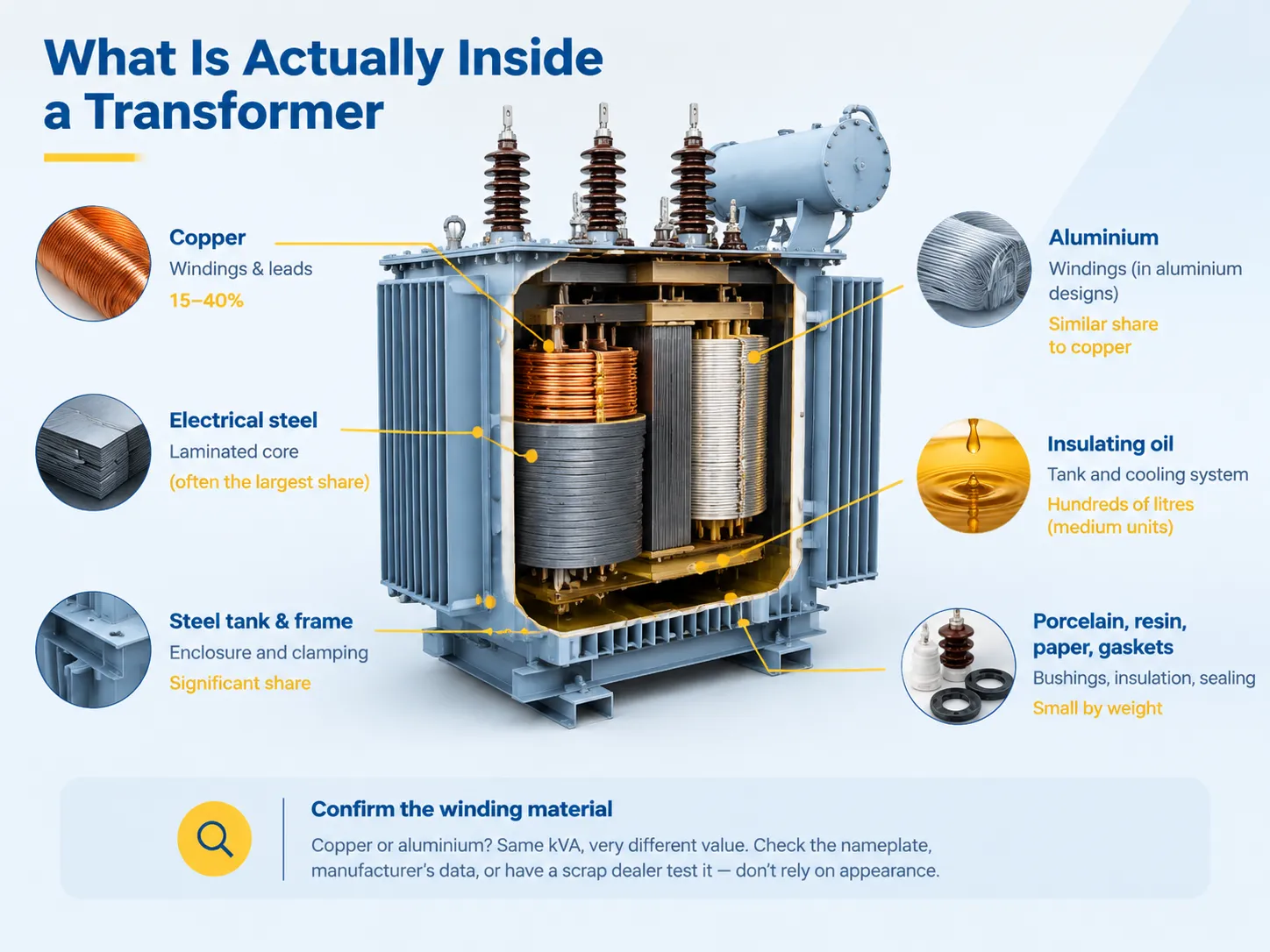
| Material | Where it is | Typical share of weight | Why it matters |
|---|---|---|---|
| Copper | Windings and connecting leads | Roughly 15 to 40 percent in a copper-wound unit | Highest value per kilogram by a wide margin |
| Aluminium | Windings in aluminium-wound designs | Similar share, much lower value density | Only about a fifth of copper’s value per kilogram |
| Electrical steel | Laminated core | Often the largest single mass | Low value per kilogram, but a large tonnage |
| Insulating oil | Tank and cooling system | Hundreds of litres on medium units | Re-refinable if clean; hazardous if PCB-contaminated |
| Steel tank and frame | Enclosure and clamping | Significant | Ordinary heavy scrap value |
| Porcelain, resin, paper, gaskets | Bushings, insulation, sealing | Small by weight | Mostly disposal, with some reuse of intact bushings |
The first and most critical step to take when preparing to sell any product is to identify the winding. Copper-wound transformers and aluminium-wound transformers that are of the same kVA have completely different scrap values; hence they can not be differentiated visually. Usually, the information is available on the nameplate; otherwise, it will be available through the evaluation of the scrap dealer; however, the dealer’s evaluation will be based on his interest and not on yours. Therefore, you should confirm the winding material either from the manufacturer or through the test prior to negotiation.
What the Materials Are Worth
Scrap values fluctuate with the underlying commodity markets, so any value mentioned here should be considered a point in time rather than a price list. The useful part, however, is knowing how to arrive at the figure: the value of a transformer equals the recoverable metal content multiplied by the current commodity price, less dismantling, transportation, oil handling and compliance costs.
| Material | Indicative scrap value | Notes |
|---|---|---|
| Copper, clean | Roughly USD 3.40 to 4.00 per pound | Winding copper is normally clean and commands a good grade |
| Aluminium | Roughly USD 0.60 to 0.80 per pound | Roughly a fifth of copper’s value per kilogram |
| Electrical steel | Roughly USD 0.05 to 0.08 per pound | Low value but heavy; core mass dominates tonnage |
| Complete oil-immersed unit, copper wound | Commonly cited in the range of USD 3,000 to 4,500 per tonne | For a 1,600 kVA class unit containing around one tonne of copper |
| Complete oil-immersed unit, aluminium wound | Roughly a third to a half of the copper-wound figure | Value collapses when the copper is not there |
| Dry-type unit, copper wound | Lower than an oil unit of the same rating | No oil revenue, and resin removal adds process cost |
The practical example which makes the arithmetic relevant is as follows: an averaged medium oil-immersed transformer with approximately 1.2 tons of copper, 1.5 tons of electrical steel and 0.3 tons of other substances. Using the prices given as the basis for this calculation, it would seem that the copper alone is worth several thousand dollars, and the core would add several hundred dollars more, before the dealer makes a high reduction charge (usually somewhere around 30 percent) for dismantling, transporting and handling. This reduction is negotiable and so this is the figure to compare when looking at different quotes.
A couple of things must be noted here commercially. The value dependency on oil is large, with a clean oil being worth lots of money, as it can be refined again and sold off, while dirty oil is a liability. In addition, it has been noted several times that some of the more valuable components, such as bushings and fans, must be sold first prior to parting with the shell of the transformer if the refurbishment process is to be successful.
The Oil Problem: Mineral Oil and PCBs
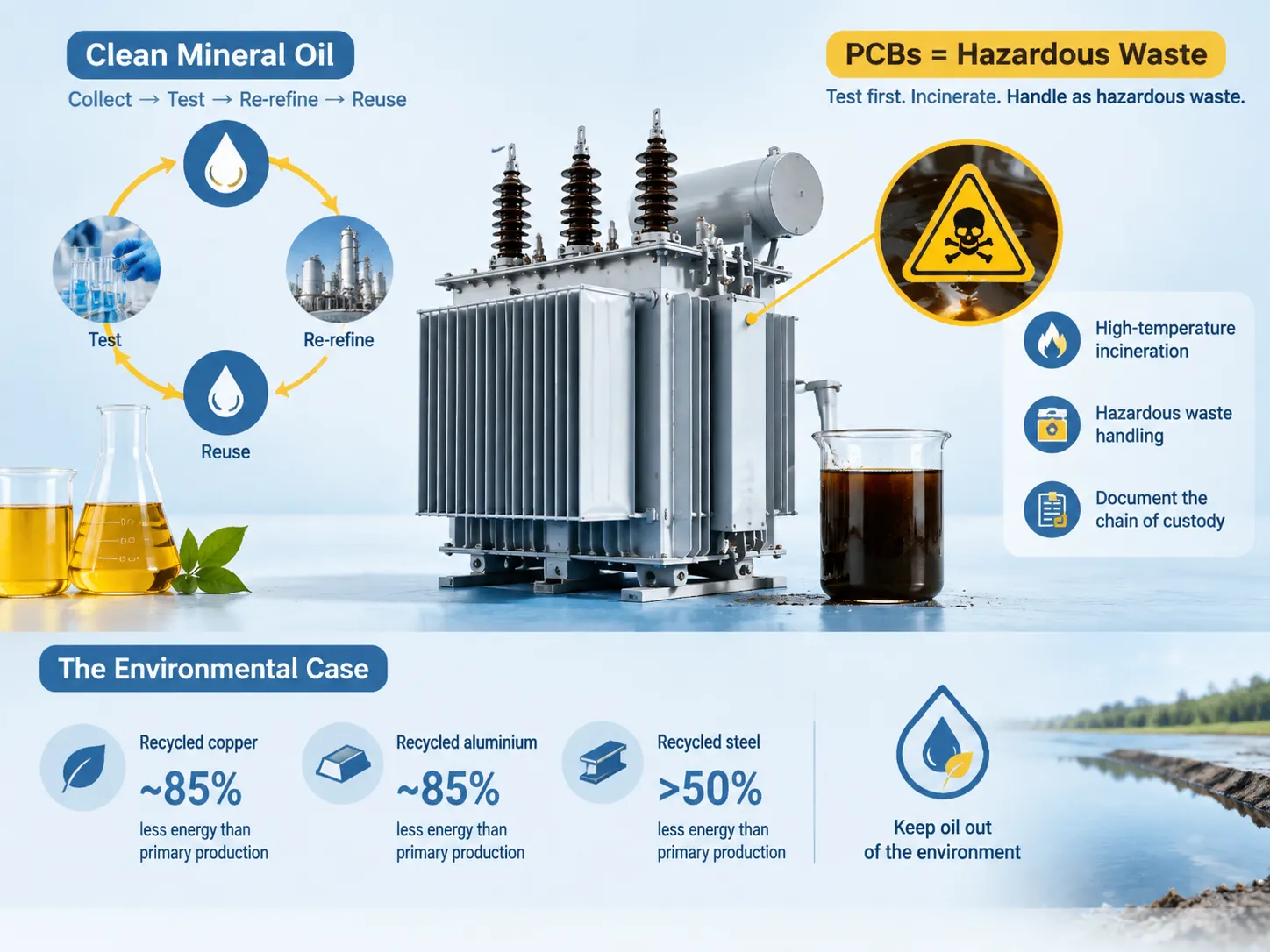
Change in status of insulating oil which shifts from recycling as a simple act to something that must comply with legislative requirements in subjecting used oil to a mandatory remediation process. It provides for the capturing, testing and re-refining of clean mineral oil, thus ensuring that this industry maintains its position as one of the more convenient recycling operations around. It however turns to being waste through contamination via polychlorinated biphenyls (PCBs).
PCBs were widely found in equipment such as transformers and capacitors, as a result of their excellent characteristics as dielectric fluids. The use of PCBs, however, was subject to guidelines which began with the Stockholm Convention of the 1970s, since then PCBs have fallen under the Toxic Substances Control Act in America, as well as regulations in Europe prohibiting certain persistent organic pollutants. As a result many units still operate with PCBs in the 21st century.
Each parties’ obligations in regard to PCB testing must be determined first prior to concluding agreements in relation to the sale of specified waste oil. If the waste is found to be contaminated post-sale, parties may find themselves in different legal issues.
The Environmental Case in Numbers
The case for recycling transformers on environmental grounds is based on the energy needed to produce the raw materials used and on the reduction of pollution that occurs when oil is treated properly. There are major energy savings from using recycled metals compared with the use of raw materials: recycled copper takes about 85 percent less energy to produce than primary copper and similar results hold for aluminium while recycled steel saves more than 50 percent compared to new steel.
The fact that recycled metals are cheaper to manufacture is what provides the motivation for the existence of the metals market. The copper from a transformer has already been refined through the use of energy and emitting emissions so recovering it will invariably be cheaper and cleaner than mining or smelting new material. The copper industry has been doing this on an industrial scale for over 100 years, which is why it is so logical to recycle the copper from transformers.
The other environmental benefit is less easy to measure but it is more pressing: it is the need to retrieve the insulating oil and not allow it to escape into the environment. A transformer has hundreds of litres of insulating oil in it, and so one transformer that is treated carelessly can contaminate the soil and ground water over a very large area for many years.
Reuse Beats Recycling When the Unit Still Works
A transformer that qualifies through a good condition assessment will be significantly more valuable as a working unit than it will as scrap in the marketplace. In many cases, refurbished transformers that pass assessment tests sell very quickly in standby, rural, and temporary service markets.
The appraisal process must be carried through in a specific manner, although it does not need to be extensive.
| Test | What it shows | Why it decides the outcome |
|---|---|---|
| Insulation resistance and polarisation index | Winding insulation condition | Poor values end the reuse option immediately |
| Turns ratio on every tap | Winding integrity and tap changer condition | A ratio error indicates internal damage |
| Winding resistance | Connection integrity and conductor condition | Detects loose connections and partial damage |
| Oil dielectric strength and moisture content | Whether the oil can be returned to service | Determines oil processing cost |
| Dissolved gas analysis | Internal thermal or electrical faults in progress | Detects damage the electrical tests cannot see |
| PCB screen | Regulatory status of the unit | Decides disposal route and cost |
| Visual inspection of tank, bushings and sealing | Mechanical condition and leakage | Sets refurbishment scope |
One which passes these inspections can be disassembled and put into operation again without fear of problems that occur when a transformer has not been properly tested. The cost of a serviceable unit should reflect the cost of acquiring new equipment but not the commodity price for the metals contained in that unit. If a unit is not usable anymore then it becomes a recycle case and the real question is which recycler to use and which process to follow.
The commercial principle, however, is the opposite of procurement in that, once again, the design specifications that will yield a transformer that is still usable after twenty five years of having been put into service do not need to be taken into account. Hence the need for adequate specifications for a transformer simply to be built.
For twelve kV distribution applications this normally means utilizing a packaged unit rather than an improvised one.RUY Power supplies the YB□-12/0.4 European-type prefabricated substation for indoor and outdoor networks from 50 to 1,600 kVA.
For overhead-fed networks the equivalent is the ZGS13-H-630/10 American box-type combined transformer, built on the same standardised production and tested before despatch.
Buyers comparing construction and cooling options across voltage levels before specifying will find them set out on the products page, and that comparison is worth making early: the choice that extends service life is almost always cheaper than the recycling decision it postpones.
How to Choose a Recycler
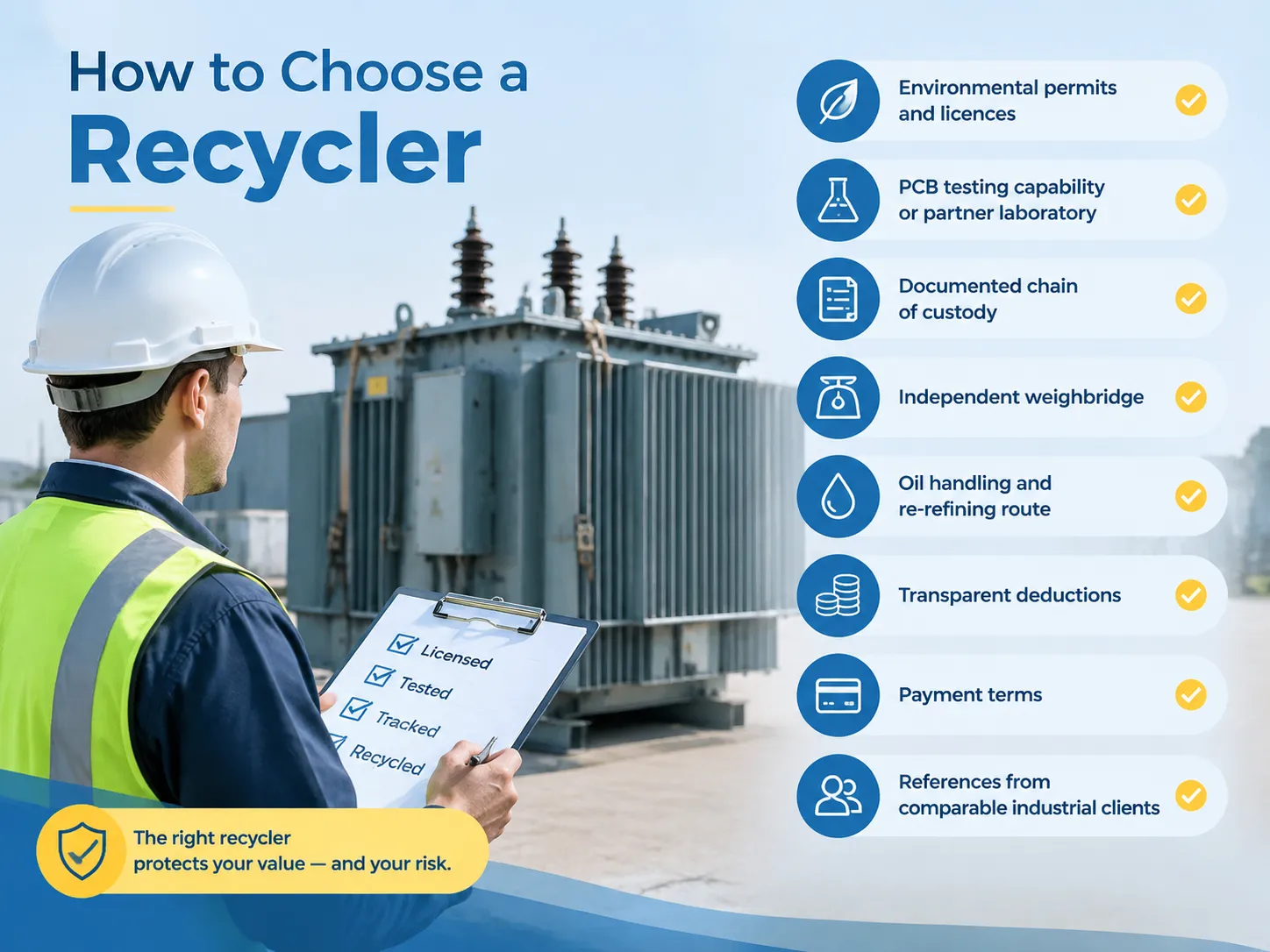
The unscripted markets result in a benefit for preparation; thus, the disparity for two comparable proposals on identical transformers may be quite large. The checklist below can be used for doing the practical work.
| Check | Why it matters |
|---|---|
| Environmental permits and licences | An unlicensed buyer transfers your legal liability to you the moment the unit leaves the gate |
| PCB testing capability, or a partner laboratory | Determines whether the oil is a product or a cost |
| Documented chain of custody | Your evidence that you disposed of the unit lawfully |
| Independent weighbridge | Scrap is bought by weight; weigh it yourself as well |
| Oil handling and re-refining route | Shows whether the oil will be recovered or simply burned |
| Transparent deductions | Dismantling, transport and handling should be itemised and negotiable |
| Payment terms | Scrap value should not be paid in instalments across an unspecified period |
| References from comparable industrial clients | Confirms they can handle the tonnage and the paperwork |
Reach out to two or three recyclers, get their unit charge, deduction rate, and disposal method, and you will spend one whole afternoon figuring out how you can maximize your profit through the process. Expect to get more from this than from any other aspect of the process. The idea that you can just accept the first call into your office from a person with a truck will cost you the most money and introduce the most risk to your business.
What a Proper Recycling Process Looks Like
The process of dismantling a transformer is performed the same way at any scale. The transformer comes in, documentation is reviewed, oil is sampled and tested for PCBs and moisture content, and oil is drained. Clean oil goes to re-refining while contaminated oil is sent to be destroyed as per regulations. After that, the transformer is opened, the active element is removed, and core and windings are separated so that transformer steel, winding copper or aluminium, and structural steel are run into different channels. Bushings and other parts are checked for resale. Insulating paper, pressboard, resin, and gaskets are sent for energy recovery or disposal. There is a record of everything that is sent from the site.
The previously presented figures of whole transformers are frequently used within the market to express the process described here, and the deduction for dismantling exists because it is really labor-intensive. This is the reason behind being cautious when selecting a whole transformer size: below the required size, labor and compliance expenses may exceed the metal value, and it can really appear that a small aluminium-wound transformer is not worth the costs incurred in dismantling and processing.
FAQ
Is it worth scrapping a transformer?
Typically yes, but if it is a copper wound unit, it will have significant valuable metal. You should check first to see if it can be reused. A transformer that passes insulation, ratio, and oil testing is worth 30 to 50 % more as a working transformer than as scrap. In the case of small aluminum-wound transformers, the expenses related to dismantling and regulatory compliance may consume most of the value of the metal, so make sure to get estimates before making a commitment.
What are 10 reasons why recycling is important?
Recycling recovers copper, aluminum, and electrical steel that require much less energy to recycle than to produce from the earth. Recycling also prevents insulating oil and PCB from contaminating the land and water. Recycling keeps hazardous waste within licensed facilities. Additionally, recycling reduces the demand for mining and smelting operations. Recycling results in reduced carbon emissions associated with the manufacture of primary metals. Recycling converts an unusable asset into money that can be recovered. It also prevents fines for improper disposal. Recycling preserves the materials for future uses instead of using landfills. It allows the refurbishment market to continue providing tested transformers. Most important, recycling provides owners with documentation that protects them from liability if the equipment is traced at any time in the future.
What is the 80% rule for transformers?
This is a guide, not a rule, which states that transformers should not be loaded higher than about 80% of their nameplate rating for continuous duty. This recommendation comes from continuous load provisions of installation requirements, which specify that conductor and overcurrent protection should be sized to ensure that the continuous load is not more than 80% of the protection. Loading of the transformer itself depends upon temperature rise limits and the manufacturer’s specifications. While a transformer can be overloaded on a short-term basis, it is important to realize that both the thermal limits and the insulation class must be taken into consideration so that the transformer can operate correctly.
Why are transformers so important?
Transformers are crucial in enabling the operation of the power supply system; without them, the process of increasing the voltage required for efficient transmission, or reducing the voltage for end-user applications would be impossible. Power could only be transmitted for short distances and would need high current levels to achieve this; this would be neither feasible nor economical. The transformers help achieve the necessary isolation and impedance matching required by safety equipment as well and as such, they are installed at every voltage threshold within the system.
How much of a transformer can actually be recycled?
Almost all of the transformer’s mass can be recycled, with the metal component recycled almost completely. The copper and aluminum wires, core and frame made of steel, bushings and metallic parts can all be recycled. Clean oil used in transformers can also be reused after re-refining its oil. However, items of waste and the insulation paper and pressboard, dry resin in the wires and other gaskets cannot be recycled and have to be burnt or disposed of in a controlled manner.
Can transformer oil be reused?
Yes, if it is clean, it can be reprocessed. The oil can be cleaned of particulates and dried to have it re-refined and used in a transformer. Oil that fails the dielectric test can generally be reprocessed and reused. Oil contaminated with PCB is treated differently; it has to be destroyed in a specialized facility.
References
- US Environmental Protection Agency — Polychlorinated Biphenyls (PCB) requirements and disposal of PCB-contaminated equipment
- Basel Convention — Control of transboundary movements of hazardous wastes, including waste oils
- Stockholm Convention — Elimination of polychlorinated biphenyls
- International Electrotechnical Commission — IEC 60296, mineral insulating oils for transformers
- NFPA — NFPA 70B, Recommended Practice for Electrical Equipment Maintenance
- US Department of Energy — Energy and emissions benefits of secondary metals production
Conclusion
The end of life of a transformer can be viewed as a chance for reclaiming materials coupled with a compliance issue. The copper, steel and oil have real worth, and the market for metals has developed an expertise in such recovery after working in the industry for a hundred years, since secondary production takes a much lower amount of energy than that consumed in the primary production of raw materials. The determining factor in terms of the profitability of government regulation and whether or not the transformer is a liability is oil content or oil PCB content.
There are three recommendations. First, test all transformers before they are thrown away or given to a scrap yard, as a working transformer has a considerably higher value in operation compared to its worth when classified as scrap. Second, be sure to check the oil for PCB content to ensure that there will not be a contamination issue causing you to be in violation of regulation if some PCB material is found after the sale has been completed. Finally, ensure that you conduct proper disposal methods which involve written quotes and a cost on a per-unit basis, as well as the use of an independent weighbridge and a documented disposal route for the transformer as it leaves your ownership. Following this approach will mean the difference between recovering an asset and ending up with a liability.
Be as careful with transformers when they reach the end of life as you would with those in their first stages of life, as this ensures that the entire asset provides greater returns in terms of financial performance.