
There are a variety of factors in Pakistan that impact transformer pricing, including the value of currency as well as the prices of steel and copper along with others. Pricing specifications for different transformer tenders and quotations being unique means that quoting aggregate prices for transformers has no practical value. Hence, it is advisable to develop a pricing matrix that shows the price range of transformers based on the kVA and various factors affecting the price changes of transformers bought by industrial customers.
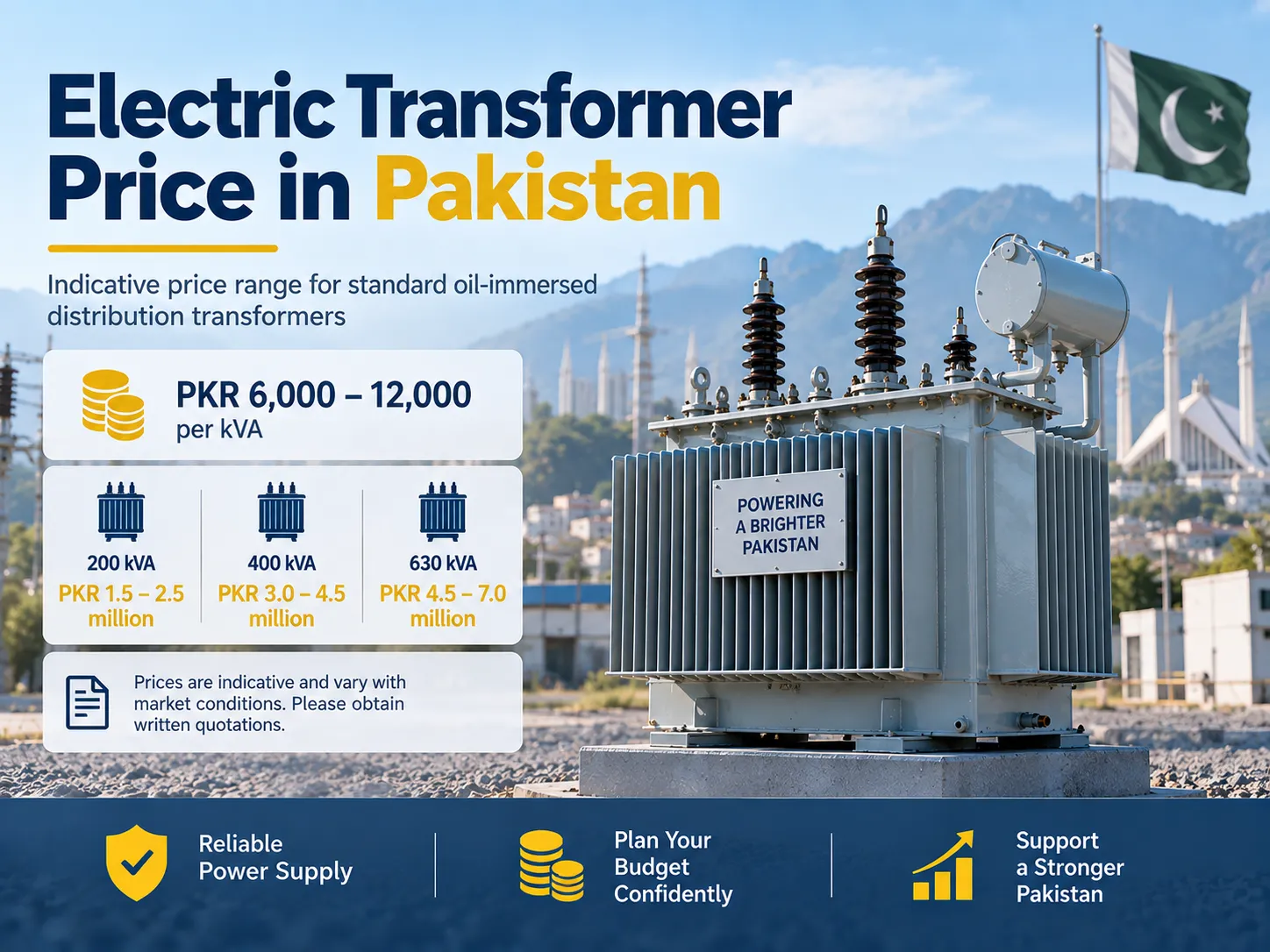
As per the previous estimates, the prices of oil transformers in Pakistan range between PKR 6,000 and 12,000; hence the expected price for 200kVA transformers would range from PKR 1.5 million to 2.5 million. The cost of 400kVA transformers is expected to be somewhere between PKR 3 million and 4.5 million. There are some conditions to be considered for the forecasts. The price of 630kVA transformers is assumed to be between PKR 4.5 million and 7 million. In terms of the current price of the aforementioned transformers, it only cost around PKR 3 million for the 400kVA transformers, which is lower than expected. It can be noted that dry resin insulated transformers are even more expensive than oil transformers, and their prices are competitive according to European manufacturers.
Think in Price per kVA, Not Price per Unit
Transformers experience increases in price as capacity rises, but this pattern of growth is non-linear because of the variances in the cost of different materials utilized in transformers. The explanation is that the costs of windings and core materials have a significant influence on the production costs, and that their costs rise at a higher rate than other costs related to tanks, bushings, and other accessories of transformers. This implies that the price of a 630 kVA transformer is much less than the cost of three 200 kVA transformers, thus resulting in lower cost per kVA.
That is the reason for understanding the factors that influence transformer prices. In particular, when the cost of transformer per kVA is much lower than expected, three explanations can be responsible for that: usage of aluminum, higher losses, and lower amount of accessories and testing.
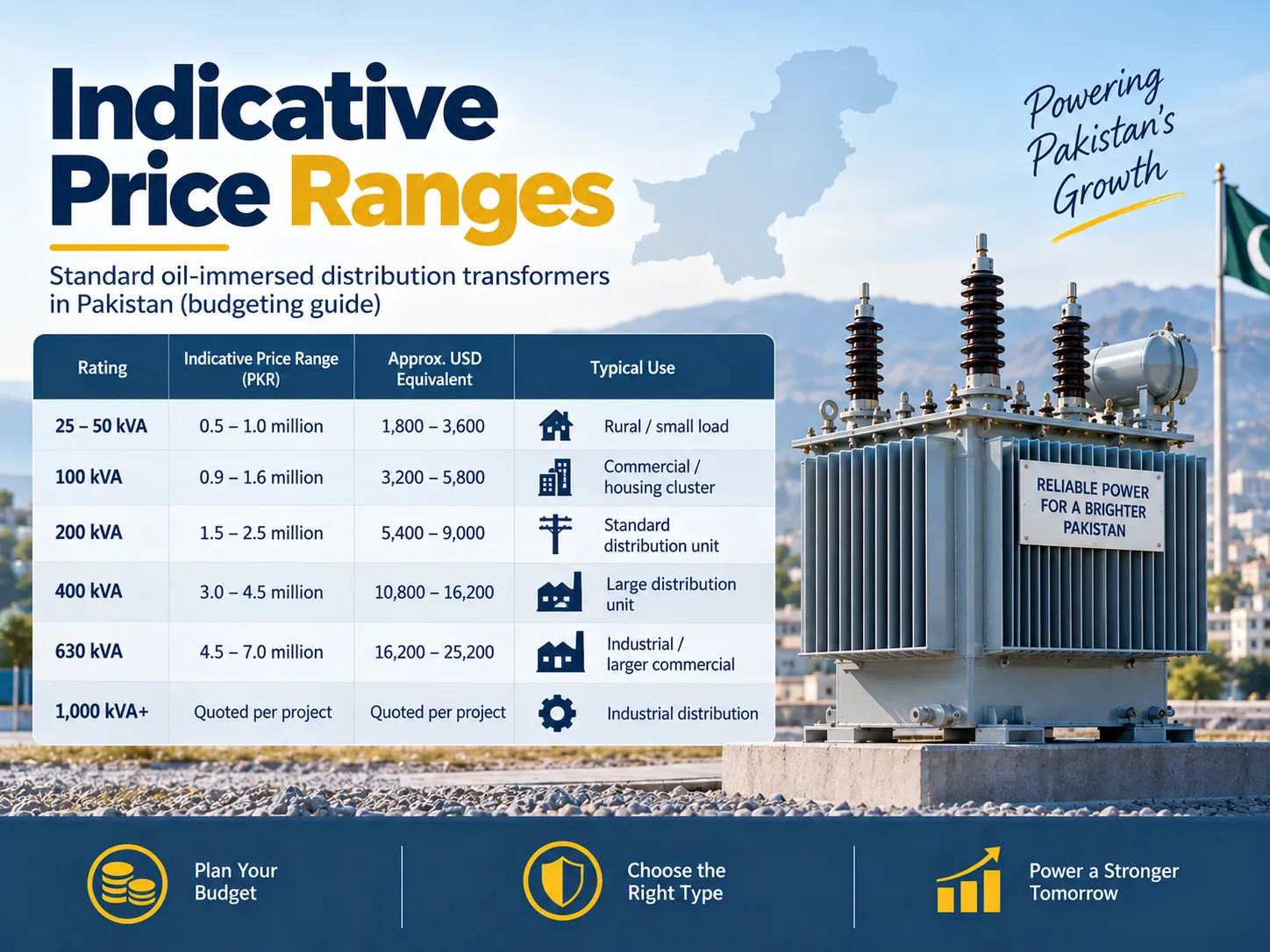
Indicative Price Ranges
The following table provides a budgeting reference for oil-filled distribution transformers from the Pakistani distribution firms. It is not a quotation, and the estimates vary according to copper, electrical steel, and currency price fluctuations.
| Rating | Indicative price range | Approximate USD equivalent | Typical use |
|---|---|---|---|
| 25 to 50 kVA | PKR 0.5 to 1.0 million | USD 1,800 to 3,600 | Single pole-mounted supply, small rural load |
| 100 kVA | PKR 0.9 to 1.6 million | USD 3,200 to 5,800 | Small commercial or housing cluster |
| 200 kVA | PKR 1.5 to 2.5 million | USD 5,400 to 9,000 | Standard distribution unit in DISCO specifications |
| 400 kVA | PKR 3.0 to 4.5 million | USD 10,800 to 16,200 | Large distribution unit; a 2026 public tender was estimated at PKR 3.0 million |
| 630 kVA | PKR 4.5 to 7.0 million | USD 16,200 to 25,200 | Industrial feeder, larger commercial load |
| 1,000 kVA and above | Quoted per project | Quoted per project | Industrial distribution, captive power |
The dry-type cast-resin units are in a different category. In reference to dry-type cast-resin unit procurement data, for a 630 kVA, 11 kV dry-type cast-resin unit with Class F insulation, the costs registered due to local producers in Pakistan are about PKR 3.8 million to PKR 5.2 million, PKR 2.9 million to PKR 4.1 million for imported units from China, PKR 4.5 million to PKR 6.0 million from Turkey, and PKR 7.2 million to PKR 10.5 million from Germany.
What Moves the Price Up and Down
A single quoting entity can span quotations of different magnitude. There are five factors responsible for the difference.
| Factor | Effect on price | What to check |
|---|---|---|
| Winding material: copper or aluminium | Copper adds a substantial premium but cuts losses and raises short-circuit strength | Winding material stated explicitly in the offer, not assumed |
| Loss level: standard or low-loss | Low-loss designs cost more to buy and less to run | No-load and load loss in watts on the datasheet, and the efficiency class claimed |
| Cooling: natural or forced | Fans and pumps raise both cost and capacity | Whether the quoted rating depends on fans running |
| Specification and standard | A utility specification with defined losses, impedance and test regime costs more than a generic build | Which standard the unit is designed and tested to |
| Origin and warranty | Premium European brands command a multiple; local manufacture is the cheapest compliant option | Warranty terms, spares availability and who performs service |
On top of these, there are two more market factors. The price of copper and electrical steel acts as the lower limit for every quotation. Since copper and electrical steel are traded globally, a quotation of a transformer in Pakistan automatically gets exposed to commodity prices. The rupee exchange rate, in turn, multiplies the exposure by any import involved. Thus, quotations require validity of fifteen to thirty days, and a budget in the quarter may not be valid in the next quarter.
How the Pakistani Market Actually Buys
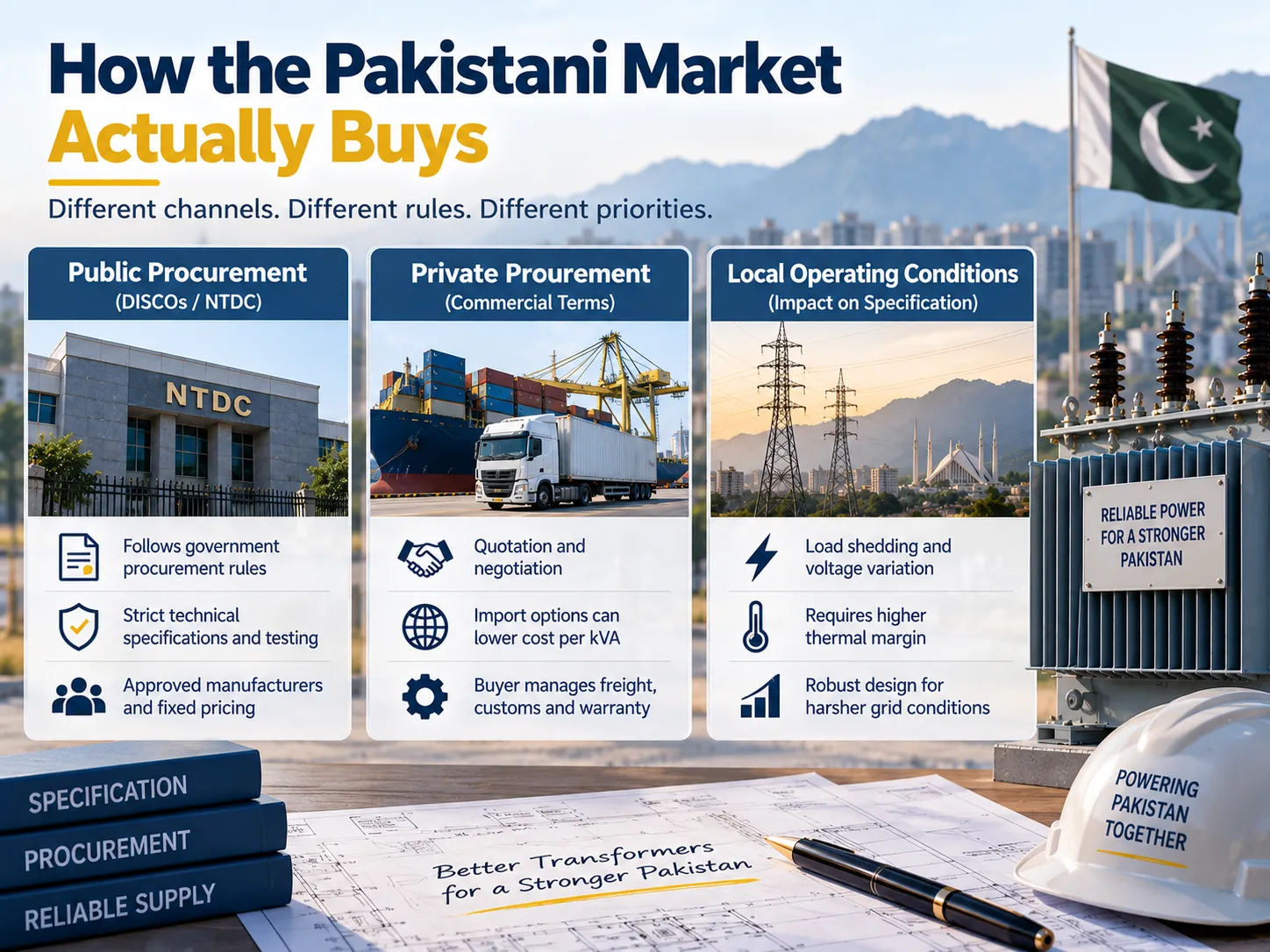
Procurement in Pakistan occurs via different systems of public and private procurement. Formats of work in both systems vary significantly and the roles performed by local utility companies and national transmission utility are different.
With regards to public procurement, actual procurement is performed by local utility companies and national transmission utility. This implies compliance with stringent specifications such as NTDC specifications, PEPCO specifications and so on. This means that quotations must be provided by manufacturers registered with relevant authorities to obtain from them the same models. In addition to that, prices are quoted on an inclusive basis reflecting taxes and inspection fees. Sometimes, independent testing commissions are used to guarantee that transformer losses are within the acceptable range.
Private procurement on the contrary implies quoting requests, getting negotiations, delivering transformers at the site, and paying for all related expenses. In this case the specification is what the buyer prefers. The advantage of this type of procurement is that large amounts can be saved since the buyers can order transformers directly from foreign manufacturers. Conversely, it also implies certain risks related to specifications, terms of delivery, and warranty service problems.
In addition, it is important to mention that specification in Pakistan is to a certain degree restricted by permanent load shedding and thus transformers used by utilities must be designed to endure voltage fluctuations since otherwise they would fail.
kW and kVA: The Question Behind the Question
Customers often request transformers which they refer to as “100 kW transformers,” even though that is not the way transformers are rated. Transformers are actually rated in kVA, which is a measure of apparent power, due to the fact that heating and losses in transformers depend on the voltage and current. The relationship is quite simple, so kVA = kW/power factor. When a power factor equals 0.8, a load of 100 kW requires 125 kVA of transformer power rating and 200 kW load will need 250 kVA of transformer power rating.
This is where the terms of overheating and underheating come from. A transformer rated in kW without taking into consideration the power factor of the load actually works in hot conditions from the very beginning; however, a transformer whose ratings are based on kVA without considering the actual load profile is oversized. Hence, the correct answer is determined on the basis of a load calculation which means the required power loading was provided along with a real life situation of the loads applied.
Costs That Are Not on the Price Tag
The cost of buying the unit is just the least portion of the decision that has to be made about the unit’s twenty-five-year lifetime. Four cost factors are important outside of the quotation stage and must be considered before offer evaluations.
| Cost | Why it matters |
|---|---|
| No-load loss, charged for every hour of the year | A unit that runs energised at light load spends most of its energy cost before it does any useful work |
| Load loss at the actual load profile | Rises with the square of load, so an undersized or high-loss unit costs more at peak |
| Civil works, foundations, bunding and fire separation | Oil-immersed and dry-type units have different requirements, and the difference can exceed the equipment premium |
| Spares, maintenance and the cost of an outage | Accessory availability and local service capability decide how long a failure keeps the load off |
Special importance falls on the loss capitalisation point, especially today, where energy costs high and supply are tight. It is easy to commit the common mistake of making a comparison based only on the purchase price, as opposed to comparing the purchase price plus the present value of lifetime losses, which causes two offers competing today to change their respective places.
What a Quotation Should Contain
A quotation that omits the following items cannot be compared with another one, and comparing incomparable offers is how overpaying happens without anyone noticing.
| Item | Why it is required |
|---|---|
| Rated power in kVA, with cooling designation | Confirms whether the rating depends on fans running |
| Primary and secondary voltage, tap range, vector group | Confirms the unit matches the system |
| Winding material, copper or aluminium | The single largest driver of both price and losses |
| No-load and load loss in watts at reference temperature | The basis of the lifetime cost calculation |
| Percentage impedance | Determines fault level and protection coordination |
| Temperature rise and insulation class | Sets the service life at rated load |
| Applicable standard and test regime | Shows what the unit has been designed and proved against |
| Accessory list with component brands | Accessories fail first; brand and availability decide repair speed |
| Delivery basis, lead time, warranty and price validity | Converts a price into a deliverable commitment |
Where a project involves the transformer as part of a packaged assembly rather than a bare unit, the comparison changes again. RUY Power manufactures 12 kV distribution equipment in this form, including the YB□-12/0.4 prefabricated substation covering 50 to 1,600 kVA for indoor and outdoor networks.
Buyers who need a specific voltage, enclosure or configuration are supported through the OEM and ODM programme, which is where a price comparison should start rather than end, because a custom configuration changes the specification that the price is attached to.
FAQ
What is the price of a 200 kVA transformer?
The approximate cost of a typical oil-submerged distribution transformer in Pakistan is about PKR 1.5 to 2.5 million which is about USD 5,400 to 9,000 at present exchange rates. The rate varies according to the type of winding material, loss class, and specification of the transformer. Tenders of utility with specified loss limitation and examination of loss already had been on the higher side of this range while commonplace commercial distribution transformers were on the lower side of the cost range.
How much does a 400 KVA transformer cost in Pakistan?
The approximate price of a 400 kVA transformer is around PKR 3.0 to 4.5 million (USD 10,800 to 16,200). This is based upon the procedure of public procurement: in one of the tenders of 2026, the cost of one 400 kVA transformer was approximately PKR 3.0 million which was the lowest price among the range of prices for these units. Cost of imported top-end brands and dry construction will be significantly higher.
What is the price of a 100 kW transformer in Pakistan?
The transformers are rated in kVA; therefore we need to convert first. A load of 100 kW at the power factor of 0.8 will require 125 kVA. For this, a 100 kVA oil submergence distribution transformer will cost about PKR 0.9 to 1.6 million, and a 125 kVA unit will cost even more. The problem with sizing of kW without considering the power factor is the main reason why these transformers become hotter than expected from the day of their commissioning.
What is the price of a 200 kW transformer in Pakistan?
First of all, we convert it: 200 kW at the power factor of 0.8 translates to 250 kVA. The 250 kVA oil-immersed distribution transformer falls in between the 200 kVA and 400 kVA range mentioned above. So, expect to spend about PKR 2.0 million to PKR 3.5 million (approximately USD 7,200 to USD 12,600). If the load has a lower power factor, or a harmonic-generating device is used, the amount of kVA will increase thus affecting the price.
Why do transformer prices in Pakistan change so often?
Two main things are: copper and electrical steel. Because these are internationally traded commodities, and the number of imported materials is huge in the final product. Thus, the price of copper will have its impact on the quotes in a few weeks. That is the reason why the reputable suppliers put a validity period into their quotes, and why your budget created in the last quarter can become outdated.
References
- National Transmission and Despatch Company, Pakistan — grid and transmission equipment specifications
- Public Procurement Regulatory Authority, Pakistan — public procurement rules and tender procedures
- Islamabad Electric Supply Company — distribution transformer procurement and technical specifications
- National Electric Power Regulatory Authority, Pakistan — tariff and performance data
- International Electrotechnical Commission — IEC 60076 series, Power transformers
- US Department of Energy — distribution transformer loss evaluation methodology
Conclusion
With respect to transformer prices in Pakistan, the best method to calculate is in terms of costs per kVA since various types of transformers with the same kVA rating could differ in price quite dramatically. The cost of conventional oil-insulated transformers will be between PKR 6,000 to PKR 12,000 for kVA-per-kVA. With respect to dry-type transformers and technology, the price can vary enormously and will depend on the prices from abroad and costs of particular raw materials according to the current market situation.
There are three key points one should consider when choosing a transformer type. First of all, one should convert kW values to kVA, which is often neglected leading to the diesel engine being too small. Next, one should collect information on all losses, raw materials used, and protocols of tests applied before pricing since those three parameters are not related to the final quotation for a transformer. Third, the quotation itself should contain all required information regarding the rating, voltage, impedance, increase of temperature, and validity so that a comparison with other manufacturers’ quotations can be made.