
The domestic transformer industry in Saudi Arabia has been developed over a period of 20 years and is now sufficient to meet all the requirements of the country’s networks up to the highest transmission voltages. This is important for commercial reasons. If a project is done with local supply, it means a quicker delivery, local maintenance, and a more favorable position regarding local content requirements.
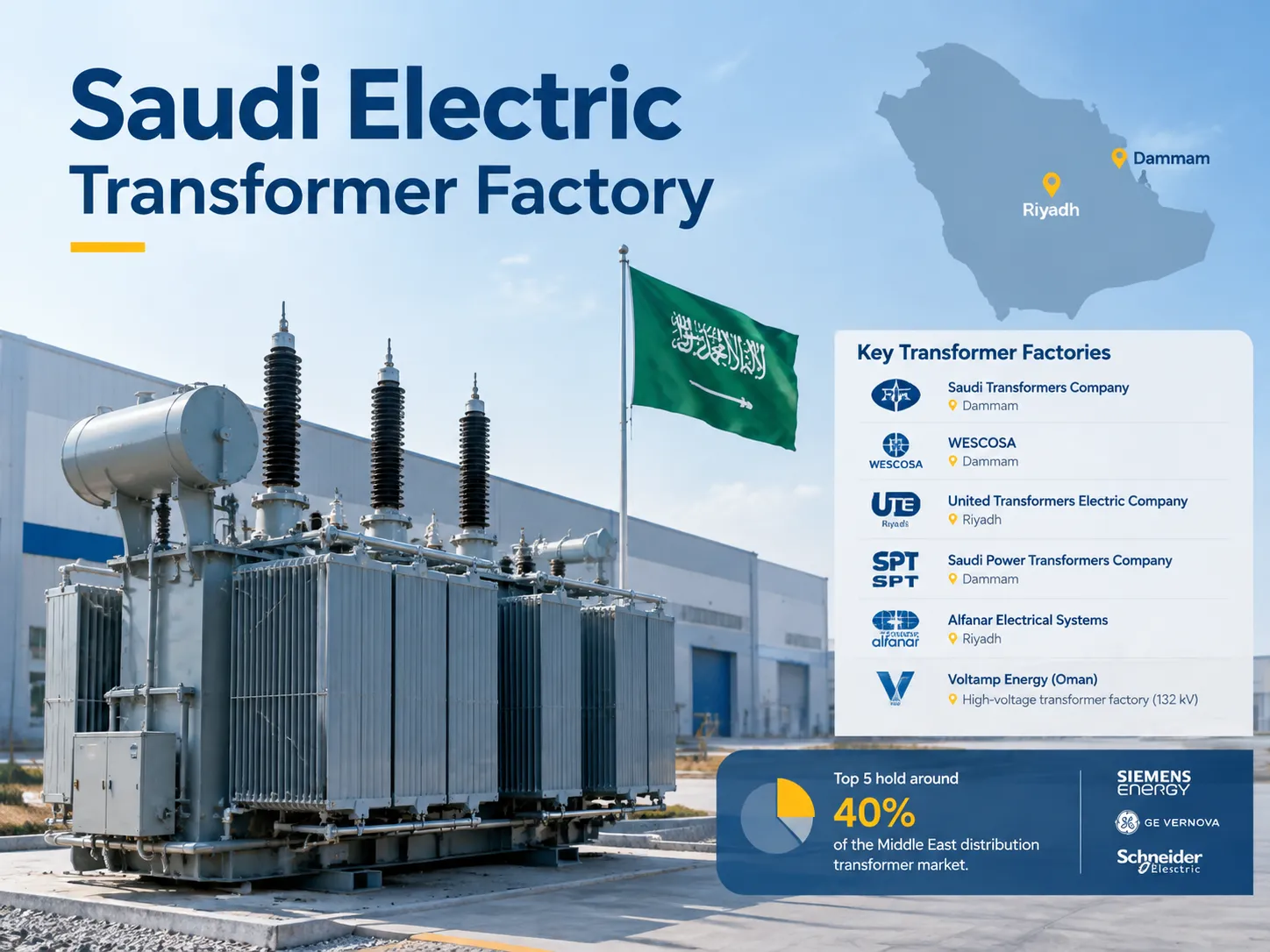
In terms of timing the biggest transformer factories in Saudi Arabia are as follows: Saudi Transformers company situated in Dammam, founded in 1982, is a company under Pauwels licence and a member of Electrical Industries company; WESCOSA, which runs work in its area of more than 132,000 square meters and employs about 1,100 people and supplies Saudi Aramco and Saudi Electricity Company; United Transformers Electric Company located in the industrial city of Riyadh and manufactures transformers range from 25kVA to 10000kVA with voltage of 36kV; Saudi Power Transformers Company based in Dammam specializes in transformers of up to 100MVA and voltage of 145 kV; Alfanar Electrical Systems located in Riyadh has also acquired a status of factory. Now Voltamp Energy of Oman is building a high voltage transformer factory in the Kingdom that operates with voltage of 132 kV. The share of the leading five companies together with Siemens Energy, GE Vernova and Schneider Electric constitutes approximately forty percent of the market of distribution transformers in the Middle East.
The Saudi Transformer Market at a Glance
On the electrical supply front, Saudi Arabia stands as the biggest single-country market in the Middle East, with a few colossal players in the country running this sector. The Saudi Electricity Company is the nation’s utility provider, whereas Saudi Aramco is known as the firm providing electrical supply in relation to oil and gas facilities. The Saudi Power Procurement Company is known for independent power supply projects and giga-projects like NEOM, the Red Sea project, and Qiddiya.
In terms of market evaluation, the leading five companies in terms of distribution transformers supply in the Middle East are likely to account for around 40 percent of revenues in 2024, according to a report by market experts. These firms are likely to include Siemens Energy, GE Vernova, Schneider Electric as well as Saudi Transformers and Alfanar Electrical Systems. The rest of the supply will come from small regional suppliers operating in Saudi Arabia, UAE, Oman, Egypt and Turkey, as well as from European and Asian markets.
This market is differentiated from the typical European or North American market in two ways. First is the implementation of local content policy: Vision 2030 has promoted local manufacturing commitments in several programmes and caused international manufacturers to localize. The second difference is the issues related to climate and duties due to infra red and temperature of 45 degrees Celsius or more which usually leads to alterations of the specifications.
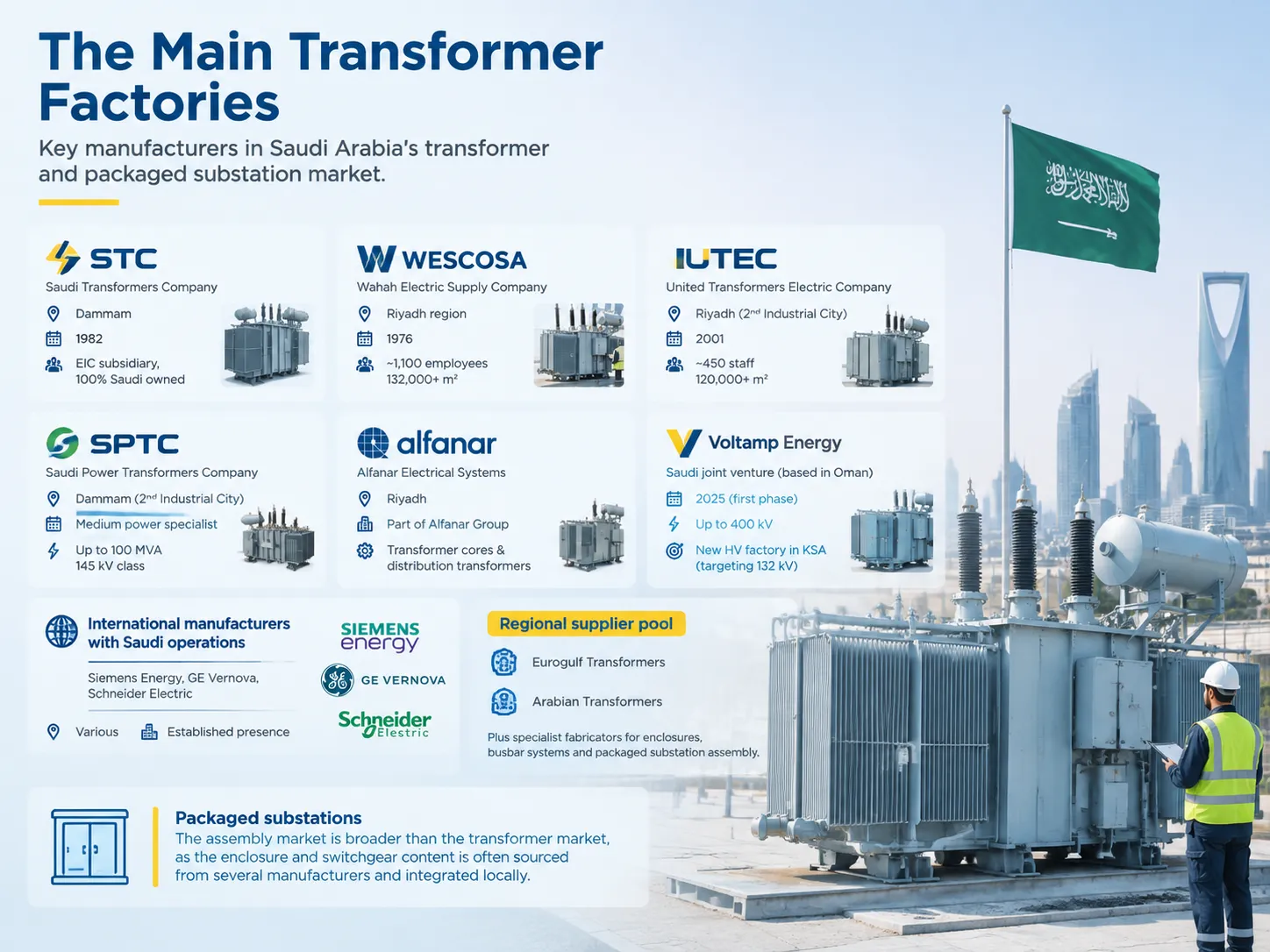
The Main Transformer Factories
The table provides information about the companies that frequently appear in the procurement data for transformers and packaged substations in Saudi Arabia.
| Factory | Location | Established | Scale and ownership |
|---|---|---|---|
| Saudi Transformers Company (STC) | Dammam | 1982 | Subsidiary of Electrical Industries Company (EIC); originally licensed by Pauwels of Belgium; 100 percent Saudi owned |
| Wahah Electric Supply Company (WESCOSA) | Riyadh region | 1976 | Founded as a Westinghouse joint venture, 100 percent Saudi since 1988; around 1,100 employees and more than 132,000 square metres of manufacturing and office space |
| United Transformers Electric Company (UTEC) | Second Industrial City, Riyadh | 2001 | Joint venture between Bawan and Wilson Transformers of Australia; around 450 staff; more than 120,000 square metres of manufacturing footprint |
| Saudi Power Transformers Company (SPTC) | Second Industrial City, Dammam | Medium power specialist | Manufactures up to 100 MVA with 145 kV class transformers |
| Alfanar Electrical Systems | Riyadh | Part of Alfanar Group | Transformer cores and complete distribution transformers for residential, commercial and industrial use |
| Voltamp Energy | Saudi joint venture, based in Oman | 2025 first phase | Largest power and distribution transformer manufacturer in the GCC; produces up to 400 kV; building a high-voltage transformer factory in the Kingdom targeting 132 kV |
| International manufacturers with Saudi operations | Various | Established presence | Siemens Energy, GE Vernova and Schneider Electric, all supplying grid and industrial projects and involved in giga-project work |
In addition to those companies, the supplier pool in the area consists of Eurogulf Transformers and Arabian Transformers and specialized manufacturers of processes like enclosure, busbar, packaged substations assembly. The assembly market for packaged substations is wider than the market for transformers because the enclosures and switchgear components of packaged substations are often sourced from different manufacturers and then assembled locally.
What Each Factory Actually Builds
The ranges specified below refer specifically to envelopes of manufacturing that are published by such factories and also refer to the elimination of projects for bidding.
| Factory | Typical product range | Where they fit |
|---|---|---|
| Saudi Transformers (STC) | Distribution transformers, package substations, low voltage panels | Saudi Electricity Company distribution work, commercial and industrial projects across the Kingdom and GCC |
| WESCOSA | Electrical distribution equipment including transformers and switchboards | Utility, Saudi Aramco and turnkey contractor supply, with a long installed base |
| UTEC | Distribution transformers from 25 kVA to 10,000 kVA up to 36 kV, pole-mounted, ground-mounted, substation and unit or package substation transformers, dry-type distribution, medium and low voltage switchgear, modular substations | Utility, oil and gas, water, transport, data centre and urban development projects |
| SPTC | Medium power transformers up to 100 MVA at 145 kV class | Sub-transmission and larger industrial supplies |
| Alfanar Electrical Systems | Transformer cores and complete distribution transformers | High-volume distribution and residential development supply |
| Voltamp Energy | Power and distribution transformers up to 400 kV, with a Saudi factory targeting 132 kV | Utility transmission and larger industrial projects as local capacity comes online |
The gap that exists has to do with the upper level of the voltage range, with higher equipment than 145 kV class-type being available only via import. Aside from such instances, only multinationals with local assembly and service remain involved in the largest projects. For distribution and sub-transmission work, the local industry can now be viewed as a real alternative rather than a fall-back option.
What Is Driving Demand
Saudi transformer demand comes from four different locations, and each of them has its own timeframes and specifications.
The first source of demand for transformers is grid reinforcement, which is a result of load growth in Saudi cities like Riyadh and Jeddah and the eastern province which makes it necessary to increase distribution capacity and remove old transformers. The Saudi Electricity Company continuously organizes a framework procurement of distribution transformers. The second source of demand comes from renewable energy integration. They have been building solar and wind capacity, including the 1500 MW Sudair solar plant and the 400 MW Dumat Al-Jandal wind farm, and they need to install a transformer and substation to connect each renewable project to the grid. The third source of demand comes from mega construction projects. They’re building NEOM and developing the Red Sea region where they need more than just transformers. The last source of demand is industrial needs. The industries of oil and gas extraction, petrochemicals, mining, and water services need to build their own transformer and power plants.
Each of these four types of demand creates its own requirements for suppliers. Utility work is based on engineering standards that need to be met in order for the customer to accept the product. Renewable energy projects require transformers to have harmonics, K-factor winding and voltage stability. In mega projects the customers are mostly concerned with local content of the transformer and the time it will take to manufacture it.
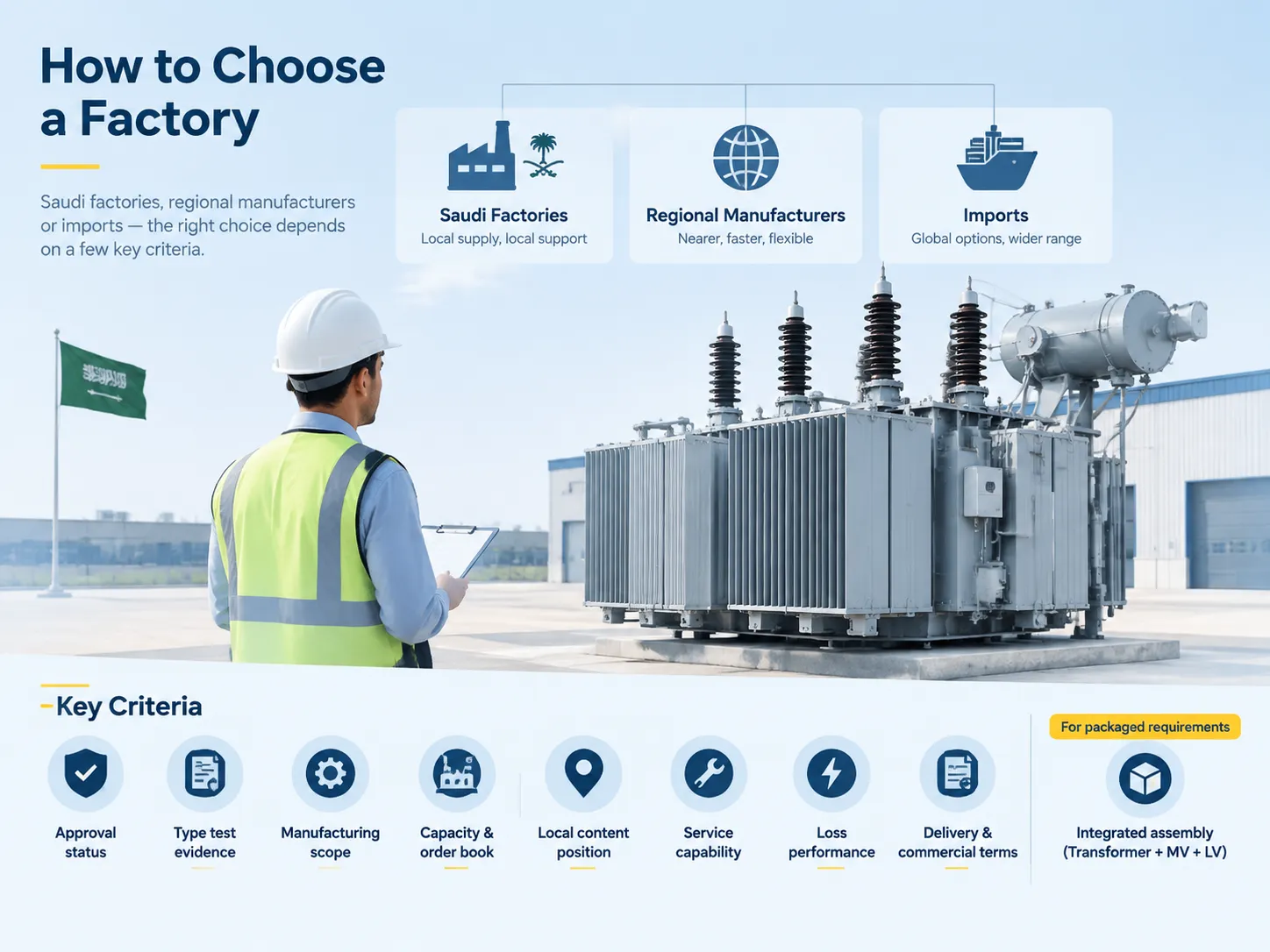
How to Choose a Factory
The choice between Saudi manufacturers, local manufacturers, and imports relies on a finite list of considerations and the importance of each depends on whether that unit is a utility, an engineered package, or a substitute.
| Criterion | What to establish | Why it decides the outcome |
|---|---|---|
| Approval status | SASO certification and, where relevant, approval by the Saudi Electricity Company or the end client’s specification | An unapproved unit cannot be energised on a utility network regardless of quality |
| Type test evidence | Test reports from recognised laboratories, including temperature rise and short-circuit tests | Shows the design has been proved, not just assembled |
| Manufacturing scope | Whether windings, core and tank are made in house or assembled from bought-in parts | Winding and core control is where quality variation originates |
| Capacity and current order book | Monthly output and the realistic delivery date | Determines whether the schedule holds |
| Local content position | Domestic manufacturing share and any localisation commitment | Influences eligibility on Vision 2030 programmes |
| Service capability | Spares stock, service teams and response times inside the Kingdom | Decides how long a fault keeps the load off |
| Loss performance | No-load and load loss in watts, not just an efficiency claim | The dominant lifetime cost on a unit that runs continuously |
| Delivery and commercial terms | Incoterms or delivered basis, warranty, payment terms and price validity | Converts a price into a commitment |
When it comes to packages, a third criterion must be considered: does the provider supply a packaged substation as a complete installation, or simply deliver equipment to the end location? A packaged substation that has been pre-assembled saves a lot of time during the start-up phase and reduces interface hazards that may occur at three different suppliers.
Qualification and Certification
In Saudi Arabia, SASO implements an obligatory compliance-based program for products entering its market or for products that are sold there; additionally, the utility equipment should also meet requirements specified by client. In practice, the supplier participating in the projects in Saudi Arabia has to fulfill three conditions in a defined order.
First, the requirements lying behind the proof of the compliance with SASO standards and the test results demonstrating it should be satisfied. Second, the approval of the utility or client which is a another qualification performed against the client specifications and this process may imply a factory inspection as well. Third, is a documentation for local content, which is important for procurement operations in local and mega-projects. Having compliance certificates without utility approval will allow the supplier to work for industrial projects; however, if the company has all the required documents, it can participate in the bidding for utility projects; having no documents at all excludes the supplier from consideration regardless of the prices offered.
When Imported Equipment Makes Sense
Local manufacturing cannot meet all requirements, and there are three cases when it is better to buy goods from foreign sources.
The first is “the voltage class” situation. When the voltage rating of transformers exceeds the capabilities of local producers, importing the required equipment is the only alternative. It is worth mentioning that it is better to cooperate with the multinational companies that can provide the needed services at the local level. The second case relates to the special configuration. It may include the need for a special enclosure design, a certain ratio of voltage, the use of K-factor windings for the connection to renewable sources with numerous distortions, or the utilization of various parts produced by different factories as a whole. The third condition is related to the price competition for standard distribution voltage. In this case, it is better to buy the equipment in another country because foreign producers offer lower prices.
RUY Power supplies the market as a manufacturer and not a trader. Founded in 2007 and located in Shenyang, China, the company manufactures complete electrical kits that include high, medium and low voltage switchgear. Buyers who need a specific voltage, enclosure or configuration are supported through the OEM and ODM programme.
For 12 kV distribution projects the first of the two relevant families is the YB□-12/0.4 European-type prefabricated substation, which integrates high voltage switchgear, transformer and low voltage switchgear in one enclosure from 50 to 1,600 kVA.
The second is the ZGS13-H-630/10 American box-type combined transformer for overhead-fed networks, where the transformer, fuse protection and metering share a single compact unit.
Reference installations in comparable markets are described on the projects page.
People who choose this option should make compliance work part of the timeline rather than an additional task: compliance certification and all necessary utility approvals must be obtained prior to pouring the foundation, not after.
Where the Electricity Comes From
Transformer demand follows electricity generation, and there exist a small number of very large plants in the Saudi generation sector. The one that ranks highest on the scale of power generation is Shoaiba with a capacity of 5600 MW, followed by Ghazlan at 4128 MW, that belong to Saudi Electricity Company, along with Qurayyah independent power project at 3927 MW, Jazan integrated gasification combined cycle station with a output power capacity of 3800 MW, Qurayyah II at 3230 MW, South Jeddah at 2892 MW, and Marafiq Jubail independent water and power project at 2744 MW, Shuqaiq steam plant at 2640 MW.
On the side of alternative energy sources, the main solar plant Sudair with the capacity of 1500 MW, a wind energy Dumat Al-Jandat plant with the future capacity of 400 MW and the second large plant Sakaka with the capacity of 300 MW that is still under construction exist.
FAQ
Who is the biggest transformer manufacturer in the world?
Hitachi Energy is generally regarded to be the issuer with the utmost transformer market share, holding a top position in numerous power transformer and distribution transformer studies. However, for buyers in Saudi Arabia, it is more important to look at local capabilities: in the country, Saudi Transformers, WESCOSA, UTEC, Alfanar Electrical Systems manufacture distribution transformers and sub-transmission transformers while any devices higher than 145 kV may be provided by worldwide producers with local representation.
Where are electrical transformers manufactured?
Transformers are produced in most industrialized countries of the world, and the highest production volumes are in China, India, Europe, North America, Japan, South Korea, and the Middle East region. Within the GCC, Saudi Arabia, the UAE, and Oman have created transformer production facilities. The location of transformer production influences pricing, lead time, local content compliance, and logistics of service and warranty work only, but not the quality of the produced transformer, as quality depends on the design of the transformer, materials, and testing procedure used.
How much does a 500 kV transformer cost?
A transformer with a 500 kV rating is a large power transformer, not a distribution transformer, and therefore the price is millions of dollars per transformer with a lead time of 18-30 months, or even longer when it comes to extra-high-voltage transformers.Normally buyers inquiring about this matter are actually inquiring about a distribution transformer with a capacity of 500 kVA, which is a different situation with price usually from low thousands to tens of thousands of US dollars depending on the specifications. Thus, confirming which rating is meant before asking for the price saves a lot of time for both sides.
What are the major power plants in Saudi Arabia?
The biggest operating plants are Shoaiba at a capacity of approximately 5,600 watts and Ghazlan at a capacity of approximately 4,128 watts, and both belong to the Saudi Electricity Company. After them go the Qurayyah Independent Power Project with 3,927 watts, the Jazan Integrated Gasification Combined Cycle Plant with 3,800 MW, Qurayyah II with 3,230 MW, South Jeddah with 2,892 MW, the Marafiq Jubail Independent Water and Power Project with 2,744 MW, and Shuqaiq with 2,640 MW. The part of renewable capacity includes Sudair solar plant with a capacity of 1,500 MW, Dumat Al-Jandal wind farm with a capacity of 400 watts, and Sakaka solar plant with a capacity of 300 watts.
Do I need SASO certification to supply transformers in Saudi Arabia?
This is the case for the regulated products reached the Saudi market, and the utility equipment also meets the requirements of the customer with regards to the specifications, which is different from the certification of conformity. Typically, the supplier should have product conformity documentation, utility or customer approval including factory audit if required, and documentation with regards to local content for public and giga-project procurement beforehand.
Can a foreign manufacturer supply Saudi projects directly?
Yes, mainly in accordance with voltage classes or configurations that local factories do not cover and for standard distribution ratings where together with freight and duty pricing is competitive. In practical terms, what is required is the certification of conformity, approval of technical specifications by the customer, and the pre-defined service route for spare parts and warranty works within the country.
References
- US Energy Information Administration — Saudi Arabia country analysis with major power plant and renewable capacity data
- Global Market Insights — Middle East distribution transformer market share and company analysis
- Saudi Standards, Metrology and Quality Organization — conformity assessment and technical regulations
- Saudi Electricity Company — utility network and procurement information
- International Electrotechnical Commission — IEC 60076 series, Power transformers
- Saudi Vision 2030 — industrial localisation and energy sector programmes
Conclusion
The country boasts a transformer sector that can satisfy its own requirements in the areas of distribution and sub- transmission. The country has a strong transformer industry, represented by several high-profile companies such as Saudi Transformers, WESCOSA, UTEC, Saudi Power Transformers, and Alfanar. Voltamp is a high-profile organization specializing in high voltage and utilizing its partnership in Saudi Arabia to address this part of transformer production. About 40% of the total revenue earned in the distribution transformer sector in the Middle East is generated by the five largest companies.
Three recommendations can be made on the issues raised. Firstly, establish the certification and approval status. It is impossible to transport any product over the utility network unless this product has been approved and certified. Secondly, use specifications that correspond to the climate and the conditions of operation of the required equipment. Instead of referring to temperate-region specifications for transformer operation, it is better to observe the ambient temperature, dust pollution of the area and fluctuations during loading, since all these factors can determine the characteristics required for transformers. Thirdly, it is necessary to compare the companies supplying packaged substations and the companies producing components; usually, people mistakenly start comparing the prices of transformers only.
It is necessary to choose the producer showing the certificates received and compliance with the schedule.