
Different databases of manufacturers of transformers actually reflect different criteria, therefore leading to the discrepancies between differing rankings of manufacturers. One might solely rank manufacturers based on their revenue and ignore all other operations while another database could solely rank manufacturers based on revenue generated by transformer sales. A third database could incorporate which share of the total market belongs to the manufacturer within a fixed segment.
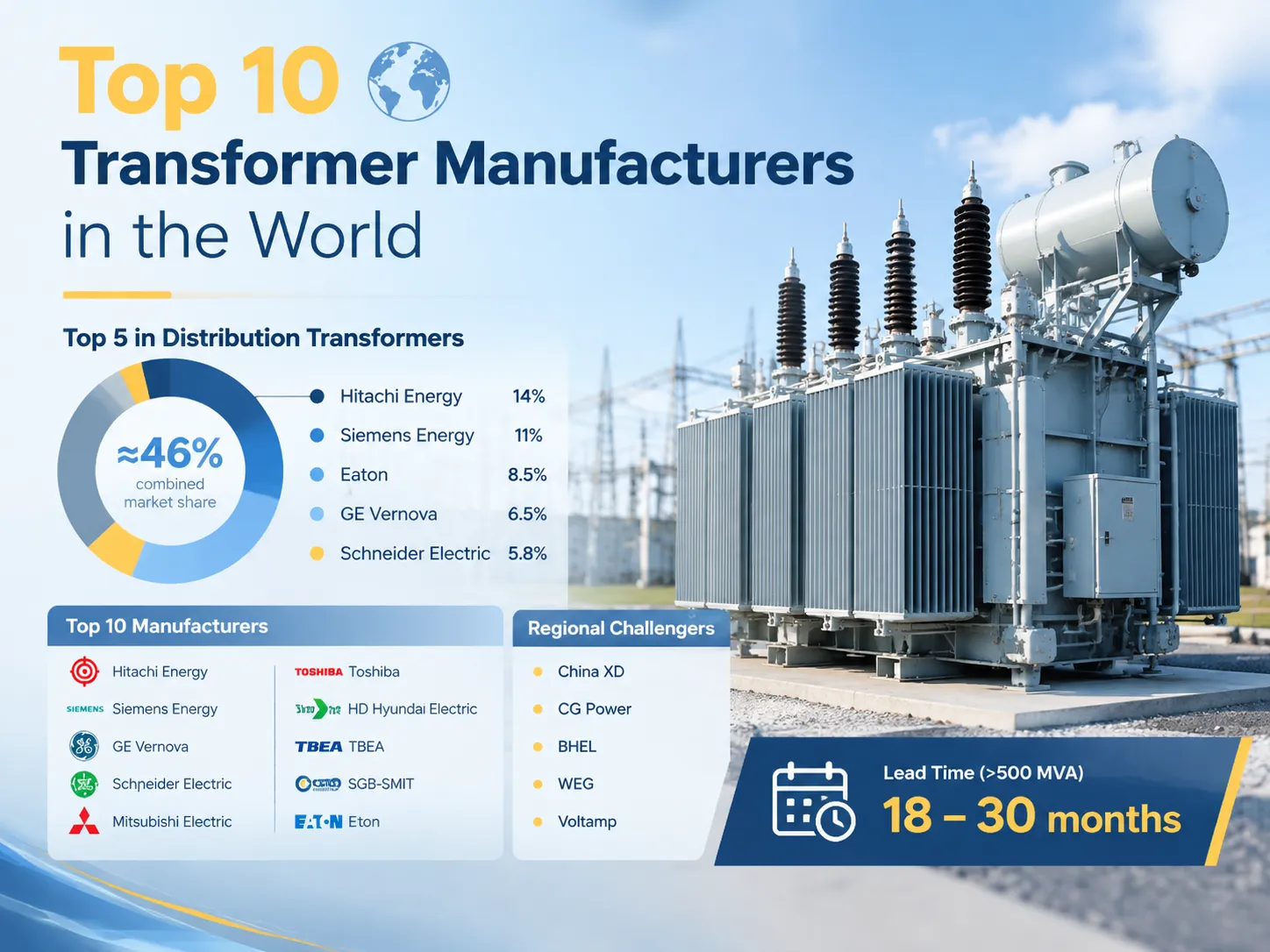
Overall it can be considered that transformer industry is medium concentrated. In case of power transformers, the share of the top five companies is about 48% in the revenue for this segment. Indeed, in case of distribution transformers market, it can be noted that there are leading companies which are currently considered as top producers, namely Hitachi Energy (14% share), Siemens Energy (11%), Eaton (8.5%), GE Vernova (6.5%), Schneider Electric (5.8%) which together cover around 46% of the market. Therefore Hitachi Energy, Siemens Energy, GE Vernova, Schneider Electric, Mitsubishi Electric, Toshiba, HD Hyundai Electric, TBEA, SGB-SMIT and Eaton are some of the major companies in this segment. In general terms, the lead time of new equipment delivery for 500 MVA and above is between 18-30 months.
How to Read a Top 10 List
To make a real difference between a useful ranking and a decorative one, it is necessary to answer four questions. What will be ranked: revenue, market shares, order backlog, or installed base? Which segment will be examined: power transformers over 100 MVA, distribution transformers below 2.5 MVA, or both? Is the revenue transformer-related, or is it total revenue of all company activities? Is the ranking global or regionally weighted?
These questions may seem basic, yet the majority of published ranking lists make use of all four criteria. As such, a company with thirty billion dollars of revenue will probably be able to claim its business numbers are smaller when compared to the one specializing in a specified field.
The Leading Manufacturers
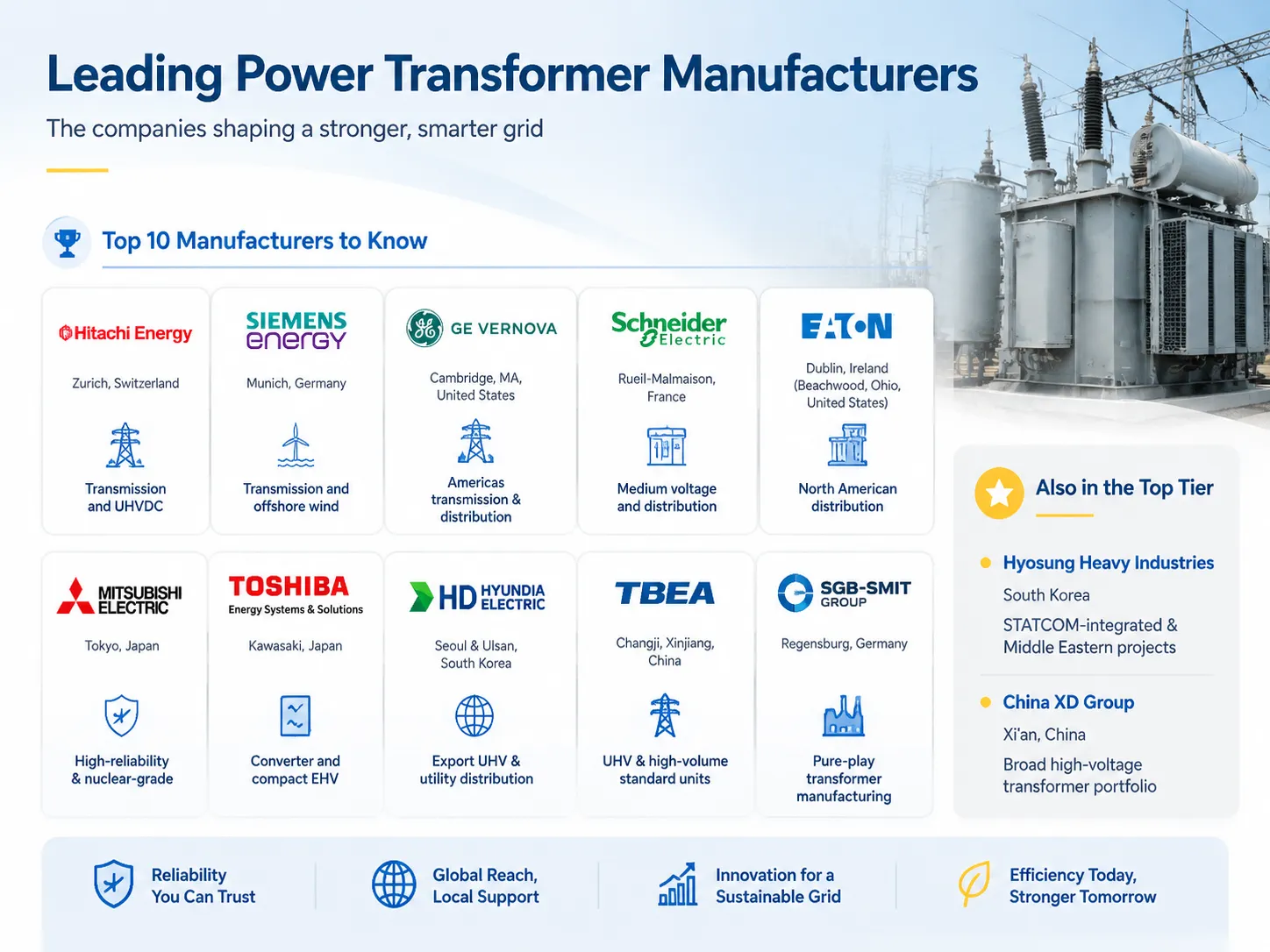
The table below indicates manufacturers that consistently rank highly in market analysis, as well as the segment in which they are strongest and why this positioning is important to the customer.
| Manufacturer | Headquarters | Strongest segment | What they are known for |
|---|---|---|---|
| Hitachi Energy | Zurich, Switzerland | Transmission and UHVDC | The broadest voltage range in the industry, eco-efficient insulation fluids, digital monitoring through TXpert, and the leading share in both power and distribution transformer analyses |
| Siemens Energy | Munich, Germany | Transmission and offshore wind | Sensformer instrumented transformers, HVDC converter transformers, dry-type ranges, and a new large power transformer plant in Charlotte, North Carolina |
| GE Vernova | Cambridge, Massachusetts, United States | Americas transmission and distribution | Full ownership of Prolec GE since 2026, a large installed base, and grid solutions integration |
| Schneider Electric | Rueil-Malmaison, France | Medium voltage and distribution | Distribution-to-transmission breadth, dry-type and resin-cast ranges, and integration with its energy management platform |
| Eaton | Dublin, Ireland, with a North American base in Beachwood, Ohio | North American distribution | Pad-mounted and commercial distribution transformers, strong through electrical distribution channels |
| Mitsubishi Electric | Tokyo, Japan | High-reliability and nuclear-grade | Generator step-up transformers, gas-insulated designs up to 765 kV, and a reliability-first engineering reputation |
| Toshiba Energy Systems & Solutions | Kawasaki, Japan | Converter and compact EHV | Converter transformers for HVDC, cast-resin dry-type ranges, and ester-filled options |
| HD Hyundai Electric | Seoul and Ulsan, South Korea | Export UHV and utility distribution | Extra-high-voltage units up to 800 kV, rapid engineering delivery, and aggressive expansion into the United States and Middle East |
| TBEA | Changji, Xinjiang, China | UHV and high-volume standard units | Ultra-high-voltage and converter transformers, with export reach through large infrastructure programmes |
| SGB-SMIT Group | Regensburg, Germany | Pure-play transformer manufacturing | A transformer-only platform spanning Europe, Asia Pacific and North America, with capacity added in the United States and Romania |
Two names remain on the cusp of this list, depending on the metric used, and should be included on a serious shortlist: Hyosung Heavy Industries of South Korea, with strong positions in STATCOM-integrated and Middle East projects; and China XD Group from Xi’an, a major Chinese manufacturer with a wide-ranging high voltage offering. Both companies rank among the top players in multiple segment analyses.
What the Market Structure Means
The global transformer industry can be characterized as oligopolistic with prominent regional rivalry. The top five companies account for nearly 48% of revenue in the field of power transformers while the concentration index for the product is classified as moderate. In distribution transformers, the five largest companies account for about 46%.
This concentration result leads to leaders making capacity allocations to long-term utility agreements and special projects while small orders do not lead to competition from them. For instance, the leaders have no systems in place to supply small orders for distribution transformers below 630 kVA, prefabricated substations of 12 kV or even orders of two units in the industrial category. The remaining large companies in the industry account for 54% of the distributed market and can therefore serve that end of the market.
Secondly, the availability of technology leadership does not equate to being able to supply it. In a market characterized by capacity shortages, a company that offers advanced UHVDC products may be able to quote delivery dates of three years into the future even if it has one of the most advanced product lines.
Regional and Specialist Challengers
Beneath the global leader tier exists a level of manufacturers that are favored for their accessibility to local markets, application knowledge, and prices. Often times, they are the ideal choice for a project due to their advantageous service response times and specification flexibility process over their brand recognition.
| Manufacturer | Base | Position |
|---|---|---|
| CG Power & Industrial Solutions | India | Broad Indian and export range across power and distribution |
| BHEL | India | Localised extra-high-voltage manufacturing with strong domestic utility procurement position |
| WEG | Brazil | Regional manufacturing across Latin America for generation, transmission and distribution |
| Howard Industries | United States | Utility-grade oil-filled distribution transformers for the North American market |
| ERMCO | United States | North American distribution transformers and pad-mounted designs |
| Hammond Power Solutions | Canada | Dry-type transformer specialisation across North America and India |
| Virginia Transformer and Delta Star | United States | Medium power and utility transformers built to North American specifications |
| Elsewedy Electric | Egypt | Regional manufacturing access across the Middle East and Africa |
| Voltamp Energy | Oman | Transformers up to 400 kV for GCC utilities, with a Saudi joint venture targeting 132 kV production |
| Saudi Transformers, WESCOSA, UTEC, SPTC | Saudi Arabia | Local manufacturing for Saudi Electricity Company and industrial projects under Vision 2030 |
Lead Times and Capacity Investment
The determining factor in transformer procurement today is lead time, and it has trended in only one direction recently. For example, large power transformers (over 500 MVA) are now providing lead times of 18–30 months, with some extra-high-voltage orders extending even beyond 36 months as manufacturers’ order books fill up. The reasons are largely the same for the buyers below this level, i.e., limited capability to produce grain-oriented electrical steel, a labor shortage of skilled winding labor, and demand from grid modernization and renewable connection projects arriving simultaneously in various parts of the world.
The players in the transformer manufacturing sector have taken the route of investing in capacity rather than shortening lead times in response to the situation. Recent announcements include: a state-of-the-art power transformer plant at Charlotte, North Carolina; an expansion of large power transformer production capabilities in Quebec worth several hundred million dollars; and an increase of high-voltage transformer production capabilities at manufacturing facilities in the U.S. and South Korea. In the distribution end of the business, capacity has been growing through acquisition and establishment of new plants in Europe and North America. Besides, these steps would help in the market over the next three to five years rather than providing any kind of relief for orders placed this quarter.
The practical implication is simple; if a project depends on any specific large transformer, place the order early; and consider delivery of such transformers as the limiting constraint.
The US Picture
When asking about the leading manufacturers in the US, buyers often have a more focused inquiry in mind given the peculiarities of the North American market. The largest domestic platform to date is GE Vernova which has owned Prolec GE since 2026. Eaton focuses on electrical distribution channels in the mid- to commercial-market territory. The production of oil-filled transformers is done by Howard Industries and ERMCO while the production of transformers that operate by creating dry power is provided by Hammond Power Solutions. Virginia Transformer and Delta Star are responsible for the medium- and high-voltage sections. As for Siemens Energy, it manufactures large-power transformers in North Carolina. SGB-SMIT has made a larger mark in North America through acquisitions.
In addition to that, one needs to take into consideration the operations of the world leaders in this industry as well as a significant volume of imported products made in accordance with North American practices. The specificity of the US market is that qualification represents the basis for the specifications rather than the brand or name of the manufacturer. The electric utility companies set their own designs and approve the manufacturers. Thus, it is more important for a buyer to be aware of the qualifications mentioned above rather than the ranks of the companies.
How to Choose, Not Just Rank
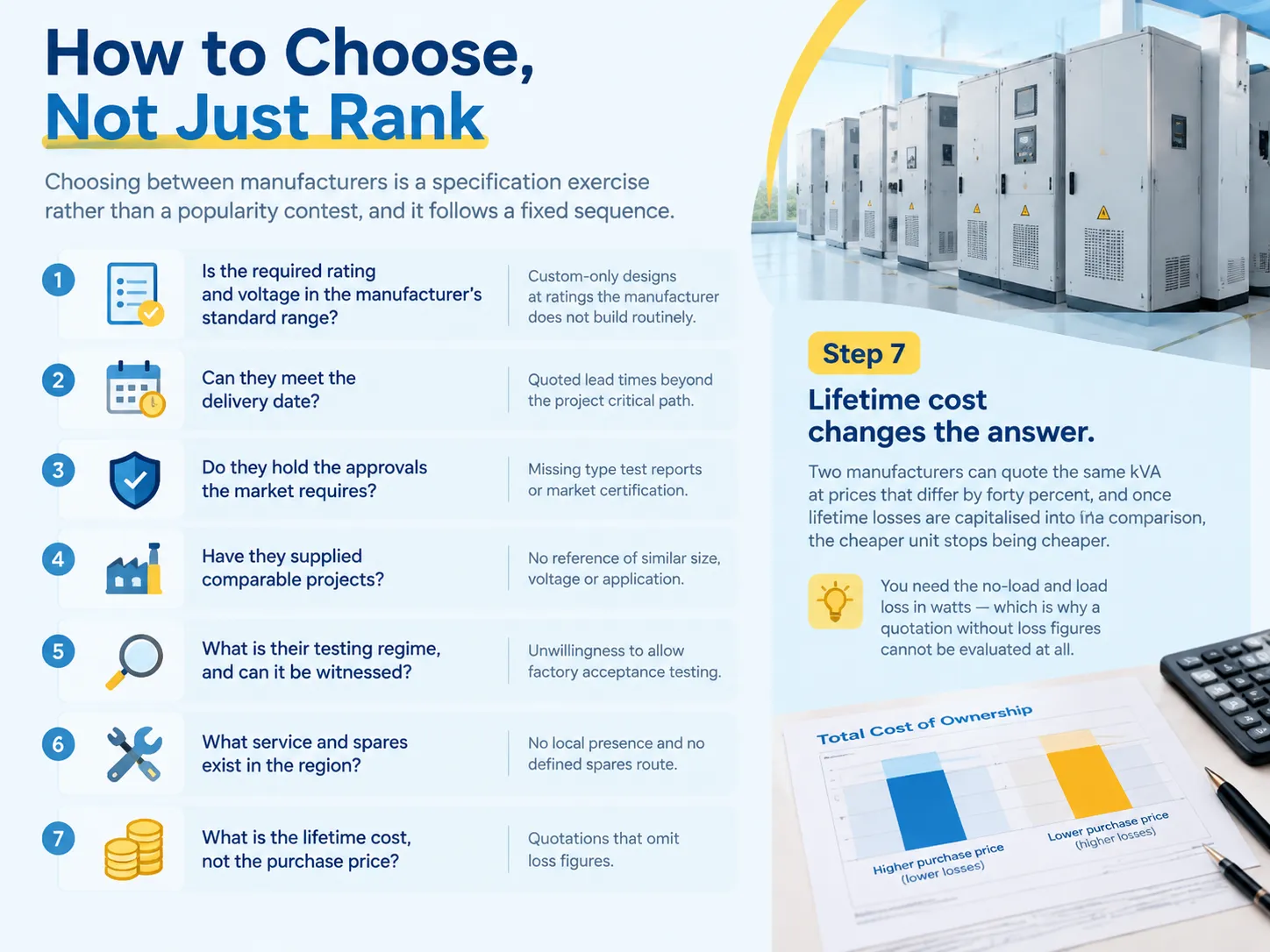
The procedure for selecting manufacturers is more an exercise in specification than popularity. There’s a fixed order of procedures to follow.
| Step | Question | What disqualifies a candidate |
|---|---|---|
| 1 | Is the required rating and voltage in the manufacturer’s standard range? | Custom-only designs at ratings the manufacturer does not build routinely |
| 2 | Can they meet the delivery date? | Quoted lead times beyond the project critical path |
| 3 | Do they hold the approvals the market requires? | Missing type test reports or market certification |
| 4 | Have they supplied comparable projects? | No reference of similar size, voltage or application |
| 5 | What is their testing regime, and can it be witnessed? | Unwillingness to allow factory acceptance testing |
| 6 | What service and spares exist in the region? | No local presence and no defined spares route |
| 7 | What is the lifetime cost, not the purchase price? | Quotations that omit loss figures |
Most times, it’s during step seven that the answer changes. The same kVA rating may be quoted by two different manufacturers, with the prices differing by up to 40 percent. Still, upon capitalization of the lifetime losses into the comparison, the less expensive unit will no longer be less expensive. This is because the no-load and load losses must be known to effect the capitalization.
Where Mid-Size Manufacturers Fit
The producers of the equipment that are within the range of 12 kV to 40.5 kV for distribution plants do not compete against the best-of-the-best and thus in most cases, they are the best choice for the project. They can offer a much faster product utilizing their ability to build to a specific utility standard, the company has direct access to their own private engineers, and their pricing structure is based on production costs instead of global resale costs.
RUY Power is one of those manufacturers that was founded in 2007 and is located in Shenyang, China. RUY Power manufactures a wide range of electrical equipment at high, medium, and low voltage including 40.5 kV switchgear, 12kv switchgear, prefabricated substations, and low voltage distribution cabinets. For 12 kV distribution projects the more relevant of the two package families is the YB□-12/0.4 European-type prefabricated substation from 50 to 1,600 kVA. The ZGS13-H-630/10 American box-type combined transformer serves overhead-fed networks in the same range, integrating the transformer and its protection into one weatherproof enclosure.The full spread of switchgear, substations and distribution equipment is listed on our products page.
The honest positioning is worth stating plainly. RUY Power does not build 500 MVA transmission transformers and does not claim to. What it does is manufacture distribution-class equipment to standard specifications, support custom configurations and white-label branding through its OEM and ODM programme, and deliver at lead times that the top five cannot match for orders of this size. The wrong offer in the case of a utility framework contract for extra-high-voltage equipment. However, for a distribution contract needing installation of hardware and switchgear in one pre-tested device delivered on time, it is far better suited than the name at the top of many global rankings.
FAQ
Which transformer manufacturer is the best?
Identifying the best manufacturer is somewhat problematic, since the correct answer depends on the category of transformer produced, the countries and voltage levels involved, and sometimes the time allowed for delivery. Given the criteria above, we would say that the leaders in the ultra-high voltage transmission sector would be the countries and manufacturers that have the technical know-how.
Who is the world’s largest transformer manufacturer?
In terms of market share for transformers, Hitachi Energy is probably the largest transformer manufacture in that they have about 14% of market share in the distribution transformer market, as well as being the top leader in other classes of transformers; however, when considering revenues from entire companies, there are parent companies that are much bigger than Hitachi Energy, except that their transformers are only one division of the larger company.
Who are the top power transformer manufacturers in the USA?
Some of the top companies that produce power transformers in the USA are GE Vernova (which owns Prolec GE 100%), Eaton, Siemens Energy (which operates a newly established facility in North Carolina for large power transformers), SGB-SMIT, Hitachi Energy, and a host of other regional companies that produce transformers in North America.
Who is the top 10 strongest transformer?
There is no official catalogue of what has been designated the strongest transformer based on many parameters. If you are referring to the transformer with the highest capacity, an ultra-high voltage transformer that provides a voltage range of the highest level at voltage of at least one thousand volts will be considered to be the strongest. If you meant strongest brand, however, the answer would be derived from the chart available. Alternatively you could refer to the strongest transformer based on its ability to withstand short-circuit test and its resistance based on the number of parameters such as impedance.
Why is there no fixed ranking of transformer manufacturers?
Power transformers cannot be properly classified because a ranking of transformer manufacturers depends on the criteria you choose to use. There is no steadfast ranking for transformers to date because It can depend on several key criteria such as revenues, transformer revenues, market share by category, order backlog, etc. Therefore, it would be better to classify transformers on its characteristics.
Do the largest manufacturers sell small quantities?
Larger manufacturers generally do not produces or offer small amounts of transformers, since they generally focus on providing the utilities and larger projects, and the small number of transformers available will usually be regional manufacturers.
References
- Global Market Insights — Distribution transformer market share and competitive landscape analysis
- Market Research Future — Power transformer market sizing, concentration and lead time analysis
- International Energy Agency — Electricity grids and secure energy transitions, equipment supply chain analysis
- International Electrotechnical Commission — IEC 60076 series, Power transformers
- US Department of Energy — Grid equipment supply chain and transformer capacity resources
Conclusion
In the transformer production arena, it is necessary to remember that the environment is slightly concentrated and thus dominated by five companies that cover the half of each market segment and include the following businesses Hitachi Energy, Siemens Energy, GE Vernova, Schneider Electric, Eaton, Mitsubishi Electric, Toshiba, HD Hyundai Electric, TBEA and SGB-SMIT which means that all market players are listed and all rankings will consist of these organizations only. This means that no single ranking mechanism can be applied because business positions will depend on a concrete segment of production.
In relation to the specific ranking being discussed, there must be three points remembered. The first point is that it is extremely important to understand the segment to be considered when getting this data because different companies can constitute top organizations depending on the given category. The second point is that it is necessary to bear in mind that the lead times of production of large power transformers are between 18-30 months and, therefore, a ranking can have no bearing on the lead time. The last point is that the second half of the market will be occupied by medium-sized businesses which will help win on the competition through providing lower prices and shorter lead times.