
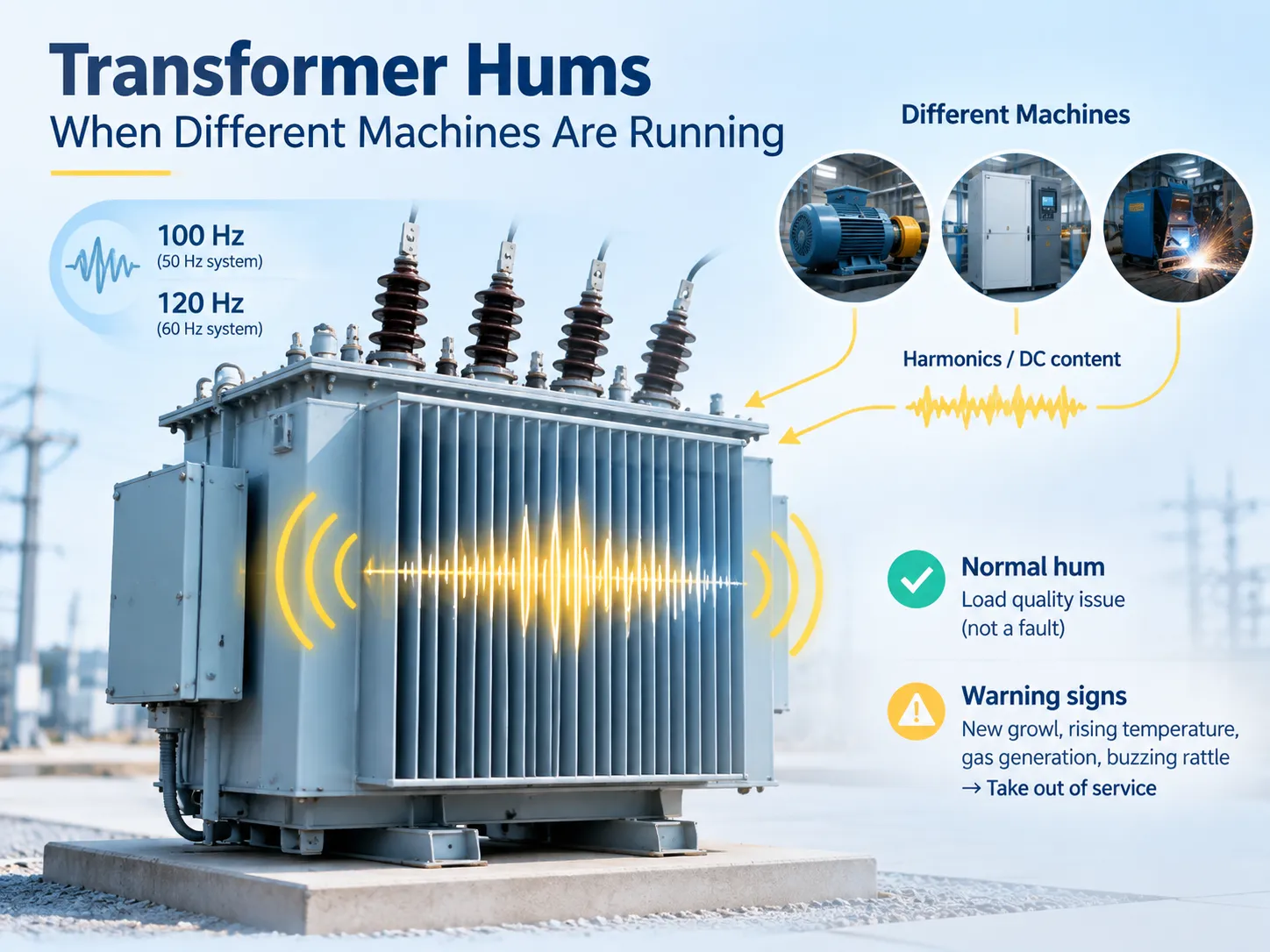
If a transformer makes an unusual amount of noise, it is performing as designed. If the humming noise varies in characteristics, loudness, or pitch when a particular piece of equipment turns on, it is giving pertinent data on the operation of that equipment and potentially on its own operation. The trick is in separating the two.
In brief, a constant vibration at both frequency supplied and double the voltage input is due to magnetostriction in core laminations and it does not cause any issues in the 50 Hz supply. However, a specific increase in sound associated with particular machines can occur because of harmonic interference from the machines when they return current to the network and distort the flux density from the transformer’s internal operation. In this case, loose cores and mountings can amplify the vibrations. A sound that changes with the load and is still within its range, on the other hand, is related to the load quality.
What a Normal Transformer Hum Sounds Like
Every transformer that has power will emit some sort of a humming sound. This humming sound is distinguishable by its steady low voice with a rough tone and the peculiarity of staying constant in nature. The frequency of the sound would be double the frequency of the power supply. For example 100Hz in a 50 Hz network and 120 Hz in a 60Hz network, such that the sound is heard by human ears as a humming rather than music.
The intensity of sound depends on the construction design of the transformer. Several factors like the core flux density, material of the core, whether the core is bolted or clamped and the design of the unit play a significant role in determining whether it would be audible or not. A transformer whose construction is done well would be inaudible even several meters away from it, but a transformer of similar construction that has been poorly mounted can become excessively loud in the room above a substation because of vibrations it creates when it is in operation.
The IEC standards and other national regulations contain specifications on the noise levels permitted for transformers and are expressed typically in terms of either dBa sound levels or a specific noise point at certain distance levels. If a transformer is working within its design noise levels and yet, there are complaints, it is usually because of acoustic transmission and not the actual transformer itself.
Why Laminations Make Noise at All
The phenomenon leading to this is called magnetostriction, which refers to the minute change in dimensions that the electric steel core experiences while being magnetized. Every time the flux reaches its maximum level, it gives rise to an enlargement of the core while the opposite occurs, that is contraction, every time the flux moves from positive to negative. In an AC supply of 50Hz, this occurrence is repeated 100 times in a second; hence, the core vibrates at a frequency of 100Hz resulting in the production of sound energy.
The two main design factors responsible for the intensity of the sound that is produced by vibration include the density of the core flux and the clamping of the cores. The density of the core flux is responsible for how much flexing occurs within the laminations whereby high densities produce both better material utilization and high amounts of sound. The clamping of the cores as well as the quality of the step-lap joints determines whether the stack acts as one rigid piece or as several separate sheets that will vibrate individually hence adding to the sound. This explains why two transformers may have the same rating but produce different amounts of sound energy.
Once the core begins to vibrate, the resultant sound reaches its destination by one of three mechanisms: through the oil and tank walls, through the mechanical attachment to the building or platform, and through the wires and busbars connecting the units. In resolving a sound problem, each of the three mechanisms is treated differently, thus the most important step in dealing with a sound complaint is to determine which of the three mechanisms is the primary source.
Why Different Machines Change the Hum
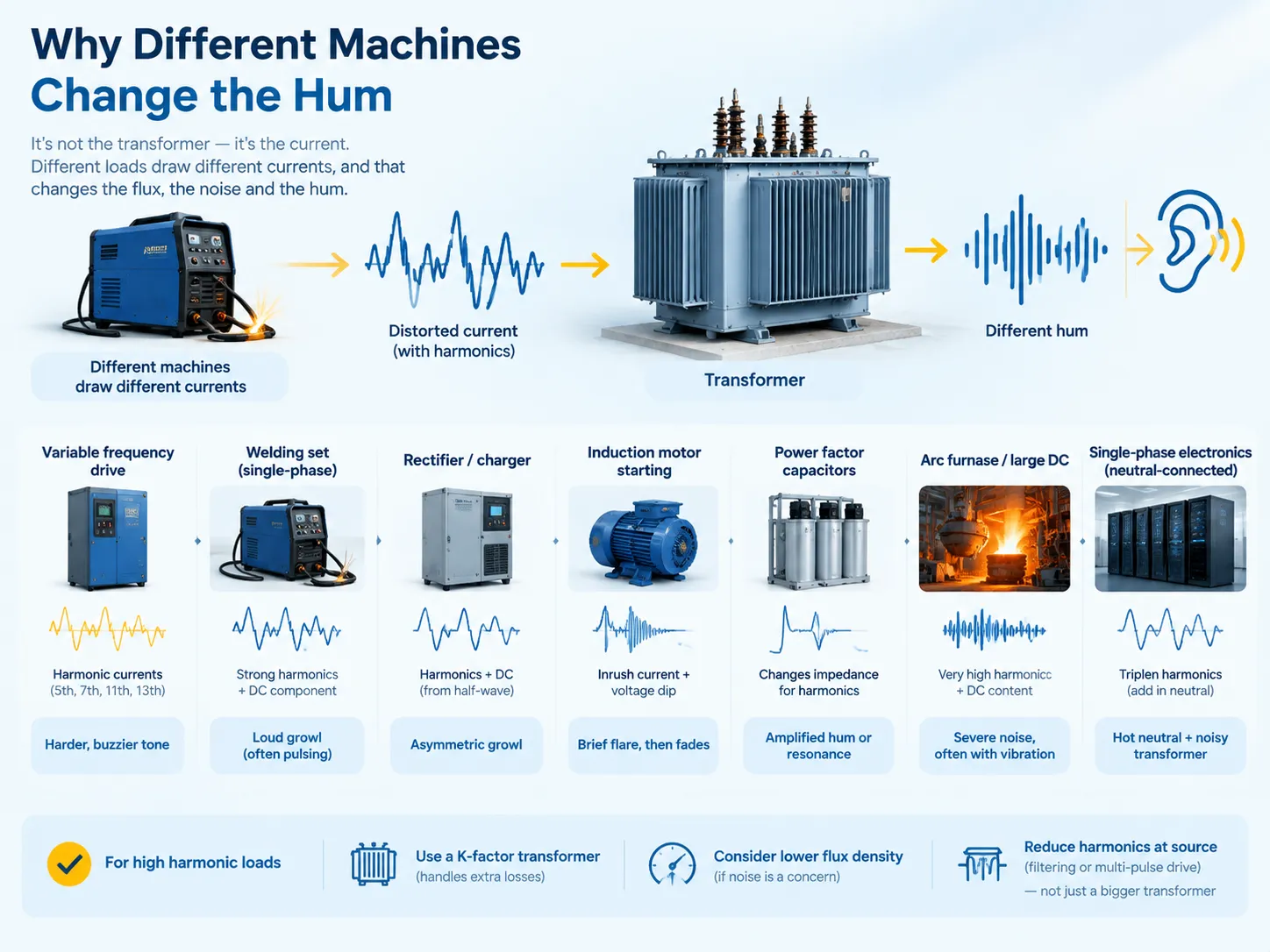
The relation of the power of welding apparatus to the current passing through welding machines located two rooms away is due to the type of current being utilized. For example, machines working on the principle of quasi-sinusoidal current generate quasi-sinusoidal magnetic fields and the distinct sound. Distorted currents generate distorted magnetic flux which is converted into additional noise under the influence of higher harmonics.
| Machine or load | What it puts back into the network | Effect on the hum |
|---|---|---|
| Variable frequency drive | Harmonic currents, mainly 5th, 7th, 11th and 13th | Harder, buzzier tone that appears when the drive runs |
| Welding set, especially single-phase | Strong harmonic content and often a direct current component | Loud growl, sometimes pulsing with the weld cycle |
| Rectifier or battery charger | Harmonics, with a direct current component from half-wave circuits | Persistent asymmetric growl |
| Induction motor starting | Large inrush current and a temporary voltage dip | Brief flare in loudness that fades as the motor accelerates |
| Power factor correction capacitors | Changes the impedance seen by harmonic currents | Amplified hum or a sharp resonance at one frequency |
| Arc furnace or large DC load | Very high harmonic and DC content | Severe noise, often with vibration transmitted to the structure |
| Neutral-connected single-phase electronics | Triplen harmonics that add in the neutral | Hot neutral and noisy transformer even at modest indicated load |
The main cause of a transformer humming in two systems varies and indicates that a specific piece of equipment is responsible for the humming. The piece of equipment itself is not defective, but rather working as intended and reproducing the precise waveforms applied to it.
There are two implications of this for design criteria. First, transformers used with an application characterized by a large harmonics contribution should have a K-factor rating to account for the reactive and stray losses that result from the presence of harmonics in the electrical system. In addition, high flux density should be avoided in designs where sound is of concern. The normal recommendation for preventing excessive harmonics from being generated is to employ filtering rather than over-dimensioning the transformer.
Direct Current Offset: The Loudest Cause
Among all the load-related reasons, the most dangerous source of deformations is the current dc component. The presence of dc current will alter the pattern of the alternating flux as it is displaced with respect to the zero axis at each order of the alternating flux. As a consequence of the alteration of the stationary field, the half of each cycle yields a saturated core which requires a very high magnetizing current to maintain the flux. The high magnetizing current produces a much rougher sound than typical sound of the magnetostriction phenomenon.
A number of industrial processes make use of dc components and they include half-wave rectification, welding devices, battery chargers as well as motors with unbalanced currents. The natural catastrophes can produce very high level of geomagnetically induced currents which will cause the various types of disturbances.
One of the appropriate tests in such situations is the noise measurement as the loads are switched off or on. In case the noise disappears during the shutdown of a specific device which works through the current dc component, the explanation lies in this condition.
Loose Parts, Mounting and Resonance
The load is not the source of every change in hum. Sometimes mechanical looseness creates audible rattles from a quiet vibration. The key indicator for this condition is that a sickening frenzied sound will occur instead of a steady hum.
| Source | Characteristic sound | Where to look |
|---|---|---|
| Loose core clamping | Rattle that worsens with load | Clamping bolts and core frame, confirmed during an internal inspection |
| Loose enclosure or panel | Tinnier rattle, changes if you press the panel | Enclosure fixings, doors, louvers, cable box covers |
| Fan or cooling equipment | Whine or grinding independent of load, starts with the fan | Fans, bearings and fan guards |
| Mounting and plinth | Low rumble transmitted through the building | Anti-vibration mounts, plinth condition, structural coupling |
| Busbar and connection vibration | Buzzing near the terminals, sometimes with warmth | Terminal torque, busbar supports, loose connections |
| Panel resonance | A tone that is much louder than the transformer itself | Enclosure panel stiffness and cavity dimensions |
Resonance needs a separate caution as it may turn a properly functioning transformer to appear to be malfunctioning. When the frequency of vibration of a panel of enclosure, ducting system or some part of the building structure aligns with that of transformer vibration (or one of its harmonics), vibrations enhance instead of being dampened. The solution to this problem requires modifying the structure mechanically by either stiffening the panel, altering the design of rooms, placing damping materials or using supports so that the whole structure will no longer vibrate due to the vibration of the transformer.
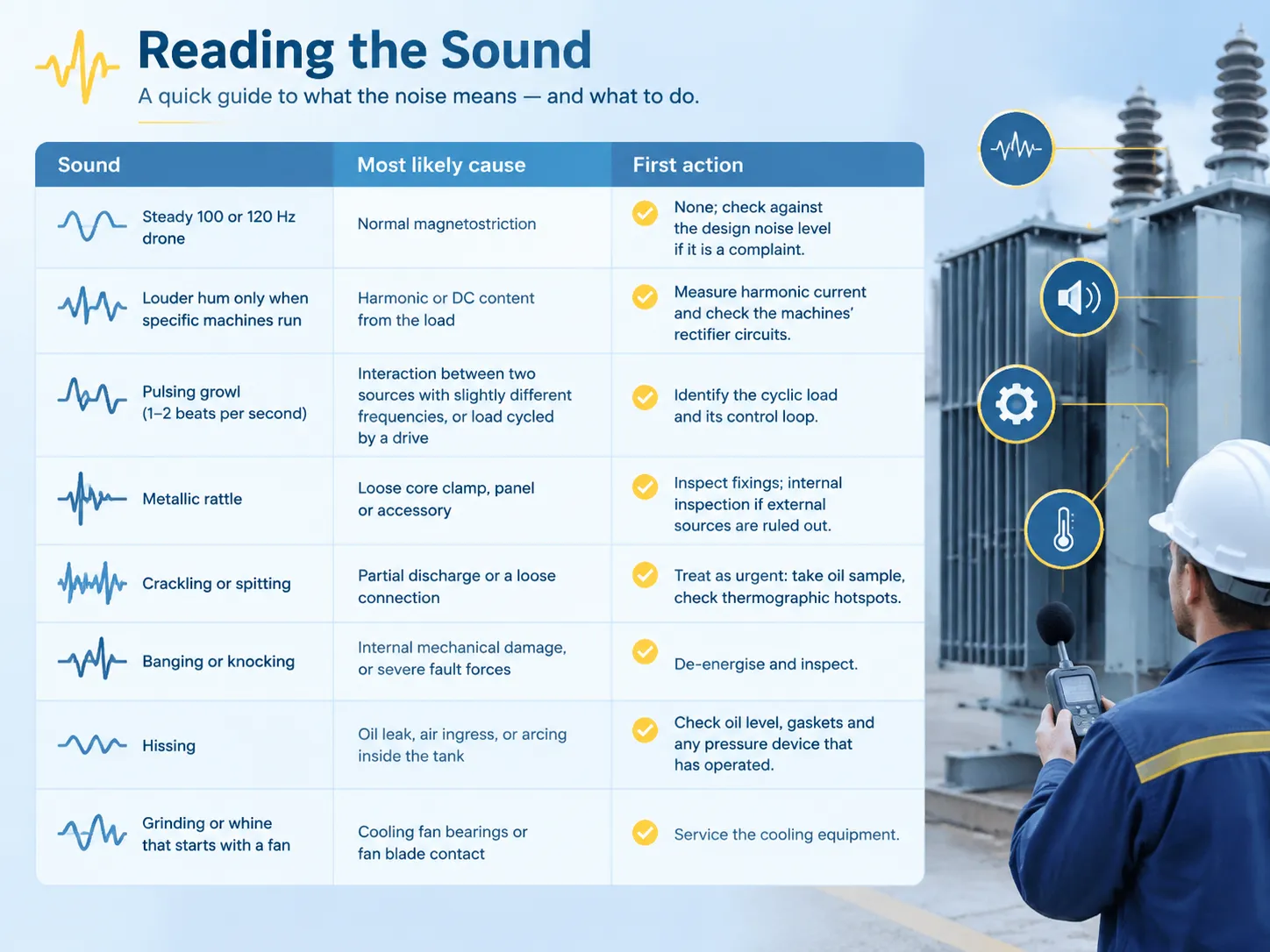
Reading the Sound: Diagnosis Table
Sound acts as a cheap way of diagnosis when interpreted correctly. The table below relates the sounds with their probable causes as well as the recommended first action.
| Sound | Most likely cause | First action |
|---|---|---|
| Steady 100 or 120 Hz drone | Normal magnetostriction | None; check against the design noise level if it is a complaint |
| Louder hum only when specific machines run | Harmonic or DC content from the load | Measure harmonic current and check the machines’ rectifier circuits |
| Pulsing growl at around one or two beats per second | Interaction between two sources with slightly different frequencies, or load cycled by a drive | Identify the cyclic load and its control loop |
| Metallic rattle | Loose core clamp, panel or accessory | Inspect fixings; internal inspection if external sources are ruled out |
| Crackling or spitting | Partial discharge or a loose connection | Treat as urgent: take oil sample, check thermographic hotspots |
| Banging or knocking | Internal mechanical damage, or severe fault forces | De-energise and inspect |
| Hissing | Oil leak, air ingress, or arcing inside the tank | Check oil level, gaskets and any pressure device that has operated |
| Grinding or whine that starts with a fan | Cooling fan bearings or fan blade contact | Service the cooling equipment |
When a Hum Is Dangerous
By itself, a hum will not damage a transformer. When it is combined with some of the following indicators, the situation is quite different; instead, this means that some energy is being transformed to heat or gases in the transformer tank.
Any rising temperature of the oil or winding without a rise in load indicates that there is some trouble. A Buchholz relay that has trapped gas or tripped due to the internal arcing producing gas must be noted. Any change in the level of the oil, operation of a pressure relief device, change in oil color, or oil test result may also signal some danger. One can observe thermal hotspots on an infrared scan. If there are any unusual noises, cracking, or smells of burning insulation, then it is important to de-energize the transformer.
In relation to this, should there be any variation of the hum with variable loading but the temperature is stable, and the oil tests confirmed to be clean without gas, the transformer should be normal since it is being subjected to an unbalanced loading.
How to Fix a Noisy Transformer
Instead of beginning with the transformer itself, it is better to work through the causes of noise from the cheapest to the most disruptive causes.
| Step | Action | Addresses |
|---|---|---|
| 1 | Establish a baseline: record load, temperature and noise level, and note when the noise changes | Separates load-related noise from a developing fault |
| 2 | Correct torque on all accessible mechanical fixings | Loose panels, covers, terminal and busbar connections |
| 3 | Fit anti-vibration mounts and flexible connections if the noise is being transmitted into the structure | Structure-borne rumble and building complaints |
| 4 | Service or replace cooling fans | Bearing whine and fan-related noise |
| 5 | Measure harmonic current and evaluate non-linear loads | Load-related hum from drives, welders and rectifiers |
| 6 | Install harmonic filtering or replace the offending drive with a multi-pulse or filtered type | Removes the cause rather than the symptom |
| 7 | Specify a K-factor rated transformer when a high harmonic load is unavoidable | Prevents harmonic losses from shortening life |
| 8 | Consider acoustic enclosure or a low-noise design where the location demands it | Residential and hospital installations with strict limits |
When a transformer is the source of noise in a unit and if the noise is intolerable, there are low-noise designs available. Some designs include using reduced flux density, improving core clamping, using step-lap joints, and using rigid tanks in the construction of transformers to help reduce the amount of sound radiation. Choosing a low-noise unit beforehand is far less expensive than dealing with a noise issue after the unit is installed. This is the reason why the quality of noise should be stated in the technical specifications for transformers placed near areas populated by people.
That is particularly true for packaged equipment sited next to homes or offices. RUY Power builds 12 kV distribution equipment in package form for exactly these constrained sites, including the YB□-12/0.4 prefabricated substation for indoor and outdoor networks.
For overhead-fed networks the equivalent is the ZGS13-H-630/10 combined transformer in the American box-type format, where the enclosure itself forms part of the acoustic design and the mounting arrangement decides how much vibration reaches the ground.
The relevant options across the range are set out on our products page.
FAQ
Why is my transformer making a humming noise?
The humming sound that is usually produced by the transformer is caused by the magnetostriction. The electrical steel vibrates due to the changes of dimensions when it is magnetized, therefore the core produces sound at the frequencies that are twice the supply frequencies. That can be considered normal as all the energized transformers produce that humming sound. If the humming sound of the transformer is louder than normal or is blocked by some specific loads, there is a possibility that harmonic current or DC current in the power supply is distorting the flux, while loose cores, panels or mountings may be amplifying the vibration.
How to fix a humming transformer?
Start with the things that are the cheapest to be resolved: make sure that the mechanical fixings are tightened, check the service of the fans and install anti-vibration mounts if the noise is losing its intensity while travelling through the building. If the humming of the transformer is being transmitted from some machines, check the current of those machines and solve this with the help of filtering or using a multi-pulse drive. If the humming sound is simply too loud and there is nothing that can be done, you may have to install an acoustic enclosure or a low-noise transformer from the very beginning.
Is a humming transformer dangerous?
The sound on its own is not dangerous and if there is humming on the frequencies that are twice the frequency of the line without causing any harm to the transformer. Dangerous moments are always accompanied with some other phenomena including rising temperature, the presence of gas through the Buchholz relay, changes in oil levels and extreme sounds, which can be checked with the help of infrared scanning.
What are the signs of a blown transformer?
There should be a sound when the transformer gets blown and a loud sound will happen when the transformer gets blown off with a protection device working afterwards while causing losses on the downstream side of the transformer. All of these symptoms including the explosion of the tank and smells of burnt insulation can be observed with the help of the analysis of the transformers.
Do loose core laminations cause transformer noise?
Yes, poor or loose laminations lead to the vibrations and cause the rumbling noises in the transformer. In order to confirm all of this, the internal assessment should be done or completed based upon the criteria of elimination including checking out all of the external fixings and ensuring that the core clamping is secure.
References
- International Electrotechnical Commission — IEC 60076-10, Determination of sound levels, and IEC 60076-11 for dry-type transformers
- IEEE Standards Association — IEEE C57.12.90, Test code for liquid-immersed distribution and power transformers
- International Electrotechnical Commission — IEC 61000-3-2 and IEC 61000-3-12, limits for harmonic current emissions
- NFPA — NFPA 70B, Recommended Practice for Electrical Equipment Maintenance
- US Department of Energy — Transformer and power quality resources
Conclusion
Transformers emit a buzz because their cores expand and contract many times each second. This does not change; however, current waveforms differ depending on what kinds of machinery are connected to the transformers, with distorted current waveforms producing increased noise. Therefore, the transformer is indicating load changes rather than revealing more serious problems.
The introduction of the load, temperature, and hum will allow the establishment of an evaluation baseline which will make recognition of load- or quality- indication easier. If the hum appears with specific machines, look for welders, rectifiers, or drives with high frequency levels and there should be real heating as well as noise involved. The combination of this hum with heat, gas, or crackle should necessarily warrant de-energization, while load-dependent hums should be treated as upstream problems.