

Finding the phone number for ecsupply.com’s headquarters usually means one of two options: you’re trying to contact a vendor and the website has hidden the contact information behind a form; or you’ve realized that “ECS” is one of the most overused acronyms in the electrical industry and you no longer know which company you’re looking at. Both options deserve a clear answer.
The following is the full contact information for the company behind ecsupply.com, including the address, telephone number, and what is really going on. Then comes the company’s name collision, which confuses more customers than any other detail; a clear explanation of what power distribution is and how it works; what is the market value of the distribution business; and how a manufacturer of switchgear and transformers called RUY Power fits in this supply chain.
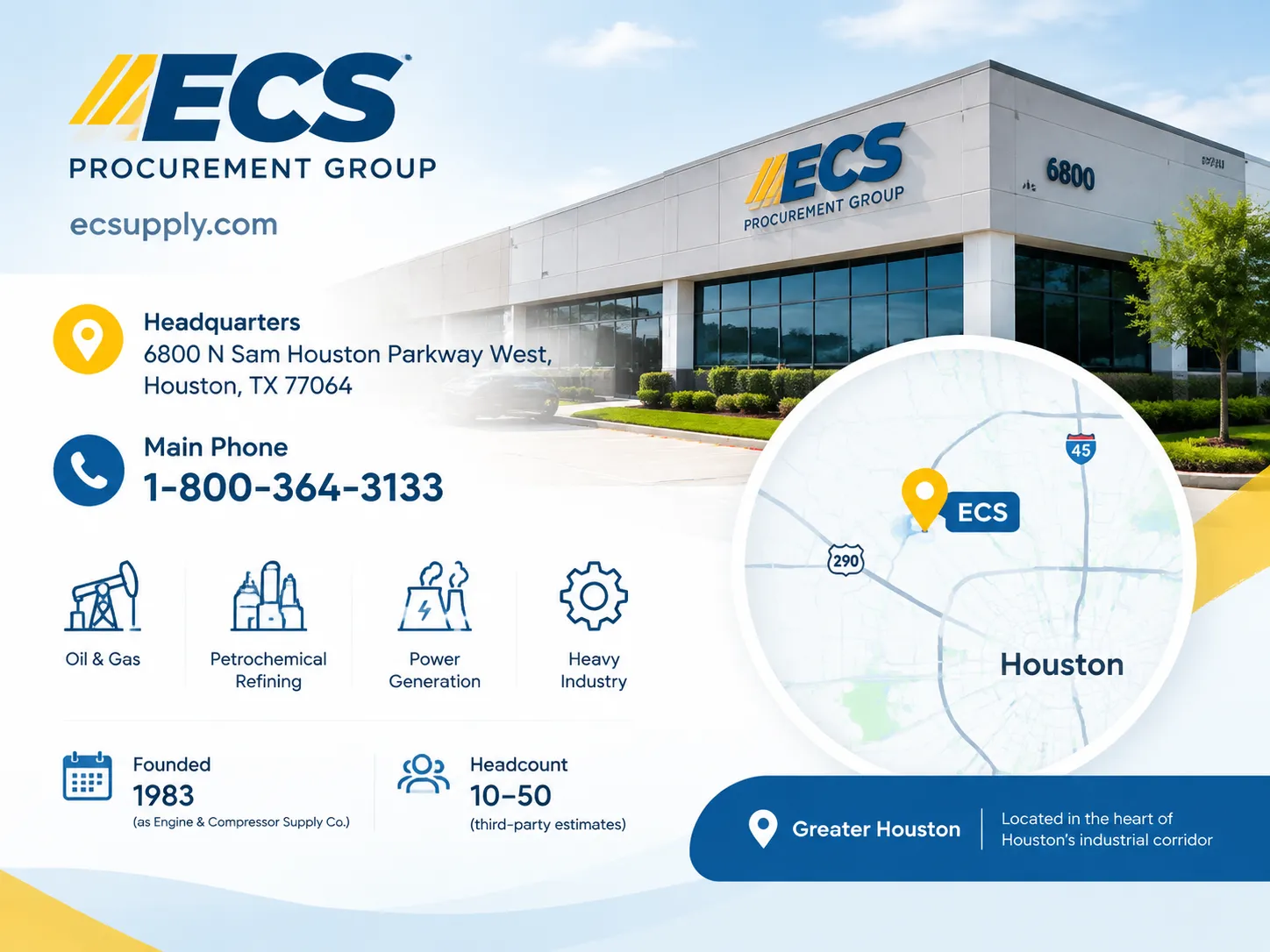
To sum up, ecsupply.com is a site owned by ECS Procurement Group that is located at its office in Houston, Texas, and can be contacted by dialing 1-800-364-3133. ECS first came into existence in 1983 under the name Engine & Compressor Supply Co. It eventually changed its name to the current one and moved into various sectors of procurement and supply-chain management for various clients, like energy and gas industry. The number of employees working on the ECS team can be estimated at between 10 and 50. Also, please note that ECS Procurement Group is not an electrical distributor. In case you thought it was ECS Electrical Cable Supply, which is based in Canada and has its US office located in Seattle.
ecsupply.com Headquarters and Phone Number in the USA
Only one company is associated with ecsupply.com, which is ECS Procurement Group, headquartered in Houston, at Sam Houston Parkway, which is the location, more or less, to understand what this business is about even without reading the details. The corridor in question is where Houston oilfield supply, valve, rotating equipment, and MRO business is present physically, and a procurement business that is servicing petrochemical and refining companies would want to be located somewhere in the middle of it.
| Item | Detail |
|---|---|
| Company name | ECS Procurement Group |
| Website | ecsupply.com |
| Headquarters address | 6800 N Sam Houston Parkway West, Houston, Texas 77064 |
| Main phone | 1-800-364-3133 |
| Founded | 1983, originally as Engine & Compressor Supply Co. |
| Ownership | Privately held, not publicly traded |
| Approximate headcount | 10–50 employees (third-party estimates vary) |
| Primary industries | Oil and gas, petrochemical, refining, power generation, heavy industry |
| Metro area | Greater Houston |
There are two points to note regarding this table. The headcount figure displayed is sourced from business data platforms and not ECS itself, and as can be common for less known outfits, the variability (in headcount) can easily be a factor of two different from one platform to another (11 employees in one system and between 10 and 50 in another one). Thus, use it as a rough estimate. The same goes for any revenue estimates provided for small privately held companies, and I would not treat them as facts. If you need accurate data for a credit check or a bidding process, contact ECS directly or obtain a commercial report as this will be more reliable than the directory.
Also, regarding getting through: a contact page utilizing a form is a common thing for procurement organizations, and ECS website is no exception, which is why people start looking for a phone number instead. If time is of the essence, make a call to the toll-free number and ask a relevant commodity or category buyer directly.
What ECS Procurement Group Actually Does
In understanding ECS’s history, we can also see the shape of the business where it started. ECS was formed in 1983 as Engine & Compressor Supply Co. that brought parts for engines and compressors into the domestic petrochemical industry. This is a very technical position to be in when one looks at the products from the aspect of reciprocating compressors and engines. Nevertheless, this was a point of growth for ECS to expand into international markets for oil and gas, petrochemical, refining and power generation.
ECS has evolved into a procurer of services rather than a stocking distributor. The difference is significant from a business perspective as a distributor manages to store finished goods and sell the products from the inventory. Procurement manages buying processes for clients when customers require storing parts or machine parts that are difficult to track down or supply and need to arrange prompt supply to meet the maintenance schedule. ECS defines its mission in providing services related to selection, qualifying and monitoring of the supply chains so it functions as an extended function for the clients of the company.
Thus, its service list consists of such services as inventory management, integrity management, corrosion control products and services, asset management, MRO supply, procurement as a service, process acceleration, material coordination, material management and inventories succussing. These services help ECS to provide necessary help to the clients who need services for their systems.
These services are expediting and material coordination that become the most important in this line of services. Of course, when the refinery operates a down compressor, the cost is calculated per day and this establishes value of expediting services in terms of relationships with the companies like steel mills and OEM. This is a relationship business rather than catalogue business which explains the reasons why small companies in the industry exist alongside large distributors.
What ECS Supplies, and Who It Serves
Heavy industry forms the customer group, and the product segments are what is expected from a company that operates in the domain of engines and compressors — rotating machines, their spare parts, valves, pipe fitting products, and electrical and instrumentation products including corrosion protection substances.
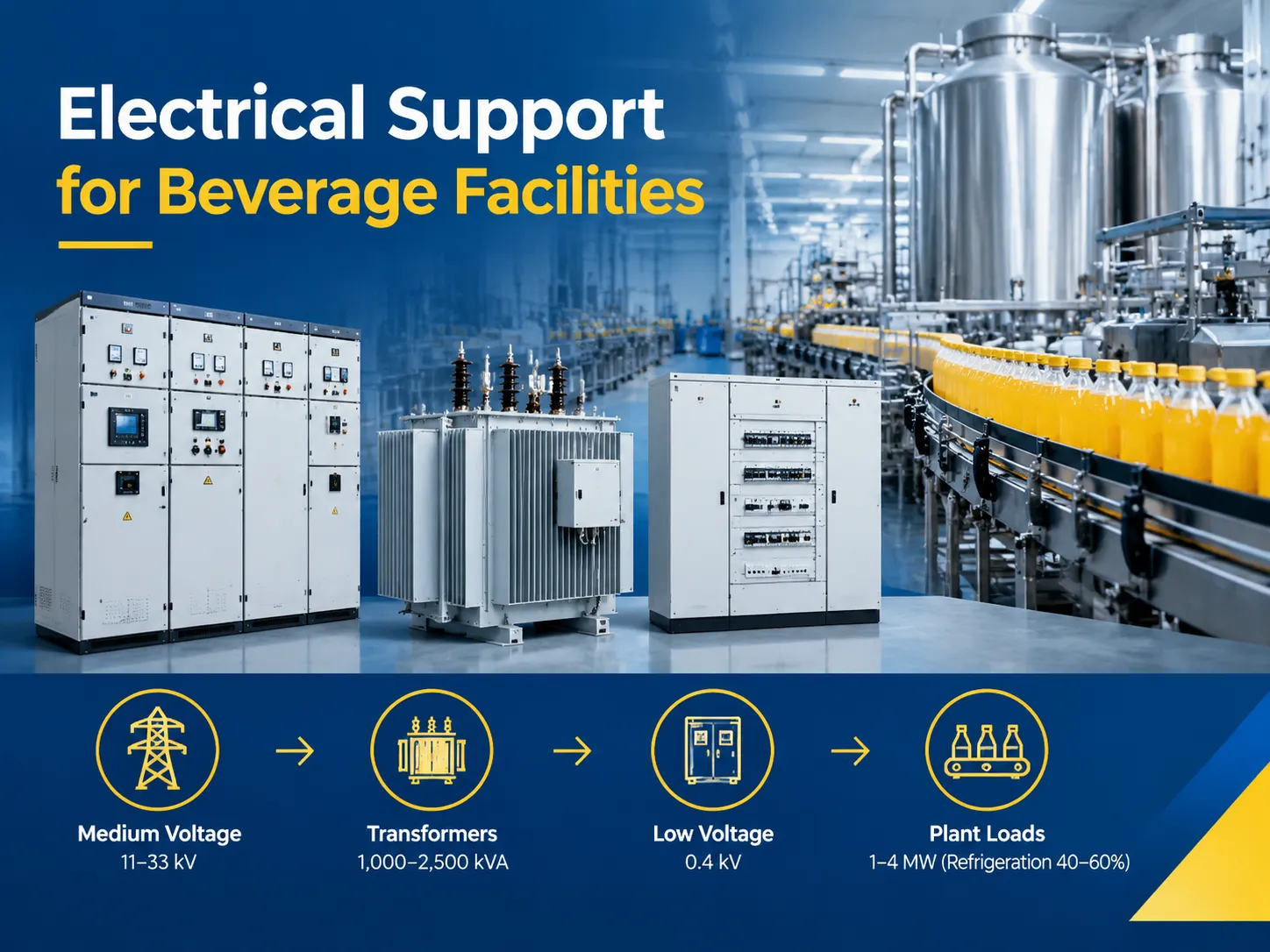
The electrical part of it is indeed real, but it is not the central point of business and here confusion comes for most of the buyers. It is necessary to have low-voltage electric equipment and motor control equipment along with spare mechanical parts at the plant during its turnaround and a purchasing center is engaged in the procuring of all this equipment. However, it has to be noted that the purchasing center does not normally keep this equipment in stock, release a catalog or have any special tests for the line of switchgears in its possession. This is the duty of the manufacturer. If you want to know where a particular electric switchgear comes from in a big industrial project, you will usually deal with several links starting from EPC contractor of the plant and finishing with an equipment manufacturer, because only the last link has documentary procedures.A withdrawable low-voltage assembly such as the MNS low-voltage withdrawable switchgear is a good example: the manufacturer owns the ratings, the type tests and the spare-part availability, while a procurement partner owns the delivery schedule.
Another noteworthy customer type that has been indicated by different search data around ecsupply.com is power generation. In fact, power generation plants prefer using the help of a procurement intermediary owing to the fact that, just like refineries, they face the following issues: a considerable time has to be spent on waiting for parts due to their specificity and high costs related to any downtime.
The Name Collision: ECS Electrical Cable Supply Is a Different Company
This information provides answers to many questions regarding this search. Two major organizations operate with the identities ECS in the marketplace of electricity and energy supply, which are not connected to each other.
| ECS Procurement Group | ECS Electrical Cable Supply | |
|---|---|---|
| Website | ecsupply.com | ecswire.com |
| Headquarters | Houston, Texas, USA | Richmond, British Columbia, Canada |
| Address | 6800 N Sam Houston Pkwy W, Houston, TX 77064 | 3135 – 6900 Graybar Road, Richmond, BC V6W 0A5 |
| Phone | 1-800-364-3133 | 604-276-9913 |
| Founded | 1983 | 1984 |
| What it does | Procurement and supply chain for oil, gas and power | Wire and cable distribution, Canada’s largest independent |
| Footprint | Houston base, international project supply | Roughly a dozen sales and warehouse facilities, Dubai office since 2004, US address in Seattle |
The reference to “ECS” by Canadian businesspeople typically indicates the Canadian company that is, likely, the largest independent supplier of wires and cables. The Canadian ECS, which also has a US address in Suite 1400, 506 Second Avenue in Seattle, Washington, has won a Platinum award from Deloitte under the Canada’s Best Managed Companies program. Therefore, if you are looking for a wire and cable distributor and end up on ecsupply.com, you are at the wrong company, and this is often the other way around.
What is learned here can surely be applied to the overall situation.Three-letter acronyms are often reused in this industry, and search engines will provide a company in the wrong country just because an acronym worked. Therefore, before transferring funds or sending the drawings, check three things: domain, legal entity name, and the physical address; all three must match.
What “Power Distribution” Means in This Sector
Since many searches lead to discussing distribution that is why it would be beneficial to explain the term correctly instead of presuming its meaning. The act of power distribution denotes the final stage of electricity delivery in the meaning of that part of the power network, which takes power from a distribution substation, reduces the voltage, and sends it to consumers using the suitable voltage level to them.
The line separating transmission circuits from distribution circuits is usually drawn at about 69 kV. Above this level, the operation is referred to as transmission, whereby bulk electricity is transmitted over long distances through high voltage thereby ensuring low losses. Under this level, the operation is termed as distribution, which can be divided into primary and secondary distribution. In this case, primary distribution is performed across the voltage level of between 4 and 35 kV while secondary distribution implies voltage level of 120/240 V for homes and 120/208 V and 277/480 V for other commercial and industrial consumers.And while that middle stage the distribution transformer is the part that most people do not think about unless it fails and becomes an obstacle for the energy consumption limit.A unit such as the KYN28-12Z AC metal-armored switchgear, rated for 12 kV service, is what sits at that layer between the incoming supply and the transformers feeding the low-voltage boards. Getting the boundary right between these layers is where a lot of project documentation quietly goes wrong, because a datasheet that says “distribution” without naming a voltage class is not telling you anything useful.
The Three Types of Power Distribution Systems
When you speak with an engineer, asking about various kinds of power distribution systems, they will very likely offer you one of two explanations, since “types” can refer to different ideas.
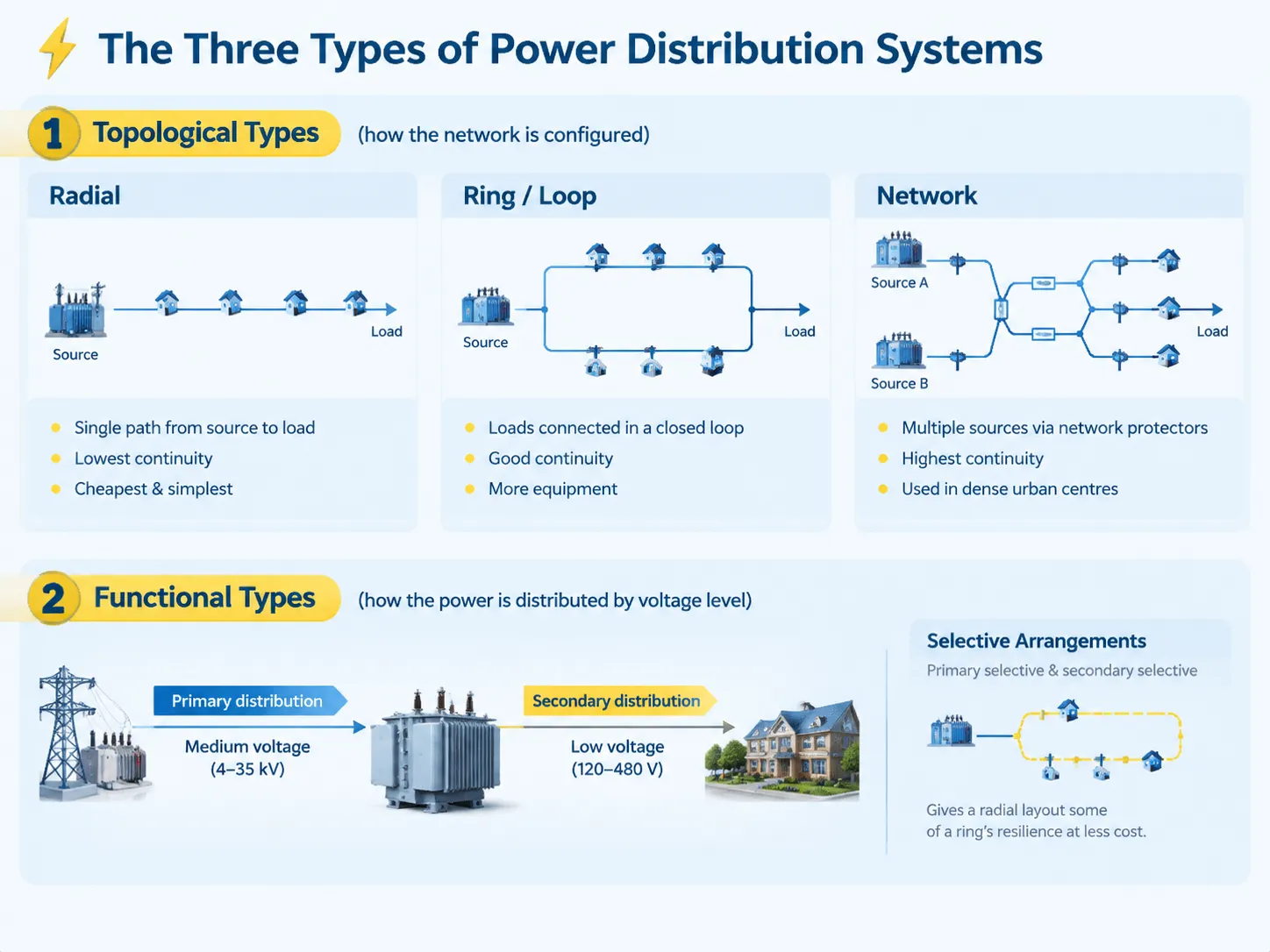
The first meaning of “types” is topological. There are three types of distribution systems – radial, ring (also called loop or ether), and network. A radial system is a system with a single path from the source to the load; this system is inexpensive to build and easy to maintain. At the same time, if a fault occurs in the system, the whole downstream part of the system will stop working because of the broken connection there. The ring system joins the loads in a loop connecting them back to the source allowing to isolate faults and continue providing power from the opposite direction. Finally, the network system incorporates several sources with the use of network protectors, so that customers do not suffer from power cuts even if one of the sources is out of order, thus making the system effective for use in crowded areas to avoid outages.
The second interpretation is functional. One may differentiate primary distribution, which provides medium voltage and serves distribution transformers, from secondary distribution, which deals with low voltage and customer distribution. In addition, one may encounter primary selective arrangement and secondary selective arrangement which are hybrid forms of design that introduce some features of the ring system into the radial form of distribution.
| Type | How It Works | Continuity | Typical Use |
|---|---|---|---|
| Radial | Single path from source to load | Lowest | Suburbs, rural feeders, plant sub-circuits |
| Ring / loop | Loads connected in a closed loop | Good | Commercial districts, campuses, industrial parks |
| Network | Multiple sources tied via network protectors | Highest | Dense urban centres, hospitals, financial districts |
| Primary distribution | Medium voltage, 4–35 kV | — | Functional layer, not a topology |
| Secondary distribution | Low voltage, 120–480 V class | — | Functional layer, customer services |
Both responses are valid; they merely address different queries. In case someone asks you which of the two answers is correct, you can answer back by asking them what question they are trying to solve. The topology answer is required for reliability planning while for the selection of equipment the functional answer is necessary.
Knowing the difference between the transformer types sitting inside each arrangement helps too, and our overview of the main transformer types and where each one is applied covers that layer in more detail than this article can.
What Power Distributors Actually Do
In this industry “distributor” has completely different meanings so mixing up two meanings leads to wrong procurement decisions.
A utility distribution company has ownership and management over wires. It is responsible for making and repairing the primary and secondary distribution network, meter reading, supply restoration after storms, service connection, and management of the power factor. This aspect of the utility business is regulated in the USA, which means that the utility receives its revenues from the public utility commission and its obligations are defined by the tariff rather than contractual relations. Based on the EIA reports, in 2024 delivery revenue in the USA alone reached $42 billion, but total revenues were significantly bigger.
An electrical equipment distributor is similar to a wholesaler. It purchases equipment from producers, puts it in regional warehouses, and sells it to electrical contractors, industry and institutions. This market produces huge companies, for example, WESCO and Graybar are worth billions by their revenue.
The area of concern that is common for both companies is the power factor; and hence capacitor banks are widely used in industrial distribution. The utility should provide more current than it is needed because of the power factor, and it makes companies having huge motor loads pay fines, so compensation needs to be applied locally. That job belongs to equipment like a GGJ low-voltage capacitor compensation cabinet, typically installed at the low-voltage main board where the reactive load concentrates. It is a small part of a distribution system by cost and an outsized part of the electricity bill by impact, which is why it is one of the first things an energy audit looks at.
How Much the Power Distribution Business Is Worth
There isn’t any specific figure for “power distribution,” since it encompasses both regulated utility business activities and wholesale business activities. The way these two are classified and measured in terms of accumulation is completely different. However, figures available so far are precise nonetheless.
From the utility side, total revenue from electricity sales to ultimate customers in 2024 amounts to around $514 billion in the United States according to the U.S. Energy Information Administration. This is higher than the $491 billion attained in 2023, with residential customers responsible for about $244 billion of the total. This figure encompasses generation and delivery of electricity as services, while so-called delivery-only services have gained about $42.1 billion rising from the $34.9 billion achieved in 2023. The total electricity sales comprise approximately 3975 billion kWh for all sectors combined.
| Measure (EIA data) | 2023 | 2024 | Change |
|---|---|---|---|
| Total US electricity revenue, all sectors | $491.4 billion | $514.4 billion | +4.7% |
| Residential revenue | $232.0 billion | $244.4 billion | +5.3% |
| Commercial revenue | $177.3 billion | $185.0 billion | +4.3% |
| Industrial revenue | $81.2 billion | $84.1 billion | +3.6% |
| Delivery-only providers revenue | $34.9 billion | $42.1 billion | +20.7% |
| Total electricity sales | 3,874 billion kWh | 3,975 billion kWh | +2.6% |
The interesting aspect here is that the jump with only delivery is reported. In a year, movement of 20% in the wires segment indicates a combination of rate case, capital recovery and an increase in delivery charges, and it can be used as a good indicator of the condition of distribution infrastructure because of the increase in the load generated by data centers, electrification and heat pumps. In relation to equipment manufacturers, this is the indicator of demand.
As for the wholesale segment of the business, there is no similar dataset available, because most distributors are private companies and provide aggregated revenue information instead of segmented revenue data. What can be safely stated is that the largest players work on multi-billion-dollar scale and operate within the business with low margins based on volume, meaning that steady consolidation of distributors in the sector has taken place during the last two decades.
Where RUY Power Fits
RUY Power is engaged in manufacturing complete electrical equipment of all voltage levels. This includes high-, medium- and low-voltage equipment. We offer metal-coated switchboard products from 12 kV to 40.5 kV (high-voltage switchboards), boxes and padded substations, oil-immersed transformers and dry transformers, along low-voltage switching boards, capacitor compensation panels and photovoltaic grid-connected boxes. We can be considered a layer of equipment producers.
It is important to keep this boundary in mind because the field of electrical engineering is full of companies that declare broader capabilities than they actually possess. In particular, RUY Power does not design the internal network. We do not install the equipment we produce or conduct the protection coordination studies and relay settings. Tasks such as these are the responsibility of a design office, a EPC contractor and commissioning engineers accordingly. What we do is manufacture the equipment in accordance with the project design specification and requirements.
In other words, we are one link above ECS Procurement Group in our relation to the industrial sector of manufacturing. Industrial business such as refinery maintenance or power generation upgrade must use medium-voltage electrical equipment such as switchgear and transformers. The purchase of our electrical equipment may pass through procurement offices or EPC contractors. In each such case, manufacturer has to ensure the integrity of technical submission including correct ratings. A combined transformer and switchgear assembly such as the ZGS13-H-630/10 combined transformer in American box-type configuration is a good illustration of why that matters: when switchgear and transformer are supplied as one integrated unit, the interface documentation has to come from a single source or the reviewer has nowhere to send a query.
Frequently Asked Questions
What do you mean by power distribution?
The final process of the electric power supply is the distribution of electric energy from the distribution substation to the consumer, at the voltage level that is acceptable for the consumer. The distribution of electricity is opposed to transmission, with the latter concerned with bulk power transfer over long distances with the use of high voltage to minimize energy losses. The dividing line between transmission and distribution can be set somewhere around 69 kV. The distribution function includes two parts. The first is the primary function that works at medium voltage, which is around 4 kV and 35 kV, set between distribution transformers and end users to get it converted to the necessary voltage level, for example, single-phase (120/240 V) for households or three-phase (120/208 V and 277/480 V). Also, the word ‚distribution‘ is often used to refer to the process of selling equipment, like switchgear and cables, thus causing problems with obtaining these products.
What are the three types of power distribution?
The prevalent classification is radial, ring, and network. Radial distribution is the cheapest and simplest and involves a single route from the source to the load; therefore, everything downstream will be lost in case of a fault. Ring or loop distribution allows establishing a closed loop from loads to the source so that the faulty part can be disconnected, but the supply can be established from the other part at the price of more switchgear. Network distributes electricity from many sources with the use of network protectors that make it possible to lose any source and keep customers supplied at the same time, which is the reason network distribution preferred in densely populated urban areas. In addition, the question can be answered from another perspective based on the function and divided into primary and secondary distribution, including primary-selective and secondary-selective hybrids. No choice is correct, with the first answer dealing with geometric structure and the second one concerning the voltage.
What do power distributors do?
The type of distributor is important because there are legal and commercial differences between the two types of distributors. A utility distribution company is in charge of using and running the physical distribution system, so it builds and maintains electricity lines, transformers, and substations. It takes care of repair work after a power outage as well and connects new clients to the grid, keeps track of the consumption of energy, and manages power supply. Utility distribution companies earn their profit by following the rates that are set by the government. In contrast, electrical equipment distributors work as wholesalers as they buy different electrical tools such as switchgear, circuit breakers and wires from manufacturers, keep these products in different locations, and sell them to companies that need electrical equipment. They earn a profit from selling goods at a higher price. There are also procurement agents, who do not do any of the above-mentioned work. They help customers to find suppliers and get their goods without owning wires or keeping the inventory. That is why whenever someone refers to “our distributor,” it is advisable to clarify which type of distributor is meant in order to assess the scope of capabilities as well as the contracts which regulate the operations of distributors.
How much does electrical power distribution make?
According to the U.S. Energy Information Administration, the regulated wires sector in the U.S. generated revenue of approximately $42.1 billion in 2024, up by 20% compared to $34.9 billion in 2023. This refers to the revenue only from distribution, and it is not mixed up with any revenue generated from electricity generation and supply. In the bigger picture, total U.S. revenue from electricity sales to end users stood at over $514 billion in 2024, including revenues of approximately $244 billion from residential customers for around 3,975 billion kWh sold. The wholesale distribution sector is different from the other electricity sectors as it does not have a publicly accessible dataset, but the company leaders disclose revenues exceeding tens of billions. If you are interested in the profit, note that, in contrast to equipment distribution, which operates on low margins, regulated distribution generates a stable profit on capital.
References
- ECS Procurement Group — company website and contact page
- U.S. Energy Information Administration — Electric Power Annual, Table 2.3, revenue from sales of electricity by provider type
- U.S. Energy Information Administration — Electric Power Monthly, Table 5.2, revenue by end-use sector
- ECS Electrical Cable Supply — separate wire and cable distributor, Richmond BC
- International Electrotechnical Commission — standards for switchgear, transformers and distribution equipment
- NFPA — NFPA 70 National Electrical Code
Conclusion
ECS Procurement Group is the organization associated with www.ecsupply.com located at 6800 N Sam Houston Parkway West, Houston, Texas 77064, on 1-800-364-3133. ECS Procurement Group has its roots in 1983 and has been serving customers from sectors like oil, gas, petrochemical, refining and power generation and they provide procurement and supply chain services and do not keep electric goods in the inventory. ECS Electric Cable Supply at www.ecswire.com is a different entity located in a different country altogether. Hence, if you can remember the distinction, you will not end up making a useless phone call.
There are two things that you can do with this information. If you are a buyer trying to get hold of ECS Procurement Group, you can call them on the toll-free number and ask for the category owner instead of making a general inquiry — the procurement company divides the work according to commodity. It is also important to know that if you indeed required an electrical equipment supplier, you should have looked at a different section of the industry altogether as in this scenario you will be required to reach out to distributor who will take care of the stocking or the manufacturer who in turn would be responsible for carrying out the type testing.
Before you send the RFQ, it is essential to understand the layer from which you are procuring the service. In this industry, the term “distributor” can mean anything — from the company that owns the poles to the unit stocking the switch gears or the entity handling the purchasing process. This single vital question will save you more time than spending hours in search of names.