
Traditionally the breaker panel in American homes performed a functional duty for much of the last century. It was installed in the garage or basement and was rarely looked at until the breaker tripped. This mindset is changing rapidly. Electric vehicle chargers, heat pumps, induction cooktops, and home batteries produce more electricity through the breaker panels, which are designed to supply homes heated by gas. Manufacturers of electrical equipment have created the new type of appliance, the electrical panel that is smart and any other smart electrical device.
This guide shows what smart electrical panel is, what the crucial designs of this product are, how these devices are priced and when it is possible for a smart electrical panel to save the homeowner from utility service upgrade. The author is a manufacturer of electrical equipment, so the guide will also give some insights into the issue often skipped by residential homeowner guides.
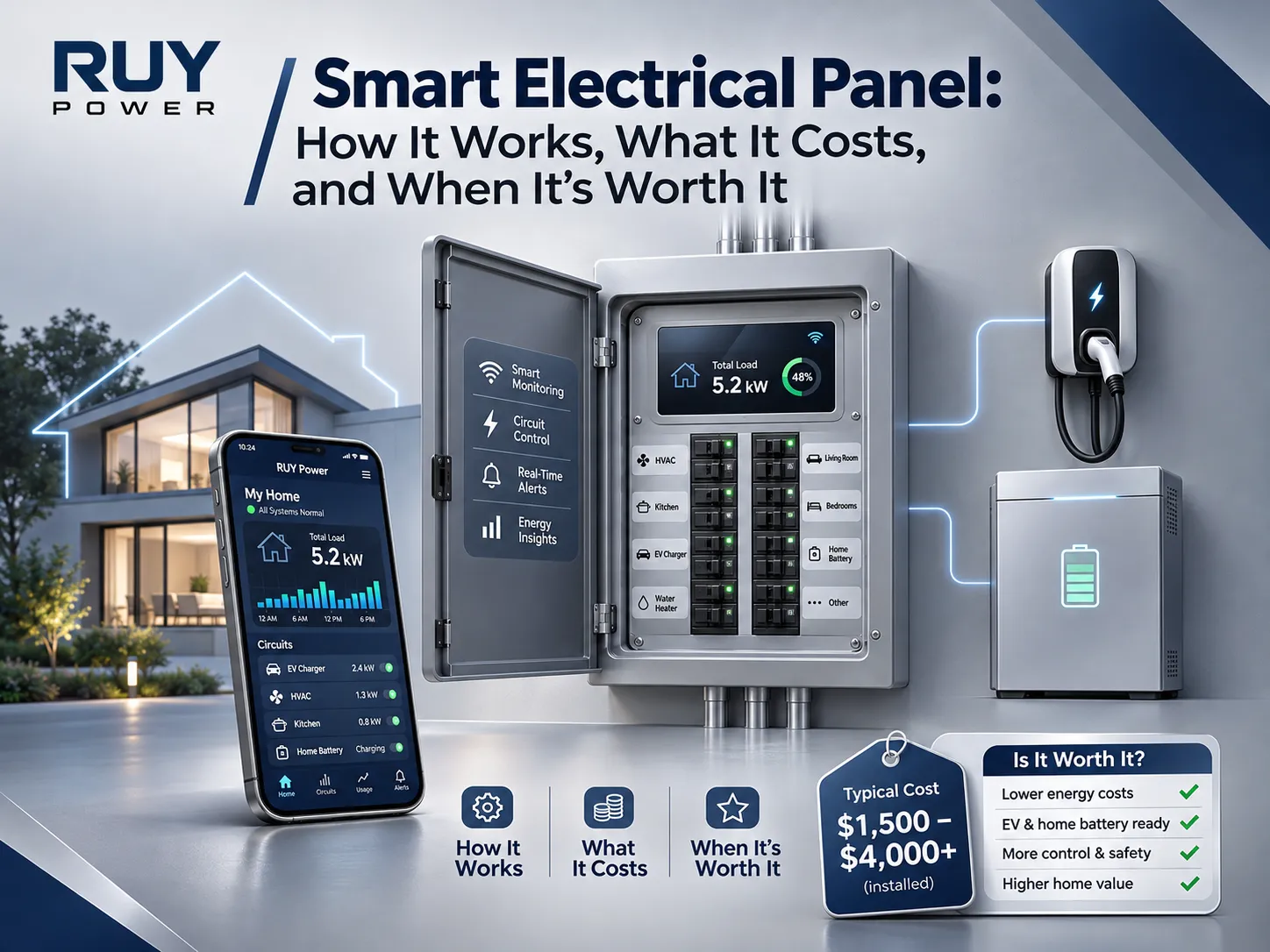
Is a smart electrical panel worth it? A smart electrical panel is an advanced version of a standard breaker panel combined with circuit-level metering, remote-controlled relays or breakers, and load management software. It is a significant investment for households that are planning to add a lot of electric appliances to their 100-150A service, homes equipped with a battery, and, obviously, for those who are building new homes and want to avoid over-sizing their service. However, if the house has enough capacity and lacks a battery, a regular panel supplemented with a low-cost energy monitor will usually provide almost the same amount of information at a slightly higher price.
What is meant by Smart Electrical Panel?
The Smart Electrical Panel still means the distribution of electricity to various branch circuits. The only extra feature added is the layer of monitoring and control on top of the existing configuration. Practically speaking, almost every smart panel sold in the US market is constructed of three features.
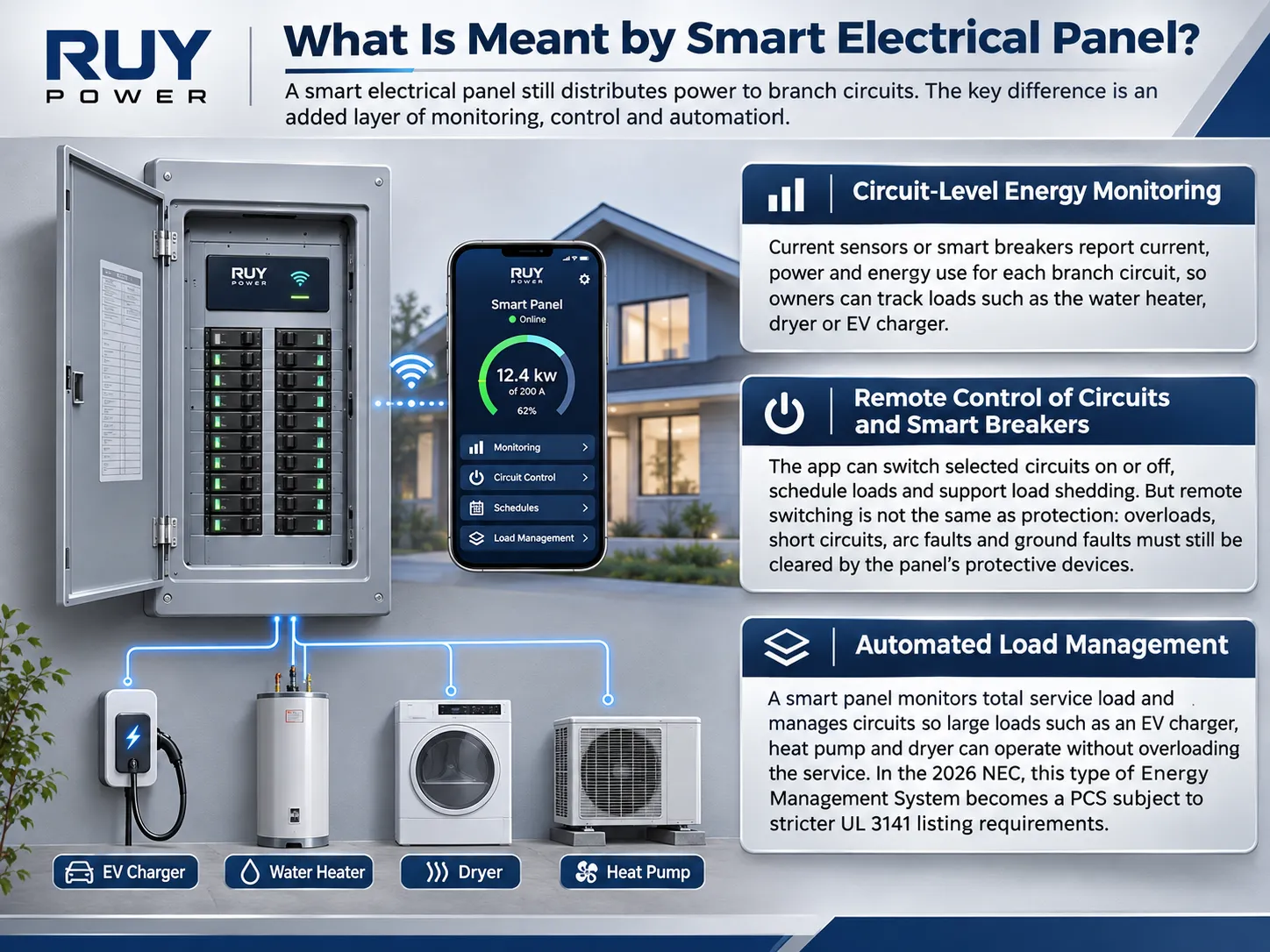
Circuit-Level Energy Monitoring
Current sensors on every single branch circuit (or every smart breaker) continuously report the current, and energy consumed up to that moment, allowing the owner to check how much kWh the water heater, dryer, or electric vehicle charger consumed last month. This is the first thing that every buyer pays attention to.
Remote Control of Circuits and Smart Breakers
Smart electrical panels introduce a new feature which allows the app to switch on and off a selected circuit, set a schedule for the electrical device, or do load shedding activity. It is crucial to understand that switching does not mean protection. Turning off the circuit does not equal fault clearing: in case of overloading, short circuit, arc, or ground fault, the issue has to be solved at the smart electrical panel, not from the app.
Automated Load Management
The most beneficial feature is the automated management system that monitors total current consumption at the entry point and prevents overloading electrical devices. In other words, it enables electrical panel owners to run electrical devices like electric vehicle charger, heat pump, or dryer simultaneously on the service that cannot support all devices operating at full load at the same time. Starting with its 2026 NEC, EMS that prevents overloading becomes a PCS subject to stricter listing requirements (UL 3141).
Three Ways to Make a Home Panel “Smart”
Search results lump every product together, but the hardware falls into three distinct architectures. Knowing which one you are looking at matters more than the brand name.
| Architecture | How it works | Typical examples | Best fit |
|---|---|---|---|
| Full replacement smart panel | The whole panel is replaced; every circuit gets metering and a controllable relay | SPAN Panel; Eaton Smart Panel with SPAN Energy Intelligence | Panel replacement already needed, new construction, whole-home battery backup |
| Smart breakers in a compatible load center | Standard-size breakers with built-in metering and remote on/off, plugged into the maker’s load center | Leviton Smart Load Center; Eaton smart breakers | Staged upgrades, buying smart control only for the circuits that need it |
| Add-on controller beside the existing panel | A separate enclosure controls a limited number of selected circuits | Lumin Smart Panel | Existing panel in good condition; battery owners who want load control without a panel swap |
Brand Overview: SPAN, Eaton, Leviton, Lumin, and Schneider
SPAN Panel
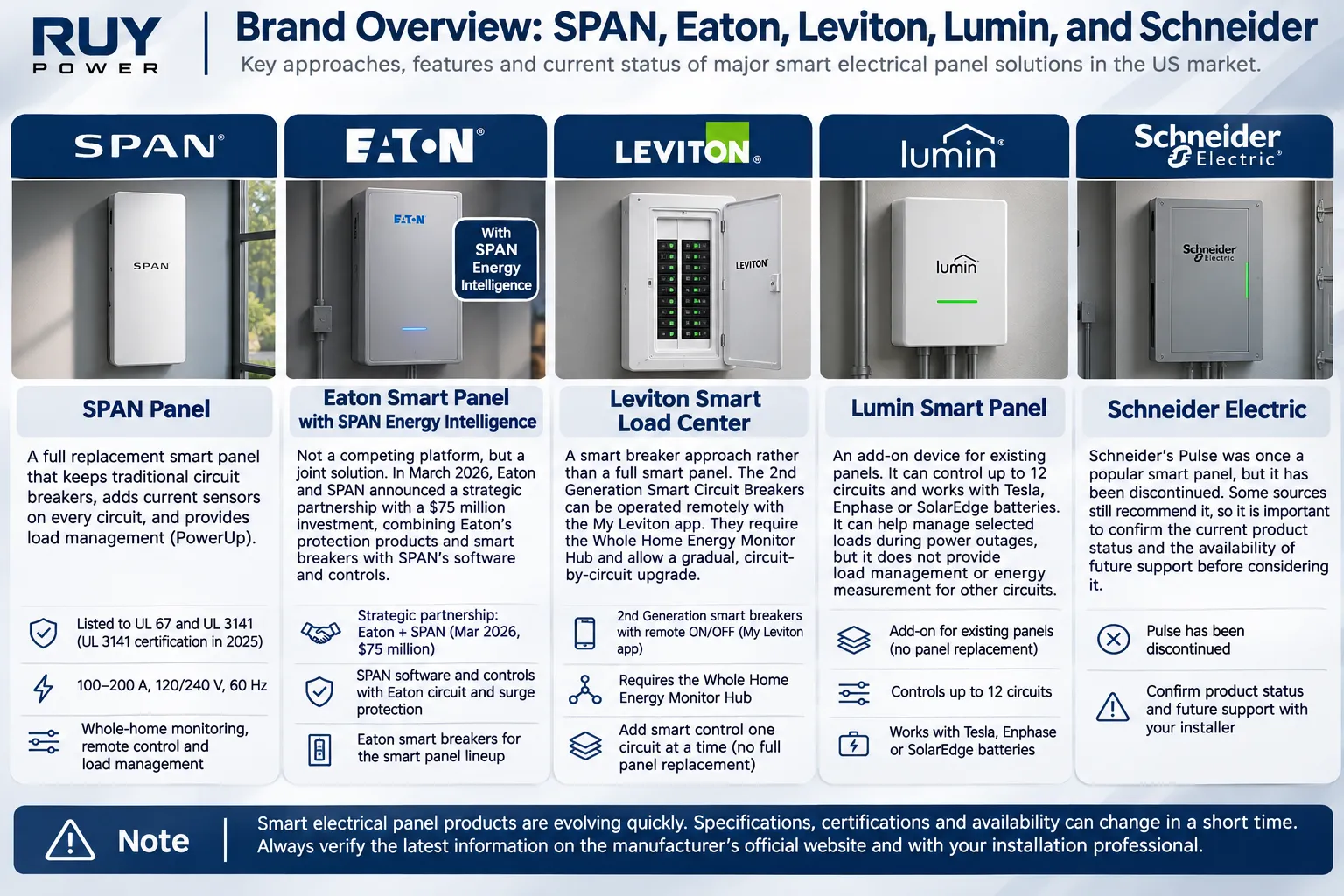
In the search for smart panels, SPAN is often the name associated with them. The SPAN does away with the standard panel altogether but retains the traditional circuit breakers. However, it uses current sensors for each branch of the circuit, enabling efficient load management. The SPAN panels have been listed under UL67 and UL3141. The latest models of SPAN panels have received certification under UL3141. The available versions on SPAN usually work under 120/240 V service at 60 Hz and their sizes range from 100 to 200 Amps.
Eaton Smart Panel with SPAN Energy Intelligence
Unlike what people believe about Eaton Smart Panel technology, it is not a rival technology. The launch of the strategic partnership between SPAN and Eaton took place in March 2026. The partnership was backed by $75 million investment. With the help of the new agreement, Eaton has included SPAN software and controls in its new smart panel, while SPAN panels have received protection from Eaton circuit and surge protectors. Moreover, Eaton also produces smart breakers for its new lineup of smart panels.
Leviton Smart Load Center
Leviton has taken the approach of offering smart breakers instead of smart panels. The latest model of its 2nd Generation of the Smart Circuit Breakers can operate remotely using the My Leviton app. Its previous models did not have this function. Therefore, the new generation of Leviton breakers requires the use of the Whole Home Energy Monitor Hub. The advantage of this approach is that a home owner does not have to completely change the circuit breakers, but can process them one by one.
Lumin Smart Panel
Lumin is a supplementary device that can be added to any existing panel. It allows controlling no more than 12 circuits, which can be used together with Tesla, Enphase or SolarEdge batteries. This means that home owner can act during the emergency outages, however, it gives no power management or power measuring for these other circuits.
Schneider Electric
Schneider’s Pulse has become a less reliable product now. Many people still recommend using it without realizing that it has already been discontinued. If anyone recommends using this product, the installation company should give clear information about the future support available for Schneider systems.
Products in the field of smart electronics are changing very fast. It is not recommended to believe any comparison without being sure of its accuracy.
Can a Smart Electrical Panel Prevent You from Needing a 200 Amp Service Upgrade?
This is the real reason why homeowners start looking for options. The utility service upgrade, for instance from 100 A to 200 A, requires new service conductors and often a new meter base, plus utility scheduling and permits, with a timeline of several months. A smart electrical panel can’t produce more capacity than the existing service. But what it can do, when all regulations and codes are observed, is to keep the total load well under the existing service rating so that the load calculations go smoothly.
What the NEC Permits
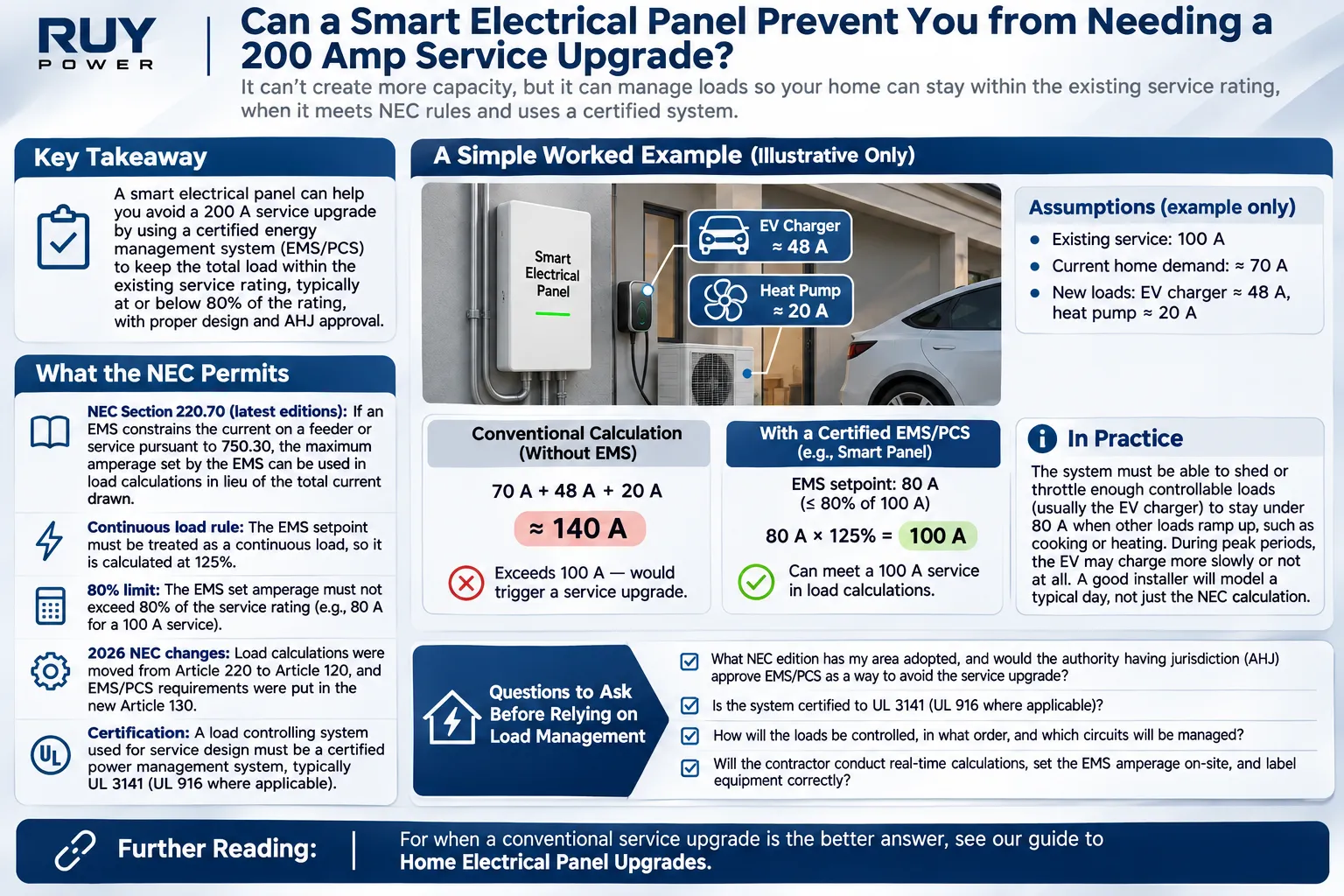
The latest edition of the NEC introduced Section 220.70 which states that if an EMS constrains the current on a feeder or service pursuant to 750.30, the maximum amperage set by the EMS would in load calculations be accepted in lieu of the total current drawn. The amperage set by the EMS must be dealt with as if it were a continuous load. Since continuous loads are calculated at 125%, this means that the amperage set must not exceed 80% of the service rating. That is why SPAN refers to its PowerUp feature, which allows keeping loads below 80% of the feeder rating.
The 2026 NEC put order into this process. The laws regarding load calculations were moved from Article 220 to Article 120, and the rules on EMS and PCS were put into the new Article 130. Additionally, a load controlling system used for designing a service must be a certified power management system, which basically means UL 3141. Which edition is acceptable in your case depends on what your municipality has enacted.
A Simple Worked Example
Though the numbers below are meant only as an example and are not a substitute for real load calculations:
Existing home has a 100 A service and a demand of about 70 A.
The homeowner plans to install a 48 A level 2 EV charger and a heat pump requiring about 20 A.
If calculated according to the conventional way, the demand would total approximately 140 A which is more than 100 A and thus will trigger the service upgrade.
If a certified EMS/PCS is introduced with a setpoint of 80 A, there will be a charge that can be calculated as 80 A x 125% = 100 A.
The difficulty is practical, not theoretical. The system must be able to shed or throttle enough controllable loads (the EV charger is usually the element to be throttled) to remain under 80 A when the uncontrolled loads ramp up. If an instantaneous load from cooking or heating reaches a level where it is close to 80 A, the EV might charge very slowly or not at all during peak hours. A good installer would take time to model the typical day instead of calculating according to the NEC. For background on when a conventional upgrade is the better answer, see our guide to home electrical panel upgrades.
Questions to Ask Before Relying on Load Management
- What NEC edition has my area adopted, and would the authority figure approve EMS/PCS as a way to avoid the service upgrade?
Is the system certified to UL 3141 (UL 916 where applicable)?
How will the loads be controlled, in what order, and which circuits will be managed?
Would the contractor conduct real-time calculations, set the amperage for the EMS on-site, and label equipment correctly?
Smart Electrical Panel Cost: Hardware vs Installation
The charges for smart panels differ greatly based on respective areas, making the installations of electrical networks in their buildings very different. In order to have an idea, it is worth mentioning that SPAN’s main smart panel is priced around $3500, whereas an ordinary panel’s replacement costs $1000 to $2500 altogether. According to the estimates available on the Internet, the price of SPANs installation may go from several thousands to dozens of thousands of dollars, while the additional equipment to it, including Lumin, makes the installation cheaper as it is used as a supplementary service, while the main panel stays.
| Cost item | What drives it |
|---|---|
| Smart panel or smart breakers | Number of controllable circuits, brand, main breaker rating |
| Electrician labor | Panel replacement vs add-on, wire extensions, panel location |
| Permit and inspection | Local fees and AHJ requirements |
| Hub, gateway or metering accessories | Required for some smart breaker systems |
| Service upgrade (avoided or not) | Utility work, meter base, conductors; often the largest number on the quote |
The correct comparison is not “smart panel vs traditional panel.” It is “smart panel installed vs traditional panel along with service upgrade.” In residences which would otherwise require utility work, the smart option can work out to be less expensive; in residences which do not need utility work, the smart system would typically be less economical.
Intelligent Panels for Electric Vehicle Charging, Solar Energy, and Household Batteries
Electric vehicle charging: the equipment behind EV charging is the best candidate for the managed consumption in the sense that a vehicle can withstand charging at low rates for many hours. Intelligent panels mean that charging can always be done taking advantage of low tariffs.
household batteries: battery backup is only able to power the home for a limited amount of time during power failure. Intelligent panels provide homeowners with the option of disconnecting non-essential loads automatically. In any case, batteries are compatible by models; so, double-check the manufacturer’s list.
Solar energy: intelligent panels will not substitute for the inverter; they will give a basic idea of solar energy consumption and allow flexible consumption of electricity during sunny hours.
What if the Internet goes off?
street under the electricity framework is isolated from electricity, as circuit breakers work regardless of the current condition of the panel. Load management can operate on-site in a panel; SPAN for instance claims PowerUp works both while offline and online. Nevertheless, the user loses the smart app containing a number of functions related to remote control and ability to receive notifications. Prior to purchasing, consult with the manufacturer to establish functions not included in the product.
Smart Panel vs Traditional Panel: Which One Should You Choose?
| Your situation | Usually the better choice |
|---|---|
| 100–150 A service, adding EV charging or a heat pump | Smart panel or add-on load controller (get a load calculation first) |
| Home battery installed or planned | Smart panel or add-on controller for backup circuit management |
| Panel is old, damaged or recalled and must be replaced anyway | Compare a smart panel with a standard panel; the price gap is smaller when replacement is unavoidable |
| Plenty of service capacity, no battery, mainly curious about usage | Traditional panel plus a clamp-on energy monitor |
| New construction | Specify load management at design stage to avoid oversizing the service |
Residential Smart Panels vs Industrial Smart Distribution Boards
The term “smart distribution” refers to very different things in household and industrial applications. A smart load center in North America is a 120/240 V split phase panelboard that complies with UL 67 and is designed for the needs of some large appliances in residential homes. An industrial low voltage switchboard usually utilizes a 400 V, three-phase power system and conforms to the IEC 61439 installation standard and can handle a few hundred to several thousand amperes to drive motors, lighting systems and industrial equipment.
| Aspect | Residential smart panel | Industrial smart distribution board |
|---|---|---|
| Supply | 120/240 V single-phase, 100–200 A typical | 380–415 V three-phase, often 630–4000 A |
| Main goal | Stay under the service limit, extend battery backup, cut bills | Continuity of supply, power quality, energy cost allocation |
| Monitoring | Per-circuit kW and kWh in a phone app | Three-phase voltage, current, power factor and harmonics on multifunction meters |
| Communication | Wi-Fi or Ethernet to a cloud app | Wired fieldbus such as Modbus RTU over RS-485 to a SCADA or energy management platform |
| Typical “smart” control | Switching or throttling EV chargers and appliances | Automatic reactive power compensation, motor control, transfer between sources |
The underlying idea is the same: measure every feeder and act automatically before a limit is reached. In industrial systems, one of the most common examples is automatic power factor correction. A capacitor compensation cabinet such as the GGJ low-voltage capacitor compensation cabinet uses a controller to monitor the load and switch capacitor steps in and out, which reduces reactive current and frees capacity in the transformer and cables, the commercial-building equivalent of avoiding a service upgrade. These are industrial products, not substitutes for a UL-listed residential panel, but if you manage a plant or commercial site you can explore RUY Power’s low-voltage switchgear and distribution products, including final distribution boxes such as the PZ30 lighting distribution box.
Frequently Asked Questions
What is a smart electrical panel?
An intelligent electrical panel is a breaker panel equipped with circuit-specific energy monitoring, the ability to wirelessly operate relays or smart breakers, and a software application that can manage power loads automatically. It still utilizes tested circuit breakers for protection against overcurrent.
Is a smart electrical panel worth the money?
In most cases, you benefit if you have heavy electrical loads to be added to a service, own or wish to own a home battery, as well as if your service panel must be replaced regardless of the solution chosen. If there is excess capacity in your residence and you do not have a battery, then a regular panel along with a cheap energy monitor is likely the better option for you.
Can a smart electrical panel avoid a 200 amp upgrade?
Sometimes, but not necessarily. The NEC permits a registered load-management system’s point of control to be incorporated into the calculation of service load, wherein the point must not exceed 80 percent of the service capacity. In order for this to happen, a calculation must be performed, the control setting made, and the authority having jurisdiction must accept it, and enough controllable load must be present at home to remain within this limit.
Does a smart electrical panel reduce electricity bills?
Alone, it does not increase the efficiency of appliances. The savings are a result of the capabilities of the data and controls themselves: finding wasteful loads, moving EV charging and water heating to off-peak hours, and utilizing solar and battery storage at the right time.
Can smart breakers be reset remotely after a trip?
A remote on/off function means that the switch is being operated from a distance. When called for a fault condition, a breaker with an overload, a short circuit, an arc fault, or a ground fault is signaling a fault condition that needs to be investigated and reset at the panel. In some cases, advanced smart breakers may have reset lockout features that prevent reset operation while the protecting condition exists.
What is the difference between a smart home panel and an industrial smart distribution board?
A smart home panel deals with various larger household loads utilizing a single-phase electrical system like 120/240 V, whereas an industrial smart distribution board is used for managing three-phase systems with much higher current ratings. Industrial boards deal with power quality monitoring, communication using an industrial protocol such as RS-485, and automatic power factor correction.
References
- SPAN Support: What is PowerUp. How SPAN’s energy management system keeps incoming power below the service rating.
- SPAN: UL 3141 Power Control Systems certification. First smart panels certified to UL 3141.
- SPAN: Announcing our collaboration with Eaton. Details of the 2026 Eaton partnership and investment.
- Leviton: Can Load Center breakers be remotely turned on and off? Differences between 1st and 2nd Gen smart breakers.
- Canary Media: Span and the Eaton partnership. Market context, pricing and competing smart panel makers.
- Mike Holt: 2023 NEC 220.70 Energy Management Systems. Using the EMS setpoint in feeder and service load calculations.
- pv magazine USA: 2026 NEC changes for PCS and EMS. Relocation to Articles 120 and 130 and the role of UL 3141.
- UL Solutions: Article 130 Energy Management Systems. How the 2026 NEC separates energy management from overload control.
Choose the Right Panel for the Load, Not the Hype
A smart electrical panel is a genuinely useful tool when a home is short on capacity or depends on a battery, and an expensive gadget when it is not. Start with a proper load calculation, confirm what your jurisdiction accepts, and compare the smart option against the full cost of a conventional upgrade. The same principle, measuring every circuit and controlling load before a limit is reached, runs through industrial power distribution as well. If you are planning low-voltage distribution for a commercial or industrial project, browse RUY Power’s switchgear and distribution equipment or read more about panel upgrades and service capacity.