
Many medium voltage switchgear problems originate from a specification that cites just a certain voltage and a current and leaves everything to the supplier. Internal arc classification, service continuity loss, insulation level, earthing system and test results are decisions that should be taken by the buyer otherwise the manufacturer will take them for him.
What will be provided below will be written as an aid for drafting specifications rather than promotional brochure. The section includes the standards and the rating tables, classification details and device selection and test data requirements that should be demanded by a buyer before a single cubicle is made.
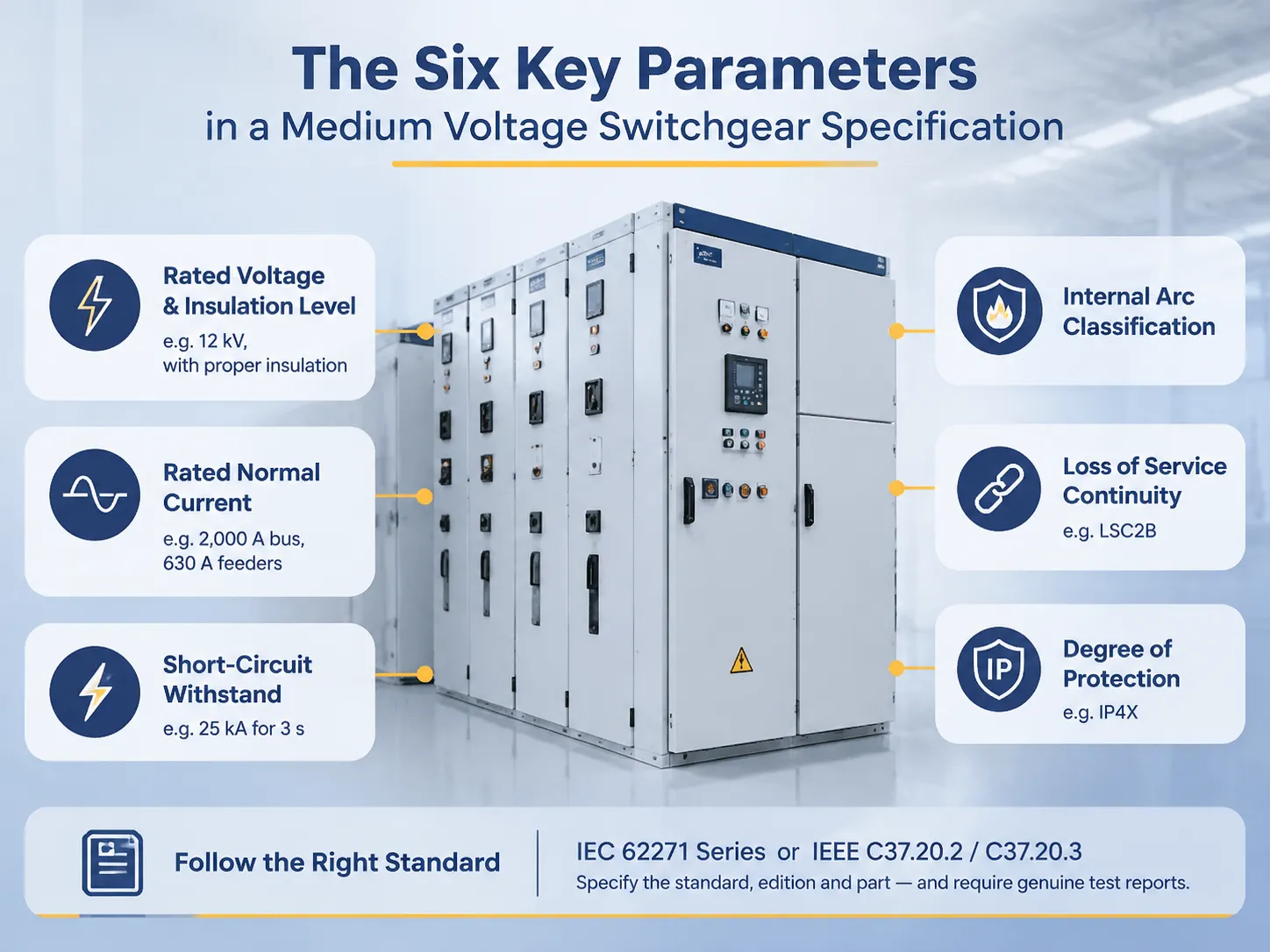
To summarize quickly: there are six aspects in the specifications for medium voltage switchgear, namely the rated voltage and insulation level, rated normal current of the busbar and of the feeder, short-circuit withstand current and duration, internal arc classification, loss of service continuity category and the level of protection degree. The rest is derived, mainly from the standard documents such as IEC 62271-1 and IEC 62271-200, which include details like the type of switching medium and enclosure materials.
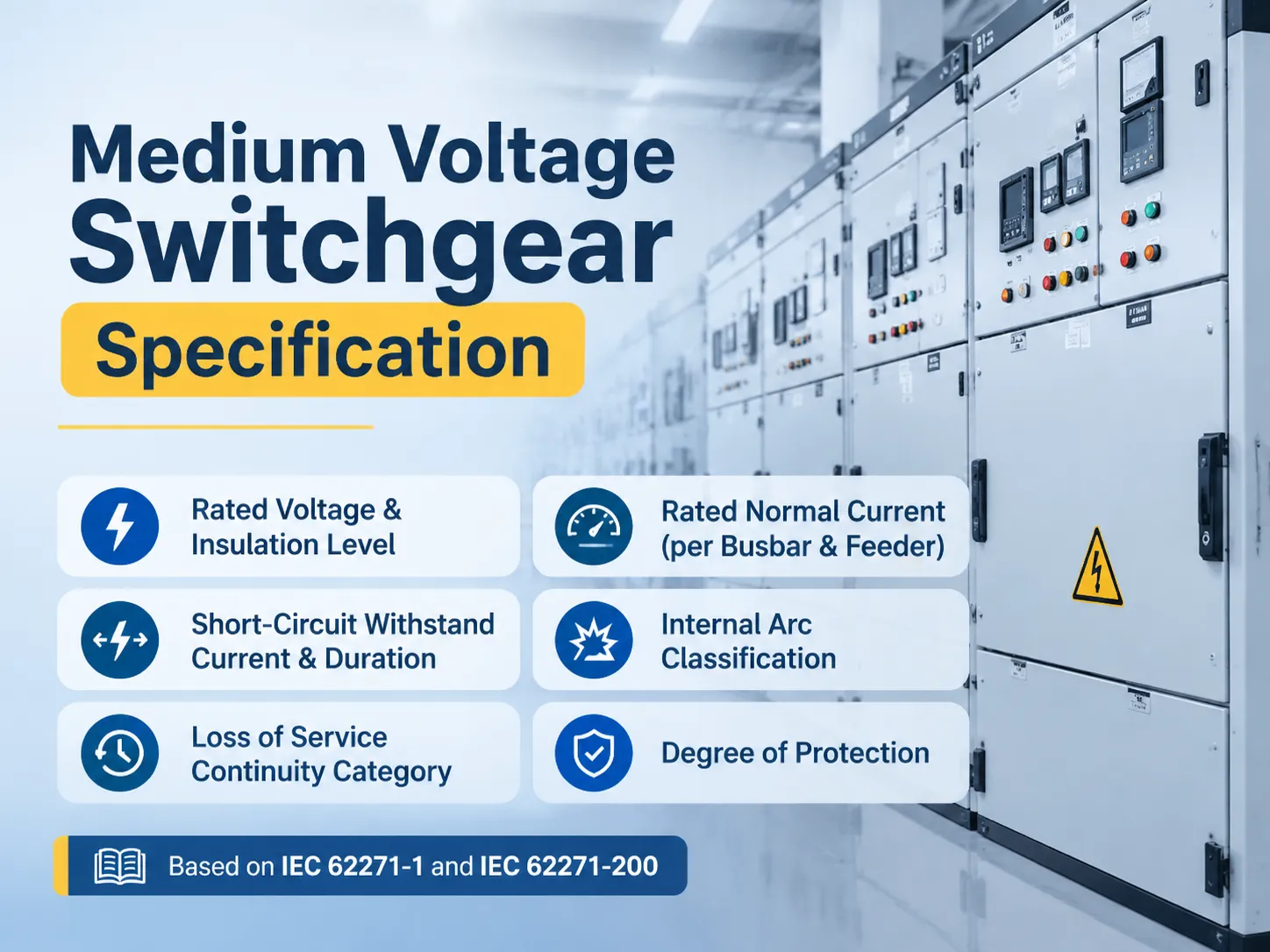
The Six Parameters a Specification Has to Fix
Begin with the components that remain unchanged post-manufacture. The cabinet is designed round the busbar, its insulation clearances and arc containing features, which are determined early on in a project.
- Rated voltage and insulation level. The standard operating voltage of the system, as well as the insulation the equipment will need to endure, defined through the lightning impulse and power frequency levels. Opting for equipment rated at 12 kV, when working with an 11 kV system is fine, while choosing the same equipment to be used for a system that will see surges of 24 electrodes, needs to be supported with valid explanations.
- Rated normal current. Provided separately for the main busbar, risers and each feeder. A system having 2000 A bus and 630 A feeders would have to be specified in that manner since if the current is shown as only “one” value, then it is impossible to find out what limits exist.
- Short-circuit withstand. This refers to the current rating, as well as its duration and rest assured that these two are never interchangeable. 25 kA for three seconds is not the same as 25 kA for one second as well, and the peak rating can be calculated through the regular rating value, as well as the frequency.
- Internal arc classification. Related information, such as whether the device has passed the tests concerning containing internal arcs, in which compartments of internal arcs did it pass successfully, as well as what kind of access was available to those chambers. This point influences the cost of the equipment the most.
- Service continuity level. Refers to the share of the equipment that remains functional after opening one compartment. The LSC2B device is completely different device compared to LSC1 device, since in LSC2B devices barriers are provided, which are absent in LSC1.
- Degree of protection. Refers to the IP rating of the equipment and then the degree of protection for people. It will be evident that indoor devices and outdoor devices have different seals and their condensation behavior differs.
A 40.5 kV metal-enclosed lineup shows how these parameters translate into hardware, and the construction that results is visible in this 40.5 kV armored withdrawable switchgear assembly.
The Standard Set Behind a Medium Voltage Switchgear Specification
IEC releases a series of publications, and each of these publications deals with a different subject matter. It is mainly the knowledge of which publication applies to which part that distinguishes the specification from a wish list.
| Standard | What it governs |
|---|---|
| IEC 62271-1 | Common clauses: ratings, insulation, temperature rise, test procedures |
| IEC 62271-200 | Metal-enclosed switchgear and controlgear from 1 kV to 52 kV |
| IEC 62271-100 | Alternating current circuit breakers |
| IEC 62271-102 | Disconnectors and earthing switches |
| IEC 62271-103 | Switches for rated voltages above 1 kV and below 52 kV |
| IEC 62271-105 | Switch-fuse combinations |
| IEC 62271-202 | Prefabricated substations |
| IEC TR 61641 | Internal arc testing criteria and classification |
Practices in North America differ and the differences are not merely superficial. Equipment made according to IEEE C37.20.2 for metal-clad switchgear and C37.20.3 for metal-enclosed switchgear has undergone a different set of standards for testing and rating, and there are differences in the signal relay schemes and in the practice of terminating cables. Thus, if one mixes the two specifications he obtains equipment which simply cannot be tested against a standard.
The practical approach should be to specify the standard, edition and part of the standard, requiring also that the test report in question refers to the specific equipment supplied, and not to some similar type. The test report for a 12 kV 25 kA cubicle cannot test a 36 kV 31.5 kA cubicle as this substitution happens to be quite broad, thus the buyer must consider checking if the report states the ratings of the device on its cover.
Rated Voltage and Insulation Level, in Numbers
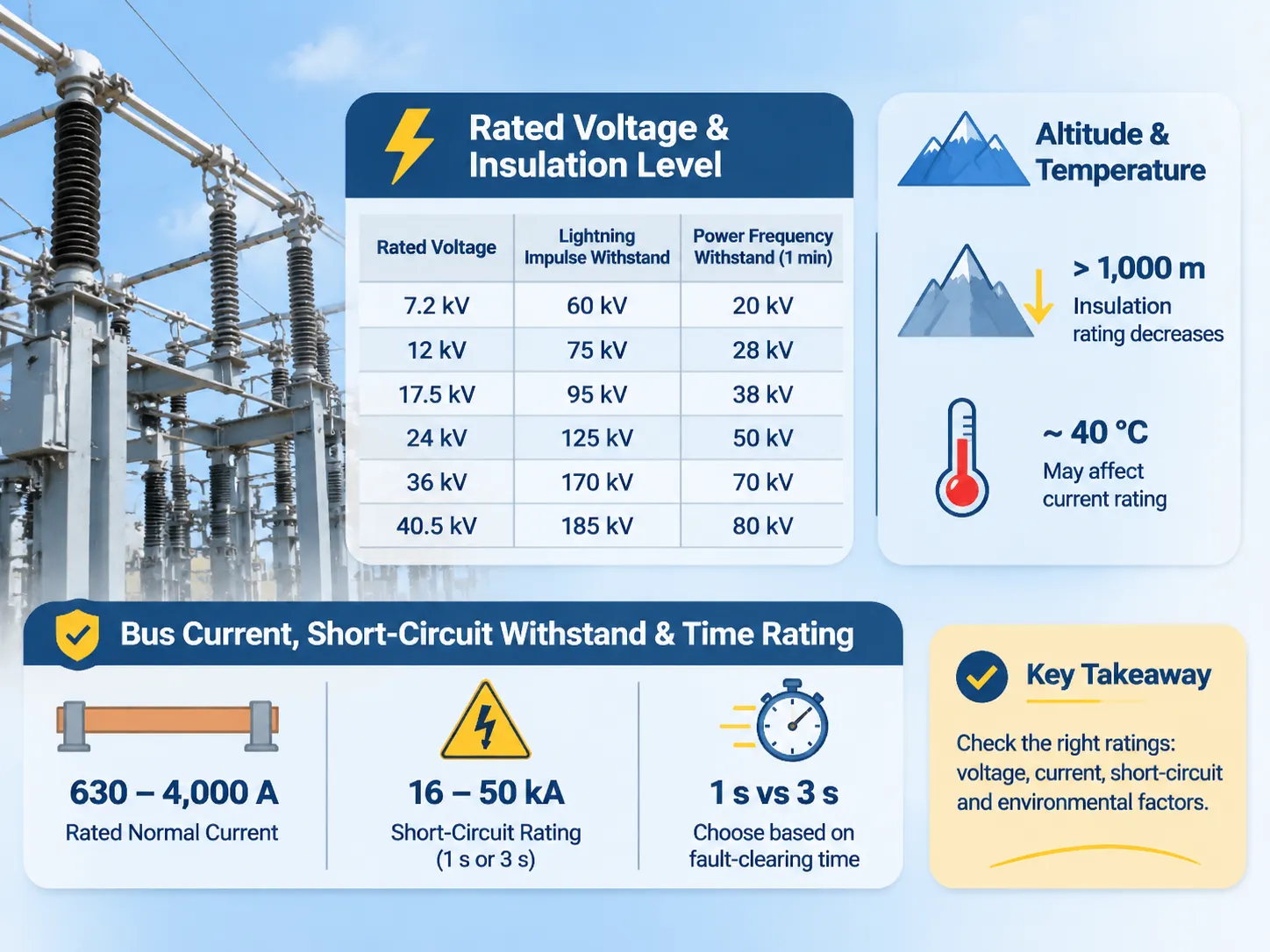
Insulation level is the parameter most often copied from a previous project without checking. The table gives the standard values from IEC 62271-1.
| Rated voltage | Lightning impulse withstand | Power frequency withstand, 1 min |
|---|---|---|
| 7.2 kV | 60 kV | 20 kV |
| 12 kV | 75 kV | 28 kV |
| 17.5 kV | 95 kV | 38 kV |
| 24 kV | 125 kV | 50 kV |
| 36 kV | 170 kV | 70 kV |
| 40.5 kV | 185 kV | 80 kV |
There are two things to consider in this case. Clauses typically include the figures for both line-to-earth and line-to-line; however, the withstand figuring when it comes to the terminals of the switching device is a different number. Therefore, the specification should include both of these. Also, altitude must be taken into account; the withstand reduces from 1000 meters above sea level; the equipment designed for elevations lower than this should be derated. Thus, the design shall state that the equipment installed at an altitude of 1800 meters with a rating of 12 kV referring to its performance at sea level is wrong.
Temperature, like altitude, influences the figures we assume. The standard climatic conditions which producers use as a base point are warmer than the temperature in summer in most countries of the world and a switchgear room without sufficient cooling will exceed by 15 K as well in summer. In this case, the effect at 40 °C is still not big, but, on the contrary, it is quite tangible, and it works against current, not voltage, which is why the equipment that has been rated for winter can trip in summer time.
Bus Current, Short-Circuit Withstand and the Time Rating
The rated current follows a well-known ladder: 630A, 1250A, 1600A, 2000A, 2500A, 3150A, and 4000A. The short-circuit ratings follow another ladder: 16 kA, 20 kA, 25 kA, 31.5 kA, 40 kA, and 50 kA with given times of 1 or 3 seconds.
The combination is much more important than the two values. 31.5 kA for 1 seconds and 31.5 kA for 3 seconds mean equipment that passes different fault-clearing times with differences in the cross-section of the busbar, bracing and thermal mass. If the protection scheme manages to clear the fault in 0.3 seconds, the rating 1 second is enough and cheaper. But if a backup protection makes it in 2 seconds, it is not that easy.
Peak withstand rating is derived, not selected: 2.5 times RTR for 50 Hz systems and 2.6 times for 60 Hz, which also reflects asymmetry at the first peak. A specification that quotes only RTR has not provided the number related to busbar bracing.
One important point in current ratings: busbar rating and incomer rating are not the same. 2,500A bus and 1,250A incomer is a normal assembly with the possibility to add a second incomer later. 2,500A bus at the outset is cheaper than rebuilding it in 5 years, the same logic applies to spare capacity in any equipment.
Types of Medium Voltage Switchgear and How Each Is Specified
Four construction families cover almost everything, and each has its own specification habits.
| Type | Typical rating | Where it is specified |
|---|---|---|
| Metal-clad, withdrawable | 12 to 40.5 kV, 630 to 4,000 A | Incoming and busbar sections, generator connections, plant distribution |
| Metal-enclosed, fixed | 12 to 24 kV, up to 1,250 A | Feeder and motor circuits where withdrawal is not needed |
| Ring main unit | 12 to 24 kV, 630 A | Distribution networks, small substations, two-transformer arrangements |
| Gas-insulated, sealed | 12 to 40.5 kV, up to 2,500 A | Space-constrained sites, harsh environments, long maintenance intervals |
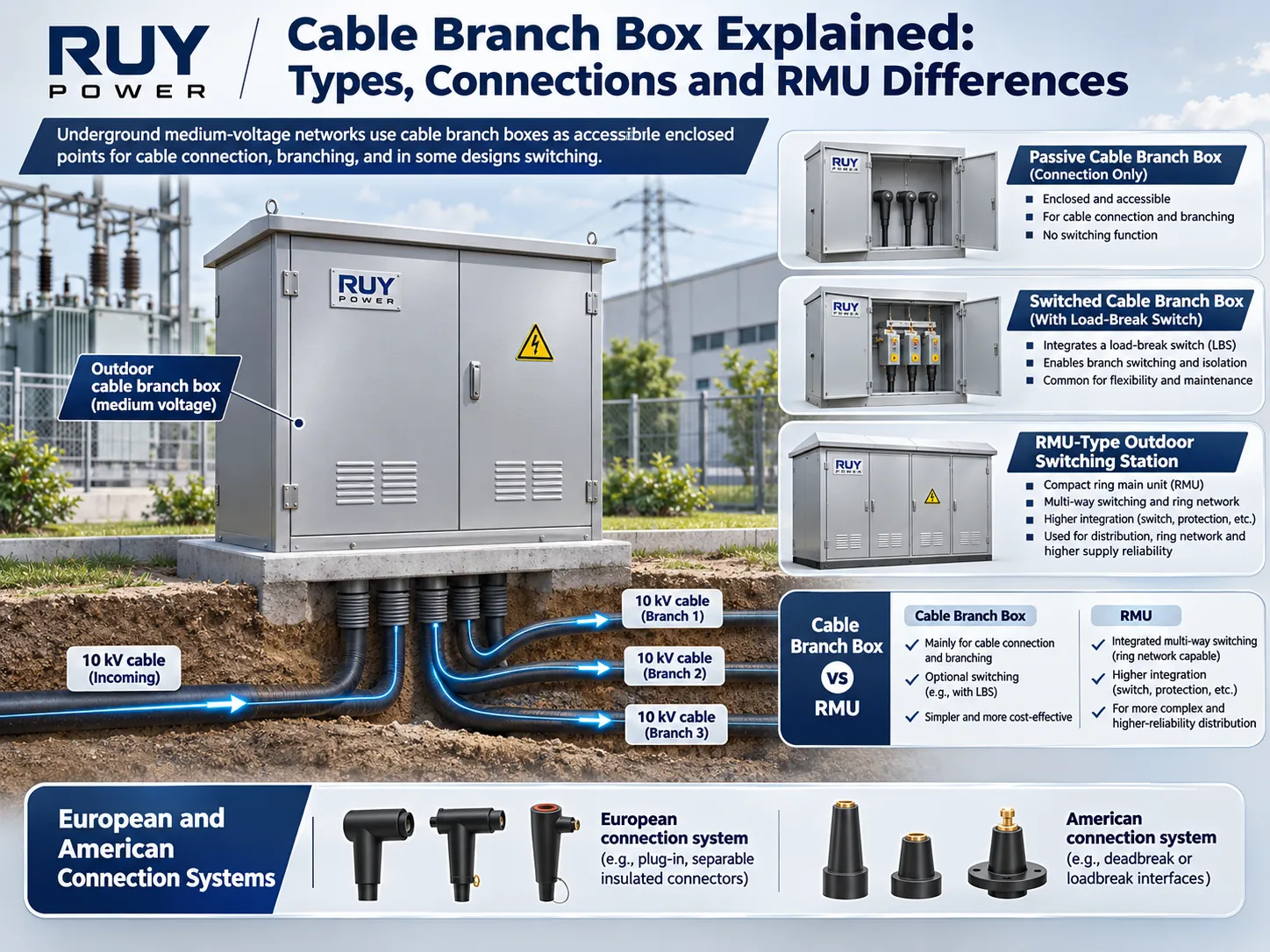
withdrawable equipment that is metal-clad serves as a workhorse for all maintenance operations that must occur without de-energization. Important characteristics of the equipment that should be considered are compartment barriers, shutter arrangement, and racking mechanism.A 12 kV armored withdrawable lineup in this KYN28 type metal-armored switchgear is a reasonable reference for what those elements look like when they are all present.
The specifications for ring main units differ in that the load is lower and their use is only of a switching nature rather than one for clearing a fault. It is the fault make rating, fuse rating of the transformer being protected and the extensibility of the unit that are relevant. Hence, a ring main unit and a circuit breaker lineup cannot just have similar specifications, but also the same cost.
Internal Arc Classification and Loss of Service Continuity
Buyers tend to neglect these two classifications, which are the main ones that change the products.
Internal arc classification describes the results of an internal fault situation. In this test, an arc is applied at a particular current for a particular time, and the enclosure is tested for containment and whether the indicators around the equipment catch an ignition. This classification provides for a number of current, time and also accessibility classified as AFL (front access), AFLR (front and rear access), and in case of side access, these classifications will be modified accordingly. The equipment that has internal arc classification is heavier due to the use of steel enclosures, pressure relief ducts and reinforced clasps. Such a modification is more expensive, but practically speaking, it is a necessity in a building where the equipment is to be placed.
Loss of service continuity concerns the question of what can remain energised when a compartment is opened. LSC1 enables de-energisation of the whole enclosure in order to allow opening of the functional unit, while LSC2 also allows energising of the busbars during opening of one of the compartments. The levels LSC2A and LSC2B go further, LSC2B allowing cable compartments to be energised as well, which will help work on one of the feeders while energising the rest of the panel.
A fully insulated, sealed construction takes a different route to the same safety outcome by removing the exposed live parts and not by containing an arc, and the design logic of that approach is visible in this fully insulated ring main switchgear. The specific area will determine the choice of project type: insulated coverings are effective against humidity, salt and limited area; while arc protective metal-clad coverings will be required in service areas with staff and spare part stores.
The Switching Device: Vacuum, SF6 and What Each Implies
The method of interruption is typically determined by the system used by the supplier, but the customer must be aware of what they are agreeing to.
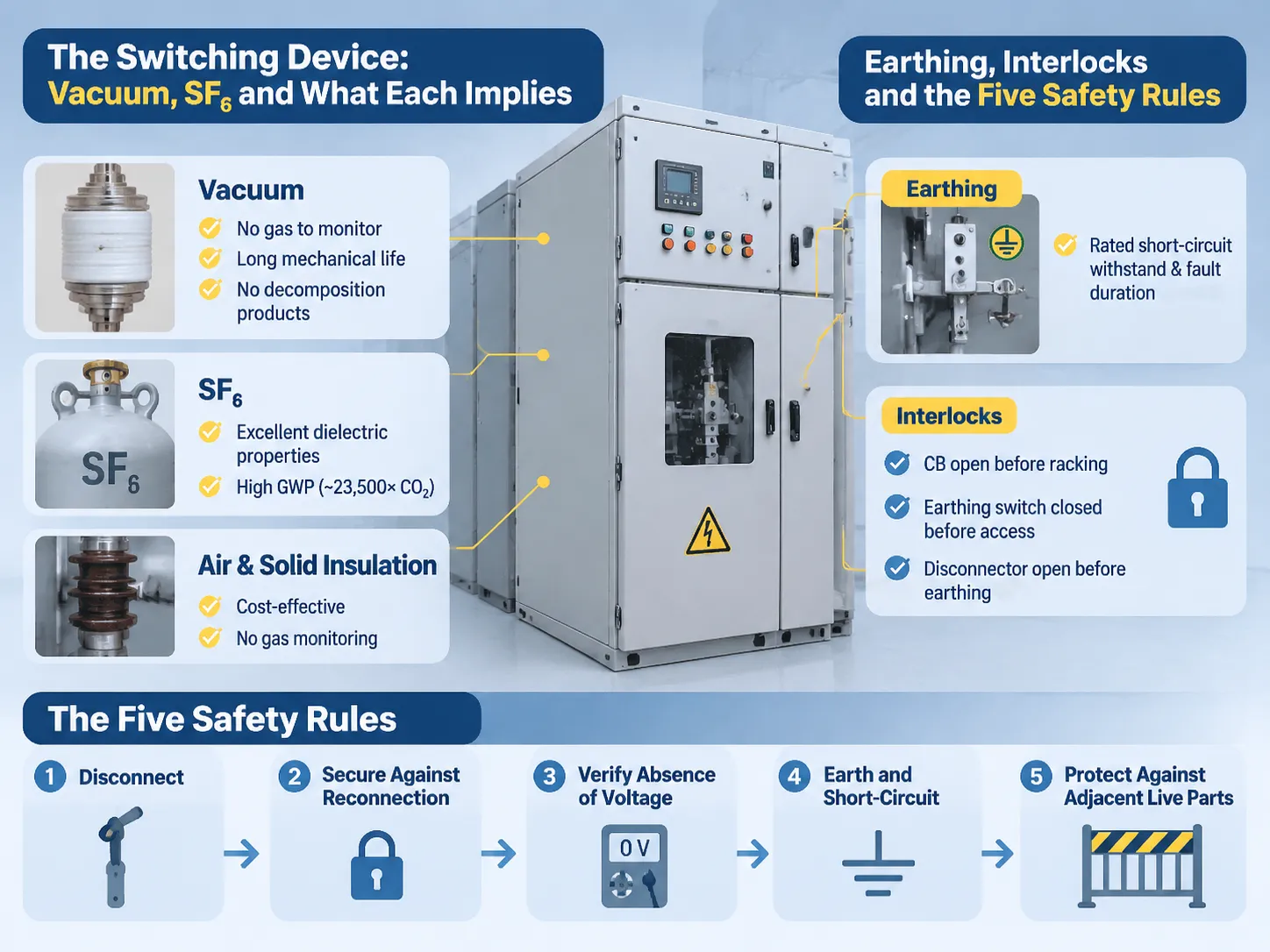
- For low-voltage circuit-breakers and contactors. No need to watch gas pressure, long lifespans, and no fumes produced at the same time. However, a significant drawback would be no possibility to repair vacuum switches on-site.
- For gas SF6. For permanent ring main units and GIS (gas-insulated switchgear) applications only. Impressive insulation and arc extinguishing properties allow reducing dimensions significantly, but the global warming factor is approximately 23,500. Therefore, leakage control and recycling have become the essential parts of specifications instead of enviable notes.
- Air and solid insulation. By default, air-insulated static devices remain the cheapest option until the low part of the medium-voltage market, while solid insulation (epoxy cast) is a common practice for compact sealed designs.
In any case, two clauses must be included in every specification regardless of medium, stating the endurance (mechanical and operational) of the device in order to establish the maintenance plan and what is possible to perform on-site because a device that must go to the factory will change the spares strategy.
Earthing, Interlocks and the Five Safety Rules
The aspect of safety design of a lineup pertains mainly to the actions of the operator, which is precisely what it should not do.
There are three varieties of earthing: through the earthing switch on every functional unit, through the earthing of the cable compartment and through the main earthing bar with its connection to the body of the earthing system. These specifications must contain not only the short-circuit withstand of the earthing switch, but also the duration of the fault it is rated for, because the earthing switch that is closed onto a live circuit performs fault-making and not no-load duty.
Interlocks obey the fixed logic which is actually worth writing down in our specification. For the unit to be racked, the circuit breaker must be opened first. The earthing switch must be closed first if someone wants to access the cable compartment. The disconnector has to be disconnected before the earthing switch can be closed. The unit cannot be racked if the earthing switch is closed. All of the above-mentioned are mechanical and/or electromechanical interlocking devices, so it should be noted in our specifications that they must not only be available, but also be tested.
The operating layer is essentially the five established safety rules: disconnect, secure against reconnection, detect the absence of voltage, earth and short-circuit and protect against other live parts. A lineup making the execution of these five steps simpler is better than a line with an option of performing these steps that is not very user-friendly. It can be noticed from the earthing switch position and test access. Compact ring main arrangements, such as this box-type ring main unit, are a good example of designing the sequence into the hardware.
Test Regimes: Type, Routine and Acceptance
There are three different types of testing, and a specification should include all of them.
- Type tests. These tests are only conducted once on one prototype in order to verify the specified ratings, which include dielectric properties, temperature increase, tolerance against short circuit, capability of withstanding internal discharge, and mechanical durability. These tests are what is behind the figures in the catalogues, and the receiving party must obtain the report that indicates ratings, laboratory name, and date.
- Routine tests. Conducted for every single product before shipment; includes high voltage tests for the connection circuits, resistance measurement, interlocks and wiring check. The evidence that particular cubicle has been tested is the routine test certificate which is demanded by the inspector.
- Acceptance tests. Conducted at the site after installation; the acceptance tests are not the repeats of the routine ones. The implementation phase ensures that nothing has been damaged while in transit, that cable terminals are in place correctly, and protective settings correspond to study findings. The typical procedure would include insulation resistance checks, control resistance measurements, primary injection, and checking the interlocks functionality.
There is meaning in the witnessing of tests that needed to be carried out both at the ground works and factory. If the buyer participated in the factory test, he will be able to see that the routine tests were executed, and he will have a chance to address the defect while it is still on the manufacturing floor, which would save him a lot of time compared to correcting a defect during commissioning process afterwards. Furthermore, testing efficiency is provided in case of the same engineer is involved in both stages of the process (testing and commissioning). Examples of that sequence in practice are collected in these high voltage switchgear application cases.
FAQ
What is medium voltage in switchgear terms?
In IEC practice, the voltage range above 1 kV and up to 52 kV is 12 kV, 24 kV and 36 kV while in North America, the 5 kV and 15 kV divisions are employed. Thus, the two methods cannot be compared directly to one another.
What is the difference between metal-clad and metal-enclosed switchgear?
Metal-clad makes it mandatory for all parts to be in respective grounded metallic compartments of removable units equipped with automatic doors. Metal-enclosed requires metallic enclosure only and does not imply splitting into compartments. It means that the product made of the metal clad is more costly and easier for servicing than the metal-enclosed one.
What does IAC AFLR mean?
This is about defining internal arc rating where the arc can occur in certain areas known by letters which act as indicators to a location where the person can be in case of an incident with respect to the front and back faces of the apparatus. Also, this classification states the fact that the apparatus is capable of managing an internal arc incident without putting a person at risk when in presence of a certain intensity of the current for a prescribed time period.
What is LSC2B?
Loss of continuity of service is a class of events created when the busbar and the cable enclosure of other operational installations retain sufficient energy even when one of the installations is in a state of being serviced. This is a category that permits servicing of installations with only one power supply unit supplying operation.
How long should a short-circuit rating last?
The duration, either 1 or 3 seconds, must be specified with the rating. A rating of 25 kA is meaningless without this. The duration must correspond to the actual duration for clearing the fault and must include a margin for the backup protection.
Does a specification need to state the relay type?
The specification must outline the required protection features and communication protocols, and permit the supplier to offer its solution. Naming a specific relay model narrows down the competition, thus interfering with the procurement process without leading to better results unless the plant has previously standardised the spare relay choice on this model.
What tests should arrive with the equipment?
The type test report includes the rating and the laboratory testing done, each unit’s certificate for routine testing and the certification of the status of interlocks and a supplier who is able to produce all three without being followed is a supplier that does this on a regular basis.
References
- ABB — Medium Voltage Switchgear and Protection
- Siemens — Medium Voltage Switchgear Systems
- Hitachi Energy — Switchgear and Grid Components
- Ormazabal — Medium Voltage Distribution Solutions
- UL Solutions — Switchgear Certification and Standards
Conclusion
Medium voltage specification consists of six parameters and one standard reference that makes up the product’s pricing. These parameters must be noted: voltage and insulation level, current per section, short-circuit current and duration, internal arc class, loss of service continuity, and degree of protection. If the data is filled in properly, all suppliers will have the same price.
If the data is left blank and filled in post-factum, the producer will put only the cheapest version suitable for a given situation, and only the occurrence of the problem or a request for the arc test report will make people realize that something is wrong.