
In 2026, there is more to consider than the price of switchgear in the USA. You need to ensure the availability of the devices. The medium voltage switchgears values indicate that the suppliers will be busy until 2028, thus the lead time is considered an important feature of the project. Additionally, the difference between local manufacturers and domestic manufacturers of switchgear equipment should be taken into account in regard to the success of the project.
This is a research project investigating the actual switchgear manufacturers in the USA and the advantages they possess as manufacturers, as well as the role of foreign-made equipment in their production.
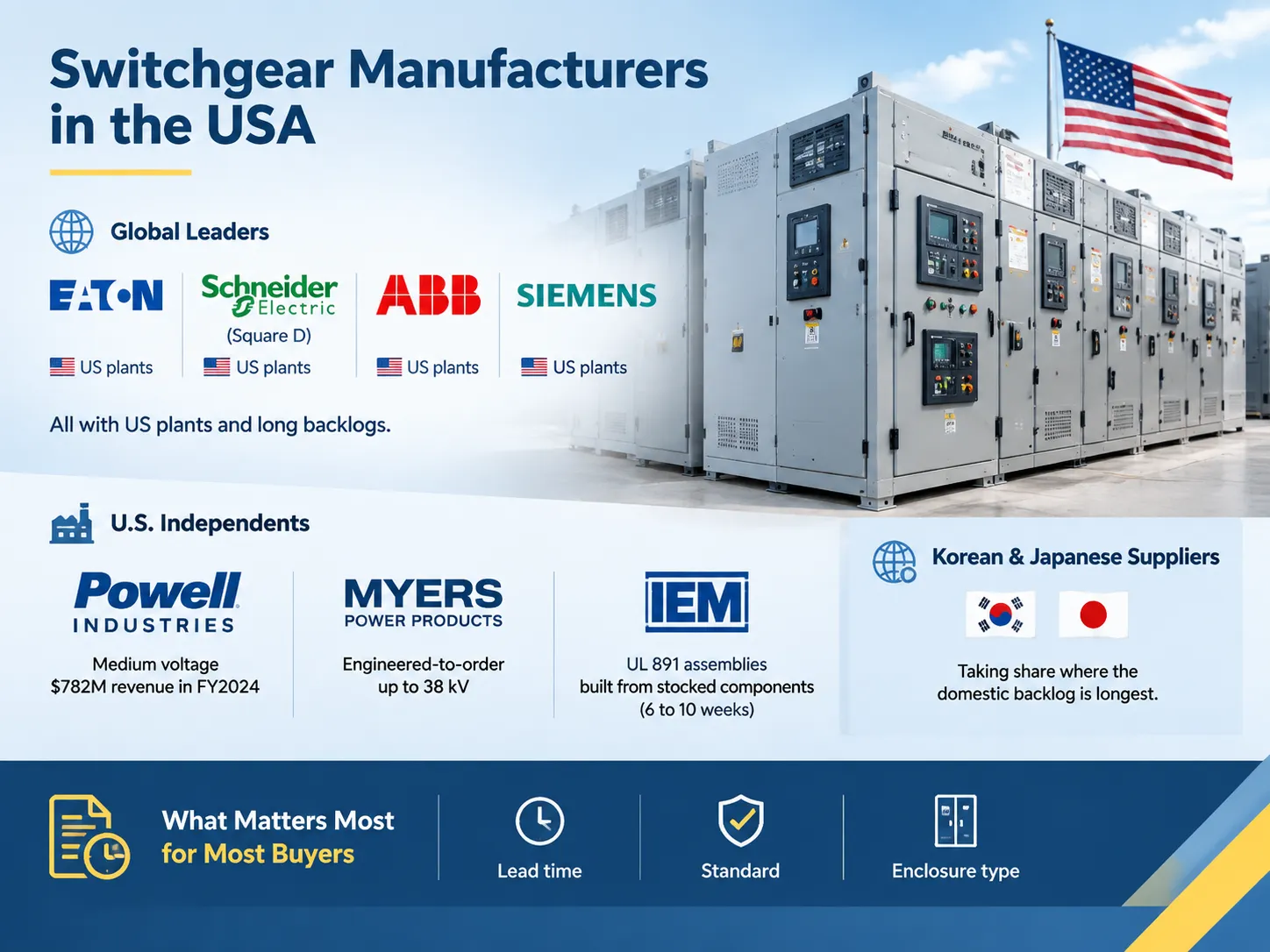
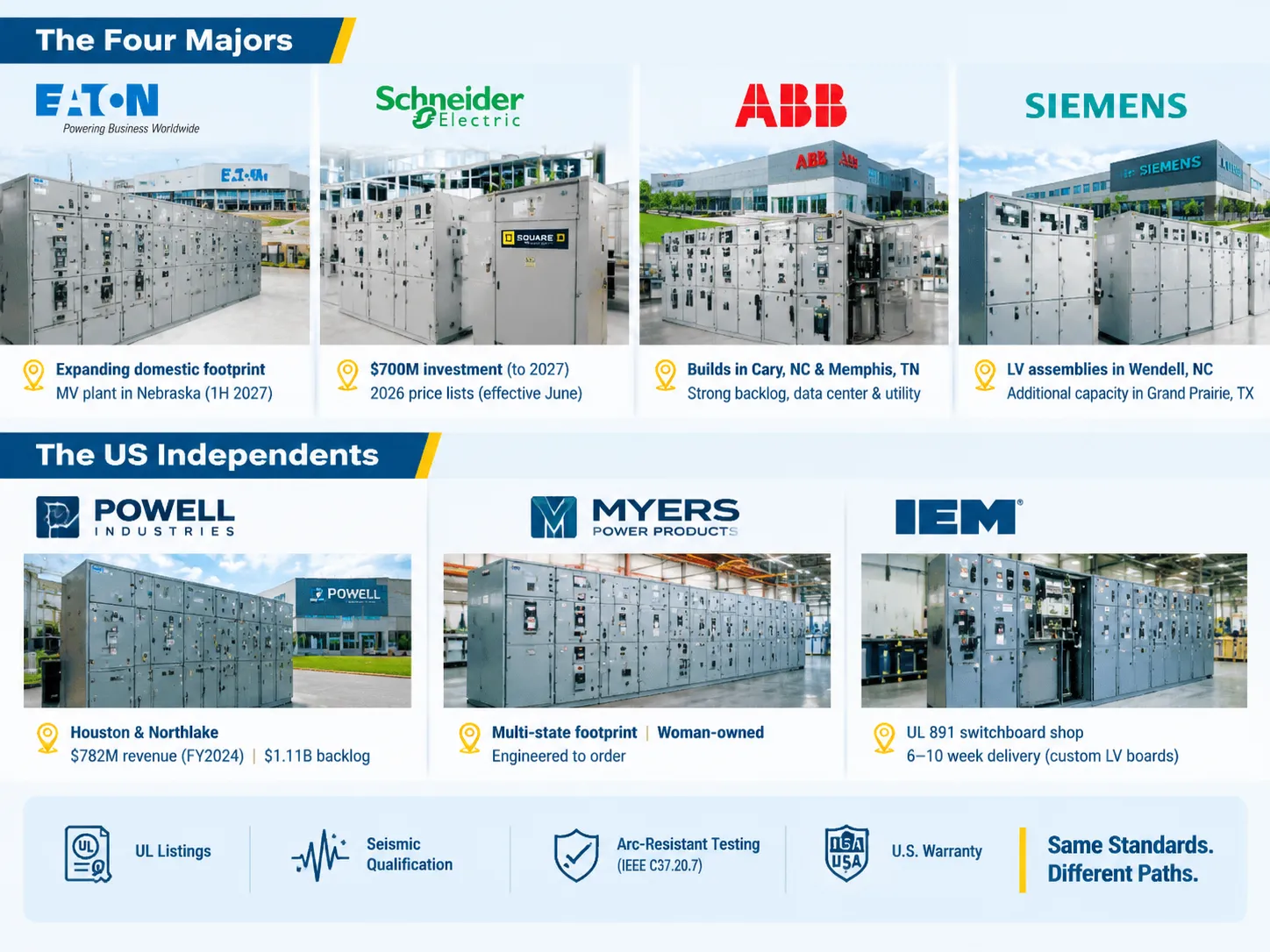
Moreover, four major players have been in the USA specification market. Eaton, Schneider Electric (Square D), ABB, and Siemens are all capable of manufacturing in the USA and having longer lead times. The other players in the market are smaller local companies, e.g., Powell Industries (medium voltage company with FY2024 revenue of $782 million) or Myers Power Products (providing engineered products with a maximum voltage of 38kV). However, Korean and Japanese companies are the ones who are dominating in the American market with the highest backlog for American companies. In fact, for most customers, lead time and the enclosure type are crucial in making their choice, although the brand is of importance as well.
The Landscape at a Glance
| Maker | US manufacturing | Strength | Reality in 2026 |
|---|---|---|---|
| Eaton | Multiple plants; new MV factory in Nebraska, production H1 2027 | Breadth from LV boards to MV gear | MV gear reported effectively sold out through 2028 in many channels |
| Schneider Electric (Square D) | US plants; $700M investment programme through 2027 | LV distribution, specification presence | Capacity expansion under way |
| ABB | Cary NC, Memphis TN | MV switchgear, electrification | Record backlog, data centre demand |
| Siemens | Wendell NC, Grand Prairie TX | LV assemblies, controls, automation | Orders up on data centre and electrification |
| Powell Industries | Houston TX, Northlake IL | Medium voltage only, engineered to order | FY2024 revenue $782M, backlog $1.11B |
| Myers Power Products | Five states, ~1M sq ft, 1,000+ staff | MV and LV, power distribution centres, transit | Up to 38 kV, WBE certified |
| IEM | US UL 891 panel shop | LV switchboards from stocked components | 6 to 10 week delivery documented |
| LS Electric | Cedar City UT, Bastrop TX | MV and LV, Korean parent | Capacity expanding toward $324M at Cedar City |
Read the last column first. In a market where the product is good everywhere and the schedule is not, availability is the differentiator.
The Four Majors
Upon further examination of the four top players in the industry, one can see that Eaton has the greatest domestic footprint which continues to grow, and the company has an ongoing plan for developing that footprint, including the construction of a medium-voltage facility in Nebraska which is supposed to come into production in the first six months of 2027. It can be important to invest in the medium-voltage facility, given that mid-2026 industry data indicates that all present medium-voltage switchgear capacity will be sold out in several distribution channels by 2028. The project director who has to procure the MV equipment from a top manufacturer has to start negotiations from the position of an available slot.
Schneider Electric is recognized as the leader in the low-voltage distribution field thanks to the Square D brand and has made an investment of $700 million in the USA until 2027, having already released the price list applicable in 2026 starting from June 2026. The company has real capabilities in engineering; at the same time, they keep customization for the bigger deals.
The medium-voltage equipment is produced by ABB, which has its plants in Cary, North Carolina, and Memphis, Tennessee, and has been experiencing incredible backlog of the medium-voltage devices that show the growth of electrification orders thanks to the demand coming from data centers and utilities.
The production of medium-voltage offerings is provided by Siemens in Wendell, North Carolina, and some facilities are located in Grand Prairie, Texas, with the demand for the devices growing significantly due to electricity projects and data centers. What makes this organization different from the above manufacturers is the presence of several assemblies such as switchgear, controls, and building automation equipment since switching to another producer simplifies the project implementation.
All four companies have developed a set of documentation packages, including UL listings, seismic qualification, and arc-resistance testing according to IEEE C37.20.7 standard, which resulted in the establishment of warranty for this equipment in the USA.
The US Independents
Under the major ones, a category that usually goes unnoticed by buyers is represented, allowing for faster delivery.
Powell Industries specializes in manufacturing medium voltage switchgear and electrical houses located in Houston and Northlake. The revenue for Prairies year 2024 is $782 million, representing a 57 % jump, while the backlog value stands at $1.11 billion – the best number recorded in the company`s history. The company making a good profit from a single product.
Myers Power Products, which has been producing goods since 1950, occupies nearly a million square feet of land distributed across 5 states and employing more than a thousand people, offering both low- and medium-voltage switchgear, distribution centers, as well as equipment for transit purposes. They are a certified woman-owned company business, which is very important in public projects, while they produce according to the order. One of their foremost examples is the production of a 15 kV metal-clad distribution center, with protection and instrument transformers built in.
IEM works in a different sphere – that is the UL 891 switchboard production, using stocked components rather than constructing the breakers. The result of the approach is staring delivery of the switchboards ranging from 6 to 10 weeks, which is definitely the fastest option available, if a customer is looking for a custom low voltage switchboard rather than the listed assembly of medium voltage switchboards.
These three companies clearly illustrate the gap in customer understanding of what is meant by a “made in USA” label. “Made in USA” can mean different things, depending on whether one speaks of the plant making the breakers and enclosures or just assembling them. What our own manufacturing process covers is the first model, which is why the distinction matters when we quote against a US assembler.
The Korean and Japanese Entrants
The backlog of orders has resulted in suppliers coming into the picture who were not very important buyers in the U.S. beforehand. LS Electric has set up manufacturing operations in the U.S. at Cedar City, Utah, and has established a complex in Bastrop, Texas. The company in Cedar City is expected to be capable of producing approximately $324 million worth of products after it is expanded. Meanwhile, Hyosung Heavy Industries and HD Hyundai Electric ship equipment from Korea without disclosing any information regarding U.S. manufacturing, but they have been successfully winning utility and industrial orders as companies are starting to diversify their supply chains away from limitations caused by the geographical location of the suppliers. Mitsubishi Electric Power Products produces its products in Warrendale, Pennsylvania.
The advantage, thus, lies in the timing and price of the order. The disadvantage is that when a project involves a product manufactured in the U.S. due to the Buy American act or a similar requirement, one has to find out where exactly the product has been made, instead of just checking the name of the brand.
What “Made in USA” Means on a Specification
Three documents determine this, and people often confuse them.
- UL 891 is the standard for switchboards, which are dead-front devices with low voltages, that are built and certified as a complete board.
- UL 1558 covers low voltage power circuit breaker switchgear, which is a heavier and more solid type of construction than the drawout circuit breakers.
- IEEE C37.20.2 and C37.20.3 determine the standards for the metal clad and metal enclosed medium voltage switchgears, whereas C37.20.7 defines the requirements for arc resistant performance.
In particular, a board that gets certification under UL 891 can be put together in the US out of the components produced abroad and be considered a product made in the US according to the current legislation. Conversely, a medium-voltage device constructed overseas according to IEC 62271-200 cannot be treated as IEEE C37.20.2 switchgear, although their ratings can be similar, due to the differences in the standards’ testing methods. This is the reason why a US consultant requires the use of IEEE approach for utility projects rather than protecting its market.
The only occasions when IEC approach to constructing equipment is relevant is when the customer gives guidelines to follow IEC from the very beginning or in case of export projects and the industrial plants with international engineering. Our KYN28-12Z metal-armoured switchgear is that kind of product: IEC 62271-200, drawout breaker, segregated compartments, interlocked shutters, with a Type 2 coordination study behind it.
Lead Time Is the Real Specification
In an ordinary marketplace, the price is the most important factor in the decision-making process and the delivery time is secondary; in this particular market situation, on the contrary, it is exactly the opposite.
As major electrical equipment companies quote for vanishing lead times that can be two years ahead, secondary producers of electrical switchboards — made on component bases, — have lead times that can be anywhere from 6 to 10 weeks. This difference is more than just a minor inconvenience for a datacentre or hospital construction project, it can mean whether or not that building gets energized this year.
There are three possible options: get the slot as soon as it is available; split the job and have LV boards built by a small assembler while MV ones are built by a major electrical manufacturer; or order MV assembly from an IEC factory and tackle the compliance issue deliberately with the help of an engineer who will sign the report.
The project case library shows what that looks like in practice: high-voltage switchgear applications across utility, industrial and infrastructure work, with the ratings and the site conditions each one had to meet.
Where an Imported Assembly Fits
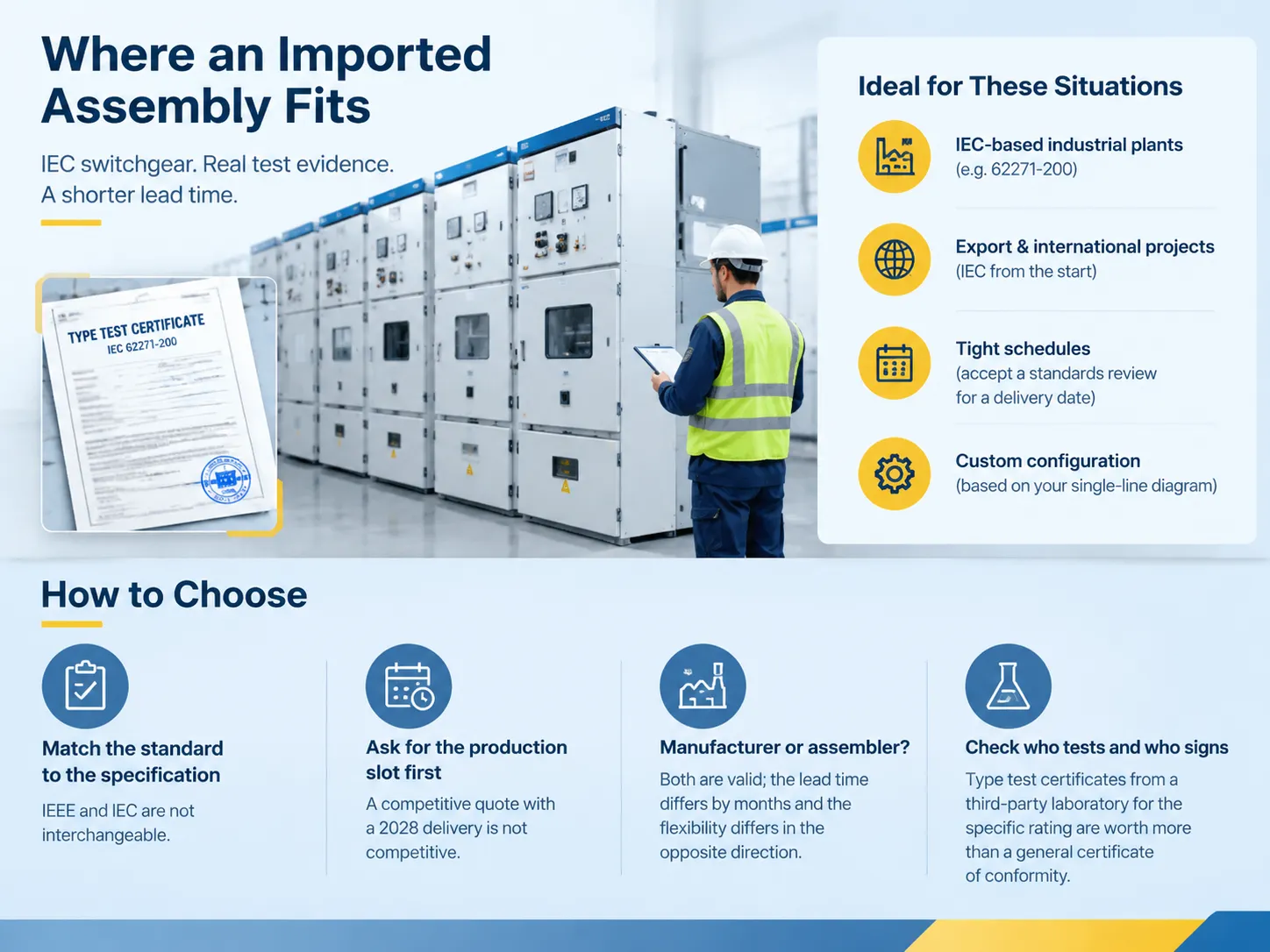
We clarify that we are not a US manufacturer as such. What we offer is a factory that can produce IEC switchgear rated from 12 kV to 40.5 kV and low-voltage assemblies rated from 400 V with type test reports, and whose lead time is measured in months rather than years.
This suits four types of situation:
- Industrial facilities to IEC specifications for which the engineering consultant is not interested in IEEE assembly.
- International projects when the owner specified IEC at the start.
- Owners facing a time problem, who would be ready to carry out the needed standards adaptation in exchange for the time it would solve.
- Buyersʼ need to manufacture assemblies according to their specific needs rather than a catalog, which is what our OEM and ODM production allows.
However, we will not deliver an assembly to a fault level it cannot withstand or falsely claim that it complies with a standard it was not tested with. If the project requires the use of IEEE C37.20.2 and UL label, be sure to offer it to a US manufacturer.
How to Choose
- Select based on the standard and not the cost. IEEE and IEC documents are not substitutes, regardless of the rating.
- Find out about slots for production before learning the price. A quote for delivery in 2028 is hardly considered competitive.
- Decide if you are dealing with a manufacturer or an assembler. Both options are good, although they involve a long wait and hardly any flexibility.
- Verify who tests and who issues certificates. Type test certificates from a recognized independent laboratory specific for a rating are better than a general certificate.
- Don’t mix standards on one board. An assembly built to UL891 standards can’t include an IEC circuit breaker unless it has been acknowledged by the maker, and mixing standards is where the matter starts. Where the project is low voltage and IEC, our GGD fixed-type LV switchgear is the equivalent starting point.
FAQ
Who are the largest switchgear manufacturers in the USA?
Eaton, Schneider Electric, and ABB are the most productive brands when it comes to sales revenue, the installed base of products, etc. Powell Industries and Myers Power Products are the key independent players in the USA working in the sector of medium voltage equipment. LS Electric, Hyosung, and HD Hyundai Electric come from the outside but still operate in the USA market, with a diverse level of presence in the manufacturing of their products.
What are the top 10 switchgear companies?
A list of companies may differ depending on the guidelines used to compile it, if sales figures in the global or the USA territory are mentioned. However, among the ones included into the list, one can find Eaton, Schneider, ABB, Siemens, Powell, Myers, IEM, LS Electric, Mitsubishi Electric Power Products, and Hitachi Energy.
Who is the leading company in the switchgear market?
Eaton and Schneider Electric have been dominating the low- and medium-voltage distribution market, while ABB and Siemens have been solidly following them in the segment of medium-voltage distribution. In the group of specialized medium-voltage manufacturers operating in the USA, Powell is considered the market leader.
Who is the largest privately owned switchgear manufacturer in the United States?
Due to the lack of reliable ownership-related information, the majority of manufacturers present on the US market are subsidiaries of larger companies. For instance, Myers Power Products is one of the independent companies. Myers produces a very wide range of products and facilities, and looks like a family business but Powell is a publicly listed company.
References
- Myers Power Products — Medium and Low Voltage Switchgear
- Powell Industries — Medium Voltage Switchgear and Electrical Houses
- IEM — UL 891 Switchboards and Power Distribution
- Siemens Energy — Switchgear and Grid Technology
- ABB — Electrification and Medium Voltage Switchgear
Conclusion
You can find great manufacturers in the US market as well as suffer from the impact of limited capacity problem and the choice would be to go for standard, then slot, and finally price. Your shortlist will be ready.
When it comes to the IEC project and if you’re short of time, feel free to send us single line diagram, fault level, and voltage class in order for us to provide information on what slot is achievable.