
Among all electrical tasks that you would perform in your home, it is only with changing an electrical panel that your decision is to be based solely on numbers. In this case, the numbers that you get define whether to go for this option or not and the scope of work dictates whether the cost would be $1,300 or $5,000. More than half of the difference in cost is due to the scope of the project and NOT to labor costs.
Moreover, this is the project that is usually sold prematurely. For instance, kitchen circuit breaker tripping cannot be blamed on the fact that charging at the electric panel is wrong. The years spent by the panel working without tripping does not mean it can work appropriately for the heat pump that might be installed.
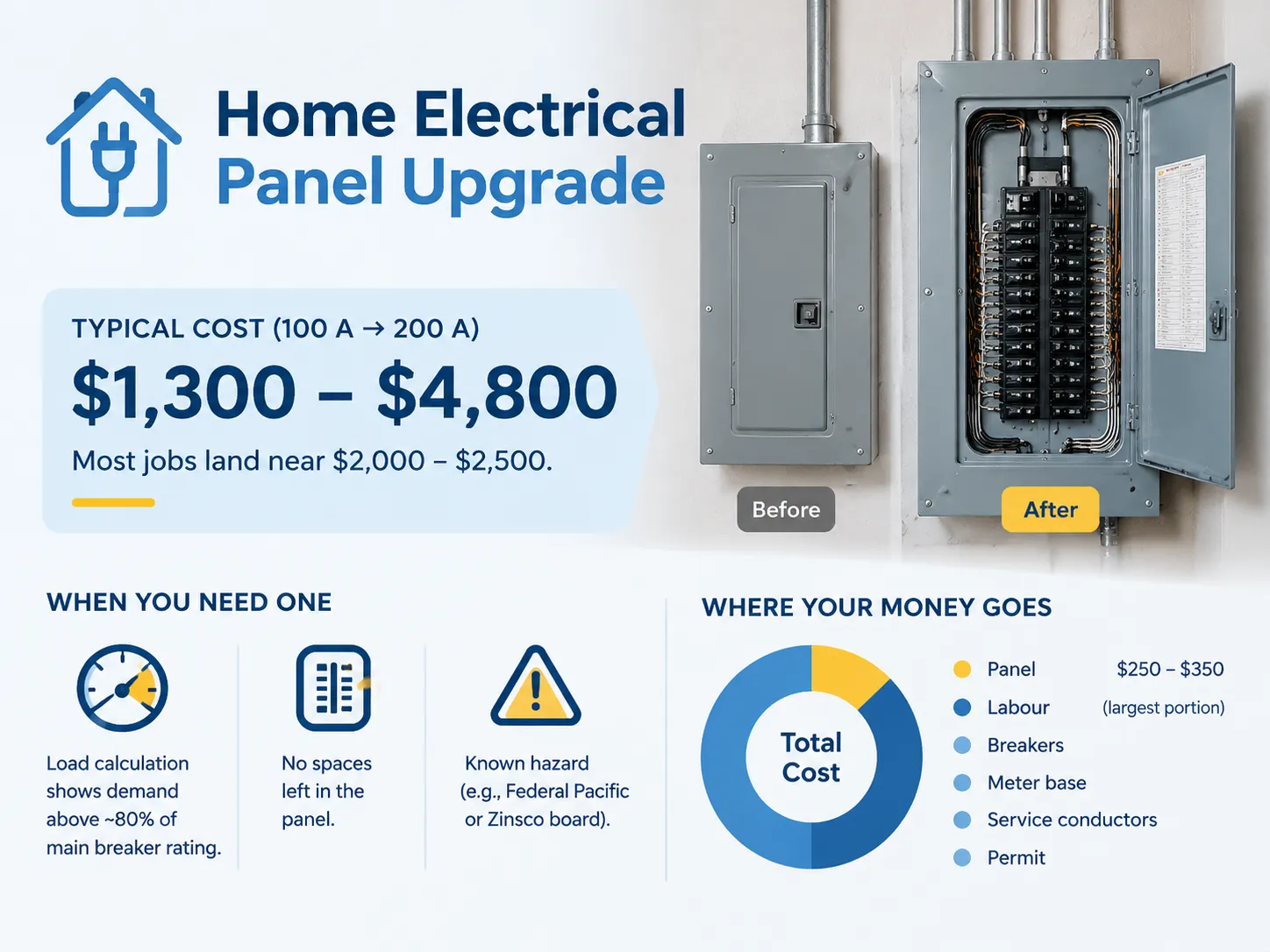
Short answer: Costs vary from $1,300 to $4,800 for increasing electrical capacity from 100 Amps to 200 Amps depending on various factors but most likely the cost will be $2,000- $2,500. The reason for getting the upgrade is when the load study indicates that load is 80% of the main circuit breaker capacity; there is no sufficient panel capacity available; or maybe the circuit breaker panel is not good such as Zinsco or Federal Pacific type panels. However, the panel price is just a small part of the total price when the majority of expenses consists of labour, meters installation and permit acquisition costs.
When a Panel Upgrade Is Actually Necessary
There are five legitimate triggers. Anything else is merely a sales gimmick.
- The load calculation is over 80%. We do not mean the total of the handles of the breakers (which is of no significance) but rather the actual load calculated according to NEC Article 220.
- There are no space available anymore. A 200 A panel that has 40 spaces can take care of a four-bedroom house with a finished basement while a 100 A panel with 20 spaces and tandems everywhere cannot provide the necessary service. Even the addition of a heat pump requires either a sub-panel or installation of a new service.
- There is a major continuous load being added. A 48 A Level 2 electric vehicle charger will draw 11.5 kW continuously. This is more than half the continuous capacity of a 100 A service. Both a 30 to 50 A heat pump as well as a 40 to 50 A induction range and a 30 A heat pump water heater require significant capacities of the service.
- The equipment is of a known hazard. Federal Pacific Stab-Lok and Zinsco panels have documented failing conditions. As a result, insurance providers are starting to refuse coverages for these panels. This is not a question of capacity and no number of free spaces can fix this.
- The service equipment is anyway being replaced. In case the meter base, the mast, or the conductors are being replaced, the increase in expenses for the installation of the 200 A service becomes negligible and making the installation twice does not make any sense.
What is not a trigger: a single breaker malfunctioning when the microwave and toaster are used simultaneously. It is simply two appliances on one 20 A circuit which requires adding another circuit instead of a new service.
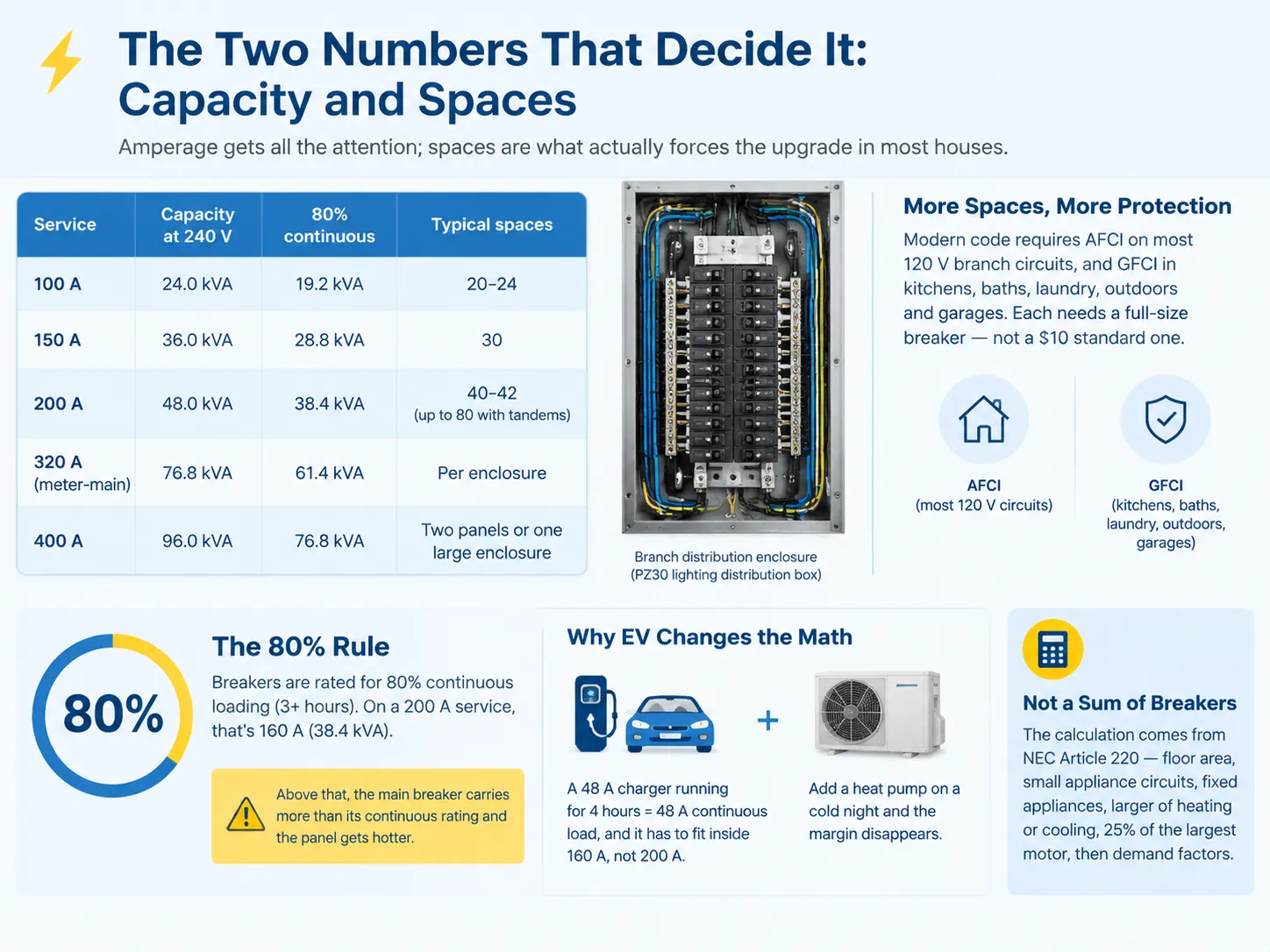
The Two Numbers That Decide It: Capacity and Spaces
Amperage gets all the attention; spaces are what actually forces the upgrade in most houses.
| Service | Capacity at 240 V | 80% continuous | Typical spaces |
|---|---|---|---|
| 100 A | 24.0 kVA | 19.2 kVA | 20–24 |
| 150 A | 36.0 kVA | 28.8 kVA | 30 |
| 200 A | 48.0 kVA | 38.4 kVA | 40–42, up to 80 circuits with tandems |
| 320 A (meter-main) | 76.8 kVA | 61.4 kVA | Per enclosure |
| 400 A | 96.0 kVA | 76.8 kVA | Two panels or one large enclosure |
The limit of the space is the real-world limitation because modern wiring necessitates breakers. It is a requirement to use AFCI for the majority of 120 V circuits in structures, while GFCI is to be used in kitchens, bathrooms, laundries, outside, as well as in garages. Taking into account that there is need to put in multi-breaking breakers, a house that has been rewired today has more spaces than the same house in 1990.
For a four-bedroom house, it makes sense to utilize a panel of 200 A with at least 40 spaces as a minimum. Tandem breakers may allow going up to 80 circuits.What a branch distribution enclosure actually looks like at this level, including the DIN-rail arrangement and the way circuits are grouped, is shown in this PZ30 lighting distribution box, which is the IEC-style equivalent of the branch side of a North American load centre.
The 80% Rule and What It Really Means
The 80% rule isn’t a rule defined in code and it doesn’t have a section attached to it. It’s just the result of breakers capable of being in continuous use at 80 percent of their capacity. Continuous loading means use for three or more hours.
In the case of 200 amp service, the maximum continuous load is 160 amps aka 38.4 kVA. If the load exceeds this value, the breaker will exceed its continuous limitation and the bus will generate more heat than the enclosure is capable of dissipating.
This is exactly the reason why the case of EV charging looks so different. A 48 amp charger operating for 4 hours produces a continuous load of 48 amps, meaning that it should be calculated against the 160 amps instead of 200. If we add to it a heat pump working at night, there won’t be any margin left.
The calculation that arrives at this number can be found in NEC Article 220. This calculation list does not involve the simple addition of the ampacity values of the breakers. This is the mistake many homeowners do by trying to add up the values of the breakers they see. The method applied includes taking into account floor space used, small appliance circuit, fixed appliances, whichever of heating and cooling has a higher value, and 25% of the biggest motor, further applying demand factors going from the fact that not all appliances work at the same time.
Sizing: 100, 200, 320 or 400 A
- 100 A is sufficient for a small dwelling using gas heating, cooking and hot water but is not anymore if switch to electric heating and cooking and if have two electric charging stations instead of just one.
- 200 A is standard for a modern house with a single family and has been a standard for new buildings for a while.
- 320 A is a meter-main rating and not a rating of a panel and it is utilized where the utility service is a continuous 320 A and is served by two 200 A panels.
- 400 A is generally used for large premises, workshops or houses that have a standalone garage and many heavy consumers. At this point the design conversation moves from a panel swap to a small distribution system, and the enclosure hardware is a project item, not a catalogue item, closer in kind to a XL-21 low-voltage power distribution cabinet than to a residential load centre.
Sizing rule: when calculating the demand, take into account everything you want to introduce within the next ten years rather than just the current loads. Upgrading once is cheaper than doing it twice, and utility coordination is the costly part.
Choosing the Panel Itself
Five options are to be made, the first one referring to brands.
- The listing. In North America residential panels are those panelboards that have been listed with UL 67 and placed as service equipment. They represent a different product class than an IEC distribution enclosure, and it is this listing that the inspector is interested in.
- Brand and breaker availability. The market of home wiring equipment is dominated by Square D, Eaton, Siemens and Leviton. The question is what brands are present in the local wholesaling trade because the panel which would require a special-order breaker in five years is a bother to the new owner.
- Busbar rating going against main breaker rating. When there is a 200 A panel with a 200 A main but 225 A busbar, this allows for the possibility of a solar backfeed, according to the 120% rule. The opposite case will be an absolute dead end for solar energy.
- Spaces and physical dimensions. Count the spaces, then count them once more. The enclosure must fit the wall and the working space in front of this is a code requirement, not a preference.
- Indoor or outdoor rating. An outdoor panel will require the right NEMA rating and a proper finish in a humid climate or near the sea. The construction differences, including door gasketing and coating, are the same ones that separate an indoor box from a weatherproof one such as this JXF low-voltage distribution box.
In a multi-tenant installation where each tenant is metered separately, the equipment is again changed: the single-family service box is now replaced by a metering enclosure with individual tenant compartments. Such type of equipment has been used in exporting and light commercial work и is the basis of MJJG intelligent metering box.
Permits, Utility Coordination and the Inspection
This is where a schedule can be found, and it is also where inexpensive quotes usually keep their exemptions.
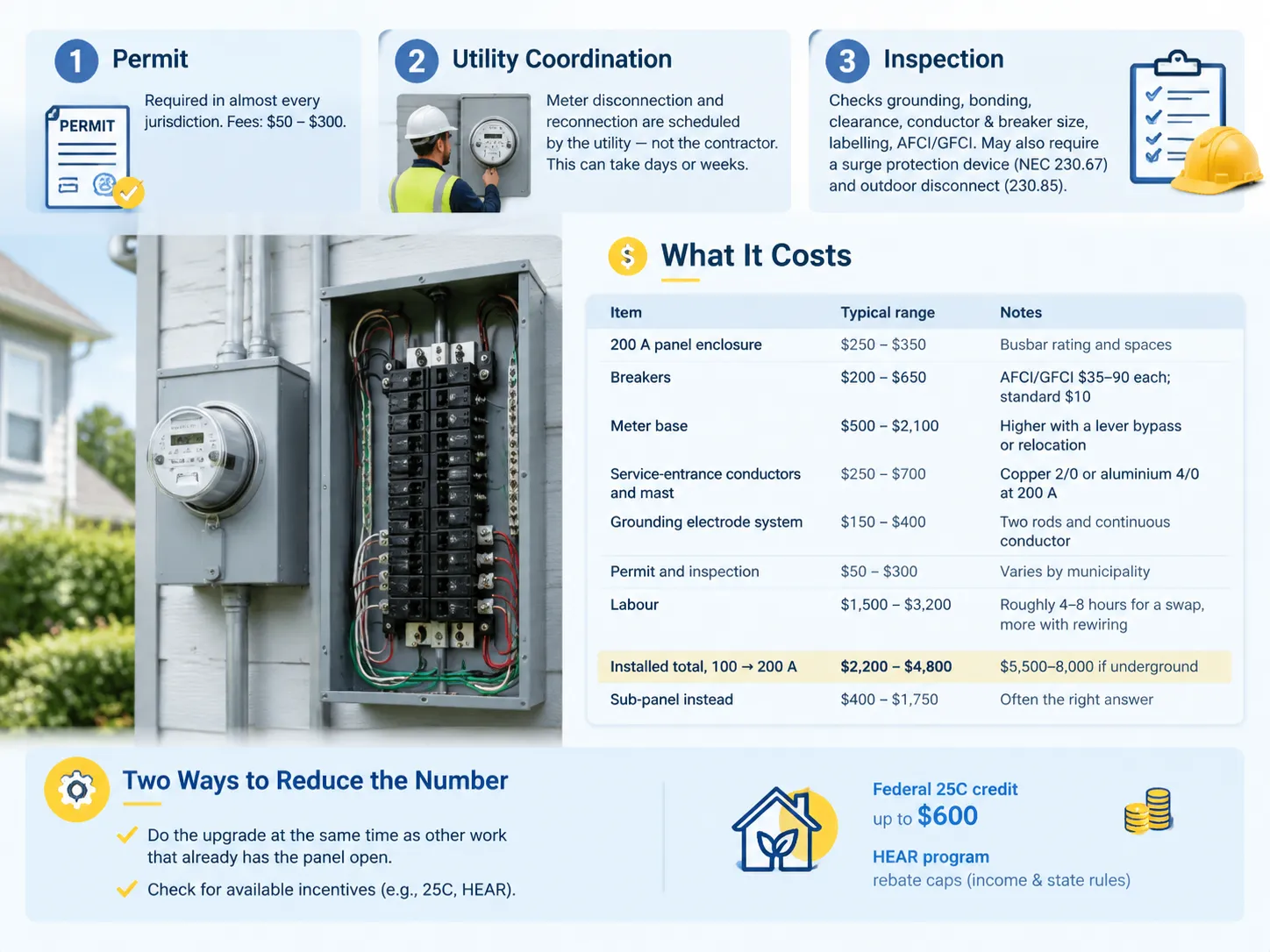
The permit is a requirement for service modifications in almost every jurisdiction. The cost ranges from $250 to $1,000 for residential work, and the inspection is mandatory!
The utility meter has to be connected or disconnected by the utility company. This means that there will be a waiting time which is not controllable by the contractor. It may take several days or weeks which depends on how much work the utility company has at the moment.
The inspector will check the grounding and bonding as well as the working space, the wiring and breaker sizes and labeling, and AFCI and GFCI protection. In jurisdictions that are relatively new with their codes, the inspector will check for a surge protection device as stated in NEC 230.67, which has been required for homes since 2020, as well as a means of safety disconnection from the grid according to NEC 230.85, if the latter applies here.
Thus, ask each contractor three questions before comparing the prices: does the permit include full service? Is the utility coordination included? Does the base of the meter and the conductors at the entrance include? The price gap that may reach $2,700 mostly depends on the different answers to these three questions.
What It Costs, Line by Line
| Item | Typical range | Notes |
|---|---|---|
| 200 A panel enclosure | $250–$350 | Busbar rating and spaces drive it |
| Breakers | $200–$650 | AFCI and GFCI are $35–90 each; standard $10 |
| Meter base | $500–$2,100 | Higher with a lever bypass or relocation |
| Service-entrance conductors and mast | $250–$700 | Copper 2/0 or aluminium 4/0 at 200 A |
| Grounding electrode system | $150–$400 | Two rods and continuous conductor |
| Permit and inspection | $50–$300 | Varies by municipality |
| Labour | $1,500–$3,200 | Roughly 4–8 hours for a straightforward swap, more with rewiring |
| Installed total, 100→200 A | $2,200–$4,800 | National range; $5,500–8,000 if the service goes underground |
| Sub-panel instead | $400–$1,750 | Often the right answer when capacity is fine and spaces are not |
Two methods by which the number can be decreased without skimping, namely conduct the upgrade when other work is already being done and check for applicable incentives such as the federal 25C credit for $600 towards a panelboard of 200 A or more or rebate caps for HEAR Program for the electric load service centre which is limited by income and state regulation. Since changes happen often due to new laws, checking the existing program is advisable instead of relying on some blog.
Maintenance After the Upgrade
There is nearly no requirement for a new panel, and the little requirement for the panel is overlooked by everyone.
The circuit board directory should be labelled while handing over the board to a homeowner as doing so is a mandate by the law, and it is among the most useful things that the homeowner gets by the process of installation.
Torque checking of the main lugs is something done only once while installing the panel. A loose neutral in the service can trigger a fire that shows no sign until it happens. If the panel is more than 5 years old and has never been opened, the service is worth it as it takes the electrician only an hour of work to do it.
A thermal scan of the panel should be performed every few years as long as the panel is under load or whenever there is any malfunction in the house. A warm lug can be detected much before it breaks down.
The area in front of the panel must be kept clear. The working clearance must be 30 inches wide, 36 inches deep, and 6.5 feet high as per law.
Where a plant room or a commercial installation has a full switchboard rather than a residential panel, the routine becomes the structured maintenance programme that switchgear technical service covers rather than a homeowner checklist.
Where the Enclosure Hardware Comes From
It is important to recognize the distinction made here.
According to the laws of America, when we refer to residential service panels, we must mean UL 67 certified panels. Recognizing this, it becomes apparent that products by RUY Power are decent substitutes for UL 67 certified products, however, not for the service panels mentioned above since RUY is not in the manufacturing of panelboards.
In fact, the company produces the surrounding hardware, such as distribution enclosures, industrial power distribution systems, energy meters for multi-unit buildings as well as low-voltage electrical assemblies. The OEM and ODM programme exists for buyers who need a specific enclosure configuration built to their drawing rather than taken from a catalogue.
The product for an individual family panel replacement is not what you need in this situation. However, for a builder finishing a building, a workshop that needs installations, or a retailer looking for distribution, that is the product. Furthermore, it is vital to understand what conversation you are having to avoid useless questions from both ends.
FAQ
How much does it cost to upgrade your home electrical panel?
A range of cost from $2,200 to $4,800 across the country for an upgrade from 100 Amps (A) to 200 A. Most jobs will cost in this lower middle range. The cost of the panel is only a few hundred dollars, around $250 to $350. Most of the cost is for breakers, the meter base, service conductors, grounding, permit, and labor. When upgrading from an overhead to an underground service, a millionaire price of $5,500 to $8,000 can be a realistic estimate.
Can a homeowner upgrade their own electrical panel?
In numerous places, this is not true. The service lugs remain energized even when the main breaker is off. The utility must disconnect and reconnect it, and a permit and licensed contractor are usually necessary before the inspection can proceed. Even in cases where owner-work is allowed, an unpermitted service change creates an insurance and resale issue that is more important than the cost savings.
What is the 80% rule for electrical panels?
A circuit breaker has a rating, which stipulates that its continuous load (which is considered a load that lasts 3 hours or more) should not exceed 80% of the rated value. Taking a service with a rating of 200 A as an example, that means we can have up to 160 A in terms of continuous load, which equates to 38.4 kVA. That explains the reason why an electric car charger that works for several hours takes as much power from the 200 A service as it does and why load calculations are based on continuous amps instead of the total of the circuit breaker handles.
Can I upgrade my electrical panel without rewiring my house?
Absolutely; in fact it is the usual scenario here. Remodeling the electrical panel means installing new equipment while reusing the existing circuits; the wiring in the wall is left untouched. Rewiring is a different job and usually only needed when the wiring is faulty, unsafe or no longer workable. If the circuits are made of aluminum wires or of cloth-insulated conductors, their state will be determined with the price quote for the panel electrical work.
References
- The Home Depot — Electrical Panel Upgrade Services
- Palmetto — Upgrading Your Electrical Panel
- NFPA 70 — National Electrical Code, Articles 220 and 230
- UL Solutions — UL 67 Panelboards
- U.S. Department of Energy — Home Electrification and Appliance Rebates
Conclusion
The question regarding panel upgrade involves conducting a load calculation and analyzing the space available, and none of these are dependent on the design of the panel. Carry out the calculations according to your expected requirements from the panel in the next ten years and conduct the space calculation keeping modern AFCI and GFCI codes in mind and define if the equipment is dangerous per se.
Subsequently, make sure to get three quotes that encompass the same jobs including obtaining the permit and coordination with the utility. It is most probably that the difference between the least and the costliest option will explain these two points and not the hourly rate.