
Argentina is a more challenging market than other Latin American markets when it comes to medium voltage Switchgear for a multitude of reasons, including availability of the equipment. Argentina has a great domestic manufacturing infrastructure as well as established distribution practices for 13.2 kV and 33 kV voltage equipment, an import licensing bureaucracy that may take up to several months more, and a number of IRAM Standards that are based on IEC standards. However, the two standards cannot be compared directly. Therefore, as soon as buyers attempt to purchase the medium voltage Switchgear in Argentina like they would in other countries, they realize that they have faced all four kinds of problems by the time they receive their order six weeks later.
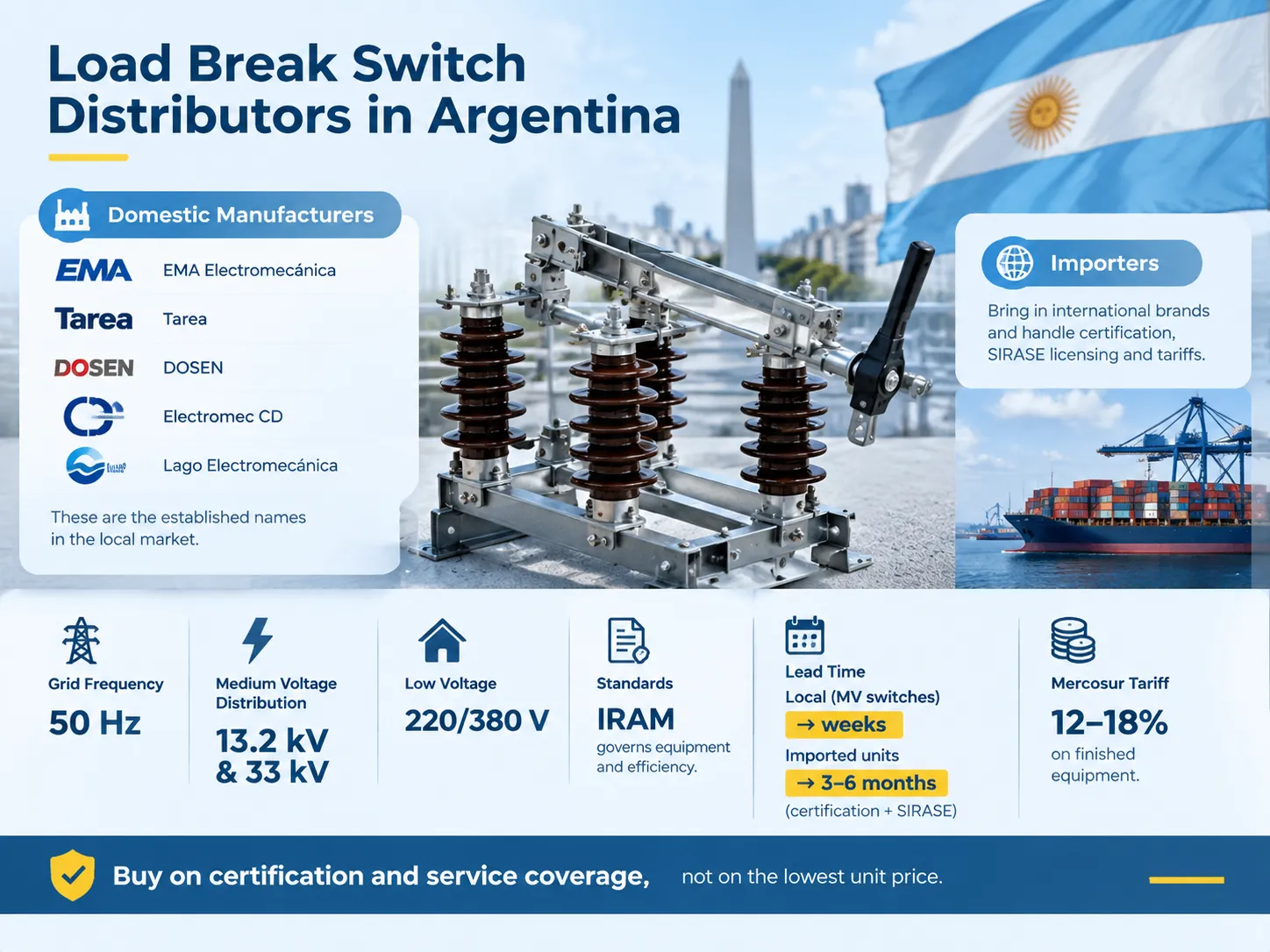
In conclusion, load break switches can be purchased from both local and international manufacturers. There are several companies in the local market such as EMA Electro Mechanical, Tarea, DOSEN, Electromec and Lago Electromecanica who manufacture this type of switch. There are also many products available in the market from international manufacturers such as companies based in Europe and North America. The electrical installations in Argentina operates at 50 Hertz and medium voltage 13.2 and 33 kV. The lower voltages are 220 and 380 V. Apparatus needs to comply with the IRAM standards. The manufacturing time of medium voltage load break switches is one week. Imported devices will need 3 to 6 months for certification plus obtaining SIRASE import permit. The import tariff for complying imported devices will be approximately 12-18 percent.
First, the Distinction That Causes Most Wrong Orders
Load break switch is neither isolator nor circuit breaker, and Spanish terminology in Argentina adds confusion. There are three devices with three functions.
- Load break switch (LBS/seccionador bajo carga) – it is able to open and close the circuit during normal loads and has the specific making and breaking load capacity, and sometimes making capacity with respect to short circuits. Load break switch is a switching device and not circuit protection device.
- Isolator/disconnector (seccionador sin carga) – it gives a visible disconnection for maintainance, and as such, it should not interrupt load current and it works only after the circuit is de-energized.
- Circuit breaker (interruptor automático) – it is the device that interrupts short-circuits. Circuit breaker is the only device out of the three mentioned ones that protects the circuit.
In the usual electric farmer distribution in Argentina all three devices are connected in series: the circuit breaker is used for protection from faults, the load break switch is used for operational switching, and the isolator makes a visible disconnection. Using the word “seccionador” without explaining the desired type leads to delivery of a device that is unable to disconnect the load or clear a fault. The practical difference in behaviour, and why the wrong one is dangerous rather than merely inconvenient, is set out in this look at a 12 kV metal-armored switchgear assembly built around a load break switch.
How the Argentine Grid Is Actually Built
Four technical facts shape every specification in the country.
| Parameter | Argentine practice |
|---|---|
| Frequency | 50 Hz |
| Low voltage | 220/380 V (IRAM standards also reference 231/400 V for new distribution transformers) |
| Medium-voltage distribution | 13.2 kV and 33 kV |
| Subtransmission | 13.2 kV, 33 kV and 66 kV — with 66 kV declining in use |
| Regulator | ENRE (Ente Nacional Regulador de la Electricidad) |
| Standards body | IRAM (Instituto Argentino de Normalización y Certificación) |
The primary voltage in urban areas is 13.2 kV as Edesur’s medium-voltage distribution network in southern Buenos Aires operates at this level, before being reduces to 220/380 V at 50 Hz at the connection point. The voltage of 33 kV is also used for the subtransmission and some regional distribution systems, while 66 kV is still being used, but phased. You cannot tell exactly what you are quoting if you are quoting a switch for usage in Argentina without knowing what voltage level the switch works at, whether 13.2 or 33 kV.
The importance of standards is on par with that of voltage in power supply. IRAM 2476:2017 covers three-phase oil-immersed subtransmission transformers that operate at nominal voltages of 13.2, 33 and 66 kV with power rating up to 20 MVA, IRAM 2269:2015 covers single-pole-mounted transformers that are powered at primary voltages of 13.2 kV or 33 kV and have a secondary voltage of either 400 or 231 V, while IRAM 2250:2013 covers distribution transformers with capacity from 25 to 2,500 kVA. The standard IEC 60076 has been adapted as IRAM-IEC 60076. The IEC 62271 standard is used for switch gear products, while the utility companies use IRAM certification. A switch that meets the IEC standards for switch gear construction but has not been certified by IRAM cannot participate in the tendering process.
The regulation friction is the reason why current urban distribution network modification projects in Argentina tend to be designed according to the already existing technologies. The constraint is familiarity and interchangeability, not performance. How that plays out in practice is visible in medium-voltage distribution work for urban grid upgrades.
The Domestic Manufacturers Worth Knowing
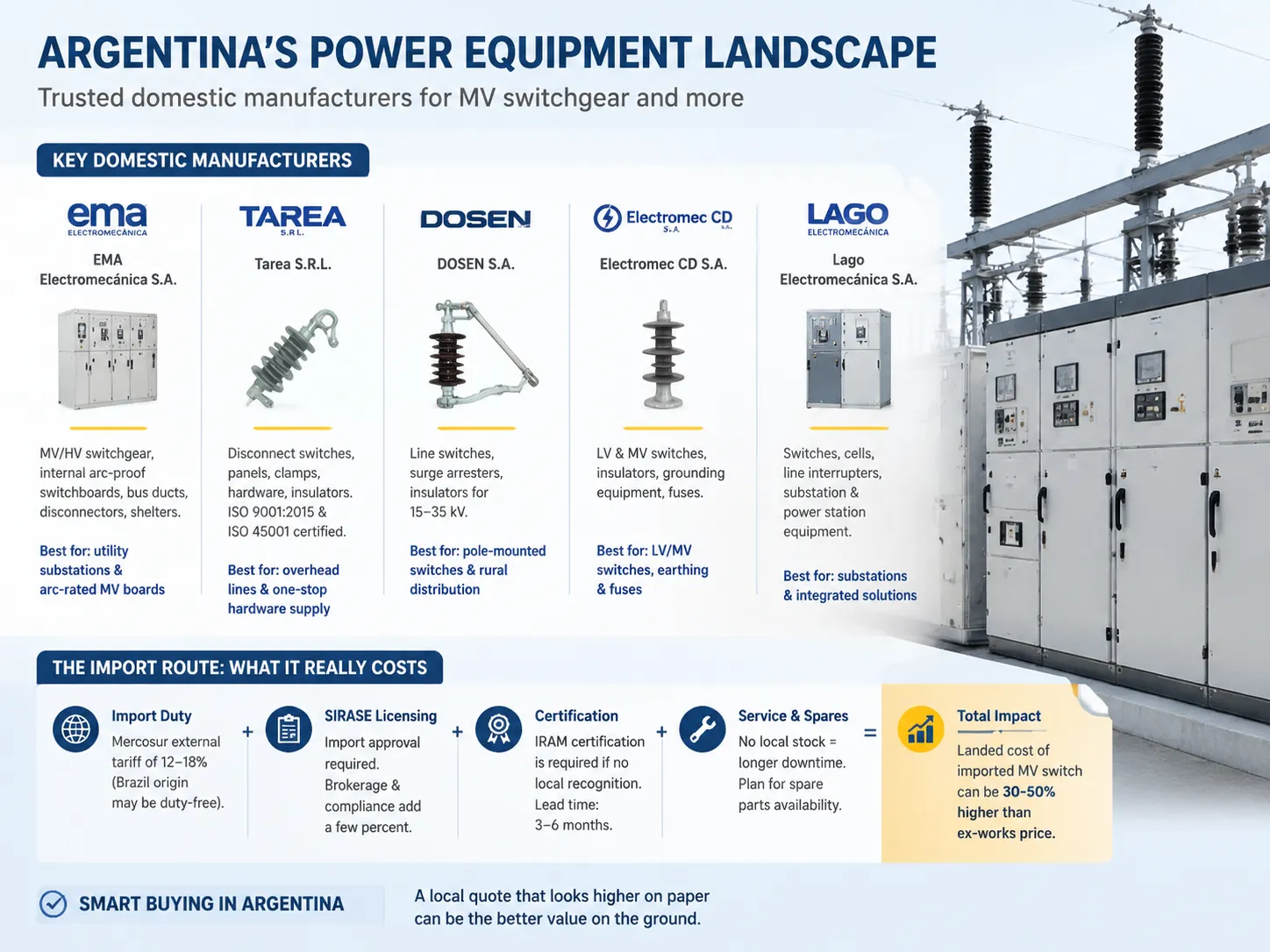
Argentina has a surprisingly strong domestic electrical equipment industry for its market size, and this accounts for most of the medium-voltage switchgear purchased for the country. These are the known companies and their product offerings.
EMA Electromecánica S.A.
Based in Florida, Buenos Aires, and the most significant national manufacturer in the field of electrical switching equipment. A remarkable presence in Argentina’s market for over 70 years and over 25 years in the USA and Latin America supplying the equipment. The product line consists of medium voltage and high voltage switches, rapid elimination switches, internal arc-proof switchboards, insulated and non-insulated bus ducts, high voltage isolators, weatherproof and secure solutions for electrical power stations. Its products are applied to generation, transmission and distribution projects.
Ideal for utility substations, internal strike-rated MV switchboards, and any project with a high importance of local manufacturing and service provision in assessing the final performance of electrical switching equipment used.
Tarea S.R.L.
The company has its headquarters in Llavallol, Buenos Aires, and it is a domestic producer of disconnect switches, panels for electricity, and a comprehensive set of hardware and clamps for overhead transmission lines. It also offers products made by other companies including patented brands. Quality control has been acknowledged with ISO 9001:2015 certification since the year 2018 as well as ISO 45001 and the company has its own test laboratory available for use. The company represents a brand of insulators Maurizio and Cerâmica Santa Terezinha.
Suitable conditions for work: jobs related to overhead line, operations and installations of MV and LV switches, as well as orders which need insulators and switches from one supplier instead of three.
DOSEN S.A.
This company was established in 1993 and is based in Caseros, Buenos Aires. Currently, it functions as a subsidiary of Lago Electromecánica S.A. It produces switches, surge arresters, and insulators for LV, MV, and HV, including autoload disconnect switches in 15, 27, and 35 kV, as well as one-pole switches at 15 and 35 kV, and polymer surge arresters in the range of 3–36 kV.
The best options: pole-mounted and line switches in voltages from 15 to 35 kV.
Electromec CD S.A.
Having more than 15 years of experience in low and medium voltage switches, insulators, grounding elements, and fuses, Quilmes is a great manufacturer located in Bernal. Although it is smaller in size than EMA, it has been a consistent supplier in the LV/MV switch industry.
The best products offered by Quilmes are LV and MV switches along with the earthing devices and fuses strictly meant for industries and distribution work.
Lago Electromecánica S.A.
The company produces switches, three-pole switches, batteries, line disconnectors, and the equipment for both power stations and substations. Moreover, it is now the parent of DOSEN.
Suitable for buyers whose requirements are related to equipment from a single manufacturer for substations and power stations, including switches and batteries.
The Importer Route, and What It Really Costs
It is an accepted practice to buy from an international brand via an Argentine representative, especially for high-voltage classes or equipment matching installed platforms. The operation of this commerce astonishes people.
- Mercosur’s common external tariff. The finished electrical equipment imported from non-Mercosur countries is subject to a common external tariff that ranges from 12% to 18% of its value. Electric equipment manufactured in Brazil can be imported without paying any tariffs according to the rules of origin established in the Mercosur agreements, which provides Brazilian manufacturers with a competitive advantage.
- SIRASE import license. The customs clearance process requires permits from SIRASE. Import license and customs clearance expenditures make several percent of the imported goods’ cost. The time required for getting approval for delivery of the modified equipment is usually very long, comprising from three to six months.
- Certification. The IRAM route must be obtained for the imported products and it is a project itself and not just an accomplishment of formality.
- Service provision. An imported switch that does not have local spare parts for repairs has an average repair time of about six weeks.
The reason for the commercial importance of this information is that the landed cost of an imported MV switch may exceed the ex-works price by about 30% to 50%.
What Load Break Switches Cost
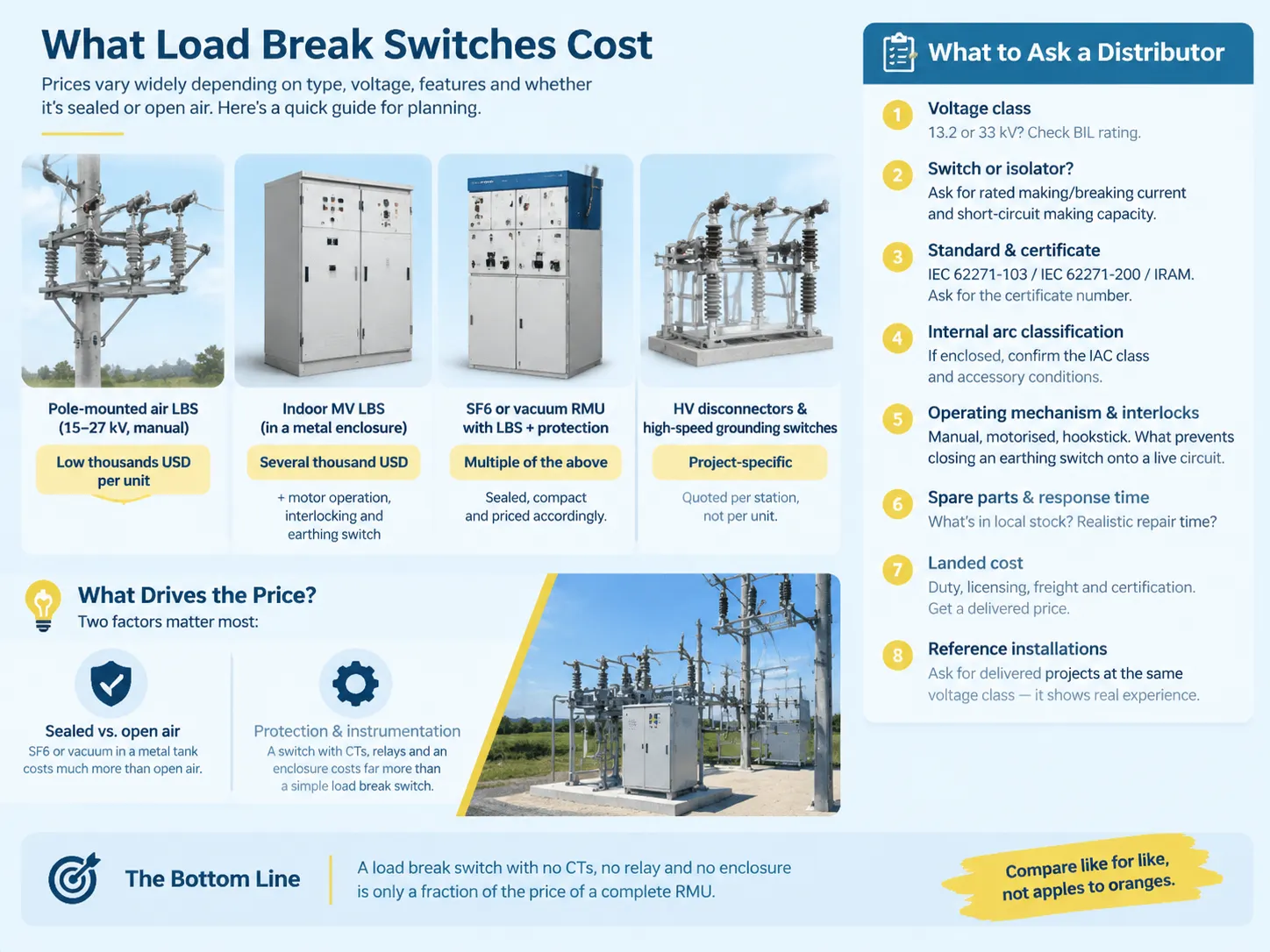
Order-of-magnitude pricing, for planning rather than for a budget line:
| Category | Typical range | Notes |
|---|---|---|
| Pole-mounted air LBS, 15–27 kV, manual | Low thousands USD per unit | The volume product; price moves with current rating and whether it is gang-operated |
| Indoor MV LBS in a metal enclosure | Several thousand USD | Add for motor operation, interlocking and earthing switch |
| SF6 or vacuum RMU with LBS plus protection | A multiple of the above | A different product category — sealed, compact, and priced accordingly |
| HV disconnectors and high-speed grounding switches | Project-specific | Quoted per station, not per unit |
Two factors come into play that hugely affect the number: whether the device is sealed (i.e., SF6 or vacuum in a metal box) or open air, and whether it encompasses a protection system and instrumentation or is referred to simply as a switching equipment. A load break switch devoid of CT, relay, and enclosure is just a fraction of the cost of a full RMU, hence putting them on the same level of comparison is widely regarded as an error in procurement that occurs most frequently in this domain.
What to Ask a Distributor
- Specify which voltage class you want, 13.2 or 33 kV, as well as the BIL rating for your network.
- Determining whether it is a switch or isolator is important. Request for the rated current breakdown and inquiry of its short-circuit capacity. Anytime a device doesn’t mention breaking capacity, it becomes isolator.
- Be inquisitive about the standards, certificates, and IEC certification, namely IEC 62271-103 for switches, IEC 62271-200 for metal cladded switchgear. Go for a certificate number.
- If it’s a closed circuit, you have to make a reference to internal arc safety standards.
- The question of the mode of operation of the unit remains. Check if there are mechanical/hydraulic means of operation and if there are interlock systems.
- Spare parts availability is crucial to ensure the reliability of the installation. Request what is in stock locally and learn what the reasonable downtime/repair time for the unit is.
- The landed cost should be determined rather than ex-works. Don’t forget to include duties, license fees, shipment, and certification in the final cost.
- Reference projects claimed to be at the same voltages provide the most reliable indicator of the supplier’s efficiency in terms of execution of similar tasks.
That last point is worth more than it sounds. A portfolio of delivered medium-voltage distribution systems shows the constraint each project was solved under — the voltage, the configuration, the environment — which is precisely the information a specification sheet leaves out.
Where RUY Fits in This Market
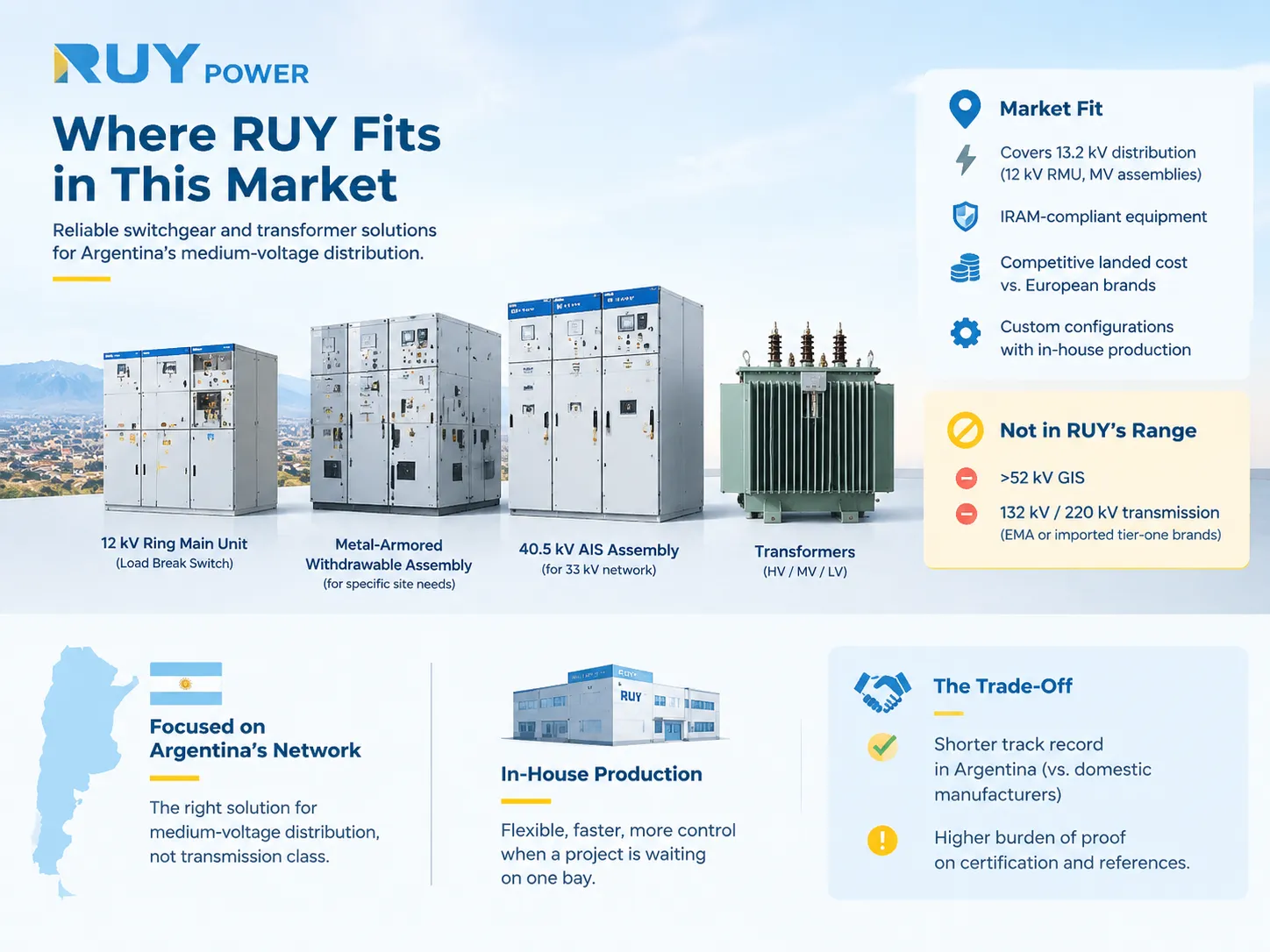
RUY Power is a Chinese company producing complete switchgear of high, medium and low voltage, prefabricated substations and transformers. In terms of the Argentine context, the company is involved in distribution and not in transmission level.
The relevant products map onto the 13.2 kV reality directly. A box-type ring main unit for 12 kV distribution is the compact switching and protection assembly that most Argentine urban and industrial MV rooms need, built around a load break switch configuration.In case the site requires a metal-armored withdrawable assembly rather than a sealed unit, the available options in this category can fulfill such needs. The first station above the 12 kV level is 40.5 kV AIS, which meets the needs of 33 kV grids.
However, RUY lacks a high-voltage GIS lineup above 52 kV, and since for the transmission of 132 kV or 220 kV in Argentina the only viable option is EMA or either the imported tier-1 brands, knowing this limitation is much more helpful for the client than the statement of an all-encompassing offer. What the company can be proud of is its manufacturing competence: such production of the high-voltage as well as medium-voltage switchgear and low-voltage equipment allows it to deliver something with non-standard parameters which cannot be done by a trading organization here a waiting bay is required.
From a commercial perspective, RUY suits buyers who seek IRAM-compliant solutions with cost lower than that of the European brands, whose specifications are developed regarding their networks rather than the catalogue.
A Short Selection Framework
- Check the voltage and frequency of the device. 13.2 or 33 kV, 50 Hz. All references to 60 Hz indicate an entirely different product.
- Consider the device type. A protection breaker, LBS switch or a disconnecting isolator. Choose accordingly.
- Comes the standard and certification. It must meet IEC 62271 specifications utilizing IRAM certification to be considered in the tendering process.
- After that the total landed cost must be calculated. What does the tender process imply about domestic or foreign sourcing in terms of customs duty, licensing, and certification timing?
- Comes the service offered. Is there access to local stock or technicians, and a spare parts provision that allows for satisfactory repair turnaround times.
- Comes the references. Have they used similar voltage devices under comparable conditions before?
There comes the price, which is the simplest part as once the first five points have been determined making price negotiations easier.Where the specification is genuinely non-standard, the manufacturing question also becomes decisive — a supplier who controls switchgear manufacturing from HV and MV complete sets through to low-voltage assemblies can hold a delivery date on a custom bay in a way that a trading house cannot.
FAQ
What is a load break switch and how is it different from a disconnector?
The load break switch is able to open and close a circuit with load current since it is rated for making and breaking. The disconnector, however, is not rated for load current interruptions; it has to be used only when the circuit is already out of service. It can therefore take on the function of providing a physical break for maintenance purposes but cannot be used to switch on the live current. However, neither device is capable of interrupting fault current — this is done by the circuit breaker.
What voltage classes are used in Argentina?
Medium voltage distribution uses either 13.2 kV or 33kV. 13.2 kV is widely used in urban networks such as the network of Edesur in Greater Buenos Aires. Subtransmission uses 13.2, 33, and 66 kV, but it is true that 66 kV becomes less and less popular. The low voltage used is 220/380 V, while there is a grid frequency of 50 Hz instead of 60 Hz.
Which standards apply to switchgear sold in Argentina?
The following IEC 62271 series serves as operating performance reference – where IEC 62271-103 covers switches, IEC 62271-200 is for metal-enclosed assemblies and IEC 62271-100 for circuit breakers – with the certification of IRAM being the essential requirement of utility and industrial procurement in order to accept tenders. Hence, for transformers, IRAM 2250, 2269 and 2476 govern their characteristics while IRAM 2240:2021 specifies their efficiency requirements. IEC 60076 has been made an IRAM-IEC 60076 specification.
How long does delivery take?
Medium-voltage switches that are produced within the country typically take weeks to deliver. Equipment that is imported incurs freight charges and has to wait for permits, and SIRASE import licensing which can take anything from three to six months. For the particular case of imported configurations that are custom-made, a well-calculated timeframe of delivery is usually in the range of four to six months. Anyone promising shorter delivery times needs to provide a plausible explanation.
References
- EMA Electromecánica S.A. — Argentine manufacturer of medium and high-voltage switches and metal-clad switchboards (BIEL exhibitor profile)
- Tarea S.R.L. — disconnect switches, panels and overhead line hardware, ISO 9001:2015 certified (market directory profile)
- BIEL Light + Building Buenos Aires — Argentine electrical industry exhibition and exhibitor directory
- ENRE — Ente Nacional Regulador de la Electricidad, Argentine federal electricity regulator
- IRAM — Instituto Argentino de Normalización y Certificación, national standards and certification body
- CAMMESA — Argentine wholesale electricity market operator and grid data
- International Electrotechnical Commission — IEC 62271 series for high-voltage switchgear and controlgear
- IndexBox — Argentine electrical equipment market analysis, import tariffs and licensing context
Conclusion
The four questions that must be answered correctly when you buy load break switch in Argentina are: what is the voltage level, what is the type of equipment, what certification is being met and who provides a service. If the answers to these questions prove to be correct, then the supplier such as EMA, Tarea, DOSEN, Electromec CD, Lago or even an importer like RUY Power becomes a commercial choice rather than an uncertain gamble from the technical point of view. The market is rather beneficial for those buyers who are willing to really consider the time frames for certification and obtaining necessary licenses, while penalties are imposed on those who concentrate only on the comparison of ex-works prices and take it for granted that the sum of money needed for customs clearance is the difference of these prices.