
An official rankings list does not exist for manufacturers of switchgear. Moreover, any such list which does not explain how it measures manufacturers’ achievements will not be much help for buyers looking for suppliers of this equipment. The clear answer, however, is that top ten manufacturers depend on the voltage level of the equipment, the part of the world where it will be purchased, and whether the overall revenue from electric production is taken into account or only switchgear sales. In this article, we provide a relevant ranking, explain how it has been formed, and have a special paragraph about how to understand which segment of the market you belong to.
Switchgear manufacturers are not ranked officially. If such a list is available without explaining the metrics behind the ranking, then it won’t be of much use to potential customers. However, there is a straightforward answer as to which manufacturers can be considered the best. The answer depends on voltage level, the country where the equipment is bought, and whether or not the revenue from electric appliances is included in calculations. In this article, we will share the latest rankings, explain how we formed them, and have a separate section on how one can determine which kind of switchgear producer they need.
How These Rankings Are Built, and Why They Disagree
There are three reasons that make it harder to produce a “top 10” list.
To begin with, the issue of scope. Schneider Electric manufactures a variety of products apart from switchgear such as building management systems, automation, software, drives, etc. When some rankings account for switchgear revenues into total revenues, they come up with billions of dollars. Others only count revenues related to switchgear alone, resulting in billions of dollars in revenues. Both are correct but cannot be compared. According to Report Prime, Schneider Electric is going to have revenues of approximately $ 37.5 billion related to switchgear in 2024, while according to Market Intelo, ABB will make around $ 12 billion in switchgear revenues only in 2025 and Schneider’s results for the same year will be around $8.9 billion. Although the same companies are mentioned, the figures are very different.
The second reason is voltage class. Medium voltage panels are different from high voltage insulated substation devices, therefore ranking companies on HV switchgear will lead to Siemens, ABB, Schneider, GE Vernova, Mitsubishi Electric, Hitachi Energy, Eaton, Toshiba, Hyosung and Meidensha being in the first place. A general ranking will include companies from China, India, and others. Medium voltage is the fastest growing in the market at around 34.2% of the market and 7.2% CAGR, therefore how companies are ranked depends on the list you see.
Last but not least is methodology. CAGR index counts revenues, growth rates, geography, patents momentum and other factors differently, and since the interviews are not public, treat any ranking list as a starting point.
For a comparison of how the same analytical problem is handled in an adjacent market, this list of the leading transformer manufacturers worldwide shows the same pattern — the ranking depends on whether it is power transformers or distribution transformers being counted.
The Ten Leaders, By Composite Switchgear Revenue
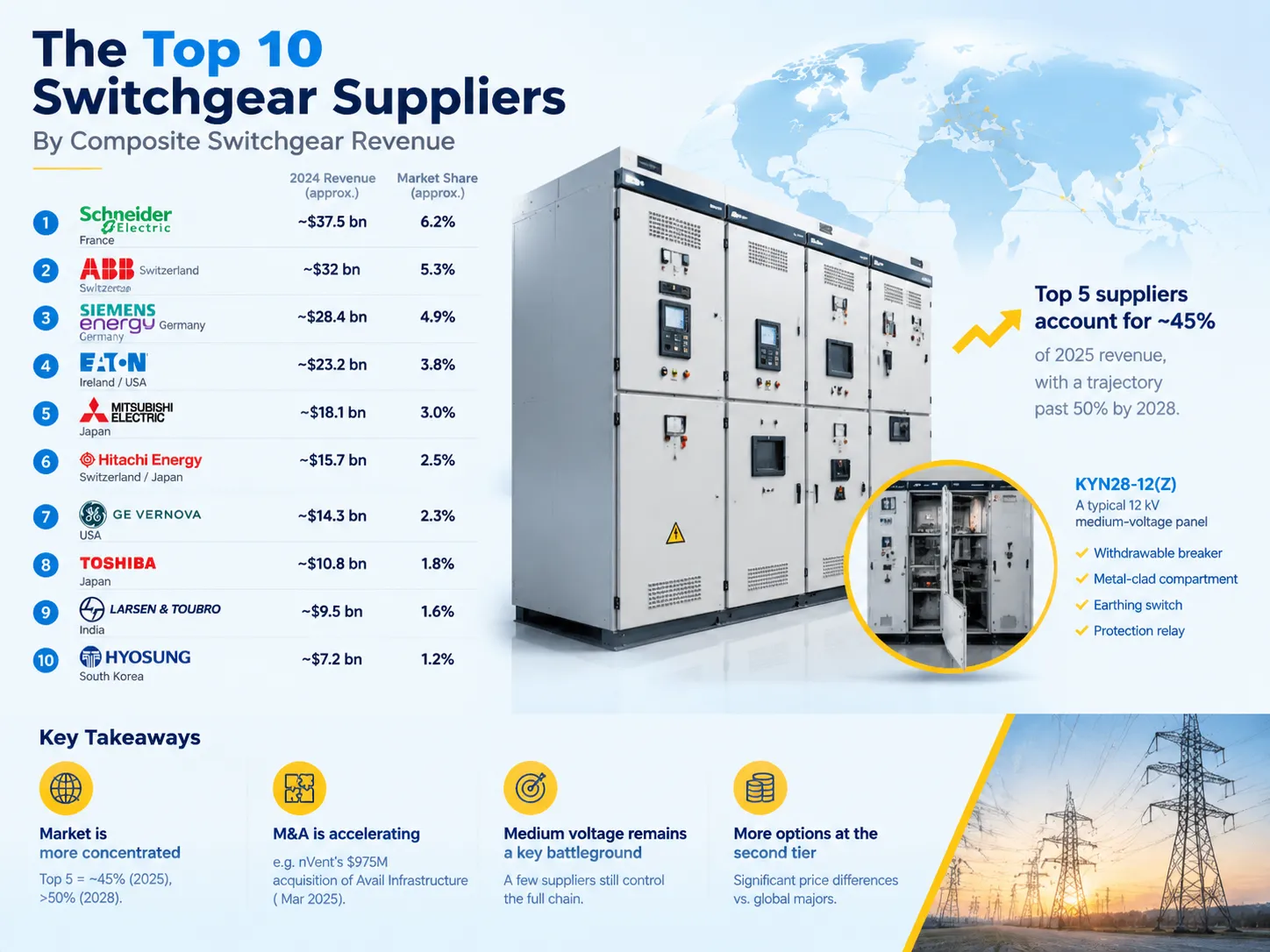
The following are the 2024 switchgear forecasted sales and market shares included in the Report Prime’s composite index. These are meant to be used as an estimate of the scale of operations of the particular companies rather than numbers quoted by them.
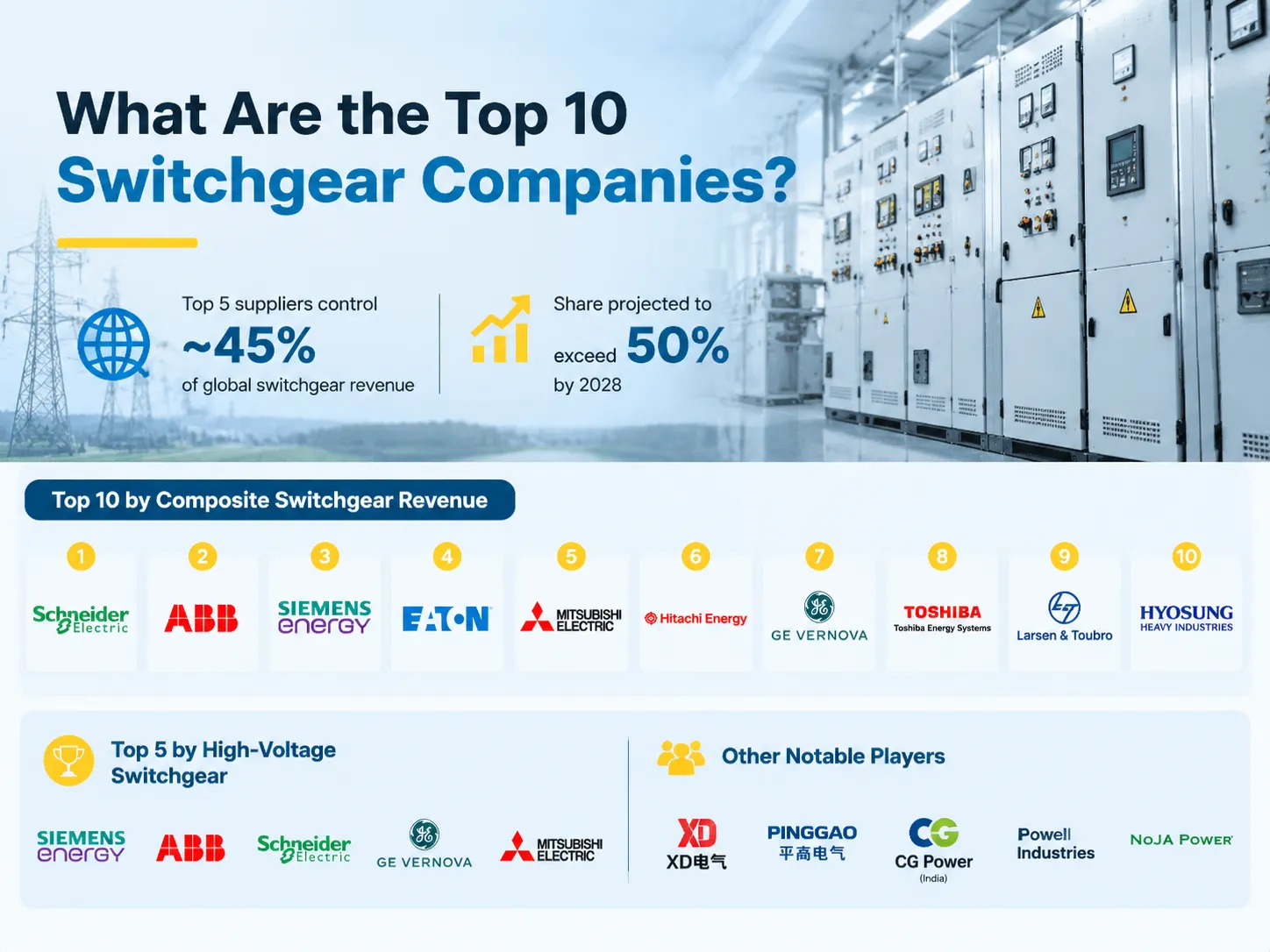
- Schneider Electric (France). ~$37.5 billion, ~6.2 % market share, approximately 162,000 employees. This company’s products include SM6 GIS panels and EvoPacT vacuum circuit breakers for the mid-voltage range with EcoStruxure Power digital layer as the top tier. The firm’s clientele includes EDF, Walmart, and SEC. Strength: the broadest catalogue in the market and a sound digital ecosystem. Weakness: inherent complexity of portfolio integration and premium pricing.
- ABB (Switzerland). ~$32 billion, ~5.3% market share. The company offers ZX2 AirPlus gas-insulated switchgear, UniGear Digital, and Relion protection relays. Its customer base includes companies such as E.ON, Google, and Petrobras. Strength: digital switchgear technology and monitoring capabilities. Weakness: higher material costs and a constantly optimizing portfolio.
- Siemens Energy (Germany). ~$28.4 billion, ~4.9%. The company offers 8VN1 Blue GIS and Sensgear products using SF6-free technologies. Its customers include RWE, Statnett, and Exelon. Strength: unparalleled integration of HVDC and grid technologies. Weakness: execution issues and pressure from businesses in the renewables market.
- Eaton (Ireland / USA). ~$23.2 billion, ~3.8%.The most powerful company in low-voltage motor control centers and the channel of electric distribution in North America. Strength has the unparalleled penetration into the North American market and contractors that is more crucial than the brand name on a global scale when dealing with projects in the USA and Canada. On the other hand, weakness is the limited presence in high-voltage operations globally, except for various selected markets.
- Mitsubishi Electric (Japan). ~$18.1 bn, ~3.0%. HVDC switchgear and live tank circuit breakers penetrating the markets of utility grids in Asia-Pacific countries. Strength: engineering expertise in equipment for the transmission of electricity to utilities, which has been built for decades in Asia. Weakness: limited presence in Western distribution channels.
- Hitachi Energy (Switzerland/Japan). ~$15.7 bn, ~2.5%. Gas-insulated switchgear and modular GIS and HVDC. Strength: excellent operation in developing ultra-high-voltage equipment and HVDC, as well as in relations with utilities. Weakness: dependence on project business with long lead times.
- GE Vernova (USA). ~$14.3 bn, ~2.3%. Dead tank circuit breakers and automated substations. Strength: the company specializes in the realization of the project and has experience in HVDC. Weakness: the newly spun-off structure is still establishing its operations.
- Toshiba Energy Systems (Japan). ~$10.8 bn, ~1.8%. Hybrid switchgear and modular GIS with voltage level of 1100 kV representing vacuum circuit breakers with voltage of 5–15 kV. Strength: has real experience in both medium-voltage and extra-high-voltage technology. Weakness: mostly sells products in domestic and regional markets.
- Larsen & Toubro (India). ~$9.5 bn, ~1.6%. Medium-voltage equipment and a huge EPC company in India. Strength: the company uses cost-competitive technology and provides local content in India and the Middle East. Weakness: little experience in high-voltage equipment production.
- Hyosung Heavy Industries (South Korea). ~$7.2 bn, ~1.2%. GIS and gas breakers with KEMA and CESI certification and installations in 40 countries. Strength: the company produces compact and sealed units that can be used in coastal, urban, and aggressive environments. Weakness: does not have brand recognition outside of utility channels.
The amount of concentration is on the rise. Based on Mordor Intelligence figures, the top five market players will account for about 45% of the total revenue in 2025, with a trend set to top 50% by the end of 2028. The reason behind it is the high level of consolidation, which was highlighted by nVent’s acquisition of Avail Infrastructure’s electrical products division for USD 975 million in March 2025. This means that buyers will have to deal with a reduced number of independent shareholders providing the same category of equipment.
At the same time, some exceptions in the market are observed in medium voltage, where a small number of suppliers control all aspects of the industry. A KYN28-12(Z) metal-armored withdrawable switchgear panel for 12 kV is a useful reference point for what the segment buys: withdrawable vacuum circuit breaker truck, metal-clad compartmentalisation, earthing switch, and a protection relay package — all of it available from the global majors at a premium and from mid-tier manufacturers at a materially lower price.
Where the Order Changes
Two segments are so different from each other that the composite list is no longer useful.
The high voltage segment is different; the top ten consists of: Siemens Energy ($4.5 billion) with an 8.18% share of the market, ABB ($4.2 billion) with a 7.64% share, Schneider Electric ($3.8 billion) with a 6.91% share, GE Vernova ($3.4 billion 6.18%), Mitsubishi Electric ($3.1 billion) with a 5.64% share, Hitachi Energy ($3 billion) with a 5.45% share, Eaton ($2.45 billion) with a 4.45% share, Toshiba ($2.2 billion) with a 4% share, Hyosung ($1.85 billion) with a 3.36% share and Meidensha ($1.6 billion) with a 2.91% share. Note that Hitachi Energy has moved from the sixth to the sixth position in the ranking, but has a much larger market share now. Meidensha made it to the market ranking, but Larsen & Toubro or Hyosung did not.
The low voltage part of the share is producing a totally different competitive picture as here all the panel builders and distributors compete, and in addition to the tested performance, other factors such as the availability and price of the product and the quality of the panel building as well as assembling become profitable to measure. A modular low-voltage withdrawable switchgear system of the MNS type is the workhorse of this segment — the switchgear brand on the frame often matters less than the quality of the assembly inside it, the busbar work and the protection coordination.
Low Voltage: Where the Brand Matters Least
Low-voltage switchgear is the segment where the top ten list helps least, and where a buyer should think differently.
There are two structural reasons for this. The first is that technology is well established: a withdrawable low-voltage circuit breaker is a commodity element for many decades now and the difference between the branded names of reliable firms at the certain rating is measured by service periods and spare part policies rather than by switching capabilities. The second reason is that the value in a low-voltage assembly is added by the panel builder: busbar sizing and bracing, fault withstand, internal segregation, cable termination quality, protection coordination, as well as the set of documentation that goes along with it.
Therefore, the right question is not which global leading company to buy a product from but who assembles and tests the panel, which standards are applied to this process and what is recorded in the testing reports. Always ask for routine testing files, busbar bracing calculations with respect to potential fault currents and the type-testing documents on the assembly, not only on the unit inside it. It is also vital to keep in mind that mid-scale manufacturers have advantages in this kind of requests during tenders when a low-voltage fixed or withdrawable switchboard produced according to IEC 61439 and properly tested makes the same work that the branded one does, but at a price which is not reasonable for the brand label.
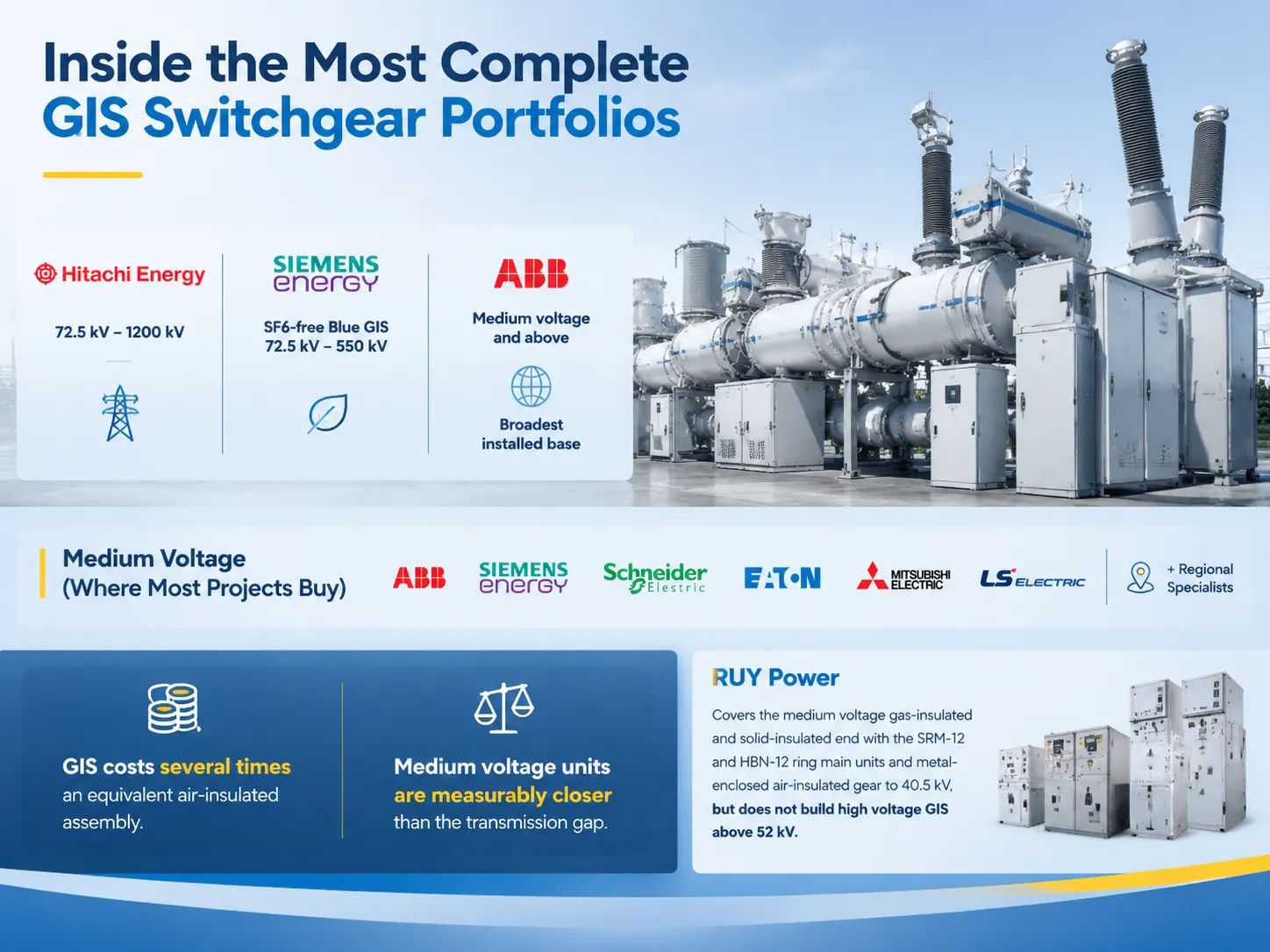
The unique feature of gas-insulated equipment is that it is being changed on the go. Gas-insulated switchgear occupies around 38.6% against 31.4% for air-insulated, 18.7% for oil and 11.3% for vacuum with a global warming potential of SF6 being about 23500 times the one of CO2. ABB launched SF6-free GIS called EconiQ, Siemens Energy creates Blue portfolio with no-fluorinated-gases line, while Schneider Electric tests SM AirSeT equipment (made with purified air). The direction is evident, however, the question arises whether the type-tested SF6-free switchboard exists for the particular rating required in the project.
Compact sealed designs show further development in this respect when it comes to distribution voltage equipment.A fully insulated, fully sealed 12 kV ring main unit in the energy-saving class is a good example of the type — it gives the footprint and the sealed-for-life maintenance profile of GIS without asking the buyer to accept a gas-insulated tank on a distribution feeder that does not need one.
The Challengers Worth Knowing
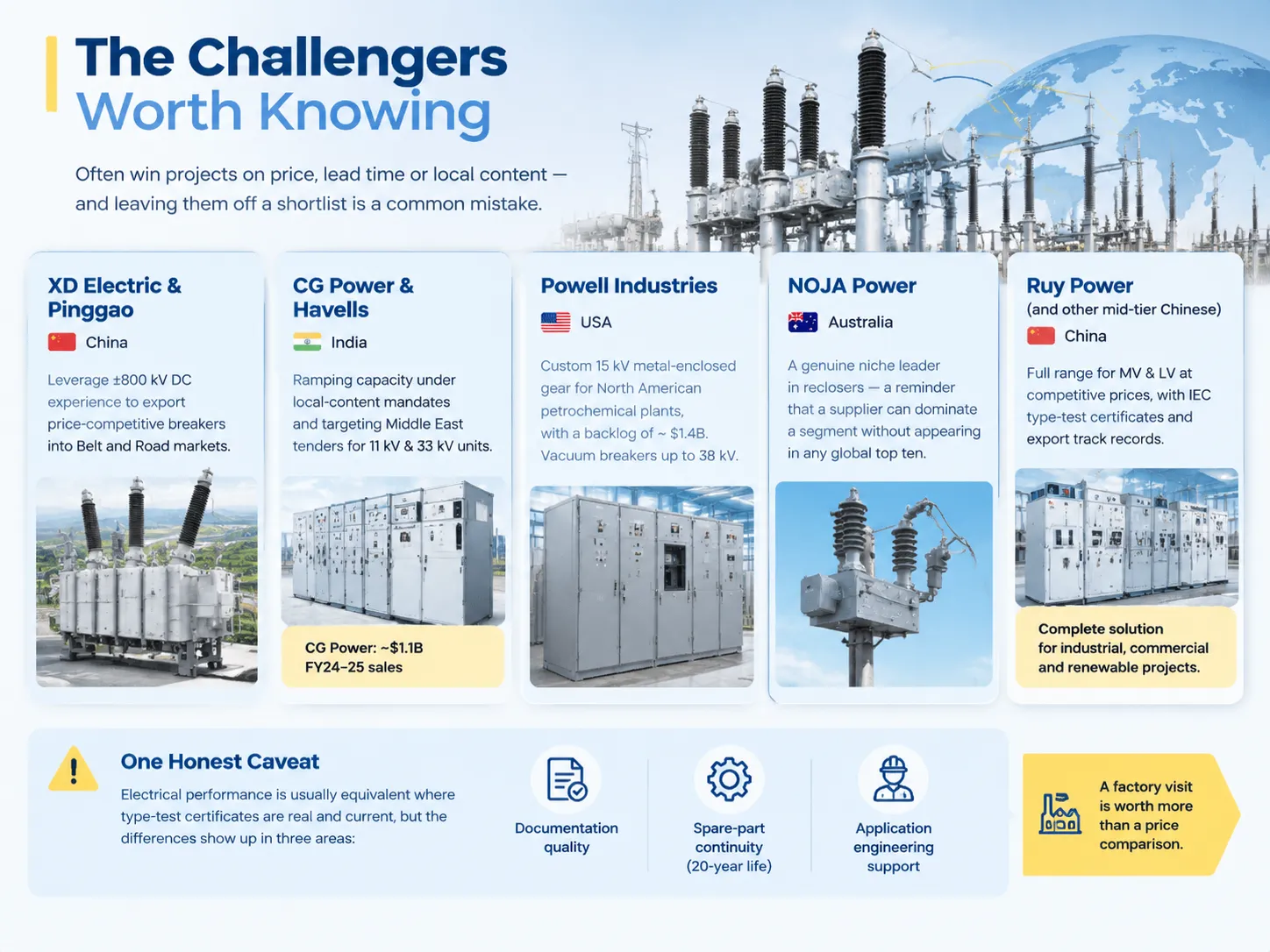
It is often the case that leaving the tier below the top ten off the list is one of the most common procurement errors that occurs because this level often wins contracts based on either price, lead time or local content.
- XD Electric and Pinggao (China) — Utilizing domestic plus/minus 800 kV DC experience to sell competitively priced breakers to Belt and Road countries. The usual method of selling to this segment is where the specification allows Chinese tested equipment and the buyer is prepared to do the certification due diligence.
- CG Power (India) and Havells (India) — Increasing production under local content requirements, tendering for contracts in the Middle East for regionally manufactured 11 kV and 33 kV equipment. CG expects revenues of about USD 1.1 billion in FY 2024–25 on their portfolio of HV and EHV SF6 breakers and GIS equipment up to 800 kV.
- Powell Industries (USA) — Custom-made 15 kV metallic enclosed gear supplied to North American petrochemical plants, having an order backlog of about USD 1.4 billion worth of vacuum circuit breakers up to 38 kV.
- NOJA Power (Australia) — The true niche leader in reclosers — an illustration that a company can dominate a niche market without being anywhere on the global top ten.
- Branch Chinese manufacturers, including Ruy Power. On the medium-voltage side, there is a huge block of Chinese manufacturers that produces a complete layer of products at prices unapproachable for the world’s biggest producers in case of standard products with the IEC type-test certificate and export experience. Among these producers is Ruy Power producing 12 kV and 40.5 kV indoor switchgear, ring main units, insulated switchgear designs and designs of gas-insulated switchgear, switchgear with low voltage withdrawn and fixed boards, compensating capacitors cabinets and ready-made and American style box substations and PV-6 cabinet.
One essential caveat about the challenger tier is that the electrical performance is usually the same when the type-test certificates are correct and up-to-date. Still, the differences are evident when comparing the following factors: quality of the documentation, continuity of the spare parts supply in 20 years of the asset life and the depth of application engineering support. It’s these factors that must be checked during a factory visit instead of on the datasheet.
How to Choose a Supplier for Your Own Project
The process begins with identifying the top ten. Different types of supply chains require different criteria.
- Which configuration and voltage class? The specific supply systems include a 12kV ring main unit, a 40.5kV metal-clad panel, a low voltage MCC, and a 145kV GIS bay. Find out what is included in your scope as the competitors differ at each limit.
- What are the requirements of the local authority? It can request certificates of type tests according to standardized IEC requirements, certificates of arc fault containment class, internal arc classification, ingress protection class and in some cases a certificate of local climate or local content percentage. The listed requirements are enough to remove potential suppliers from competition before the price is even discussed.
- What is the fault level? Short-circuit withstand is a safety criterion not a preference for performance, because it provides much more information about busbar and breaker ratings than the load.
- What is the useful life of assets in question, and who provides support? It is expected that the equipment lives for 25 years, so find out as of year fifteen where spare parts will be coming from and how fast a relay will be repaired.
- Is the equipment part of a larger package? If it has to be compatible with the transformer, control system or PV inverter provided by a third party, being able to communicate with other machines becomes as important as the equipment itself. In most cases, one company provides the layer of equipment without any problems during integration.
Can you check the company? Request all the certification of QMS, processes of manufacturing equipment and testing procedures.
As for the pricing aspect, the indicative lists of price ranges help to prepare a budget without pretending to issue quotes being $3000-15000 for a 12kV metal-clad retractable panel (for each unit), $2000-8000 for a 12kV ring main unit, $1500-10000 for low voltage complete switchgear (for each section) and bays well into six figures for high voltage GIS bays.
As for the practical aspect, it is defined that the layer of equipment is the one where a mid-tier producer is able to compete, while you need to check the manufacturing abilities of the provider in order to make sure that the supplier is trustworthy. That is the logic behind working from how a switchgear factory’s production and testing capability is structured rather than from a brochure — a supplier’s assembly lines, routine test stations and certification scope tell you more about the next ten years than the first price list does.
Frequently Asked Questions
What are the top 10 switchgear companies?
In terms of revenue in composite switchgear, leading firms are as follows: Schneider Electric, ABB, Siemens Energy, Eaton, Mitsubishi Electric, Hitachi Energy, GE Vernova, Toshiba, Larsen & Toubro, and Hyosung Heavy Industries. The leading companies in the field of high-voltage switchgear are (in order of revenues): Siemens Energy, ABB, Schneider Electric, GE Vernova, Mitsubishi Electric, Hitachi Energy, Eaton, Toshiba, and Hyosung. There is no universal authority responsible for the lists. So differences originate from ranging from segment revenue and to switchgear-only revenue in terms of high-voltage as well as low-voltage definitions.
Who is the leading company in the switchgear market?
The definition of market depends from where you look at it. If you look at the composite switchgear revenue, then Schneider Electric took the top place with around $37.5 billion in income as per the composite rankings available in 2024. When it comes to switchgear-only revenue, ABB takes the top position with about $12.8 billion of revenue in 2024, followed by Siemens with around $11.2 billion. However, if you take just the high-voltage switchgear, Siemens Energy holds the top position with around $4.5 billion in 2024. In terms of the total market, the top five accounts for around 45% of the total switchgear revenue for now but this understanding is expected to dramatically change by 2028 reaching over 50%.
Is GIS better than AIS?
Neither is the absolute better solution, as each addresses a different problem faced by sites. The gas-insulated switchgear is compact, hermetically closed and provides reliable operation, which makes it suitable for such cases as planning urban substations, establishing operations in closed spaces, as well as working at coastal and contaminated sites, or any other locations where the area is costly. The drawbacks are the cost and the difficulties of field work inside the closed equipment, as well as the ecological disadvantages of SF6, which is 23,500 times more dangerous than CO2 (greenhouse effect). On the plus side, the air-insulated switchgear is more affordable, simple and convenient in terms of maintenance, and it is a more reasonable option for open areas.
What are the biggest switchgear companies?
The leaders can be called the diversified electrical players — Schneider Electric, ABB, Siemens Energy, Eaton, and Mitsubishi Electric — whose switchgear operations are part of a broader electrical business portfolio. The most important ones that deal with switchgear and grid equipment, in particular, are Hitachi Energy, GE Vernova, and Toshiba Energy Systems. Regional importance plays a role as well — for instance, XD Electric and Pinggao are major companies for the domestic market of China, CG Power and Havells are important in India, and Powell Industries is known in North America. However, the measures of scale and level of recognition are not synonymous; therefore, a company can be huge in a segment, while not being listed in the top 10 of the world.
References
- International Electrotechnical Commission — IEC 62271 series, high-voltage switchgear and controlgear
- NFPA 70, National Electrical Code — switchgear, switchboard and panelboard requirements
- Siemens — switchgear and grid technology documentation
- Schneider Electric — medium-voltage and low-voltage switchgear product ranges
- Hitachi Energy — high-voltage switchgear and HVDC portfolio information
Conclusion
The list of ten is a truly useful and real one; however, it is not a list that implies the same thing from segment to segment. In composite revenue, the diverse powerhouses are in the lead; when it comes to high voltage power only, the positions are reversed; mentioning mid and low voltage, there is a much wider pool of competitors on the market including China, India, and other manufacturers that specialize in providing low pricing, fast delivery and putting focus on local quality. Define what you want to buy, what you need from your local body, how long the equipment should serve, and use the list of companies to find the right option rather than to justify your choice already made.