
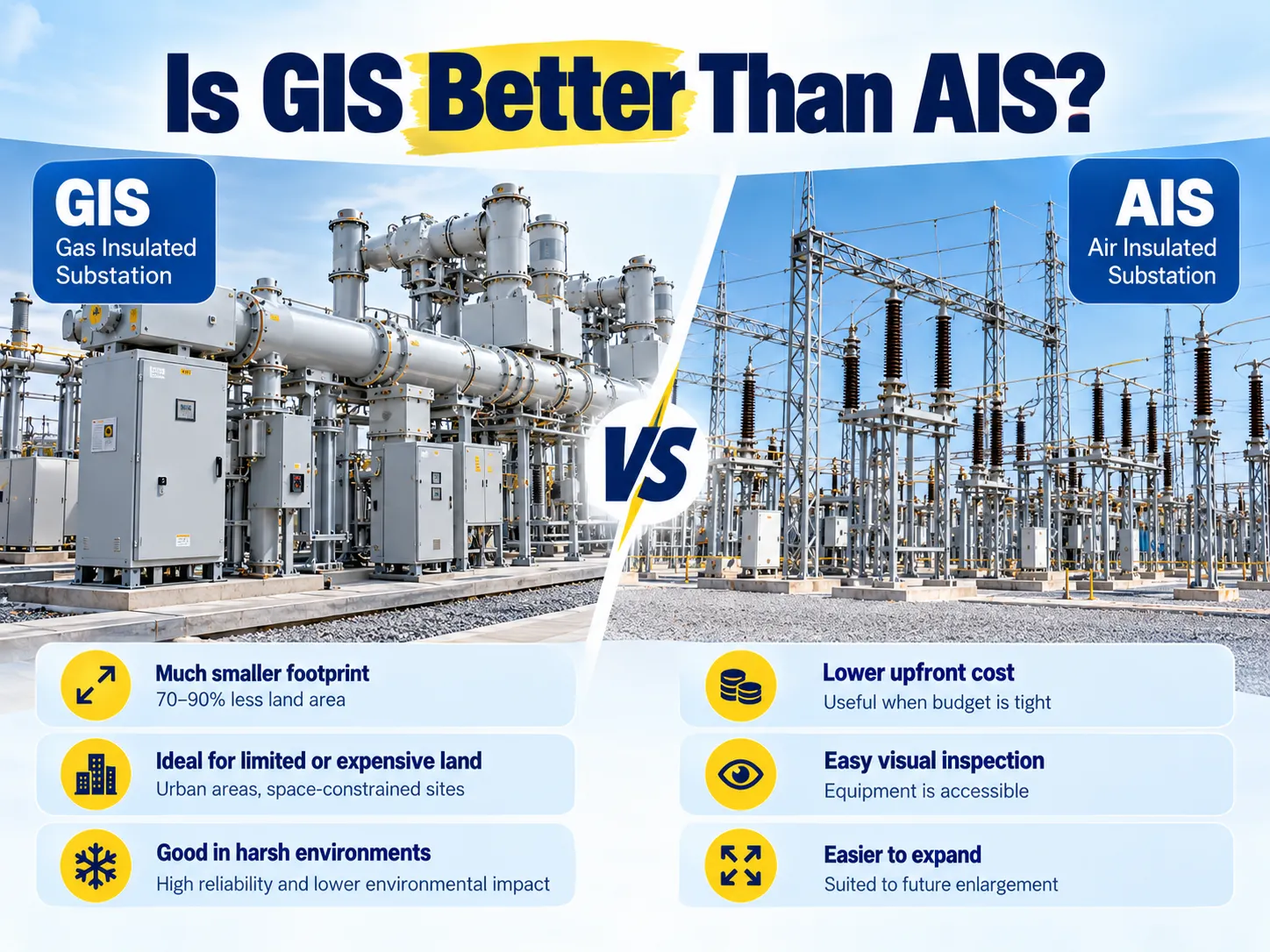
This query pops up invariably during every substation kick-off meeting, but it is often put backward. GIS is not a better form of AIS; it is just a different way of packaging the same components, which include circuit breakers, disconnectors, current and voltage transformers, busbars, and more, in such a way that they would fit in sites where constraints are the amount of space available, environment, and accessibility for maintenance work. Choosing the wrong technology can mean either paying for saving space that was not required in the first place or using equipment with a very long maintenance period.
The question invariably arises in every kick-off meeting for substation, but it is usually asked the wrong way. GIS is not a better type of AIS but rather different configurations of components, like circuit breakers, disconnectors, voltage and current transformers, bus bars, etc., fit into the project considering restrictions imposed by available space, environment, and maintenance accessibility. Using the wrong technology implies operating equipment for which space was needed in the first case or equipment that requires a great deal of maintenance.
What GIS and AIS Actually Are
Usually, AIS air-insulated switchgear employs ambient air as its insulation material. The components of AIS, such as the breakers, disconnectors, and instrument transformers are installed in an open area on porcelain or composite support insulators. Since the supporting structures are distanced adequately, it provides the necessary clearance in the operating voltage. This describes a classical substation layout where one could see gantry structures along with disconnect switches and breakers installed in a confined area.
The GIS gas-insulated switchgear also utilizes the same kind of electrical equipment housed in grounded metal casings filled with insulating gas such as sulfur hexafluoride. The SF6 gas has a dielectric strength that is three times higher than that of ambient air; therefore, we can set the conductors quite closer compared to the previous case. While a bay of AIS would require several tens of meter of clearance, GIS allows use of compact, metal-clad modules for housing the equipment.
That explains the entire difference: everything else about the switchgear life cycle (size, cost, maintenance requirements, reliability, etc.) follows from that difference.
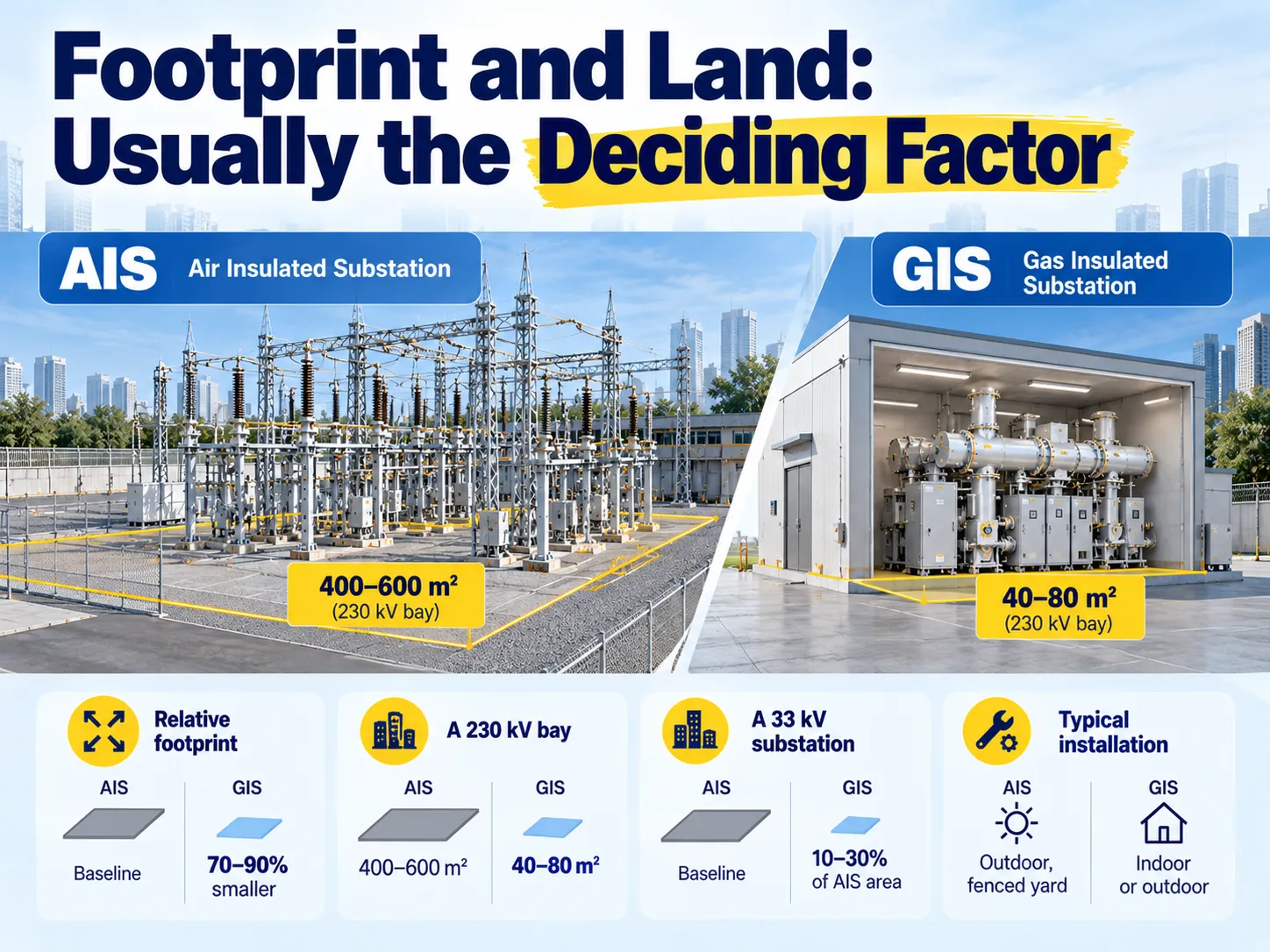
Footprint and Land: Usually the Deciding Factor
This is the point of greatest difference between the two technologies which is why decisions are usually made before electrical engineers are involved.
| Metric | AIS | GIS |
|---|---|---|
| Relative footprint | Baseline | 70–90% smaller |
| A 230 kV bay | 400–600 m² | 40–80 m² |
| A 33 kV substation | Baseline | 10–30% of AIS area |
| Typical installation | Outdoor, fenced yard | Indoor or outdoor |
In urban locations or an industrial area, one item in the budget is the cost of land and GIS is an immediate cost and an investment. Whereas in a rural area where land is cheap, the same compactness can do nothing but increase the cost of the installations.
The practical version of the argument shows up in medium voltage everywhere. A single fully insulated, fully sealed metal-enclosed switchgear unit rated 12 kV replaces an arrangement that would otherwise need a room-sized air-insulated board, and that is usually what makes a refurbishment fit into an existing building at all. If the switch room already exists and the door is the constraint, GIS is not a preference — it is the only option that fits.
Capital Cost Versus Life Cycle Cost
In the case of costs, published information contradicts each other because of different scopes. There are sources that claim the cost of GIS devices is 1.3-1.8 times the price of comparable AIS bays and sources that claim it is 30-60% higher. Both of them can be right; the only difference is whether civils, land, and construction are included in the price.
- In case of AIS, it has low equipment costs, but higher land, foundation, construction, and installation costs. Longer construction time is another disadvantage, as more installation work is performed on site.
- In case of GIS technology, higher costs of equipment compensate for lower costs of land and civil works. Shorter term of construction is one of the advantages of GIS supply since the bays are delivered pre-assembled for installation.
If land cost is considered, only then it would be reasonable to compare the two options. On a greenfield outside the town, AIS systems are much cheaper. GIS systems on brownfield in the city become more profitable even despite the higher price of GIS device due to the need of purchasing land lots nearby.
It should also be mentioned that one aspect is not taken into account in both cases. It is a mixed demand for MV gas-insulated busbars for constricted spaces along with LV air-insulated buses for plant distribution. This factor is important because it allows finding a supplier able to meet all requirements from one source instead of engaging two suppliers and finding out the best way to combine their efforts during the process.That breadth is what a switchgear manufacturing operation covering both HV and LV complete sets actually delivers commercially: one interface, one lead-time commitment, one set of type-test documents.
Reliability and Safety: Where GIS Pulls Ahead
GIS has two very significant advantages in this context. Since all active components are securely housed in a grounded metal container, it is impossible for workers to accidentally touch a live conductor. Furthermore, the container is not affected by environmental factors such as dust, salt fog, pollution, moisture or animals — altogether making it a perfect choice for coastal substations and sites located in deserts, pollution-heavy areas, high altitudes and any other locations where birds or other small animals may enter a busbar chamber.
Also as mentioned above, GIS has gained popularity as the solution for critical loads. Data centers, hospitals, airports, subways and financial districts generally go for GIS because of the fact that being in one sealed unit excludes almost all types of environmental faults that cause outages. GIS also performs better when it comes to seismic loads due to its compact passive assembly compared to a number of narrow insulators.
However, it is worth mentioning that there is a flipside to the coin. Despite the fact that GIS failures happen infrequently, when they do happen, locating it is much harder than with AIS, plus it takes much more time to repair. AIS failures are usually easy to detect and if found can be eliminated in hours. Thus, the pros and cons must be taken into consideration — in other words, the statement “GIS is more reliable than AIS” is only half-true.
The SF6 Question
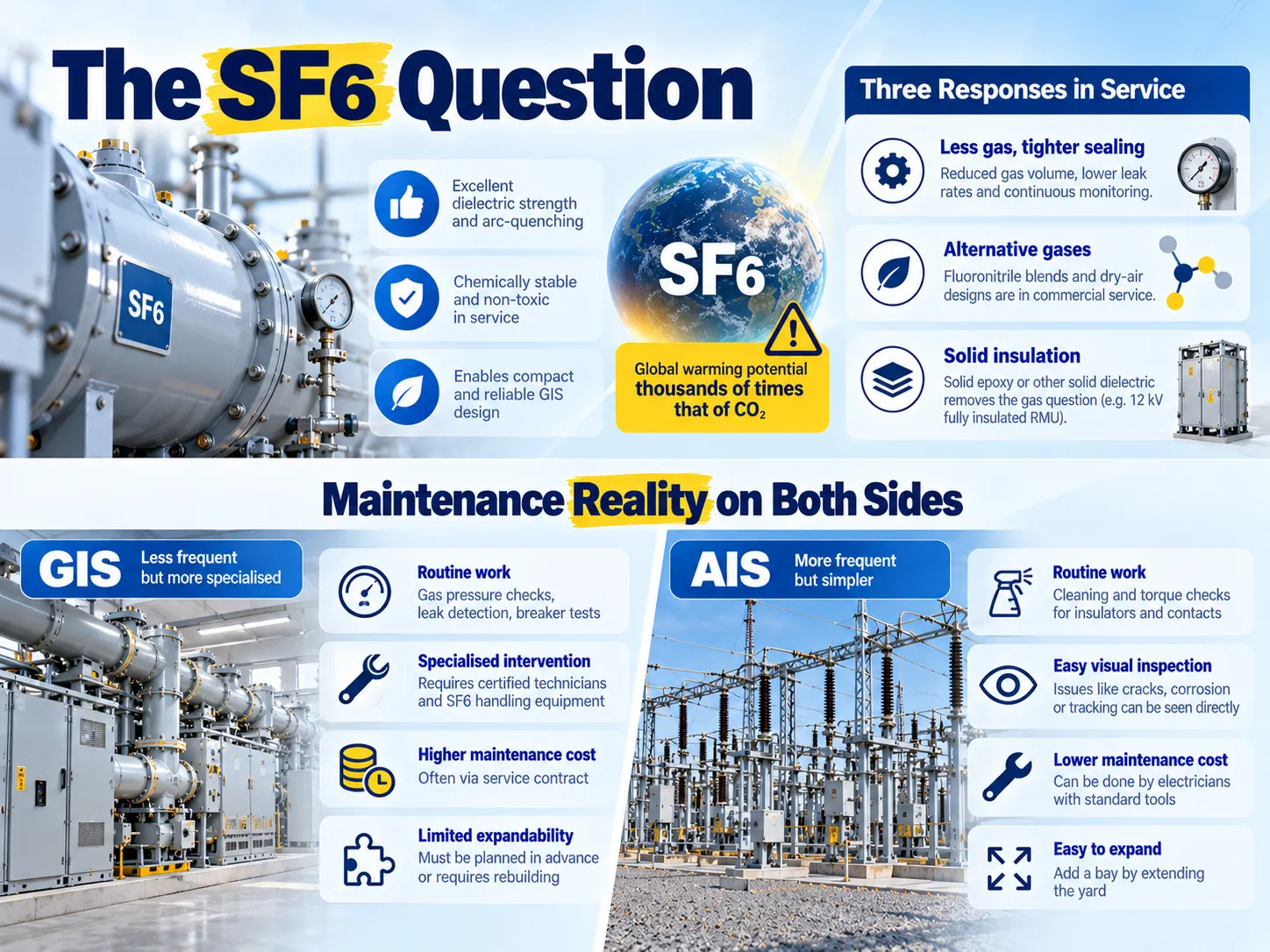
SF6 is the reason GIS is developed and why it is changing as it moves forward. The reason for its success has to do with its standing as an excellent dielectric and arc extinguishing agent, as it is chemically stable and harmless. However, the problem with this gas comes when it reaches the end of its life cycle as it is very harmful causing global warming thousands of times stronger than CO2. Therefore, SF6 is controlled by the EU F-gas regulation and it is criticized by an increasing number of countries all around the world.
At the moment, three options to mitigate SF6 impact exist.
- Reduced gas volume and better sealing techniques. Modern GIS designs and newer technologies require less gas volume to operate properly while making sure that the leakage rates are tight enough and the pressure and leak detection are performed on a continuous basis, ensuring that all leaks are detected early.
- Alternative gases. Fluoronitrile mixtures and dry-air systems have been developed and are now available. Increasingly, the risk of being penalized by the regulators makes the companies turn to these systems.
- Solid insulations. High voltage insulation system designs can protect the live parts using solid epoxy or any other solid insulation material thus making the use of gas unnecessary.This is the approach behind an fully insulated ring main unit rated 12 kV on energy-saving design principles — compact and sealed like GIS, with no SF6 to monitor, report or eventually recycle.
Should you specify today and the plant has a design life of thirty years, ask the SF6 question. A supplier who is unable to discuss the gas policy, the leak rate, and the end-of-life recovery is not being serious about it, and the burden of that fact lies with you.
Maintenance Reality on Both Sides
GIS has lower frequency of interventions but in turn requires more specialized work. Regular maintenance procedures include gas pressure tests, leak detection, and rupture testing, while everything which happens inside the GIS requires certified technicians, clean environment, and special gas handling facilitation. If it is possible to assemble a well-equipped utility maintenance team in the presence of SF6 tools, there is no urgency in this maintenance activity, yet otherwise it becomes a service contract of regular payments.
AIS requires more frequent maintenance involving less specialized standards. Insulators and contactors are exposed to pollution, rain, salt, and dust, which means that cleaning of the components and checking of screws must happen according to schedule. The good thing is that an ordinary electrician can maintain AIS technology if he/she can conduct basic checks visually.
One of the maintenance management aspects in maintenance costs which is often forgotten by people is the expansion of the facilities. If from AIS technology we frequently need to add a new bay, then for GPS technology it requires re-engineering and redesigning. It means that the redesign and planning must be aimed at achieving the best preservation of the other original elements of the GIS technology.
When AIS Is the Right Call
- Land availability and cost are both advantageous. Equipment prices per bay are lower. No compression efficiency on site is necessary.
- Performing visual inspection and maintenance in the field is crucial. If your team has chosen to work with exposed equipment, AIS will allow you to do that.
- There are expectations for future growth. Any AIS site grows extensively and gradually, while GIS ones do not.
- Budget is the limiting factor, while the site is not. This can be said about any utility-scale substations and other similar facilities.
- The environment is excellent. There are clean sites that do not require protection from salt fog, dust or pollution, and consequently, do not have to pay for it.
The medium-voltage AIS technology is already established and standardized.A 12 kV metal-armored withdrawable switchgear assembly is the workhorse of that segment: compartments, withdrawable trucks, interlocking and simple field maintenance, at a price that makes a large distribution board affordable. For most industrial MV rooms this is still the correct answer, and choosing GIS there would be over-specification.
Where GIS Is the Right Call
- The location has limited space available. The substations of the metropolitan area plus indoor areas + brownfields + underground installations.
- The environment is not friendly. The presence of the coastal salt fog + heavy industrial pollution + desert dust + high altitude or really humid climate.
- The load is highly important. Data centers + hospitals + transport infrastructure + financial district.
- The time line is short. The modular substations produced in the plant are considerably reducing construction time in comparison with traditional installations.
- Maintenance is hard. Hardly accessible remote locations where any service is very costly.
- Noise and visibility issue. The indoor and underground solutions provided by this technology are much quieter and invisible at the same time, which is often the decisive factor for the approval of urban planning projects.
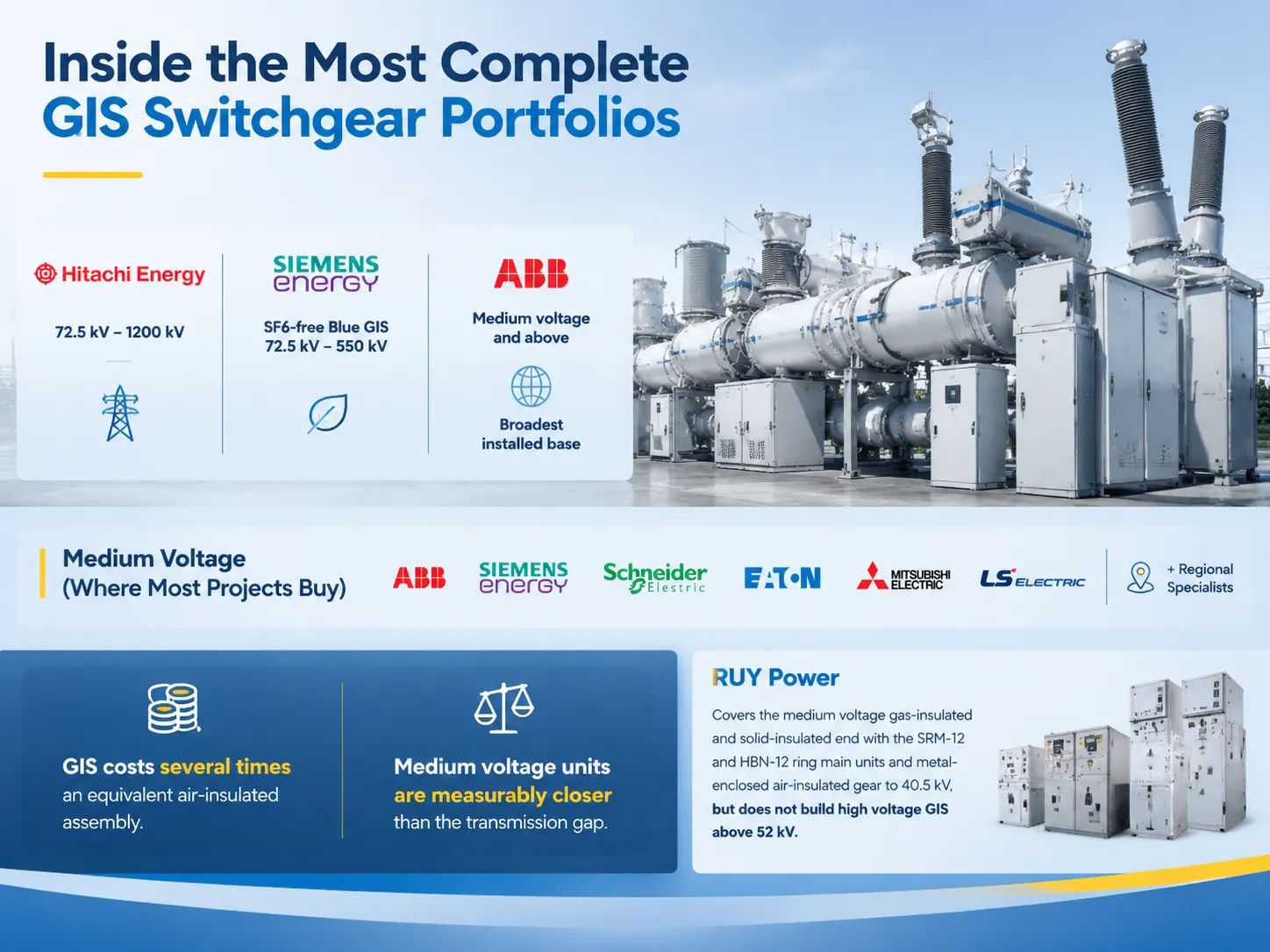
- The fact that both technologies are used in one project provides a unique opportunity to see whether the supplier gets to the core of the differences.A portfolio of delivered high-voltage switchgear applications across voltage levels and configurations tells you more about competence than any capability statement, because the constraint each project was solved under is visible in what was built.
Hybrid Configurations
Even if the binary framing is advantageous, it is not always right. Hybrid substations have become the norm in many cases and represent the best solution: for instance, GIS is good for high-voltage bus connections or for compact indoor areas, while AIS is a better suited technology for the less powerful outdoor equipment and substations as well as for the feeder side of the substation when possible. It is also true of retrofitting projects involving the connection of the new part of the station where the new unit can be compact while the existing part remains unchanged. For a supplier to offer either one technology or another is more a limitation than the result of engineering efforts.
A Practical Selection Checklist
- The cost of land per square meter. If this amount is high, there is a good chance your answer is GEO.
- Environmental vulnerability. Locations that are coastal, dusty, contaminated, and with altitude have the advantage of using GEO.
- Fault level and class of voltage. Make sure to check what the technology you’re thinking of using can actually allow you to do, rather than relying on what you read in the marketing material.
- Plans for growth and expansion. If modules are going to be added to the system, the expansion of both solutions should be understood before the choice.
- Maintenance capabilities. Find out what your team can do themselves and what you will need to get from third parties.
- Regulatory risks. Ask about SF6 gas regulation, fugue rate, and end-of-life recovery.
- Timeline. Make sure to analyze the installation time, not only the equipment delivery time.
- Total cost of ownership over 30 years, including equipment, civil work, land, maintenance, and spare parts.
FAQ
Which is better, GIS or AIS?
It completely relies on the site. GIS saves space (70-90% less) and is protected from pollution and humidity, and can be beneficial where space is limited or expensive, climatic conditions are harsh, and loads are important, or when schedule is tight. On the contrary, AIS performs better where land is cheap, the capital budget limits your choice, it is likely that you will need to expand, and your team is able to do maintenance.
What are the disadvantages of a gas-insulated substation?
In terms of asset outlay, it represents a high level of input cost (usually 30-80% more than an AIS of equal rating). In case of an internal failure, maintenance and repair becomes more complicated, taking longer time for the same. Specific gas handling, monitoring and personnel training regulations apply in this case. Some limited possibility for upgrade. The disadvantages linked to the environmental and legal aspects of using the SF6 gas makes it feasible to develop less gas-intensive, as well as alternative and solid-insulated power installation designs.
Why is SF6 gas used in GIS?
Due to its remarkable qualities as a dielectric and medium for extinguishing arcs. It has a dielectric strength of about three times that of air at the same pressure, which makes it easier to pack live components together, enabling it to have a compact design. This also means that it is chemically stable and safe to use. However, it has a significantly high global warming potential that outweighs that of CO2; this is the reason it is being replaced by low-gas, alternative gas and solid insulation projects
What is AIS in substation?
Because of its exceptional properties as a dielectric material and a means of putting out electric arcs. Its dielectrical strength is nearly three times that of air at the same pressure, which makes it possible to put the live parts closer to one another and results in compact construction. It is also a safe and stable chemical. Nevertheless, due to its high global warming potential, which is incomparable even to that of CO2, it is gradually replaced by gas-free, alternative gas, and solid insulation technologies.
References
- Hitachi Energy — gas-insulated and air-insulated switchgear portfolio and substation reference material
- Siemens Energy — high-voltage switchgear product data and SF6-free technology documentation
- ABB — Electrification switchgear ranges and gas-insulated switchgear technical publications
- Mitsubishi Electric — power distribution and high-voltage switchgear engineering documentation
- GE Vernova — grid solutions switchgear and substation technology reference material
- Schneider Electric — medium-voltage switchgear and prefabricated substation documentation
- International Energy Agency — grid investment and electrification analysis driving substation demand
- International Electrotechnical Commission — IEC 62271 series, the standard family covering high-voltage switchgear and controlgear
Conclusion
Is there an advantage of GIS over AIS? The answer is “yes” for the urban location with critical consumption. For “greenfield” utilitarian design, the answer is “no.” The variables which decide the issue are the costs of land, the level of exposure to the environment, the plans for future enlargement, and the maintenance practice that can be upheld by the company, rather than the technology name itself. Carrying out an honest assessment of these four variables will typically yield a surprising answer.