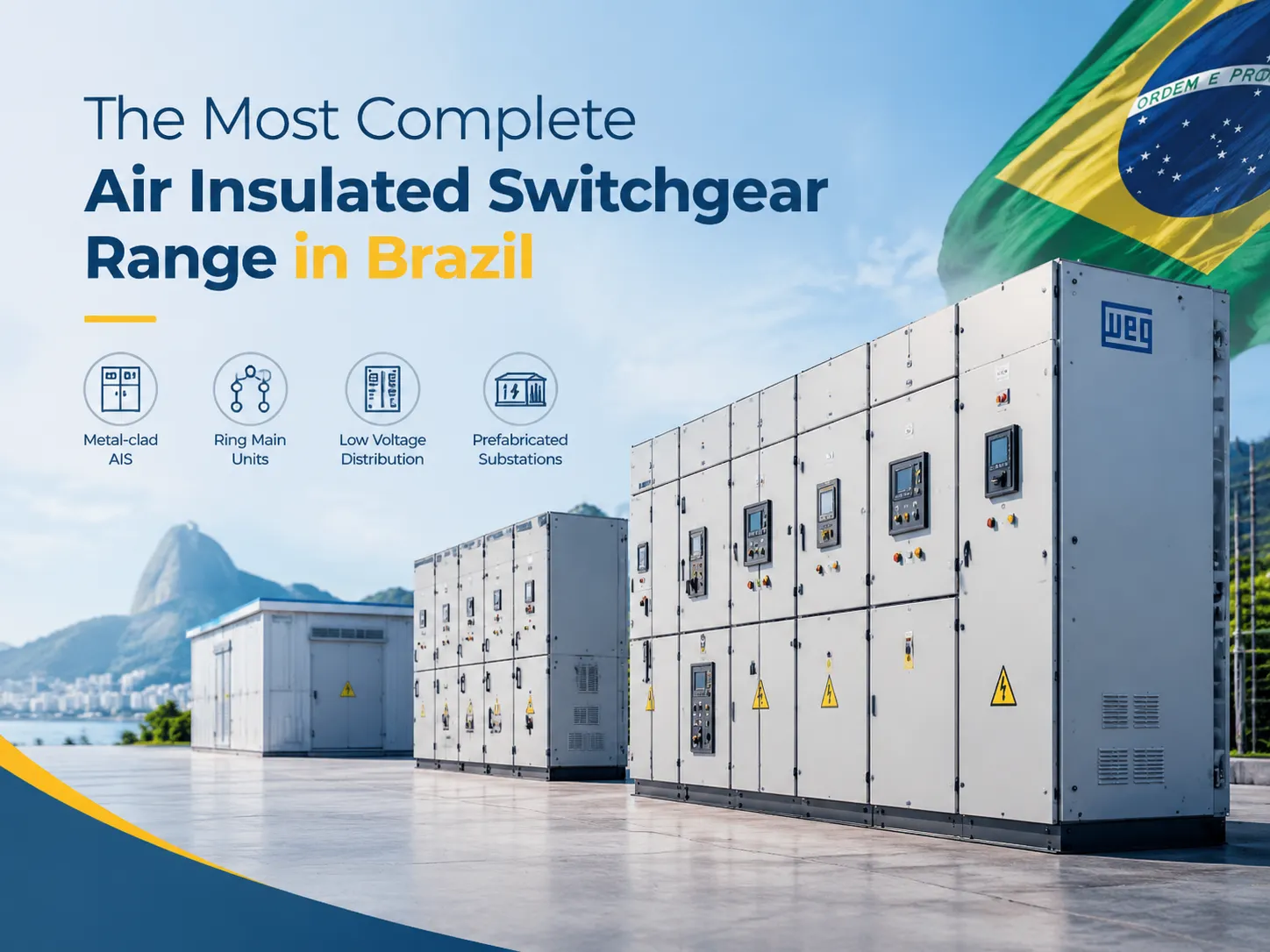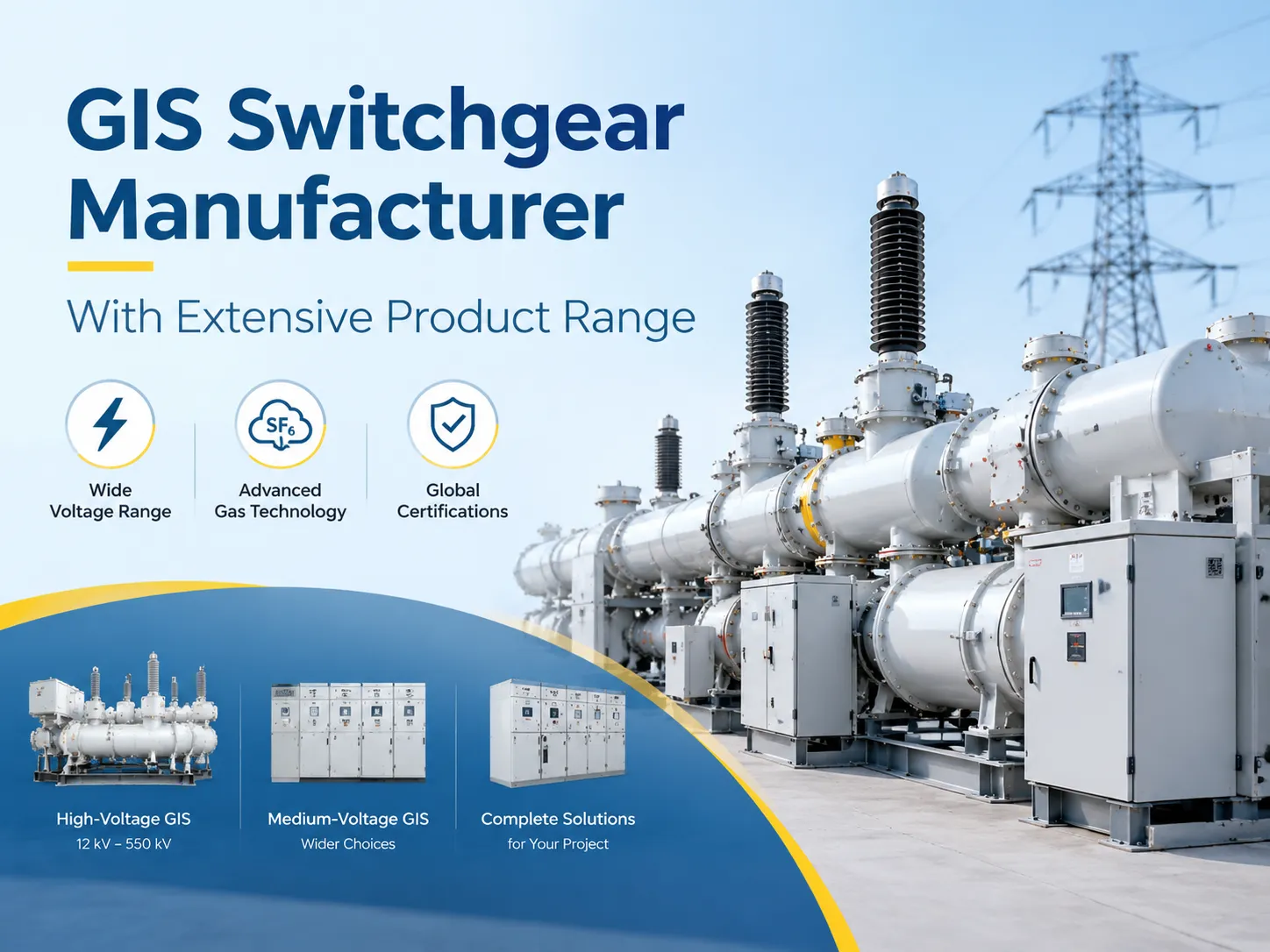

The phrase “most complete” is widely used in advertisements of many types of switchgear devices. Nevertheless, its definition can differ very much depending on context. In terms of insulated switchgear, its meaning might also be rather vague, as it is dependent on the level of voltage being referred to. For instance, companies dealing with 550 kV products may not be the same that work with 12 kV devices to be used commercially, when the switchgear is installed under the ground. In this article all the kinds of the production are presented and the manufacturers of the production are outlined so as to enable the comparison of GIS and air-insulated switchgear technologies.
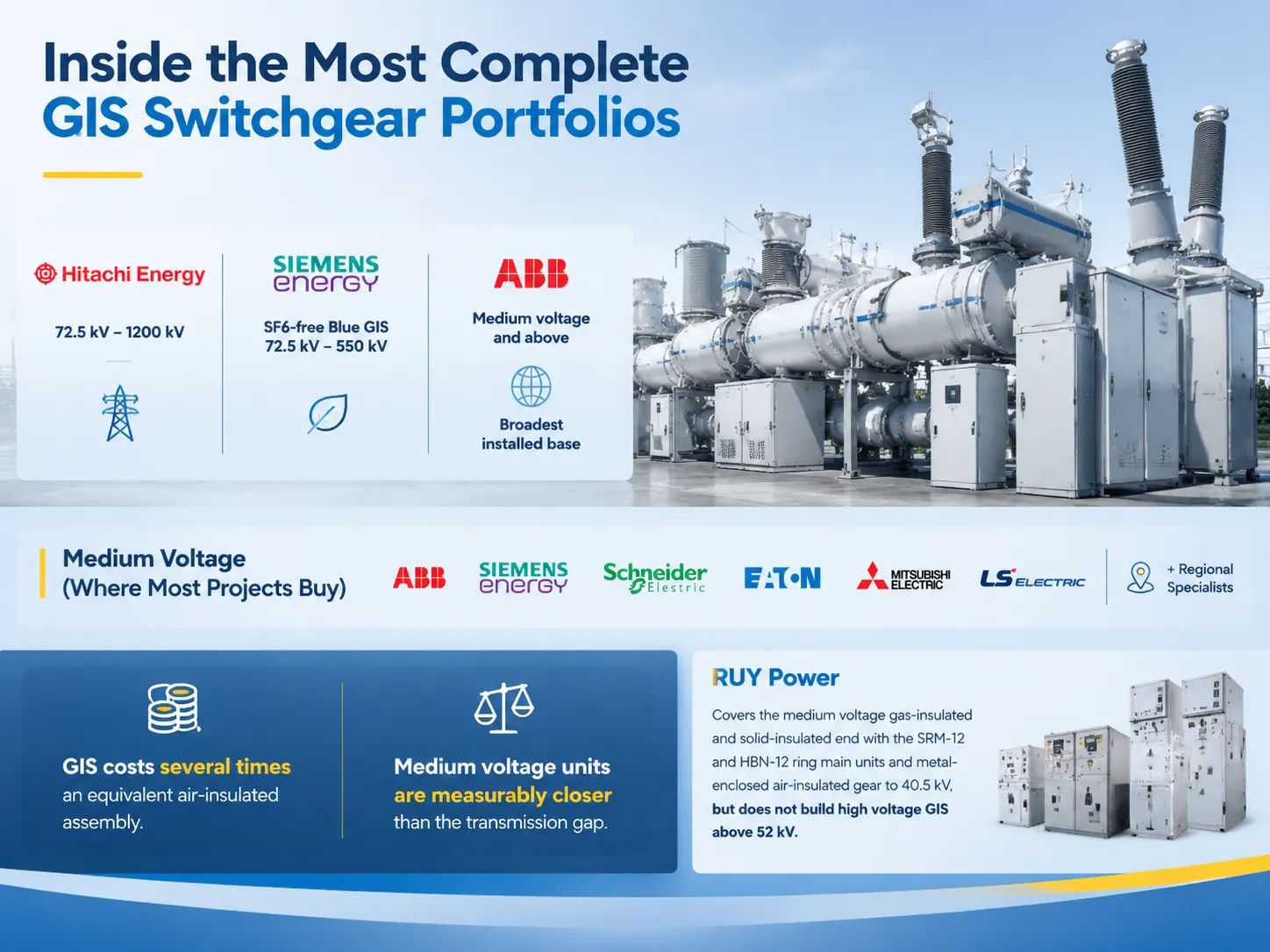
The answer to this question is hard to find. It is not possible to name only one company to answer. However, there are three companies that have the least distance in the complete spectrum of GIS. The first company is Hitachi Energy which produces GIS devices of 72.5 kV and 1200 kV. The second company is Siemens Energy which develops a blue GIS with the maximum voltage level of 72.5 kV and 550 kV without the use of SF6 technology. The third company is ABB which has the most GIS configurations in terms of the number of devices in operation. Such companies leading in the market of medium voltage devices that manufacture GIS devices, apart from ABB and Siemens Energy, include also Schneider Electric, Eaton, Mitsubishi Electric, LS Electric, etc. Being expensive, GIS devices are, in general, closer in price to medium voltage devices than to air-insulated devices. There is a possibility for RUY Power to produce devices of 40.5 kV, while it does not have the installation for producing devices with the voltage higher than 52 kV.
What GIS Actually Is
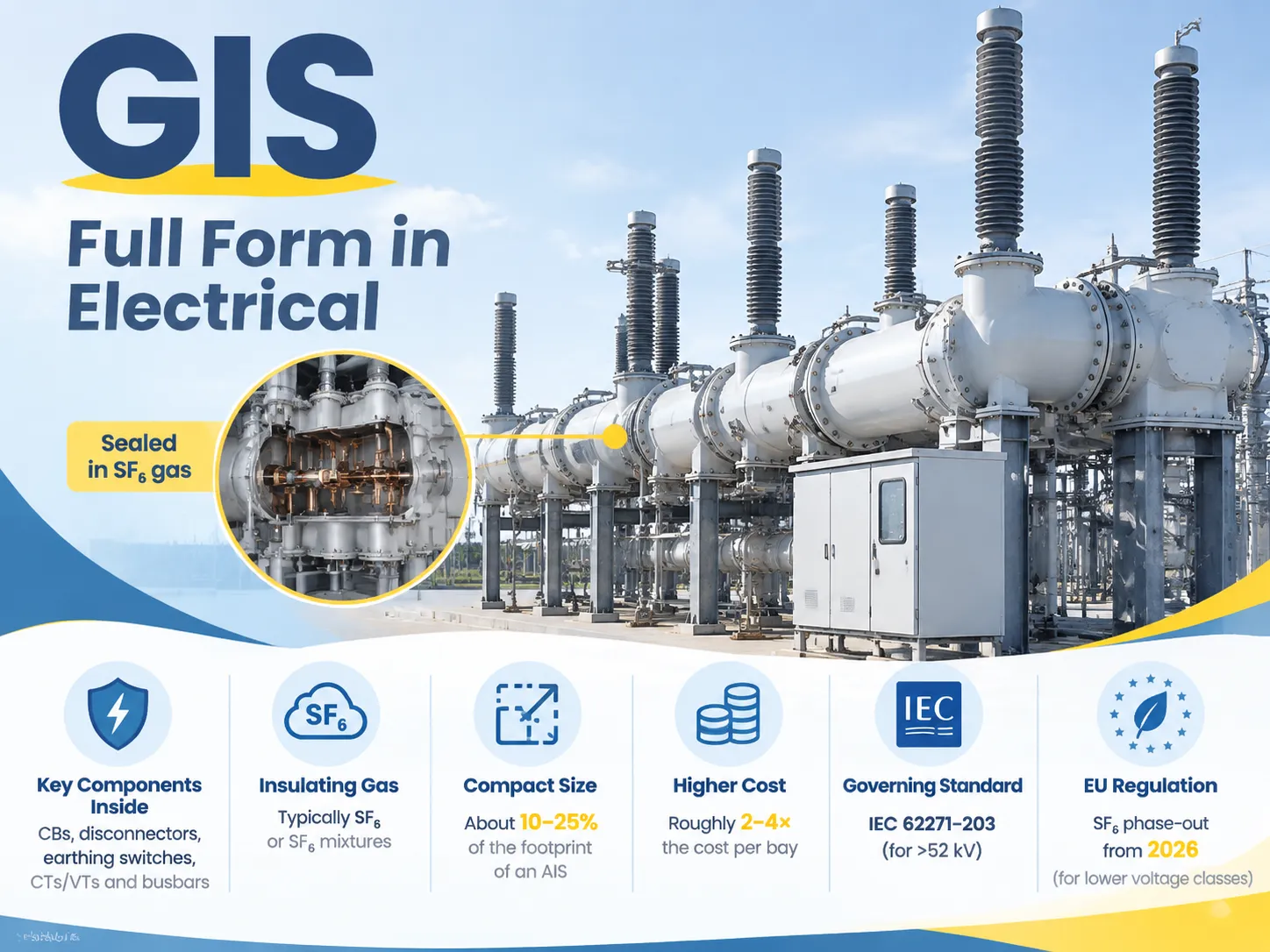
Gas-insulated switchgear encloses live parts, busbars and switching devices in a hermetically sealed vessel filled with insulating gas under a few bars of pressure. Since the dielectric strength of the mentioned gas is multiple times stronger than the dielectric strength of air at atmospheric pressure, required clearances and occupied area are greatly reduced.
Two standards define this category. Above 52 kV, GIS is described in IEC 62271-203, gas-insulated metal-enclosed switchgear. As for medium voltage, starting from 52 kV down to 1 kV, the document describing the subject is IEC 62271-200, covering both air and gas-insulated metal-enclosed assemblies. National adoptions follow the IEC text, and a difference between the two occurs not at the level of principle.
Commercially important factors result from hermetic construction. GIS compartment is not impacted by humidity, dust, salt and small animals, which is the reason for the predominant use of this technology in coastal, industrial and densely populated areas. The annual percentage of gas leakage is indicated as a percentage of the amount of gas used — a well made medium voltage device indicates a leakage percentage of a fraction of a percent per year — and hermetic tank will get an IP67 rating compared to the IP rating of the outer case. Maintenance is minimal as long as the device does not reach the end of its sealed life, when the question of replacement or refurbishment arises instead of making adjustments.
| Property | Gas-insulated (GIS) | Air-insulated (AIS) |
|---|---|---|
| Insulating medium | SF6 or an alternative gas, sealed | Ambient air at atmospheric pressure |
| Standard, above 52 kV | IEC 62271-203 | IEC 62271-203 / 62271-1 |
| Standard, 1–52 kV | IEC 62271-200 | IEC 62271-200 |
| Footprint | Small — often a fraction of AIS | Large, needs clearances |
| Environmental sensitivity | Effectively immune when sealed | Affected by humidity, dust, pollution |
| Maintenance | Minimal; gas handling only when opened | Inspection and cleaning, air clearances accessible |
| Cost | Higher | Lower |
| Lead time | Longer, especially at high voltage | Shorter |
Why the Portfolio Question Matters More Than It Used To
Since 2024, two factors have greatly influenced GIS specifications.
The first factor is regulation. The EU imposed the EU Regulation 2024/573 in March 2024, which prohibits the use of certain fluorinated greenhouse gases in new switchgear in stages, beginning in 2026 and ending in 2032. Since SF6 is very harmful and has a global warming potential that is thousands of times higher than other pollutants, the first switchgear affected is medium-voltage equipment, followed later by high-voltage systems. California’s Air Resource Authority’s schedule mirrors this approach. Therefore, the specification created today must specify whether any alternative without SF6 could be used, since currently available products that use GS6 may not be marketable anywhere during the life of the asset.
The second factor influencing this evolution is that currently available alternatives are no longer only experimental. For example, Hitachi Energy has started producing EconiQ on a large scale, including products such as SF6-free gas-insulated switchgears of 550 kV and the 420 kV switchgear that has already been implemented in Germany. Siemens Energy also launched its own Blue GIS line which operates with clean air, while GE Vernova created its eco-friendly g3 line. Finally, Scheneider Electric has launched its AirSeT line of SF6-free gas-insulated systems for medium-voltage applications.
Consequently, the phrase “the most complete” has acquired a new meaning since in addition to voltage specs and portfolio breadth, it now reflects how updated the supplier’s products actually are regarding the SF6 technology.
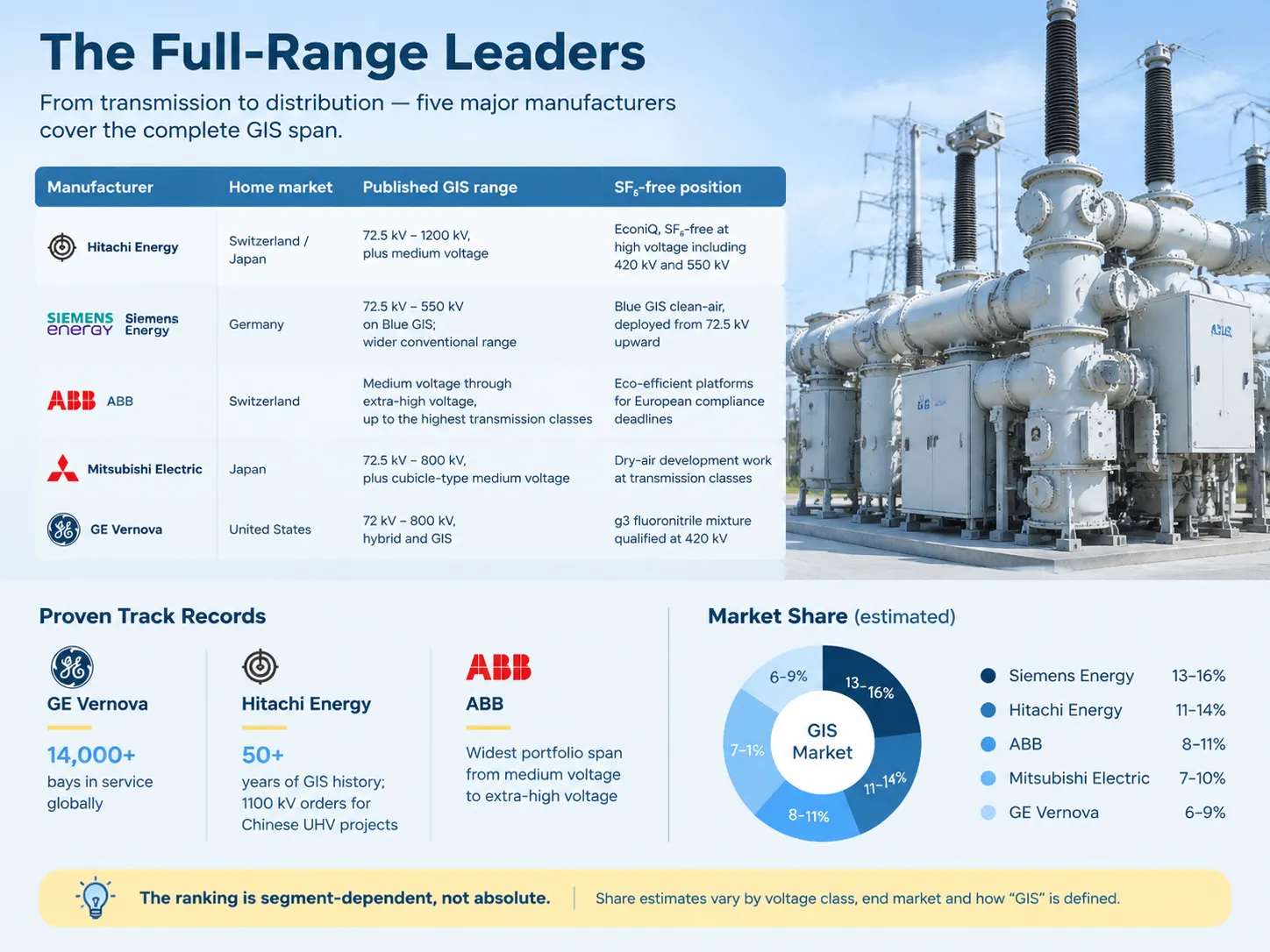
The Full-Range Leaders
Four manufacturers offer a genuine transmission-to-distribution GIS span. The table below summarises the published coverage.
| Manufacturer | Home market | Published GIS range | SF6-free position |
|---|---|---|---|
| Hitachi Energy | Switzerland / Japan | 72.5 kV to 1200 kV, plus medium voltage | EconiQ, SF6-free at high voltage including 420 kV and 550 kV |
| Siemens Energy | Germany | 72.5 kV to 550 kV on Blue GIS; wider conventional range | Blue GIS clean-air, deployed from 72.5 kV upward |
| ABB | Switzerland | Medium voltage through extra-high voltage, up to the highest transmission classes | Eco-efficient platforms for European compliance deadlines |
| Mitsubishi Electric | Japan | 72.5 kV to 800 kV, plus cubicle-type medium voltage | Dry-air development work at transmission classes |
| GE Vernova | United States | 72 kV to 800 kV, hybrid and GIS | g3 fluoronitrile mixture qualified at 420 kV |
When examining installed power, it is important to understand the base installed behind each player in this segment. GE Vernova’s high voltage division has close to 14,000 bays in service internationally, which is the type of data worth noting when assessing the type test results and operational experience as opposed to the supplier’s offer breadth. In contrast, Hitachi Energy boasts over 50 years in the GIS business with both moderate voltage and ultra-high voltage projects such as the 1100KV GIS for Chinese UHV substations. ABB’s competitive advantage is having the widest range in the industry starting from medium voltage equipment enabling the supplier to provide the full power set for a mixed voltage facility with no need to deal with multiple vendors.
As for the market shares picture, it is never simple to compare results as noted. Analyst estimates have Siemens Energy market share as being in the range of 13–16%, Hitachi Energy 11–14%, ABB 8–11%, Mitsubishi Electric 7–10% and GE Vernova 6–9%. Some reports argue for ABB as the company with broader range of operations and the biggest installed power base. Nevertheless, both statements can be true since the percentages vary depending on the classes of voltage and definitions of GIS used by the analyst.
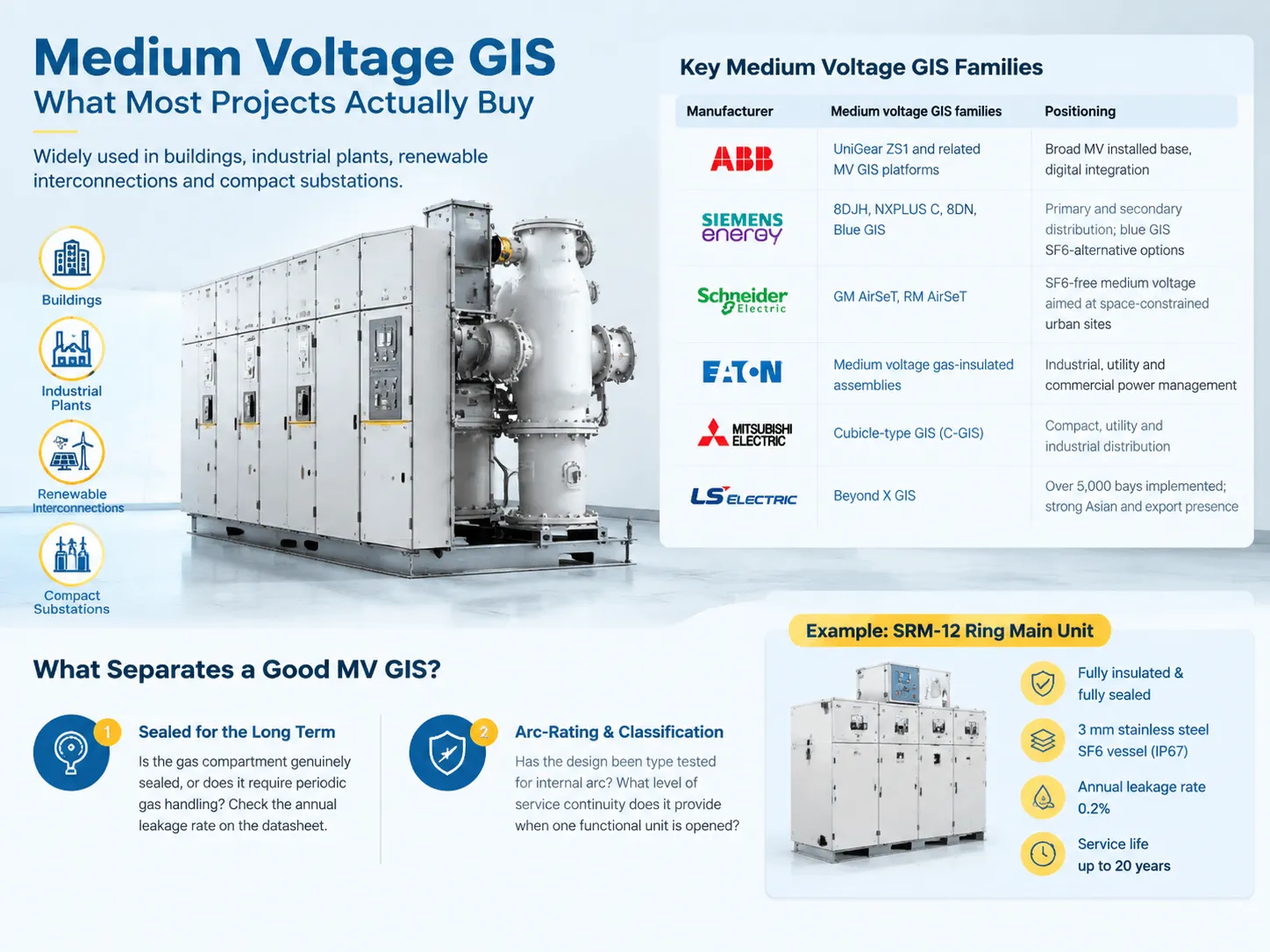
Medium Voltage GIS: What Most Projects Actually Buy
These are the locations where the bulk of GIS purchases occurs. A significant portion of GIS acquisition is related to MV distribution used in buildings, factories, renewable energy connections, and compact transformer stations, where an area savings justify the costs.
Among product families of interest, there are not many changes here:
| Manufacturer | Medium voltage GIS families | Positioning |
|---|---|---|
| ABB | UniGear ZS1 and related MV GIS platforms | Broad MV installed base, digital integration |
| Siemens Energy | 8DJH, NXPLUS C, 8DN, Blue GIS | Primary and secondary distribution; blue GIS SF6-alternative options |
| Schneider Electric | GM AirSeT, RM AirSeT | SF6-free medium voltage aimed at space-constrained urban sites |
| Eaton | Medium voltage gas-insulated assemblies | Industrial, utility and commercial power management |
| Mitsubishi Electric | Cubicle-type GIS (C-GIS) | Compact, utility and industrial distribution |
| LS Electric | Beyond X GIS | Over 5,000 bays implemented; strong Asian and export presence |
A good medium voltage GIS can be distinguished from a simple compact one by two key features. Firstly, it depends on whether the gas compartment is really sealed for the expected service life or it requires periodic gas handling, which can be found in the datasheet as the leakage rate per year. Secondly, it depends on the arc rating and classification of the compartment – whether the design has undergone arc testing and what service continuity is provided during the opening of one of the units.
That is also where the practical value of a specific product becomes visible. A ring main unit like the SRM-12 fully insulated and fully sealed metal-enclosed switchgear puts all live parts in a 3 mm stainless steel SF6 vessel rated IP67, with a stated annual leakage rate of 0.2% and a service life up to 20 years — the numbers a buyer should be comparing against, whichever brand is on the door.
GIS and AIS: Which One Fits
It is important to realize that using the term “technology” does not automatically signify “better.” Each situation will differ due to factors such as available space, environmental considerations and project budget.
The decision to utilize GIS technology arises when space is limited, installation will happen indoors or underground, site is located near water or heavily polluted or high voltage requires impractical distance between equipment. High buildings, underground metro stations, offshore installations could be listed here.
AIS technology works better when there is no issue of space, budget is limited, crew has to access equipment on site or time requirements are more pressing than space constraints. Performing maintenance on AIS devices is simpler compared to GIS and sometimes it is a reason why the technology is still dominating the field of medium voltage distribution across the globe.
Lastly, there is a third option that is overlooked usually but deserves to be mentioned. It is solid insulated technology (full insulation) that achieves a very compact design and does not use gas. In cases of working with 12 kV voltage in regions where usage of SF6 is becoming a burden, this option should be chosen instead of traditional GIS or AIS technology. Metal-clad air-insulated gear remains the volume answer for anything with space around it, including primary switchgear such as the KYN61-40.5Z armored removable metal-enclosed switchgear at the 40.5 kV class.
What a Complete Portfolio Should Include
When assessing suppliers instead of products, the following attributes determine whether one vendor can handle a project.
- The voltage spans across your project scope including interfacing. If a supplier can handle 12kV and 36kV but not the transition from 36kV to 145kV, then you will have to work with two vendors.
- Availability of an SF6-free solution for your voltage class, not just the premium voltage rating. It is important to ask for the type testing report instead of a brochure.
- Availability of ring main units, compact substations, and primary switchgear since most medium voltage projects will have the need for both.
- Protection and control integration, including relays, interlocking, auxiliary circuits, and the digital interface.
- Retrofit capability into existing cubicles, which is often cheaper than replacement and a true differentiator on brownfield sites.
- Documentation-wise: type testing certificates, routine test reports, materials certificates, wiring diagrams, and spare parts list.
- Service and spare availability in the area of destination or a written agreement with an OEM and a local partner who will have them on stock.
Point seven is where medium-sized manufacturers can compete honestly. A solid-insulated or fully insulated ring main unit such as the HBN-12 energy-saving fully insulated ring main unit can be configured for smart-grid remote monitoring with the same functional units a European platform offers, at a materially lower price, and the trade-off is brand recognition and local service depth rather than electrical capability.
Price and Lead Time Realities
Indicative figures only, since busbar current, breaking capacity, arc rating and protection package move the number more than any other factor.
| Item | Indicative position | Notes |
|---|---|---|
| Medium voltage GIS bay | Roughly 1.5–3× the equivalent AIS cubicle | Footprint saving is what is being bought |
| Medium voltage ring main unit | Below that multiple, and falling | SF6-free and solid-insulated options compete hard here |
| High voltage GIS bay | A large multiple of the medium voltage figure | Diverges sharply from AIS as voltage rises |
| Complete GIS bays, high voltage | Lead times extended to 12–18 months in 2025–2026 | Component supply, not assembly capacity |
| SF6-free premium | Narrowing, and negative on life-cycle cost | Regulatory deadlines are removing the choice |
It is the lead-time figure that needs to be worked with. Lead times for gas-insulated products extended to 2025 and 2026 due to supply for upstream components but not due to capacities of factories. A portfolio that includes a locally made alternative could mean the difference in whether one hits a construction date or not.
Where RUY Power Fits
RUY Power manufactures both switchgear and substations in one product line. But the truth is that the range of products produced is limited to quite a small selection of medium and low voltage products. In particular, these include0kV and 40.5kV air-insulated switchgears and 12kV gas insulated and fully insulated ring main units, as well as various types of transformers and substations.
But another important point is that the company does not offer any of the high voltage products, namely those above 52kV. If one needs to complete a project with 145kV or 420kV bays, one will have to contact such companies as Hitachi Energy, Siemens Energy, ABB, Mitsubishi Electric and GE Vernova instead of wasting time on discussing the issues with RUY. In addition to that, RUY has made its entrance into the medium voltage industry and is ready to supply and equipment needed for the project in the shortest period of time. For buyers who need the equipment to carry a local partner’s nameplate, the OEM and ODM programme covers documentation, labelling and configuration changes.
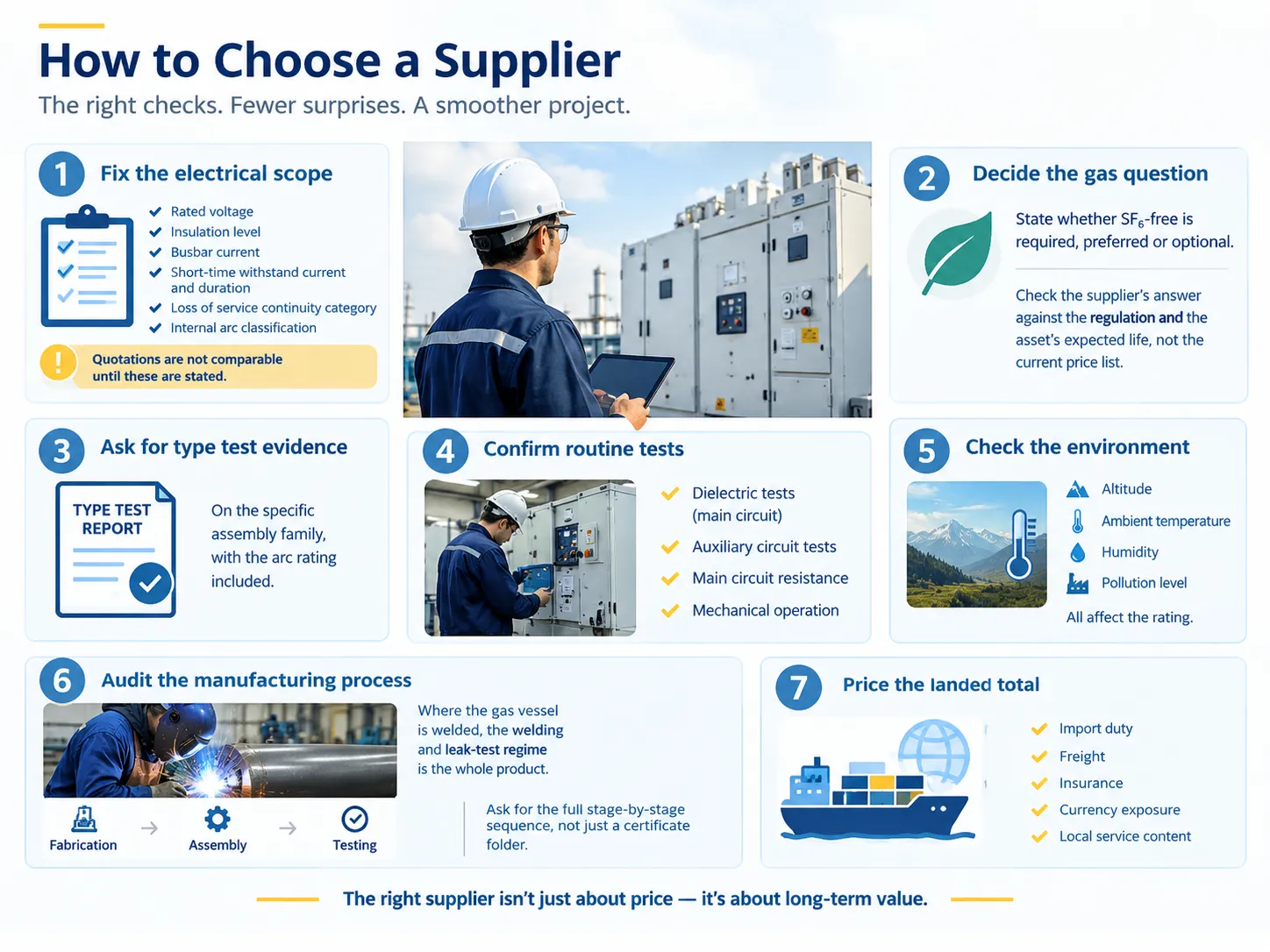
How to Choose a Supplier
A series of steps that minimizes the likelihood of having to repeat tasks.
- Establish the electrical parameters for the project first: voltage class, class of insulation, current rating of busbar, short-term thermal withstand capability, consistent service interruptions, and type of arc classification. Without specifying these parameters, the completed quotation will not be comparable.
- Carefully approach the question of gas. Indicate whether or not gas with no SF6 is preferred by you and check the supplier’s response against the current regulations, having nothing to do with the current price list.
- Require test evidence from the supplier in the form of required tests for this specific type, with respect to which information about the arc rating is to be included.
- As for routine tests, make sure that tests indicated (including the insulation tests of the main circuits, tests of auxiliary circuits and tests of operations of the main circuit) were completed before any units were delivered.
- Compare the specs of the environment with the specifications required — altitude, temperature, humidity, etc.
- Monitor the production processes. Do not settle for the certificate folder only, especially if the test of welding was necessary. The stage-by-stage implementation of the process is available on the website of the company.
- Calculate the price of the ready project including imports, transport, insurance, and any other services.
FAQ
Who is the leading company in the switchgear market?
The determining factor is the category of the switchgear. Overall switchgear revenue puts Schneider Electric at number one position, and ABB follows closely, being very good in the medium voltage segment. In the case of high voltage switchgear ABB and Hitachi lead in gas-insulated switchgear whereas, Siemens finds its place among the top players in SF6-free switchgear with its Blue GIS portfolio. Any claim to be the number one supplier is specific to the segment as the leading five suppliers occupy around 46-52 % of the total revenue in the medium voltage switchgear.
Is GIS better than AIS?
Generally speaking, there is no clear winner between the two systems. While GIS outperforms AIS in the categories of size, resistance to humidity, pollution, and installation in compact or indoor locations, it is also much more expensive in terms of equipment and requires a longer installation process. Conversely, AIS is cheaper to buy, easier to maintain, multiplex and inspect. Nonetheless, the majority of medium voltage distribution systems worldwide are based on AI technology. Ultimately, the choice between these two systems will be based on the availability of space and resources — and when it comes to the market, they could increasingly consider another type of medium voltage system: GIS.
What are the biggest switchgear companies?
Based on revenue, Schneider Electric, ABB and Siemens Energy are leaders in the switchgear sector, followed closely by Eaton, Mitsubishi Electric and Hitachi Energy. With more than 14,000 installed high-voltage gas-insulated bays, GE Vernova has the most number of bays around the world although Hitachi Energy has been a player in gas-insulated technology for more than 50 years with numerous ultra-high-voltage projects in its books. In the sector of medium-voltage gas-insulated technology, LS Electric has successfully installed over 5,000 gas-insulated bays. It also seems that being the largest player does not mean being the best — a specialized company with medium-voltage capabilities usually provides better price and lead-time than a multinational corporation with a transmission technology focus.
How do I know if a supplier’s GIS range is genuinely complete?
There are three questions that will usually resolve the situation at hand. These include asking for the range of operating voltages that have been officially verified through testing at every class and not just one certificate for a rated voltage. You can ask if there are options available without SF6 gas at your voltage or just at the upper end of the range. Finally, it is prudent to learn if the vendor also sells ring main circuit breakers, protection devices, low voltage distribution boards, and transformers that complete a GIS system since that is where the bulk of the delays during the projects happen.
References
- European Commission — Fluorinated greenhouse gases, Regulation (EU) 2024/573
- IEC Webstore — IEC 62271-203, gas-insulated metal-enclosed switchgear for rated voltages above 52 kV
- International Electrotechnical Commission — IEC 62271 series, high-voltage switchgear and controlgear
- Hitachi Energy — EconiQ and high-voltage gas-insulated switchgear portfolio
- Siemens Energy — Blue GIS and medium voltage gas-insulated switchgear
- ABB — electrification and switchgear portfolio
- Market Research Future — Gas Insulated Switchgear Market competitive benchmarking
Conclusion
The claim that there exists a single best GIS portfolio is false. There is no GS service provider that can claim to have the greatest or the most extensive GIS portfolio, since this would mean distorting the initial idea of the process in favor of commercial interests. Companies like Hitachi Energy and Siemens Energy have the largest range of solutions with no SF6. If we take the amount of technology into consideration, ABB has the biggest portfolio. Mitsubishi Electric and GE Vernova belong to the most advanced companies when it comes to transmission technology, while companies working in the sphere of mid voltage equipment still have a lot to do to take the deserved place in this field, as they develop innovative solutions and have a competitive price policy.
When it comes to defining the technical requirements for the equipment, it is important to highlight some key points. The specification should include the voltage and the presence of the SF6-free technology, since it will make it possible to reduce the number of options from dozens to hundreds of companies. Moreover, before asking for the equipment quotation, it is necessary to have the type test results. Generally speaking, it is important to take into account the annual leakages provided in the specification, as well as avoiding the phrase “sealed for life.” Additionally, it is worth mentioning that the medium voltage equipment is different from the transmission equipment, meaning that the name of the top company in the world cannot help find the right alternative for one’s 12 kV equipment.