
When searching empintl.com for information about power projects in the Middle East and North Africa, the first thing that comes up to the mind must be the obvious question regarding who the people behind it are and when did they begin their activity. This question has a good reason because the company’s site contains much of capability language, but leaves quite little for the potential customer looking for the details they need.
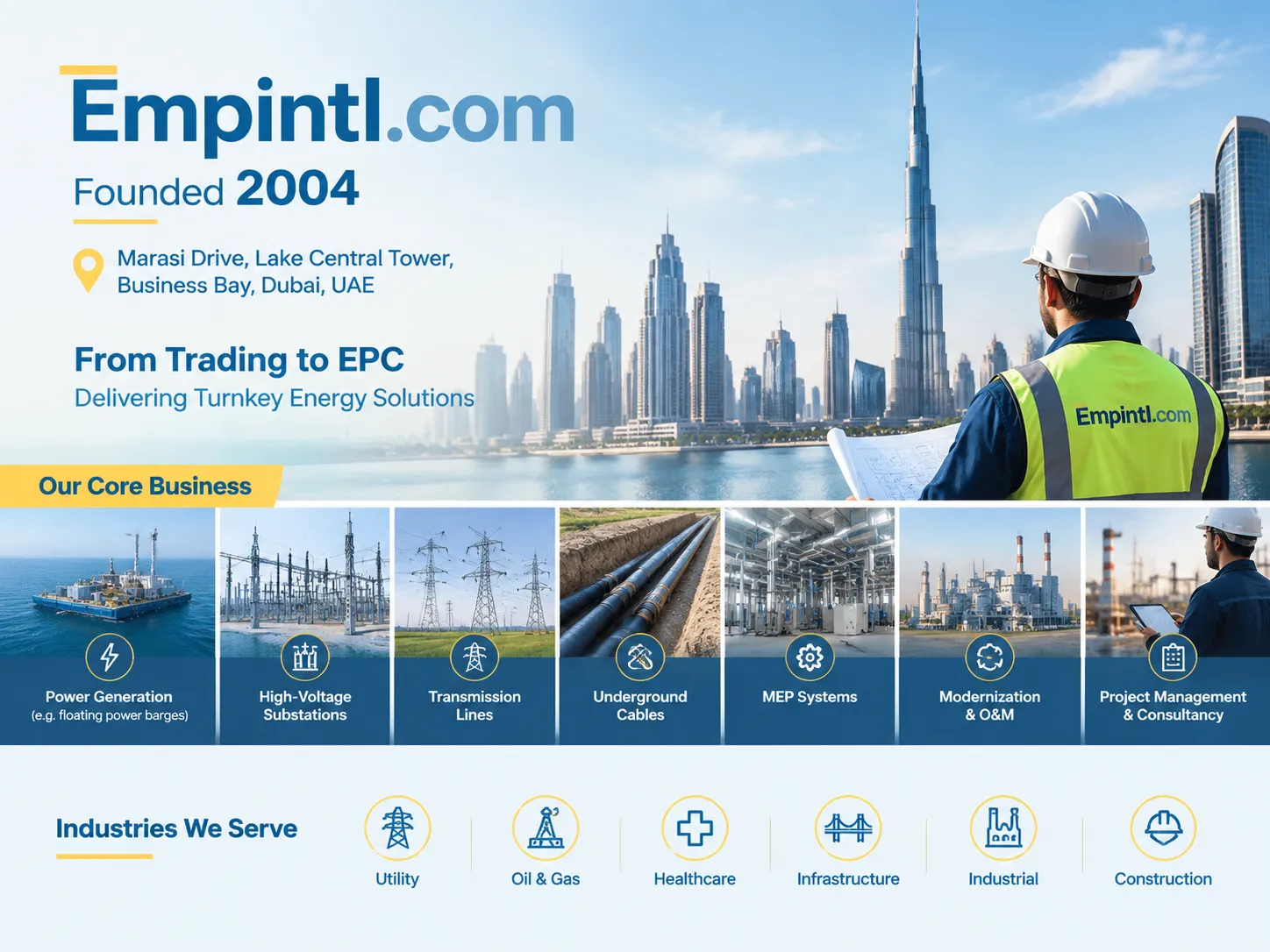
Here is the answer to the aforementioned question plus some more details. Electromecha International Projects (or EMIP in short) is a contractor operating in engineering, procurement and construction of power projects. EMIP was founded in 2004 and is located in Business Bay in Dubai. It offers services for power generation plants—both terrestrial and floating ones, substations, transmission lines, underground cables, and MEP systems. EMIP began its operations as a small trading company and grew into an EPC contractor implementing larger-scale projects with a funding provided by various organizations in the region.
In summary, EMP International represents the Electromecha international projects (EMIP) behind empintl.com. It was established in 2004 and its headquarters are located in Marasi Drive, Lake Central Tower, Business Bay, Dubai, UAE. The company’s team has expanded from a small trading enterprise to full-fledged EPC contractor. The primary business of the company is geared towards providing turnkey energy solutions. It focuses on power generation projects (e.g. emergency and temporary floating power barges), high-voltage substations, transmission lines, underground cables and MEP systems as well as modernization of old power stations, O&M, project management and consultancy services. Additionally, some of the sectors where the company applies its operations are utility, oil and gas, healthcare, infrastructure, industrial and construction.
The Short Answer: Brand, Year, Place and Business
Four facts, laid out cleanly, because this is what most people are looking for.
| Question | Answer |
|---|---|
| What is the brand or company name? | Electromecha International Projects, commonly abbreviated EMIP |
| When was it founded? | 2004 |
| Where is it based? | Marasi Drive, Lake Central Tower, Business Bay, Dubai, United Arab Emirates (P.O. Box 290046) |
| What is the main business? | Turnkey EPC contracting for power generation, substations, transmission lines, underground cables and MEP systems |
| Who founded it? | Nazem Alzaghir, who serves as Founder and CEO |
| Which sectors does it serve? | Utilities, oil and gas, healthcare, infrastructure, industrial, construction and energy |
There is a small note on the name itself that confuses a lot of individuals. The domain given is “empintl.com” and the firm refers to itself as “ELECTROMICHA” on its pages. Although both expressions refer to the very same thing, the tender documents and project reference refer to Electromecha International Projects or EMIP and the domain “empintl.com” as mentioned earlier in this document. This note was particularly included in case people were searching for “empintl.com founded” and expecting any other answer except for the one above.
Founded in 2004: From Small Trader to EPC Contractor
The company gives a straightforward account of its own history when it states that it developed from being just a small trader into owning an EPC contractor and handling projects worth millions of dollars which help solve the most important problems in the energy sector. The significance of that story should be noted since that is quite an easily recognizable process which is typical of the energy sector. In the Gulf region, huge numbers of firms started as trading companies which imported equipment and then moved to engineering. Trading is the fundamental stage for any EPC contractor providing close supplier cooperation and the ability to deliver timely to its clients.
The EPC stage involves much bigger responsibility than just being a trader. It covers the entire working process starting from designing and procurement and ending with installation of the project. In case the transformer is delivered late the contractor should deal with the issue on its own as well as with the protection settings and acceptance test of the substation. Not many companies are able to successfully make this transition since it requires serious in-house engineers and not only commercial ties with suppliers.
What this shows is that in EMIP’s view it means having the technology for completing the project and meeting all the requirements set by international law. The key phrase used is “in-house”, meaning that if a company does not develop its own engineering solutions it will only serve as a project manager. The difference between design made in-house and design contracted to other companies is critical.
It is expected that by 2026 EMIP will have gained almost a twenty years experience in the sector and, therefore, will have enough experience to complete regional energy projects.
Where the Company Sits: Business Bay, Dubai
The firm’s headquarters is located on Marasi Drive, in Lake Central Tower, Business Bay, Dubai and the postal address is set as P.O. Box 290046. Their contact number is +971 50 411 4285.
Business Bay is important for more reasons than it seems. It is a commercial area near Dubai downtown, which has successfully attracted many firms specializing in engineering, consulting, and project management, working in different corners of the globe. Being situated in Dubai offers such advantages to contractors: banking and contracting conditions acceptable for international lenders and donors, easy access to any project places in the Middle East, North Africa, and South Asia, and a labor market that has a lot of multilingual engineers available.
Moreover, for the company, being in Dubai means the ability to operate under the UAE commercial and licensing rules. Thus, it is really easy to check their background through the records available in the UAE. If you’re evaluating them as a partner or a counterparty, the company background on their own site is the natural starting point, and it’s worth cross-checking the registered address and licence against the Dubai economy department records before you rely on it for anything contractual.
A warning to state clearly: EMIP is a privately held firm, not listed on any stock exchange. There is no disclosure of the company’s finances. To determine the financial health of EMIP, one has to rely on referrals, project records, and personal methodology with regard to assessing EMIP’s finances.
What Electromecha Actually Does
The menu of services offered is varied, which is usual for an EPC contractor, but it splits into several categories. Knowing what category a particular project belongs to will give you insight into the type of contract you will be signing.
| Service area | What it covers | Typical contract shape |
|---|---|---|
| Renewable energy projects | Solar, wind and hybrid generation systems | Design-build or EPC |
| Traditional energy solutions | Fossil-fuel generation, thermal plant works | EPC or EPCM |
| Rehabilitation of aged power stations | Refurbishment, retrofitting, capacity restoration | Refurbishment contract, often phased |
| Emergency and temporary floating power plants | Barge-mounted generation for rapid or interim supply | Build-own-operate or rental-adjacent |
| Operations, maintenance and support | O&M contracts, spares, technical support | Long-term service agreement |
| Project management | Owner’s engineer, programme management, supervision | Fee-based consultancy |
| Consulting services | Feasibility, technical studies, specification | Study or advisory contract |
| Sustainable solutions | Hybridisation, efficiency measures, integration | Varies |
Three of those deserve more attention than a table row can give them, because they’re where the engineering difficulty actually lives.
Power Generation Projects
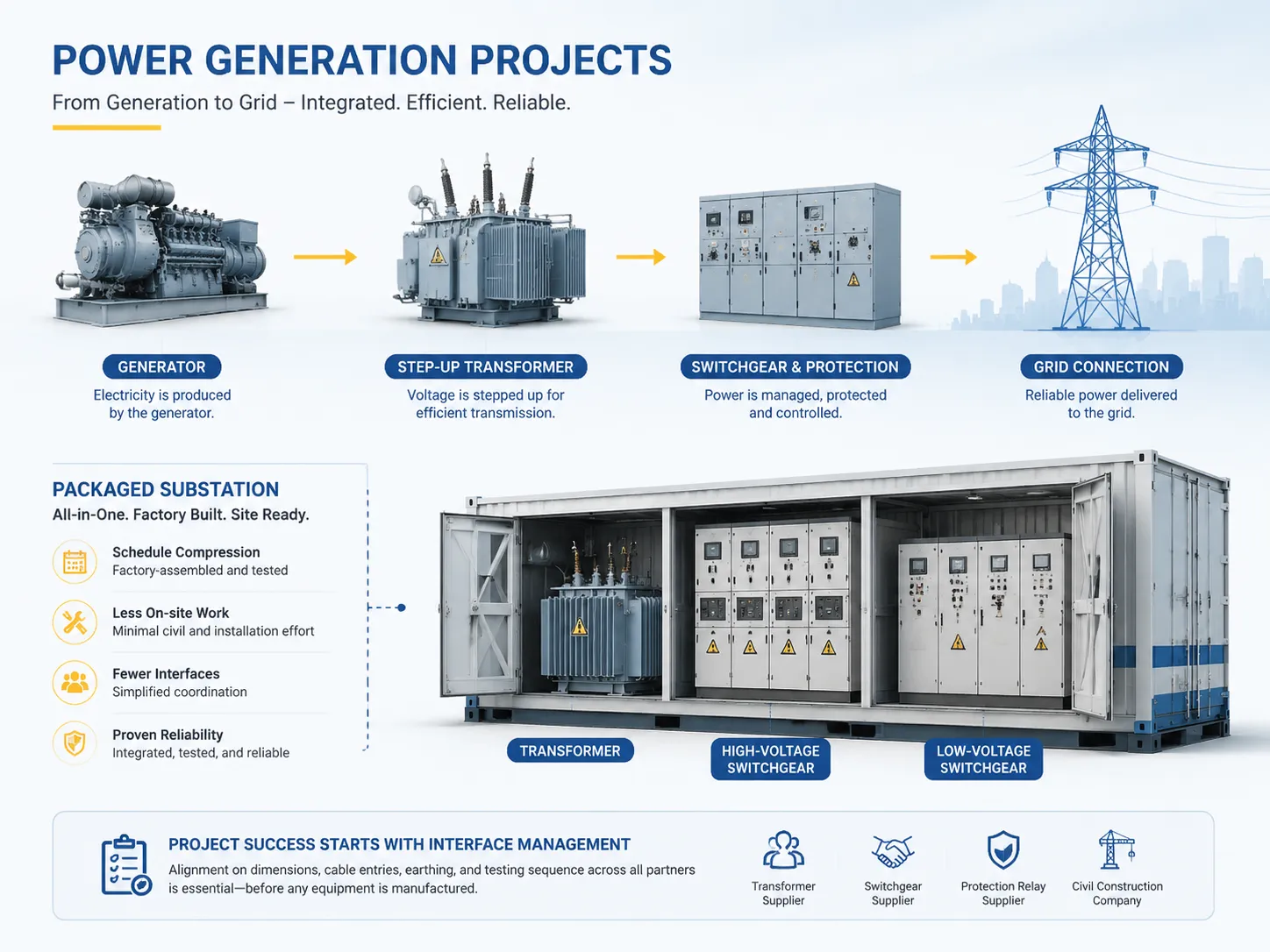
Generation process is a very important aspect of the functioning of the company, which covers both large central-station systems and small distributed ones. The technological basis of any generation process is the interaction between the generator and the electric grid, which consists of step-up transformation and its protection.
At this stage, the equipment layer becomes evident. The generation process does not only include the turbine or the engine, but also a series of steps that have to be executed together. The standard process consists of transforming the output of the generator into transmission voltage through a step-up transformer and transforming it again into the auxiliary and distribution voltage for the needs of the plant. Every stage of this process needs switchgears of proper capacity and other equipment.
In many situations, particularly when the generation asset is located far away from the point of demand, the packaged substations play an important role in energising the project. A combined transformer and switchgear unit in a box-type substation format is a good example of the class of equipment involved: transformer, high-voltage and low-voltage compartments integrated into a single transportable enclosure, factory-assembled and tested, then delivered and connected on site. From an EPC contractor’s point of view, the value is schedule compression — less site civil work, less on-site assembly, fewer trades to coordinate.
The practical implication for project owners would be the fact that their success in the project depends on how well they would manage the interfaces. Before any equipment is manufactured, all of the transformer supplier, switchgear supplier, protection relay supplier, and civil construction company must agree on the dimensions, position of the cable entries, earthing arrangement, and testing sequence.
Substations, Transmission Lines and Underground Cables
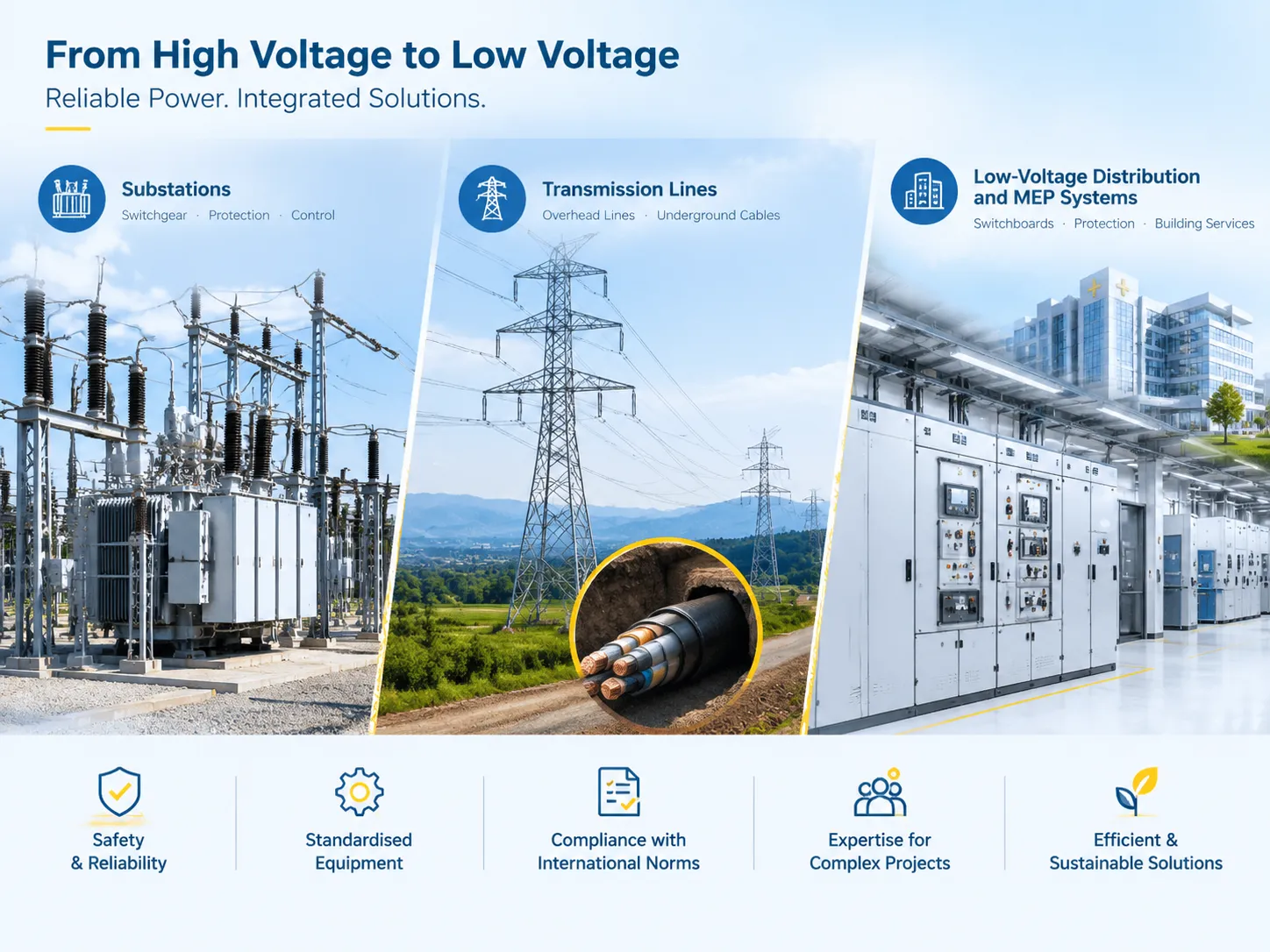
The tasks done on the substation are recognized as tasks that require a lot of special knowledge and skills to tackle. That is why this part of the project is the one that allows verifying the company’s claim about its ability to perform complex operations according to international norms.
It should be specified that the term high voltage substation stands for a mechanism rather than a construction. The substation includes main busbars, circuit breakers, disconnectors, instrument transformers, systems of protection and control, devices for auxiliary voltage supply, and systems for earthing and in some cases systems for SCADA. When making design decisions one should take into account that the first decision about the arrangement of busbars will affect the flexibility of switching processes for the next thirty years, the second decision about the fault level will define the parameters of the equipment, the third decision about earthing system will help to estimate the steps and the touch voltage and the last decision about protection scheme will determine whether the malfunction will lead to trip of one feeder or the whole station.
At the medium voltage level, the switchgear is the type of equipment that already has a standardization. Different types of metal-clad switchgear are commonly used for industrial and distribution substations since by using this design it becomes possible to replace the faulty circuit breaker without the necessity to turn off the main busbars. If you want to see what that category looks like as a manufactured product rather than a project deliverable, a 12 kV metal-armoured withdrawable switchgear assembly shows the standard configuration: separate compartments for breaker, busbar, cable and instrument transformers, each with its own pressure relief path.
The third component is the transmission lines and underground cables. Overhead wires are preferred in locations where land is available and cost considerations apply, while underground cables are used in locations where land use is either not obtained, where the route passes through urban zones, or where environmental and security concerns prevent overhead construction. Working with underground cables is more expensive on average and gets a lot less forgiveness — jointing has to happen under tightly controlled and monitored conditions, and locating faults in underground cables is significantly harder than with overhead lines. Determining the appropriate route for the cables, the thermal capacity of the transmission material, and establishing the jointing sequence is a separate field of expertise altogether.
Low-Voltage Distribution and MEP Systems
At the low-voltage end of the scope, MEP integration takes place, which is the stage that most affects the functioning of the building or the facility at the time of handover.
MEP means mechanical, electrical and plumbing, which also means building services. The electrical component in hospitals, data centres or industrial facilities is represented by a system of distribution switchboards, cables, protection devices and metering devices that interact with mechanical loads. The issues that need to be solved in the design process though are of serious importance: determination of the amount of diversity applied to the load, differentiation between essential and non-essential supplies, arrangements for automatic switching from utility to emergency power source, discrimination between various protection devices in such a way that may facilitate maximum efficiency of operation of the system.
At this level, the equipment is modular and standardised. Low-voltage assemblies such as a withdrawable low-voltage switchgear assembly are built up from standard functional units — incoming, bus-coupler, outgoing feeder, capacitor and motor starter sections — configured to the project’s single-line diagram.
That standardization is truly a positive aspect for the EPC contractor, which allows for the factory construction of equipment and type testing before dispatching the unit with the documented configuration compatible with design drawings instead of on-site construction.
According to EMIP, its sectors perfectly correspond to such activities. Healthcare facilities require substantial basic supply separation, whilst industrial establishments demand motor control and harmonics management. Oil and gas facilities require classification of hazardous sectors and efficient approaches to them. None of these represent standard MEP jobs, which is probably the reason why the company distinguishes them.
Floating Power Barges: The Unusual Specialty
One of the elements that stands out in the services offered is the floating plant for temporary emergency utility. To get a better understanding of this offering, it’s critical to gain an understanding of what this unique service entails because the number of vendors with this capability is pretty limited.
A floating power plant is a power generation facility placed on a vessel or a pontoon. The contexts when floating plants make the most sense include the situations when generating facilities are needed faster than a land-based plant could be erected, the place does not have any land available for convenient connection with the grid, or when the necessity is really temporary, for example, the period of reconstruction after war, peak seasonal demands, or just the need for transitional energy supply while a stationary plant is built.
Indeed, there are undeniable engineering benefits of this approach. The floating plant can be almost completely assembled or erected in a shipyard under controlled conditions and towed to the site right after that, which allows for an enormous reduction in comparison with an entirely new facility. Another huge benefit of this solution is its mobility: once this necessity disappears, this floating facility can easily move to another place instead of being stuck at one point. The operation at the site should be limited to conventional tasks associated with mooring, grid connection, and arranging fuel supply.
There are, however, a number of major challenges that make this service a niche, not a common offering. The fuel has to be delivered to a floating energy unit and the design of the equipment should take the factors related to the cooling system and the environment on board into regard. The connection of a moored unit requires custom solutions due to its mobility, and the comprehensive equipment installation has to meet both requirements of energy generation plants and marine classification standards. EMIP positions this capability as one of the leading products of the company, which means that they spent investments into making it available for customers.
Current Status: Size, People and Reach
These days, EMIP is viewed as a medium-level specialized contractor rather than as an important global company. Different directories say that the number of employees varies between 20 and 100 and this is logical, considering that a successful project management and engineering organization does not maintain a large number of employees constantly but needs them for projects in a particular timeframe.
The company focuses on the global market, but it works primarily on the regional projects financed by regional donors. Understanding such financing of projects is important, as it allows to define the complexity of the work done. Projects financed by donors and other generous organizations involve formal procedures of purchases, complete specifications, independent supervision, and other processes. The companies that manage to work in such conditions have a much better understanding of compliance and formal issues; as a result, they encounter challenges with flexibility in implementing changes in the scope of work.The projects undertaken include many sectors mentioned before. The company also has the separate section dedicated to the projects it has implemented so far.
QHSE, Standards and Qualifications
Quality, health, safety, and environment are said to be a key priority in every single operation. According to the company, it guarantees that its projects adhere to the highest possible quality and safety standards and support the provision of a healthy working environment and sustainable methods.
This is something that is widely used in the industry and this should be known about when verifying it. In practice, the credibility of QHSE in power contracting relies on the following confirmations:
- A registered management system. ISO 9001 standard for quality is the minimum requirement; ISO 45001 standard for occupational health and safety, and ISO 14001 standard for environmental management are usually available. One should ask for the certificate, the registering body, and features as many of the certificates are valid only for “engineering services”.
- HSE performance data for the project. Lost-time injury frequency, accident investigation results, and closed safety observations. The aggregate figures do not mean much while project data provides insight into the action of the organization under pressure.
- Standards for design and construction. For the power industry, it means compliance with IEC standards for switchgear, transformers and protection engineering, as well as the local country codes. One should clarify what edition of the standard was used because stating it is compliant with the IEC without a number does not mean that something can be verified.
- Testing and commissioning certificates. This means that records for factory and site testing as well as protection coordination are available. These documents will determine whether an object can be delivered and efficiently operated.
- Suppliers’ certificates. The manufacturers behind the EPC contractor are equally as important as it is the contractor himself. Type-tested switchgear, certified transformers, and calibrated relays are essential for insurance purposes.
When someone is evaluating EMIP for a project, it is logical to ask for the management system certificates and then get two or three reference projects that are similar in scope in the same sector and country context. It is better to ask the references directly as they will provide a more reliable source of information.
Where the Equipment Layer Sits in a Project Like This
There is one important distinction that needs to be made because it manifests itself every time any research is conducted regarding EPC contractors and equipment producers on the same page.
EMIP is a layer of contracting that is responsible for the design, procurement and construction of a project. At the same time, it does not claim to be the manufacturer of switchgear, transformers and distribution assemblies inside the project. This role is played by the layer of equipment, which consists of dedicated plants producing high-quality equipment according to the requirements of IEC and country regulations, testing it in independent laboratories and issuing complete documentation.
This means that the projects using the EPC approach have two separate supply chains: the supply chain of the contractor who manages engineering processes and site works and the supply chain of equipment producers included in the project single line diagram. Both should coincide correctly for the successful completion of the project — the contractor that uses poorly documented equipment does not leave the customers with an operational plant while the excellent equipment may not function if the EPC contractor’s work does not have proper coordination.
This is the layer where RUY Power operates. We are responsible for producing highly efficient equipment operating at different voltage levels. For projects where the equipment needs to carry a different brand or a specification written by someone else, that’s handled through our OEM and ODM arrangements, which is often how EPC contractors prefer to buy: their own name on the drawing, ours on the factory test certificate.
When specifying equipment for a project involving a contractor like EMIP, it is important to determine the level from which the equipment is procured. Buying through a manufacturer then contracting with the contractor tends to lead to the worst of both worlds in equipment acquisition.
FAQ
When was Electromecha International Projects founded?
According to numerous independent company directories, EMIP was founded in the year 2004. The about page of EMIP gives information that this company existed in 2004 and since then this company has grown from a small trading company into a big EPC contractor that has been executing multi-million dollar projects.
Where is Electromecha International Projects located?
With its head office located in Dubai, UAE, the company is situated on Marasi Drive in the Lake Central Tower at Business Bay. Its postal address is P.O. Box 290046. Located next to Downtown Dubai, Business Bay is commercial district that provides the company with opportunities connected to projects in the entire region of MENA and South Asia.
Is empintl.com the same company as Electromecha International Projects?
Yes. The domain empintl.com represents the firm Electromecha International Projects, which abbreviates to “ELECTROMICHA” and is usually shortened as EMIP. The domain and company name refer to the same organization in question.
What products and services does EMIP provide?
Services provided are made available for renewable energy schemes, energy resources based on conventional methods, refurbishment of old power facilities, temporary and emergency floating energy stations, and operation and maintenance assistance along with managing and consulting on projects. In other words, the technical capabilities include generating electricity, high-voltage transform stations, lines of electricity transmission, underground cabling, and MEP installations implemented through the EPC contracts.
Is Electromecha International Projects publicly traded?
EMIP is a private company so there is no financial information available to the public. Financial standing should be assessed based on projects references, direct inquiries, and commercial references rather than published accounts. The number of employees varies according to different independent directories estimates from 20 to 100 employees.
References
- Electromecha International Projects — official website
- Electromecha International Projects — About Us — founding year, headquarters and service areas
- International Energy Agency — Reports — global electricity and power investment data
- IECEE — international certification scheme for electrical equipment
- IEC 60947-6-1 — transfer switching equipment standard
- Dubai Electricity and Water Authority — Dubai grid and connection requirements
Conclusion
The website empintl.com belongs to the Electromecha International Projects firm, which is an EPC contractor based in Dubai and began its work in 2004. At present, the firm has done many projects in the areas of generation, substations, transmission, underground cables and MEP systems in the whole Middle East, North Africa and other places as well. The capacity which is unique to the Electromecha is floating emergency/temporary power plants, and it should be mentioned that many contractors can not provide this service due to the specifics of the technologies used.
The transition of a trading house into an EPC contractor reflects the evolution of the company. The trading allows to develop a network of suppliers and acquire commercial discipline, while EPC needs engineering and accountability. Nonetheless, making this transition is a difficult process, and 2004 is a long period of time so it seems that it was successful.
For those who are looking for the company to cooperate with, it is important to check the following: the management system certificates and their scope; project statistics on HSE instead of averages; reference projects. It is also important to not confuse the two levels of a power project, namely, contractor and manufacturer of switchgear and transformers — there are two separate supply chains and two separate processes of documentation preparation.