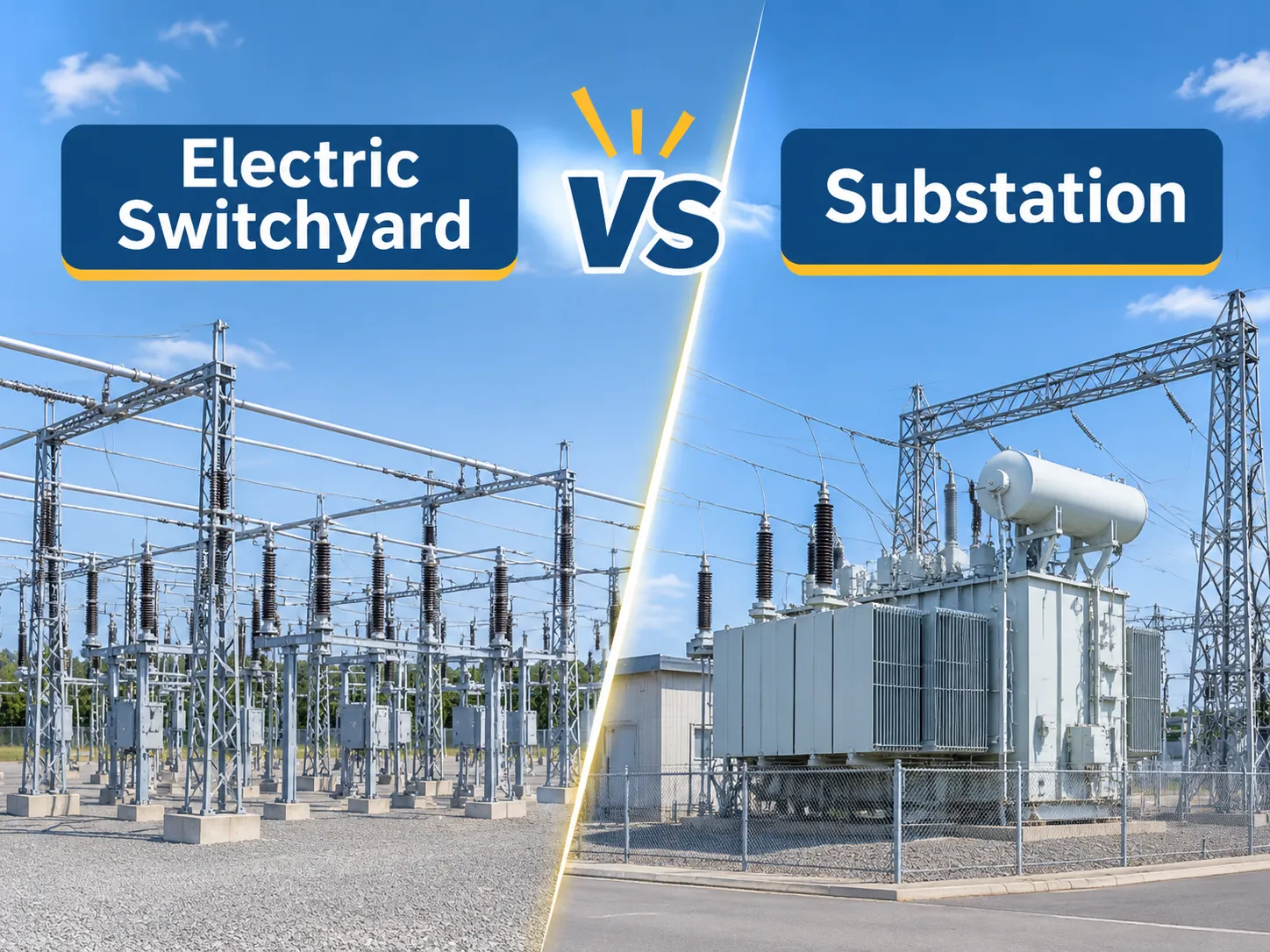

Powerplant Maintenance Specialists, Inc. is a company that is very active in the US power industry yet nearly invisible outside of that industry. There are no Wikipedia pages for them, very little information on their website and most of what a buyer would find regarding PMSI has been published by trade press/publications, professional directories or their own Linkedin profile. Therefore, an article about their Leadership Team has to use Public Record and not repeat information from their Corporate Profile
The Short Answer – Powerplant Maintenance Specialists, Inc., (PMSI), is a Private Company, a Minority-Owned Company, and a Power Plant Maintenance Contractor located in Costa Mesa, California. PMSI was founded in 1981 by Richard Dick Engel after leaving Bechtel. James McEachern currently serves as President and CEO, and is displayed on PMSI’s Linkedin Page along with numerous Professional Directories as the Company’s Senior Executive. The Administrative portion of PMSI, (Accounts Payable, HR, Payroll, IT), is managed by Duane Rumas. PMSI’s Linkedin Page shows 44 Employees, yet the Company states the Company Size Band is between 201-500. PMSI is established based on Engineering, Project Delivery, and Field Execution for Boiler, Turbine, and Balance of Plant Work throughout the United States.
The remainder of this document includes the Structure of PMSI, the people from the Public Record that have been identified as part of PMSI Leadership, the Delivery of Leadership on specific Projects, how PMSI fits within the overall US Plant Services Market and the limits of the Publicly Available Information.The final section provides insight on what a procurement team should check regarding verification prior to forming a contract.

An Overview of the Company
| Company Type | |
|---|---|
| Legal Name | PMSI (Powerplant Maintenance Specialists Inc) |
| Founding Date | 1981 Founded by Richard “Dick” Engel |
| Base of Operations | California, Costa Mesa, United States |
| Entity Ownership | Privately owned (per the company’s interpretation of minority ownership) |
| Industry Classification | Engineering/Construction for Electric Generation |
| Senior Management | CEO/President James McEachern |
| Number of Employees | The Company’s LinkedIn Claims of 44 Employees; Company bandwidth of between 201 and 500 Employees |
| Scope of Services | Consulting, Engineering, Procurement, Construction, Rehabilitation, Repair |
| Website Address | http://www.pmsipower.com/ |
The company states its service delivery model as well as it says that it has a team of senior executives who are carefully selected and then deployed into field resources to complete projects that need the following services; consulting, design, engineering, procurement, construction, rehabilitation, or repair. This is the operative description of a mobilisation company, not a manufacturing company; this also indicates the additional importance of the leadership team in this environment as opposed to just focusing solely on headcount numbers.
Who Is Running PMSI? Public Record Information
James McEachern – President and CEO. James McEachern, as referenced in the company’s LinkedIn page, the management listing by RocketReach, and various Business Contact directories all reflect James McEachern as both President and Chief Executive Officer located in the Costa Mesa headquarters. No other executives are listed on the company’s public LinkedIn employee listing, consistent with a relatively small senior team of executives not maintaining active social media profiles.
Richard “Dick” Engel, Founder – Dick Engel, the founder of PMSI, started PMSI in 1981 subsequent to his departure from the Bechtel Group, where he performed engineering for different projects.The reason for his departure was that Bechtel was refusing to accept the high volume of work it was receiving from fossil-fuel facilities needing support, thereby placing all of that work into the hands of specialist maintenance contractors (as opposed to being able to work with Bechtel themselves). This is significant to those who evaluate the company, as it indicates that the company has been built to do the work that large engineering companies do not want to perform, and not to compete directly with them.
Duane Rumas, who is responsible for administrative functions, is listed in the directories for Accounts Payable, Human Resource, Payroll, IT, and Composites. The fact that all of these functions are handled by one individual is an indicator of the size of the company that they operate within; a company with thousands of employees generally has them separated into different individuals, while a company with dozens of employees typically combines these functions within one individual.
All of the other named executives that have been referenced consistently within public records are unlikely to be representative of the leadership team of the company. Many directories feature information associated with Companies of Engineers, Project Managers and Service Staff from many different countries, but since the majority of these are self-reported and can change on a daily basis, they are of little value as a representative leadership team of any sort.
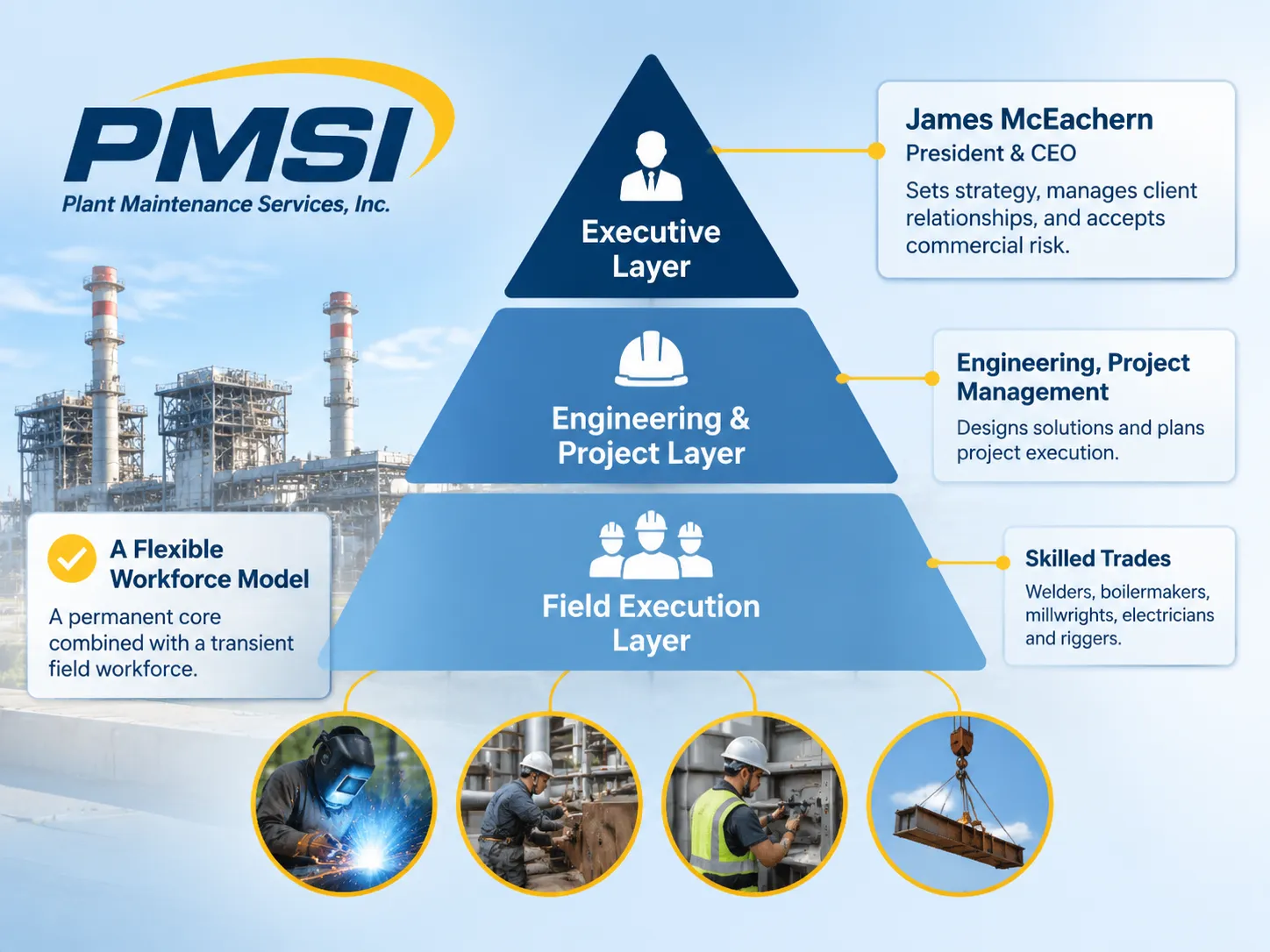
There appears to be a threelayer structure of the plant service contractor as evidenced by information in the public record. It is a common model used by plant contractors of this size.
The executive layer includes the President and CEO of the company. The Executive Layer is responsible for maintaining the relationship between the company and its clients, negotiating contracts, and accepting the commercial risk associated with very large projects. In the case of a company of the size represented in this case study, the Executive Layer is the final escalation point for any quality or schedule issues, which is why their name appears on nearly all references found in public records.
The engineering and project layers of the company are represented by the Listings provided for the Directorates. Directory information on the organisation of Departments suggests that Engineering and Technical Design constitutes the largest single function, with Project Management being smaller by way of numbers of employees assigned to this area.The usual ratio of engineering to field operations (boiler, turbine and balance-of-plant rehabilitation) is in the ratio that engineering cuts disposable materials out and installs replacements while the project group plans the sequence of work within an outage window.
In the current stage (field execution layer) of the project, welders, boilermakers, millwrights, electricians and riggers are mobilised to each project on a non-permanent basis. In the case of the AES Huntington Beach Generating Station project reported in 2001, approximately several hundred workers would be on site with an intention to scale to approximately 600 workers drawn from an international pool of trades. Thus, the model is comprised of a permanent core (engineers/managers) plus a transient field workforce for each outage.
This organisational structure explains a key point often seen in public descriptions of the company. Because the company does not maintain a workforce on its payroll between projects, it can quickly build a workforce needed to staff a critical-path scope. Furthermore, the permanent nature of the engineering core allows the company to undertake an atypical or non-traditional project scope that most companies could not.
What the Leadership Has Delivered
The most widely documented project in the company’s history is the AES Huntington Beach Generating Station in California. The work on units 3 and 4 was performed by PMSI, under a $130 million contract. Scope at the time included demolition and rebuilding of steam boilers, condensers and two turbine generators, installation of pollution control systems, repairs/replacement of piping, rebuilding of auxiliary systems, and installation of digital emissions controls. The company intended to repair the 45,000 gallon-per-minute ocean-cooling water pumps.
Two items found in the reporting are important to understand the company’s operations.
The gross impact of the contract is that sales increased from $25 million to $180 million within a year. This demonstrates how much of the company’s revenues are reliant on one large contract. The gross profit from the contract will be influenced by PMSI’s labour model, which employs several hundred trades from its home base in Poland, Texas, Louisiana and other areas and is projected to reach a total of 600 by the end of 2015.
The project is only one of many projects undertaken by PMSI over its more than 20 years of operation. It is, however, the only one with publicly available, detailed reports, and it exemplifies the ability the company’s leadership claims to possess; taking an old, decommissioned boiler and turbine, rebuilding them and getting them up and running before a specified regulatory deadline. The equipment from which this project was developed (including switchgear, breakers, and generators) is subject to the same types of risks as all other electrical infrastructure equipment projects in this industry; available capacity, availability of skilled labour, vendor payment issues, etc.
As a company reaches its forty-year anniversary, it typically experiences a transition in ownership and leadership style, which can have a distinct impact on the company’s clients. PMSI finds itself in that same situation today. PMSI is experiencing the transition from the founder’s generation to a new generation of leadership. In a typical situation, the leadership typically identifies with the history of the company. However, as PMSI undergoes this transition, it will have to be careful not to lose sight of its roots.
When a company is built around one owner’s connections, and that owner either leaves or has stepped back, it loses access to those connections. The absence of a visible second tier of leadership in a company makes it difficult for a new customer to evaluate that company. The only way to protect oneself from this situation is through a systematic process, not through an individual. Request an org chart for the specific scope of work you’re requesting, the names of engineers who will be assigned to the project, their CVs, and an escalation process in the event that the assigned project manager is not available.
Just because you do not see a visible second tier of leadership in publicly available resources does not mean that it does not exist. It simply means that the company does not publish this information. This is typically how contractors work with utility companies and independent power producers (not consumers), who award work via a qualification process rather than via a website.
Where PMSI fits into the US Power Plant Maintenance Marketplace
The US power plant maintenance marketplace is quite large and varies significantly in structure, and PMSI has carved out its own distinct niche in this area.
OEM service arms occupy the top tier of the marketplace and represent companies that have design authority over their equipment: GE Vernova, Siemens Energy, Mitsubishi Power, and Wärtsilä. They sell long-term service contracts in conjunction with the turbines that they manufacture, and their presence in the maintenance marketplace grows whenever an OEM provides a long-term service contract as part of a new build.
Beneath the OEMs are the large engineering and construction firms, as well as the utility service providers, which include Fluor, Black & Veatch, Burns & McDonnell, Sargent & Lundy, NAES, and EthosEnergy. These firms provide full service as part of their entire EPC or full O&M contracts, including plant operating services.
The source of revenue for PMSI is from specialist contractors, as they focus on doing maintenance/repairs only, not on the new construction of plants or operating plants. Unlike OEMs (original equipment manufacturers) that provide complete installations of equipment and have full control over the design and engineering of the work, specialist contractors work on a much smaller scale by performing specific defined scopes that are typically related to the repair or replacement of failed equipment, such as boilers, turbines, condensers, piping systems, and balance of plant packages. The equipment scope will include additional work to be completed during an outage that has been previously scheduled by the plant owner.
Specialist contractors benefit from being positioned at the lower level of the equipment provider’s hierarchy; they do not compete directly with OEMs for design authority, and they do not have to incur the full overhead associated with providing complete EPC (engineering, procurement, construction) services. However, specialist contractors are impacted by the same economic, regulatory, and technical environment that affects all other competitive contractors and have to rely on an owner to make the decision to repair or replace equipment based on current electricity prices (which fluctuate) and the regulatory lifespan of the equipment.
As part of PMSI’s position in the equipment provider hierarchy, PMSI also has to consider the competitive environment to the equipment manufacturers. This presents PMSI with an opportunity to take advantage of equipment and design consolidation in the utility marketplace, and maintain its current position in the utility marketplace while providing value-added maintenance services to utility companies.
During 2025 and 2026 there are several key developments that are impacting the plant maintenance contractor’s interest in expanding their service offerings and customer base.
Regulatory Timing – Changes in laws and regulations related to electric utility operations and their corresponding impact on electric rates and the utilities’ ability to remain profitable.
In 2025, the EPA extended the date that coal-fired plants must comply with these guidelines, which allows the plants to combine environmental upgrade projects with a much longer timeframe. Since contractors will now have to plan for a longer outage period, outage planning for all contractors involved will be affected.
The second major trend is the new volume of life extension projects. In 2025, DOE issued numerous emergency orders under federal law to continue to operate certain coal and oil-fired power plants beyond their scheduled retirements. A utility may have issued one or more of these types of orders, converting a decommissioning project into a maintenance project that is the exact type of scope a specialist contractor typically handles.
Constitutionally speaking, this continuing trend of OEMs consolidating maintenance revenue will continue. For example, in December 2025, Mitsubishi Power renewed a long-term service agreement with an independent power producer for an independent power producer project; as of January 2026, Wärtsilä received a 123 MW order for Odessa with a ten-year agreement attached for O & M services. These examples demonstrate how equipment and maintenance are increasingly being sold to a single buyer, thus narrowing the field for independent contractors in the context of new-build projects, while retaining work on existing fleets.
For PMSI, this trend provides an overall favourable situation. The existing fleet of coal-fired power plants in the US has very old equipment; many of these plants have received regulatory orders to extend their lives, and OEMs are focusing solely on selling their offerings. As a result, there will continue to be an ongoing need for the type of rehabilitation services that PMSI was created to perform.
The only difference on the supply side is the actual equipment. A plant looking to extend the life of its equipment will require lead times for the breakers, switchgear and transformers, and the time to manufacture and test this equipment has now become as much of an issue with schedule as with price.
Things a Purchaser Should Be Aware Of That Aren’t Posted in the Public Record
There are four areas of information that a Purchaser should be aware of, and not erroneously believe they exist.
- The Purchaser does not currently have a copy of the Leadership Team. There is only one Executive Listed Consistently and only one Executive that is named in connections to this Contractor. A Contractor of this size typically has a CFO, an Operations Director and One or More Project Directors, but none of these individuals can be located from the Public Sources.
- The Purchaser does not have Financials. There is no disclosure of revenues or any financial performance. The only information released in the public domain regarding the Financial position of the Contractor, is the 2001 Financial Report, which only reflects one exceptional year of performance, and not the average of performance.
- The Purchaser does not have Certification and Safety records. The Purchaser will normally request a current certification list and OSHA/Lost Time Reports when selecting Contractors to perform work in Operating Plants; no listing of certifications exist and no listings of OSHA or Lost Time Reports are available.
- The Purchaser does not have access to a List of Recent Projects. No recent project references after the mid-2000s can be found in the Public Sources.
This information is not uncharacteristic of a Contracting Company whose Customers are Utilities and as such, it is necessary to base an assessment of this Contractor on direct engagement and not on indirect research; this is addressed in the next section.

Contractor Verification Guide
Usually, the five requests below cover nearly everything needed by a procurement team to evaluate a contractor at the qualification stage.
- An organisation chart must be provided that shows the proposed team for your contract. The chart must include the names of individuals who will work on the project, their roles and the percentage of time committed by each person to your project. Having a chart showing only the roles of the team members with no names is only considered a proposal, not a plan.
- CVs for each of the key personnel (the project manager, site superintendent and lead engineer) who will work on your project. When reviewing their CVs, pay attention to the date of previous outages using the same type of equipment they will be using on your project and not general experience with the type of equipment.
- Three references (with phone numbers) from each contractor for the last five years for projects that are similar in scope to your project. If a contractor cannot provide references from projects of a similar scope within the last five years, that contractor has not done that type of work recently.
- Documentation regarding contractor’s safety statistics and insurance coverage including the experience modification rate, OSHA recordable rate, three years of lost-time data and certificates of current general liability and workers’ compensation insurance, naming your organisation as the Insured.
- Evidence of a contractor’s financial capacity to perform contract work, including either a letter from a surety company indicating the maximum amount of contract work a contractor can bond or a bank reference letter. If a contractor does not have either of these letters, the contractor is taking on a project larger than its balance sheet can support, and is therefore at risk of failure, despite its potential technical capability.
The five requests listed above are essential elements for obtaining verification of a contractor’s qualifications. For an organisation like PMSI, the ability to provide these five requests seperates it from being a subcontracting broker and demonstrates the company’s engineering capabilities, its field mobilisation model and the existence (providing the documentation is up-to-date).
The same test should be applied to all suppliers on the project, and the support and service arrangements for a switchgear order are the same types of questions to be asked before placing the order rather than waiting until after delivery to ask.
Where RUY fits into it
RUY is not a plant maintenance contractor and does not compete with PMSI, rather, RUY manufactures the electrical equipment generally required along with the mechanical portion of the plant maintenance project. These include: 12 kV and 40.5 kV medium voltage switchgear, Low voltage distribution assemblies, Prefabricated Substations, and Distribution Transformers.
This is important when considering a rehabilitation project where there are mechanical and electrical portions of the work typically covered by two separate contracts on the same outage schedule.
Therefore, when the contractor pulls a request for a replacement boiler feed pump, he also requires the motor starter and feeder breaker to complete the job and the service and support arm of RUY provides that equipment with consideration to the project schedule rather than catalogue lead times.
For the plant owner, or an EPC (engineering, procurement, construction) contractor, who is self-performing the electrical package, all the types of low voltage and medium voltage assemblies will be provided under one interface for the electrical room. The assembly types are switchgear, distribution cabinet, capacitor compensation, and prefabricated substations.
RUY also is not a publicly traded supplier of UL assemblies designed for utility substations.
If a UL 891 or UL 1558 certification needs to be included with the project, the supplier we suggest will be a local panel builder and this will be noted in the initial response to our customer. If a project allows IEC assemblies to utilise the electrical scope for an IEC Market, the price point differs dramatically, with the equivalent 630 A lineup representing a much lower cost than domestically sourced items.
FAQS
Who is the President and CEO of Powerplant Maintenance Specialists, Inc.?
According to LinkedIn and a number of other professional directories, James McEachern is the president and chief executive officer based out of the corporate headquarters in Costa Mesa, California. The company was founded in 1981 by Richard “Dick” Engel, who led the company during the trade press reports dated from the early 2000s to present.
How many Employees does PMSI have?
LinkedIn lists PMSI as having 44 employees, even though they claim a range of employees between 201 and 500. The discrepancy between the total number of employees is due to the company’s operating model, which consists of a permanent core of engineers and managers, and field crews that are activated upon the start of a project and are not retained on payroll. The 2001 AES site work report quoted PMSI as having several hundred trades on site and anticipated having up to 600 on site by project completion.
What does Powerplant Maintenance Specialists do?
Powerplant Maintenance Specialists provides engineering, procurement, construction and rehabilitation services associated with electrical generation projects within the United States. PMSI offers a full-service project scope, including consultancy, design, engineering, procurement, construction, rehabilitation and/or repair, focusing on boiler, turbine, condenser and balance-of-plant equipment that is done within scheduled plant outage windows, if applicable.
Is PMSI a Minority Business Enterprise (MBE)?
Yes. PMSI, within its own corporate profile on LinkedIn and in various directories has designated itself as a minority-owned business enterprise. That is important relative to US utility procurement for the use of supplier diversity programs on maintenance or construction-related contracts.
References
- LinkedIn — Powerplant Maintenance Specialists, Inc., Company Profile
- Orange County Business Journal — Powerplant Maintenance Specialists at Ground Zero
- US Department of Energy — Grid Reliability and Plant Operations
- US Environmental Protection Agency — Steam Electric Power Generating Effluent Guidelines
- POWER Magazine — Plant O&M and Maintenance Practice
Conclusions
PMSI is a small privately held specialist contractor with a narrow focus and a long-standing history of being a reliable contractor, and its leadership consists mainly of one name.
James McEachern is the operator of PMSI, Richard Engel the founder, and the company has a permanent core engineering staff with field crews activated for an outage project. The amount of public record available for this contractor is relatively thin, which should indicate to a potential buyer to do their due diligence and not dismiss PMSI based on that alone.
To confirm and validate the contractor’s capabilities, the buyer should request the project’s organisation chart, CVs of the staff assigned to the project’s output, three recent reference letters, a copy of PMSI’s safety record, and a bonding letter. A contractor with engineering depth as described by PMSI should be able to provide all requested documentation in a timely manner. However, if the contractor does not provide such documentation, it is a clear indication to the buyer of their capabilities beyond just relying on web content.