
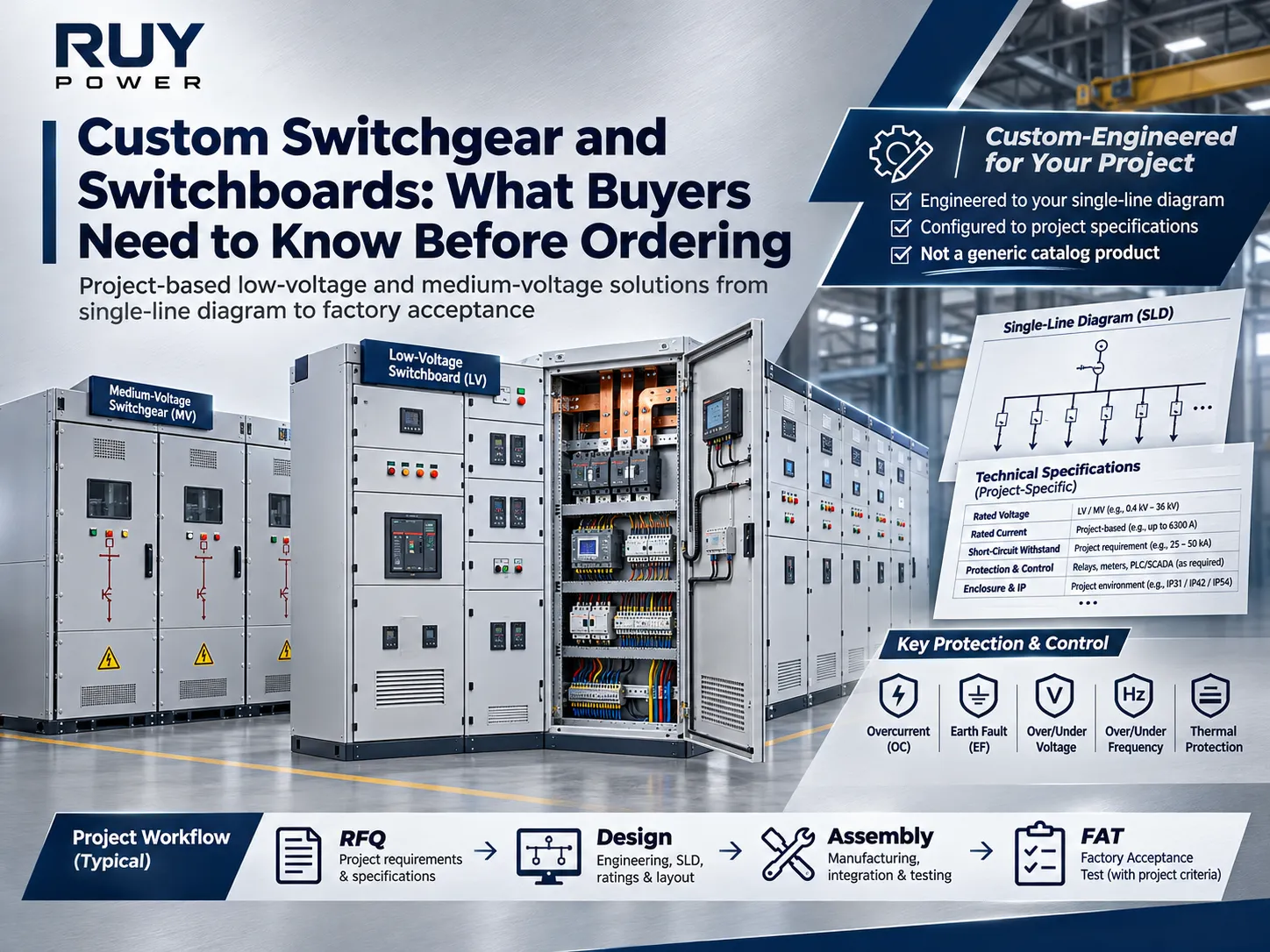
Custom switchgear is created based on the single-line diagram and technical specifications of a project instead of using a catalogue. Many distribution projects use prefabricated low-voltage or medium-voltage switchgear; however, non-standard voltages, limited space, specialized protective systems, or connected to a nearby substation projects require custom equipment. This guide explains when it is appropriate to use custom switchgear and custom switchgear switchboards, as well as what information a producer requires and how the entire process works from request to factory acceptance.
Short answer: Custom switchgear is medium-voltage or low-voltage switchgear made for a specified project and specifically designed to adhere to the specified single-line diagram. Custom switchgear switchboards usually imply low-voltage distribution boards or motor control panels designed according to certain feeders, protection, and communication requirements instead of a standard catalogue solution.
What Is Custom Switchgear?
The main rather interesting thing about custom-made switchgear is that it can be seen as equipment designed in accordance with the specifics and needs of the client and not as equipment manufactured under the standards regulating the manufacture of switchgear and its components. Although standard electronic components such as circuit breakers, disconnectors, current and voltage transformers, busbars, and protection relays are involved in the manufacturing process, the innovation comes from the application of the components in accordance with the client’s requirements and specifications.
The reasons for choosing custom switchgear can range from non-standard voltage or frequency of the system to limited size of the switchroom. Upon switching to custom equipment, the client obtains a variety of solutions such as:
-Components designed for working under non-standard voltage or frequency conditions
-Specific dimensions of the switchroom or special cable entry direction
-Complicated protection and automation requirements
-Need for matching the previous station or box-type one
-Unusual environmental conditions of operation (mountain height, coastal area, high temperatures of the environment)
-OEM or private-label needs
Custom Switchgear Switchboards Explained
In the market for low-voltage gear, custom switchgear switchboards are often sought after by customers. These switchboards or MCCs (motor control centers) are arranged according to load schedule-based specifications regarding feeder configuration, busbar capacity, and control capabilities.
A typical custom low-voltage switchboard includes the following components:
– Incoming compartment adjustment made according to actual transformer rating
– Combination of fixed feeder units and withdrawable components
– Necessary protection systems (such as residual current, arc fault detection, and temperature monitoring)
– Communication capabilities with the site’s SCADA or PLC system
– Provision of certain spare ways and allowance for future expansion
– Body dimension, color, and IP rating suitable for the way the place looks.
On the contrary to a conventional switchboard purchased by means of catalogue number, a custom switchgear switchboard is usually confirmed on the project’s single-line scheme and load schedule before it is produced, meaning it comes ready to connect with the minimum modifications.
When Do You Need Custom Switchgear?
Not all projects necessitate complete customization. Standard switchgear is generally appropriate when the voltage class, short-circuit rating, and number of feeders are within normal limits as well as when the dimensions of the switchroom fall within average sizes.
Custom switchgear becomes the right decision in the following cases:
– The voltage rating or power output falls in between the steps in the catalog.
– Cable entry should take place from an uncommon angle due to already existing trenches or cable basements.
– The protection scheme requires additional interlocks, transfer schemes, or remote control features.
– The switchgear should be coordinated with the transformer or box-type substation supplied by the same supplier.
– The installation takes place outdoors or in the conditions that require a higher IP or special surface treatment.
– The project is OEM/ODM, and it is essential for the panels to have the appropriate brand and documentation style.
In many cases, it makes sense to take a hybrid approach: use standard panels for the main distribution of power, and apply customization only to the low-voltage switchboards or control parts.
The Custom Switchgear Design and Manufacturing Procedure
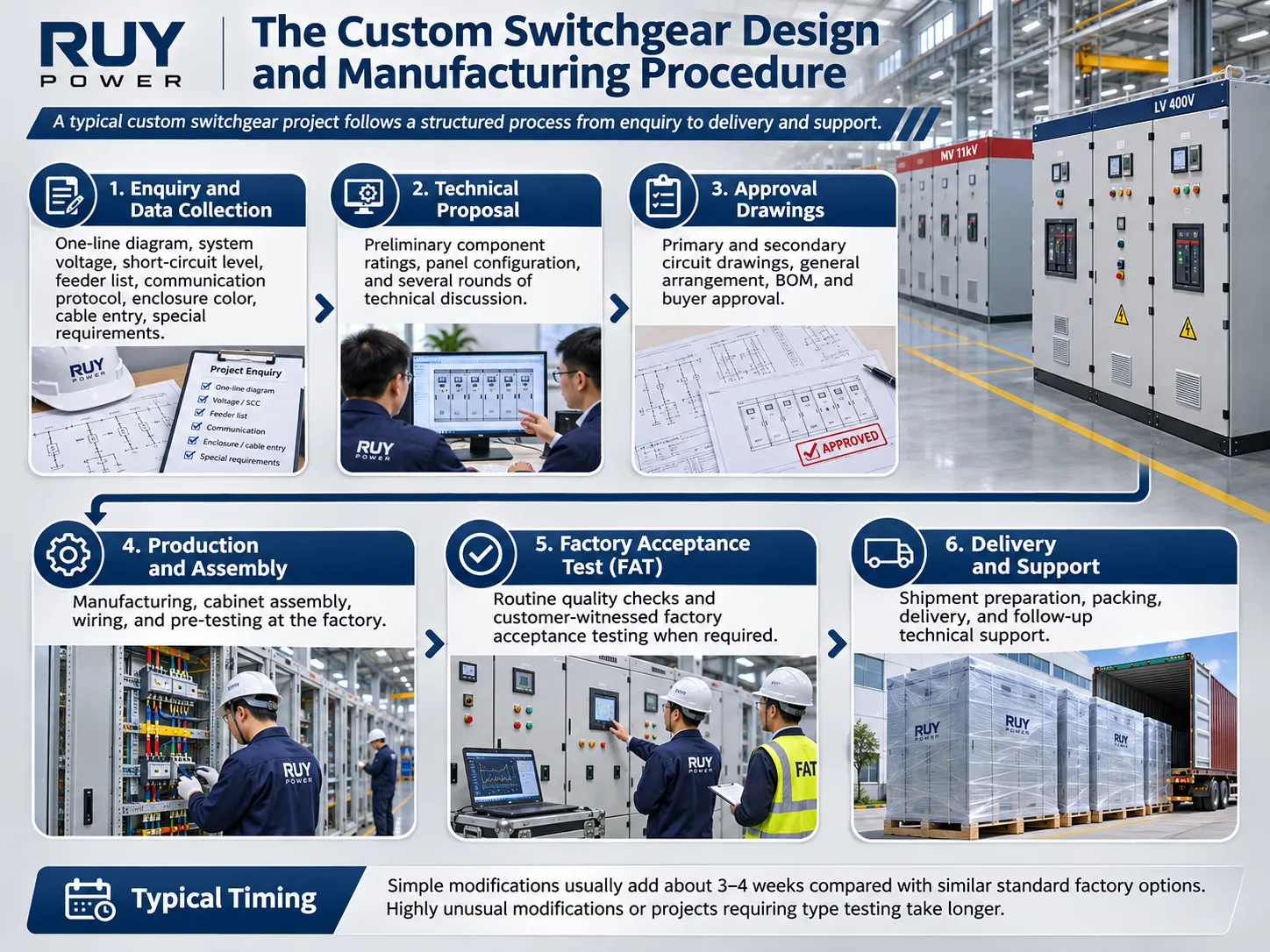
Typically defined by a series of steps, a custom switchgear project can help project stakeholders to accomplish their goals and achieve initial expectations.
Enquiry and data collection
Information needed by the manufacturer includes a one-line diagram, system voltage, short circuit level, list of feeders, and any special requirement such as a certain communication protocol, enclosure colour, and cable entry.
Technical proposal
In response to the buyer’s enquiry, the manufacturer submits a technical proposal with the estimated ratings of components and configuration of panels. This process may include several rounds of discussion.
Approval drawings
The approval of the technical proposal will lead to preparing detailed diagrams of the primary and secondary circuits, general arrangement of the switchgear, and BOM.
Production and assembly
After the drawings are approved, the process of manufacturing will commence. All relevant components will be assembled and pre-tested at the manufacturing site.
Factory acceptance test
Regular testing will be performed to ensure the quality of the product. If required by the Customer, factory acceptance testing can be organized at this stage.
Delivery and support
At this stage, all products will be prepared for shipment in accordance with the arrangements made at the previous stages.
For simple modifications of the existing models, the duration of the procedure is normally 3-4 weeks longer than for similar options produced in the factory. In case of highly unusual modifications or when type testing is required, the duration increases to a greater extent.
Key Technical Points Buyers Should Specify
When information is clear in the enquiry stage, it cuts the number of revisions and minimizes the time needed for the project. Information to be included in this stage is:
Rated voltage, frequency, short circuit current
Incoming, bus-section and outgoing feeders number and its capacity
Type of circuit breaker used and the required breaking capacity
Functions of the protection relay and communication protocols
Direction and type of the cable entry (bottom, top, rear)
IP rating of the enclosure and its special corrosion protection
Required number of spare ways and future provision
Whether the switchgear should fit with a transformer(s) or a pre-fabricated substation
Necessary codes and standards required to be followed
Providing a single line diagram and a basic list of loads to be supplied is enough to have a meaningful technical discussion.
Custom versus Standard Switchgear: Cost and Lead Time
Custom switchgear is not automatically more expensive. The cost difference depends on how far the design moves from the manufacturer’s standard platform.
| Factor | Standard switchgear | Custom switchgear |
|---|---|---|
| Design effort | Minimal | Drawing and engineering time required |
| Component selection | Catalogue items | Mostly catalogue items with possible special relays or interlocks |
| Lead time | Shortest | Typically a few weeks longer |
| On-site work | May need adaptation | Usually arrives closer to final configuration |
| Documentation | Standard package | Project-specific drawings and test reports |
In projects where site space is limited or the protection scheme is complex, the extra factory engineering cost is often offset by reduced site labour and fewer late changes. When the required configuration is very close to a standard design, it is usually more economical to stay with the standard product and add only minor modifications.
FAQ
What is the difference between custom switchgear and standard switchgear?
Standard switchgear is manufactured according to set catalogue designs, with predefined ratings and arrangements. In turn, the custom switchgear uses similar components but reconfigures the ratings, compartments, control wiring, and enclosure specifications in line with the detailed design of a particular project.
What information do I need to provide for a custom switchgear quote?
A basic requirement is to include a single line diagram, system voltage details, short circuit rating and a list of feeders showing their ratings. Other information such as communication requirements, cable entry direction, electrical enclosure IP rating and specifications of environment can improve the quality of proposals.
Can custom switchgear switchboards be expanded later?
It is indeed true that making available spare ways and busbar rating during the initial stage of design and production is a more simple and less expensive option than changing a ready-made board design afterward.
Do custom switchgear need special type tests?
Many custom projects remain within the scope of a previously verified design. New type testing is only typically necessary when important changes are made to the insulation system, arc-fault prevention system, or short-circuit capabilities. The design must be verified by the producer in terms of available test reports.
How long does it usually take to manufacture custom switchgear?
Easy customisations that are not diverging from a standard platform will only mean an order time increase of about two to four weeks compared to a plain order. Complicated arrangements that entail the use of new drawings, special components or witnessing actual tests will take longer and need to be discussed at the proposal stage.
Can you supply both custom MV switchgear and LV switchboards for the same project?
Yes. Supplying medium-voltage switchgear and low-voltage switchboards from the same manufacturer simplifies coordination of ratings, protection settings, and documentation, and can reduce interface issues on site.
Conclusion
When the voltage, layout, protection, and integration requirements of a project are beyond those provided by standard catalogs, custom switchgear and custom switchgear switchboards become helpful solutions. The important point is to precisely define the requirements at the beginning of the project and ensure compliance with accepted envelope standards whenever possible. Besides, one should choose a company that can handle both the low-voltage segment and the medium-voltage section of the project.
RUY Power designs and produces medium-voltage switchgear, low-voltage switchboards, prefabricated substations, and ring main units. The company starts working from single-line diagrams and proceeds with factory testing and delivery if custom products are needed. If you need any bespoke products, you can send us a single-line diagram and information about basic electrical capacities for an assessment.