
High voltage switchgear is a rare case where decrease of number of suppliers is a fact. The two sell-offs, a few buys and ten years of consolidation ended up with five corporations controlling approximately 43 percent of the world market, while the earlier players either operate locally or on the basis of low prices. For a customer, this market concentration is probably the most useful information they can get, providing an explanation of lead time and the fact that quotes are delivered in three weeks.
The following part of the article does not focus on company histories, although it is done according to what makes it possible to compare. Cross-comparison of the offers and quotes will be based on rating envelopes, insulation medium, arc extinguishing technology, results of type tests, and service coverage.
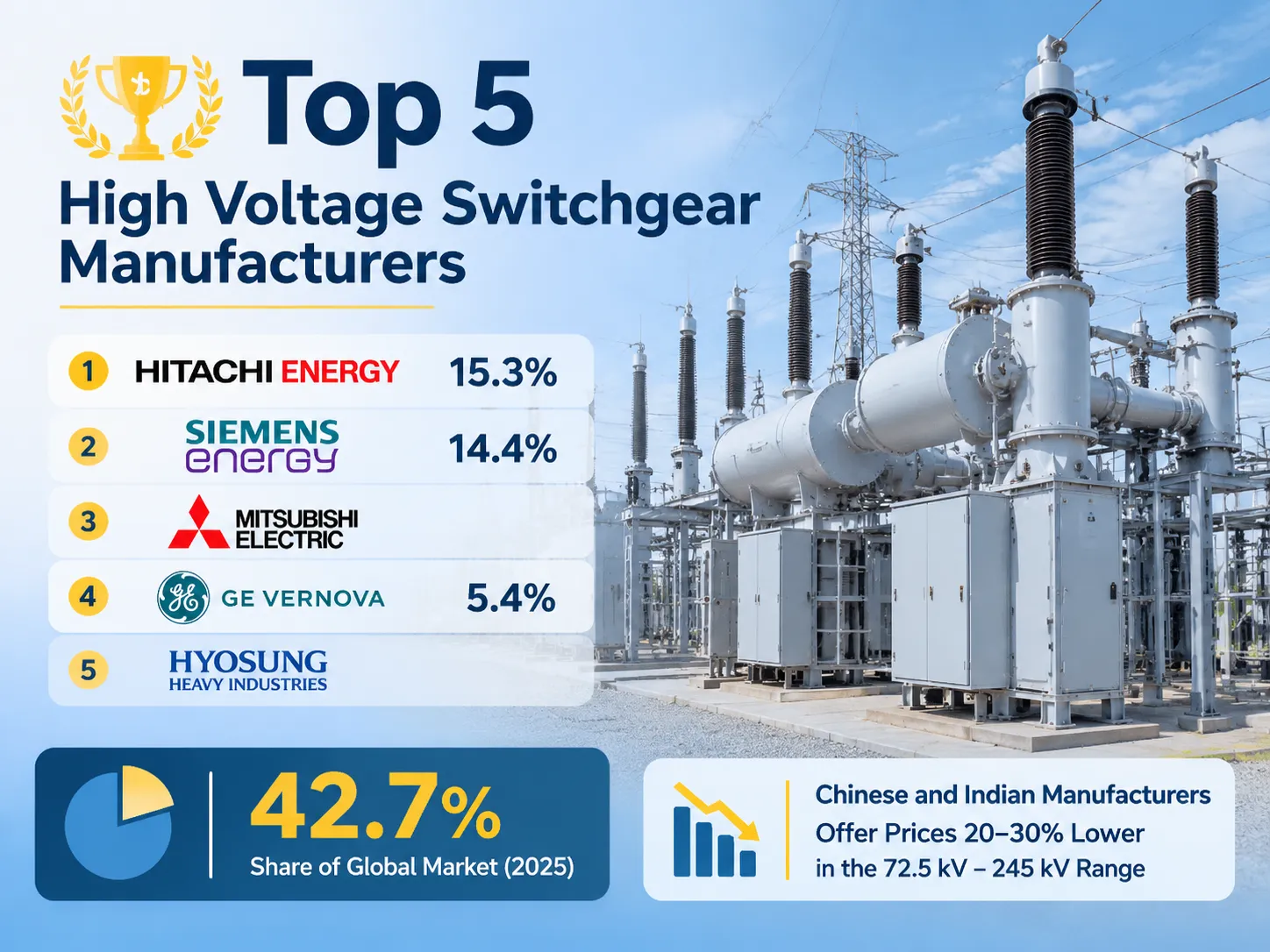
Short answer: The five companies dominating the high voltage switchgear market are Hitachi Energy (approximately 15.3% share in 2025, with the EconiQ line of SF6-free products), Siemens Energy (around 14.4% share with GIS, AIS and hybrid technologies), Mitsubishi Electric (leading in the Asia-Pacific region with GIS technology), GE Vernova (5.4% share with a strong presence in North America), and Hyosung Heavy Industries (a major player in South Korea and the Middle East skipped from most rankings).In total, these companies accounted for about 42.7% of the global market in 2025. ABB is absent from this list due to its transfer of high voltage grid business to Hitachi Energy back in 2020, so there is no valid reason to rely on 2026 reports claiming that ABB holds that much share. In the subsequent tiers, manufacturers of high voltage switchgear from China and India cut the prices of the existing manufacturers by 20-30%.
What “High Voltage” Means in This Market
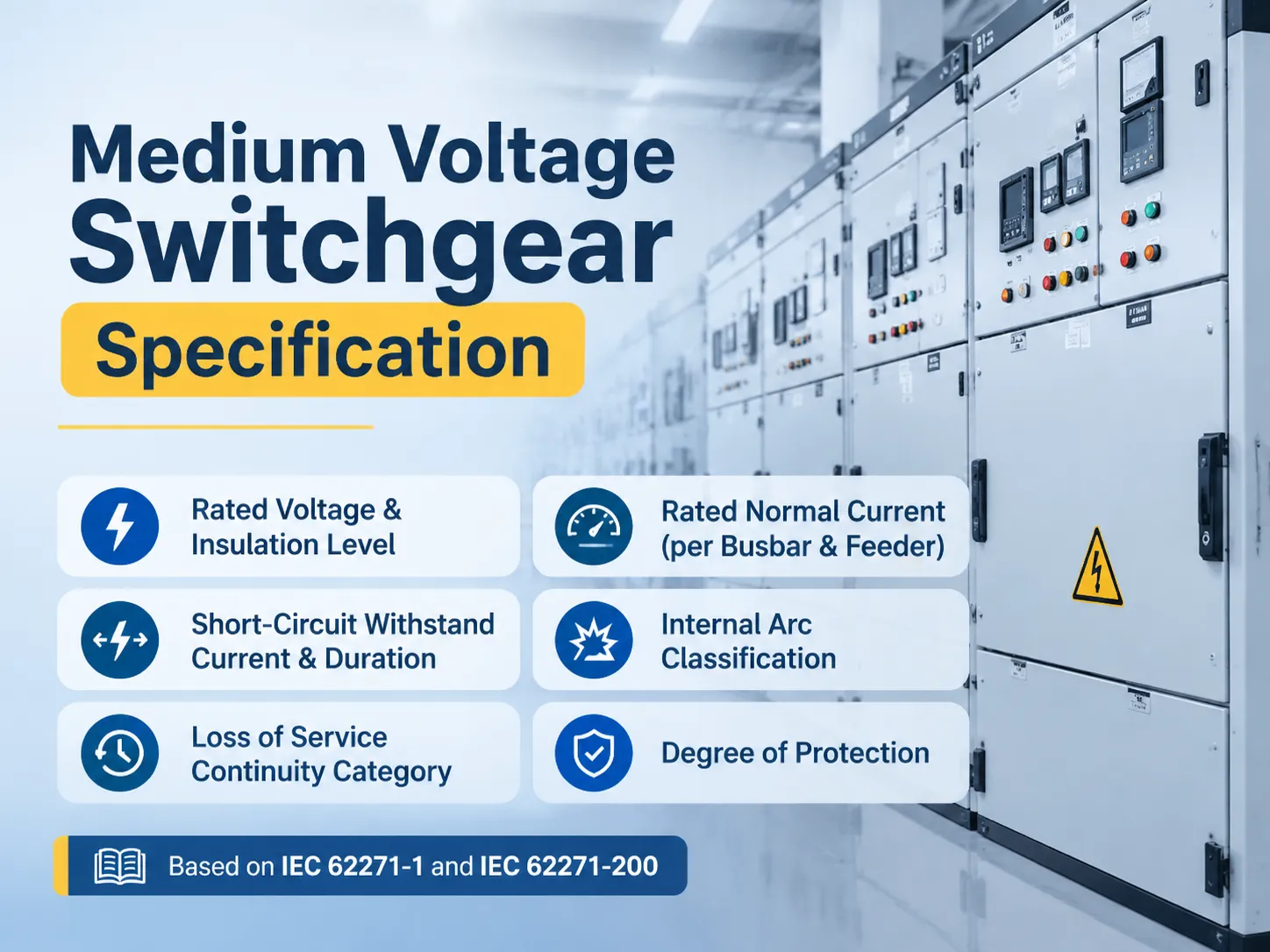
The IEC has established the voltage limit at 1 kV. If the voltage exceeds that level, then the commonly followed standards are IEC 62271-1 for general requirements and IEC 62271-200 for metal-encapsulated assembly projects. So in practice, the market is divided between 3.6 kV to 40.5 kV (the medium voltage sector) for sales to factories and buildings, and 72.5 kV to 245 kV (the substation voltage) for bulk sales. Lastly, the most advanced voltage level -420 kV and above-is reserved for mega projects only.
The 12 kV and 40.5 kV equipment in this 12 kV metal armored switchgear range is technically high voltage and commercially medium voltage.The product is designed and developed according to a customer specification, but it is produced using standard components. Hence, lead times are measured in months instead of years. The 245 kV and 420 kV blocks offered by the aforementioned firms are designed fundamentally; hence the prices.
This is an important consideration when it comes to selecting suppliers. A 36 kV project should not try to compare Hitachi Energy with a local manufacturer in terms of price as they do not offer comparable products. One company offers a type tested solution operating globally, while the other offers a solution designed to meet the same type test. They are both potentially legitimate.
The Five That Actually Hold the Market
| Manufacturer | 2025 global share | Insulation and switching | Structural advantage | Where they win |
|---|---|---|---|---|
| Hitachi Energy | ~15.3% | GIS, AIS, hybrid; vacuum and SF6; EconiQ SF6-free range | Scale plus the former ABB grid portfolio and service base | Transmission utilities, HVDC-linked substations, SF6 replacement programmes |
| Siemens Energy | ~14.4% | GIS, AIS, hybrid; Blue GIS clean-air range | Deep European TSO relationships and F-gas transition products | European utilities, offshore wind connections, regulated networks |
| Mitsubishi Electric | Not separately disclosed | GIS at transmission and UHV | Installed base and specification influence in Asia-Pacific | Japanese and Southeast Asian utilities, UHV projects |
| GE Vernova | ~5.4% | GIS and AIS, plus grid automation | North American manufacturing and utility relationships | US and Canadian utilities, large substation packages |
| Hyosung Heavy Industries | Top five by revenue | GIS, AIS, circuit breakers, transformers | Korean manufacturing cost base with Western qualification | Middle East, Korea, and increasingly US projects |
The two companies that are important to mention are Schneider Electric and Eaton, whose position is between the 6 and 8 percent margin depending on market measurement, mainly on the industrial and medium voltage sides. Moreover, Lucy Electric, S&C Electric, G&W Electric, and Tavrida Electric occupy their own niches, which include distribution automation, reclosers, and padmounted switches. In case a project requires one of these niche products, people might find a better solution than offered by any of the five.
Hitachi Energy: Volume Leader and the SF6 Exit
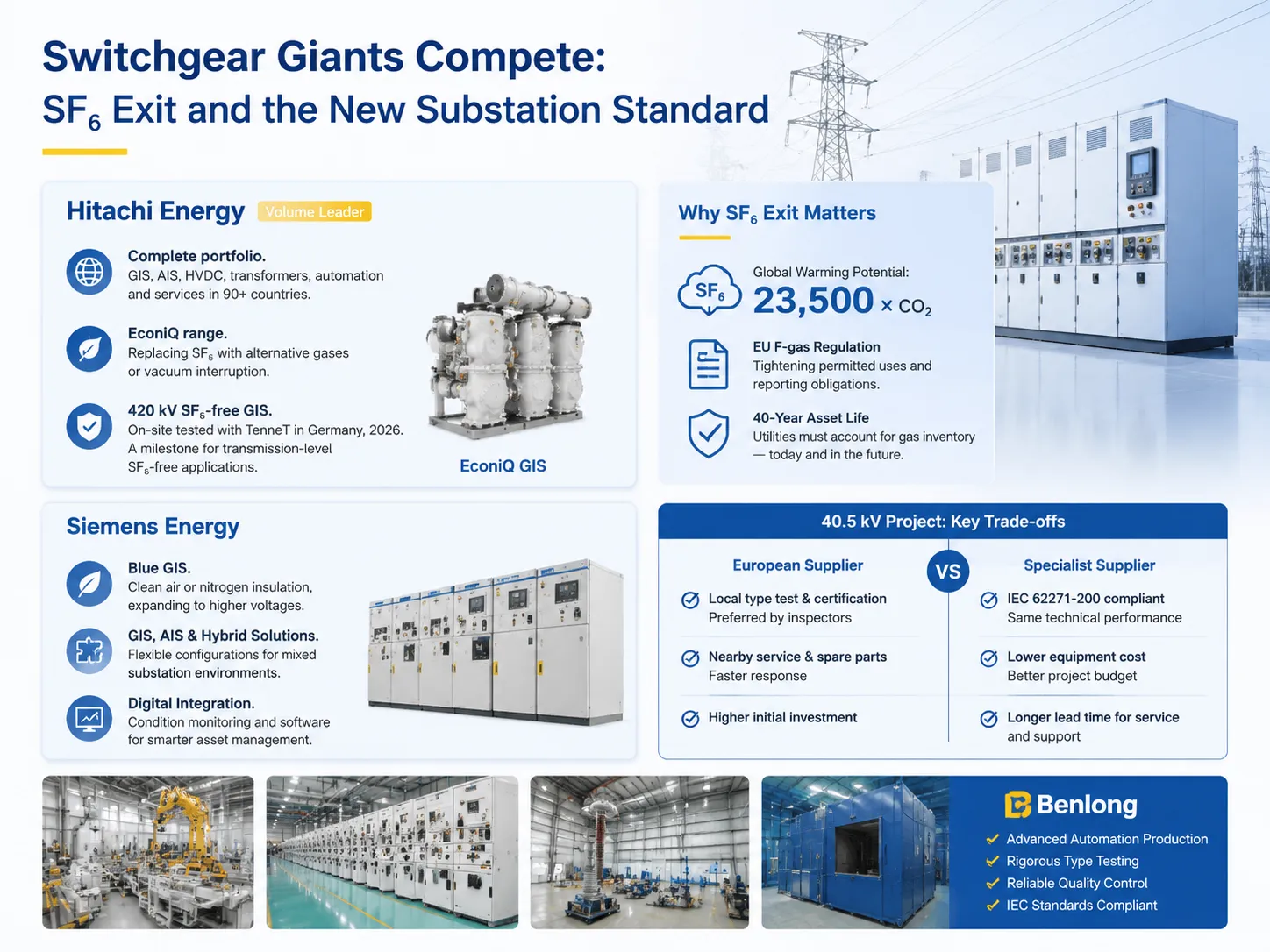
Hitachi Energy has the highest stake as its acquisition was comprehensive. When ABB sold its power grids segment in 2020, the buyer’s transaction covered GIS, AIS, HVDC, transformer, grid automation, and worldwide operations guaranteeing services in over 90 countries. Whatever the rationale might be, the outcome was the equipment supplier capable of providing end-to-end substation products.
Currently, the EconiQ series is a commercial success. It makes use of alternative gases instead of SF6 and some products feature vacuum interruption, with the key event of note being the 420 kV zero-SF6 switchgear installed and successfully tested with TenneT in Germany in 2026. This means that zero-SF6 now would not only be a distribution switchgear feature and become a transmission switchgear feature, hence the operators with deadlines for using F-gases are urgently approaching this supplier.
On its own, SF6 is responsible for that. Its greenhouse effect potential is 23,500 times greater than CO2, while the EU F-gas regulations have been introduced into life for many years. When the utility company plans for the equipment to work for over 40 years, the function of switchgear makes it responsible for the amount of gas that it will have to declare and later reuse. This is exactly why the insulation material appears in the list of characteristics to be compared with regards to the opening feature.
Siemens Energy: GIS, AIS and the F-Gas Problem
Siemens Energy is the nearest rival where market share is concerned, and the more European of the two, as seen in its customer roster. Its Blue GIS product range adopts clean air or nitrogen in the distribution voltage sector and is in the process of expanding, thereby establishing a position that suits TSO’s facing national F-gas regulations that are stricter than the EU standard.
The company’s product offering comprises GIS as well as AIS and hybrid solutions, which is not a small matter. A 145 kV substation could use GIS technology in the substation and AIS technology in outgoing feeders, and buying both from one vendor eliminates interface-related issues when the products do not meet expectations. Furthermore, the company is bringing condition monitoring and integrated software solutions to the market, which is either useful or useless depending on your maintenance unit’s ability to utilize the data.
For a 40.5 kV project, the comparison with a specialist supplier is worth doing honestly. A 40.5 kV armored withdrawable switchgear assembly built to IEC 62271-200 can carry the same ratings as a European bay at a materially lower price. What it fails to provide is the type test of the European manufacturer in the format preferred by your inspectors, or service centers located two hours away. These are the trade-offs that should be priced, not argued about.
Mitsubishi Electric and GE Vernova: Two Regional Fortresses
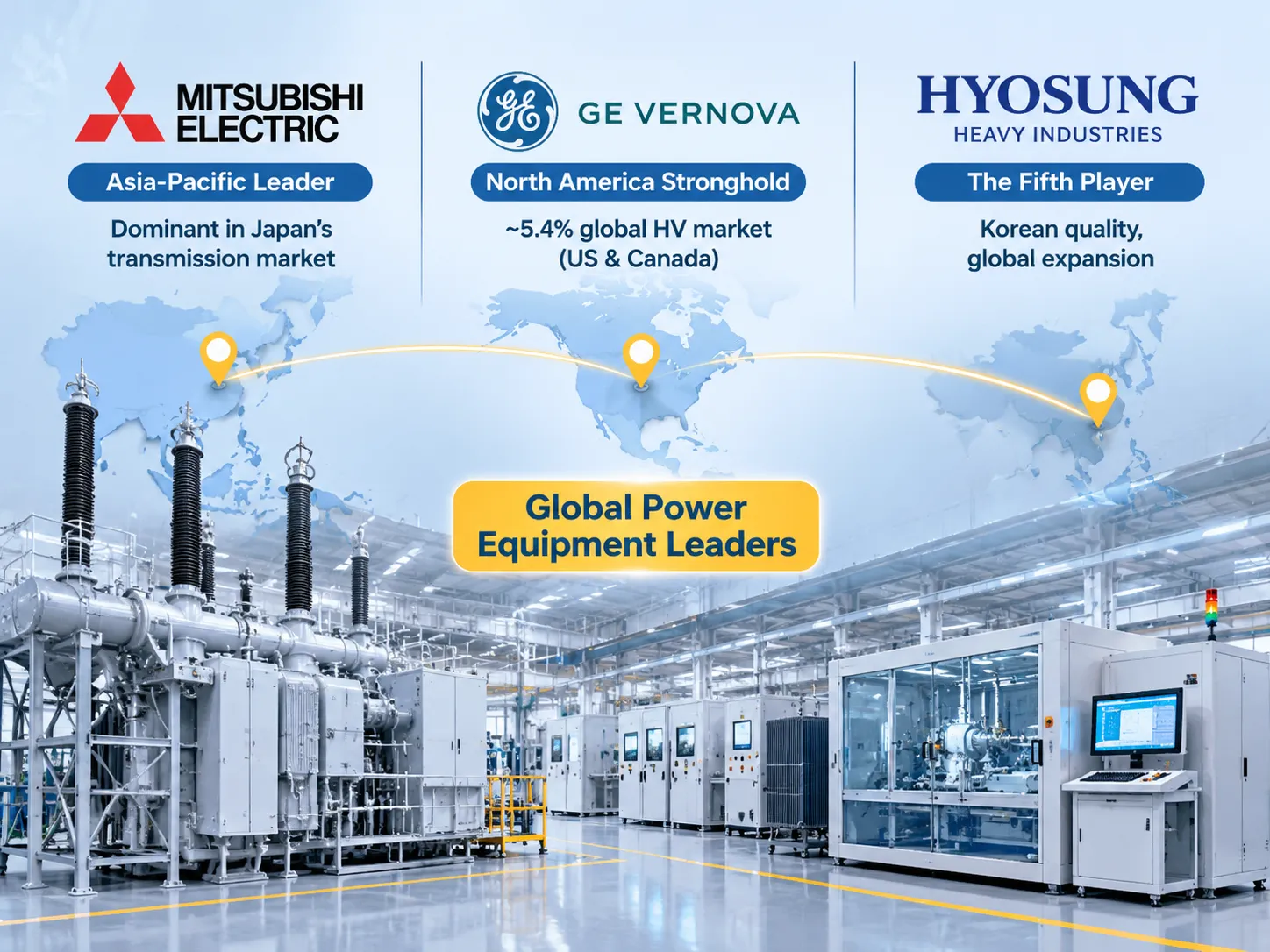
Mitsubishi Electric is the leading supplier of GIS utilities in the Asia-Pacific region and is also the leader in the local transmission market in Japan. The rankings published do not include separate figures for Mitsubishi since the company reports only at group level, therefore the figures are lower than due to constructed segment revenue. When for example a utilities has been using Mitsubishi installations for decades, it continues to use it due to the fact that it already has the experience with needed spare parts, training and test equipment.
GE Vernova stands in a different position in the North American market, with its share constituting about 5.4% of the global market for high-voltage technologies, with the major share of Canadian and US consumption. It also expands its production capabilities due to the finalization of the deal on acquiring the remaining stake in the Prolec GE company by 2026. The company also leverages the domestic content laws in the US and the fact that a US utility is able to justify procurement easily since it would be already American.
Additionally, both companies are difficult to compete with locally, and expensive abroad, while a consumer in one of the Middle Eastern or Southeast Asian countries is comparing them with Korean or Chinese companies, basing the decision on their price level instead of service level.
Hyosung Heavy Industries: The Fifth Position Nobody Names
Hyosung deserves to be present in any ranking list drawn up in English while it is surprising that company does not appear in most of them. This is a strong manufacturing player in the market of GIS, AIS, circuit breakers and transformers, especially in Korea and the Middle East, and its operations have expanded to the USA. In 2026 its US subsidiary created a joint venture with Quanta Services for manufacturing high voltage circuit breakers to comply with domestic content requirements for grid procurement processes in North America.
From a commercial point of view, Hyosung offers manufacturing costs associated with Korean production but with necessary documentation and certification of a Western level. Incorporating this solution into its business operations will also be appealing to those projects that cannot afford to take the risk of working with a supplier that has no proven track record but whose goods are less costly than those made in Europe.
The Price Tier Below, and What It Actually Costs You
According to market research in this area, Chinese and Indian producers are selling their products for around 20 – 30% lower than current players in the market in the 72.5 kV to 245 kV market segment. Such a gap increases even further for 40.5 kV and below segment, and the reason is not only the labor cost, though it is one of the factors involved. It is also the issue of the number of standard products used in the area, incoming supply chain of the nationally produced cabinets and quicker certification of products.
However, cheaper price does not necessarily mean that the service is also included. If a branch of a 132 kV substation fails it is not a warranty problem, it is an outage with the main question being about how many hours it takes until a technician with all the necessary spare parts arrives. If the time limit is four days and a flight then that should be included in total cost of ownership tally, but does not usually end up in the invoice.
The other point is whether the documentation is available that would satisfy the inspector. Type test results to IEC 62271-200 are available from accredited laboratories, but it is required that they be performed for this specific set of equipment, the one specified in the offer. So it is reasonable to look at the report number and the laboratory accreditation prior to price comparison, because the offer with such answer is not complete yet. The routine tests that sit behind that report, including power frequency withstand and mechanical operation, are the ones a buyer can watch being performed, and the switchgear manufacturing and test process sets out what happens at each stage.
Rating Envelopes: What to Compare Before You Compare Price
Two switchgear quotes look the same if five stipulations are satisfied.
- First comes rated voltage and insulation. For example, 12 kV switchgear must be resilient to the highest voltage to withstand lightning. Therefore, 12 kV must meet 70 kV testing for lightning and 20 kV for operational voltage. Generally, at 24 kV, the rated value increases to 125 and 50 kV, respectively. At 36 kV, it will be 170 and 70 kV and at 40.5 kV it becomes 185 and 80 kV, respectively. The quotation without clarity of the numbers mentioned cannot be considered complete.
- Second is rated current that includes ranges 630, 1000, 1200, 1600, 2000, and 2500 A. The same happens with values of busbar and chamber ratings. However, as long as there are differences between these values, the lower number should be used.
- Third is shortcircuit capacity. Short circuit rating is insufficient without duration thereof. For example, 25 kA for 1 second means one set of components, while 25 kA for 3 seconds indicates another one. Thus, one may refer to the peak withstand, normally equal to 2.5 and 2.6 times the RMS value, that represents a third measurement.
- Fourth one is Internal Arc Classification. The meaning of each letter is as follows: AFL means hot steam is released at the front; and AFLR indicates the rear opening as well. Clearly, these abbreviations are not merely marketing tools, but they influence the sales and construction prices, too.
- Last one is loss of service continuity. LSC1 and LSC2 show how much of the busbar remains energized when a chamber is opened. LSC2B specifies that both busbar and adjacent circuits are energized during opening of the compartment.
Where RUY Fits
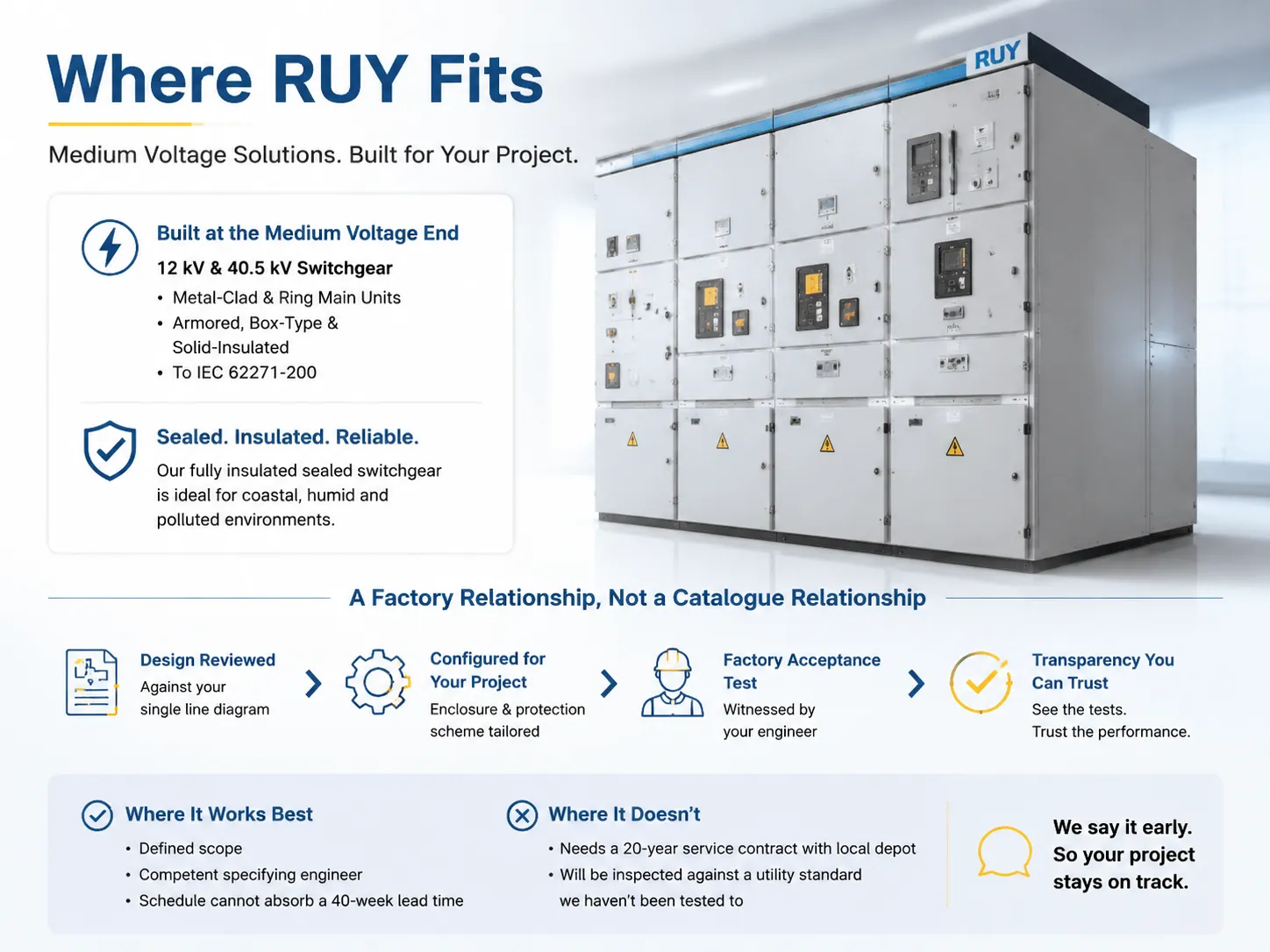
We build at the medium voltage end: 12 kV and 40.5 kV metal-clad and ring main units, in armored, box-type and solid-insulated constructions, to IEC 62271-200. The 12 kV fully insulated sealed switchgear is the product that suits coastal, humid and polluted sites, because the sealed construction removes the insulation surface that contamination degrades.
We do not wish to be categorized along with the five instances mentioned above, and it would be misleading to claim that we are. We provide a factory-type relationship, not a catalogue-type relationship: we will consider the design from the perspective of your single line diagram, the enclosure and the protection scheme will be tailored to your requirements, and you will witness the factory acceptance test. That last point is worth mentioning because if a supplier does not allow you to be present at the routine tests, he will ask you to trust the papers instead.
This model doesn’t fit all projects; it is best suited for a project that can be defined, executed by a competent specifying engineer and where time constraints do not allow for a 40-week lead time. It does not work well for projects that would have a 20-year service contract with a local depot or those that are exempt from the utility compliance we have not met.
How to Shortlist for an Actual Project
Begin with the voltage as the starting point, and let it do the work. Any voltage over 145 kV will narrow the field down to the five mentioned in this article. The discussion will then concern type tests, SF6 policy, and service response. When the question is about voltages from 40.5 to 145 kV, one must mention the strong Chinese manufacturers and refer to a higher price spread level of 30% and above. When dealing with voltages under 40.5 kV, the five companies described above are not the right counterparties for a single order, and a factory with proper type testing would be the better choice.
Now apply four filters in the order stated. Is the quote complete and does it mention the full rating envelope, insulation level, short circuit duration, IAC class, and LSC category? Does the supplier have a type test report from a recognized laboratory proving this assembly production? Can they provide two customer examples at your voltage in a market with a similar inspection environment? Will they agree for the factory acceptance testing of the manufacturing process with your representative present and under the written test plan?
The high voltage switchgear application cases are worth reading for the pattern rather than the products: in each one the constraint that decided the design was the site, whether that was a coastal atmosphere, a container footprint, or a protection scheme the local utility would not vary from.
FAQ
Who are the largest high voltage switchgear manufacturers?
By global market share, the leaders in 2025 would be Hitachi Energy with approximately 15.3 percent and Siemens Energy with about 14.4 percent, then Mitsubishi Electric in Asia-Pacific utility GIS, followed by GE Vernova at approximately 5.4 percent and Hyosung Heavy Industries. The top five players accounted for approximately 42.7 percent of the global market share. ABB no longer enjoyed a position in this space as its high voltage grid business was transferred to Hitachi Energy in 2020.
Is ABB still a high voltage switchgear manufacturer?
The transmission division is not included in this matter. In 2020, ABB sold its power grids division to Hitachi, which has been operating as Hitachi Energy and has controlled ABB’s GIS, AIS and HVDC services ever since. ABB, for its part, still provides medium voltage switchgear and protection solutions through its electrification company. Any ranking that credits ABB with a double-digit high voltage share is based on information that precedes 2020 and is thus uninformative with regard to the validity of other rankings.
What is the difference between GIS and AIS switchgear?
The Gas Insulated Switchgear employs an insulated gas which encloses all live parts within a metal housing leading to a small footprint and immunity from environmental pollution. In contrast, Air Insulated Switchgear employs air at atmospheric pressure along with open busbars leading to a lower cost and much easier maintenance and inspection yet requiring much more space and being sensitive to pollution. Gas Insulated Switchgear currently controls approximately 45 percent of the market for high voltage equipment in terms of market value with particular preference given to it, where land is expensive or environment is hostile.
Why is SF6 being replaced in high voltage switchgear?
Due to the fact that it possesses an enormous global warming potential of about 23,500 times that of carbon dioxide and that legislation with respect to F-gases was tightening up in many countries of the world and was becoming more and more strict with every following year with respect to those chemicals. As we can see, it is worth noting the existence of a certain shift to vacuum interruption in combination with clean air as well as nitrogen or different gases that belong to fluoronitrite group. One of the representatives of the sectors engaged in switching from SF6 gases was Hitachi Energy, who managed to conduct on-site testing of the latest technology at their 420 kV gas-powered grid with the help of TenneT company.
What is IAC classification on switchgear?
As per internal arc classification, it can be confirmed that an internal arc will form inside the assembly and that hot gases will flow out from a defined side of it. Called IAC AFL, the internal arc means that arc gases are vented out from the front of the enclosure; if classified as AFLR, then gases may stream from both front and rear of the equipment. Additionally, the classification implies a type of access of the assembly as well as its current and duration, as this is a tested characteristic rather than a design feature. Internal arc classification matters since an arc fault occurring in an unclassified enclosure may cause the doors to blow out and injure people standing near the equipment.
How long is the lead time for high voltage switchgear?
Medium voltage switchgear ranging from 12 kV to 40.5 kV takes about 10 to 20 weeks from a manufacturer after completion of all design stages including factory tests. For GIS equipment, the timeframe increases considerably for voltages starting from 145 kV, and leading manufacturers are reporting at least 40 to 70 weeks in the market, with many orders having already been allotted in two years’ time. The difference in these timeframes explains why customers sometimes choose the more convenient low voltage solution instead of a tailor-made one where they are entitled to.
References
- Hitachi Energy — Grid Integration and Switchgear
- Siemens Energy — High Voltage Products
- Mitsubishi Electric — Transmission and Distribution Systems
- GE Vernova — Grid Solutions
- Hyosung Heavy Industries — Power Equipment
Conclusion
The reason why the market is so concentrated is because transmission switchgear is a type-testing industry, with type testing at 245 kV being too expensive for the majority of companies to expense. Thus, only five names come up in every shortlist, and the main challenge is to compare their quotes.
First, look at the rating envelope instead of at the price. The insulation level, short circuit duration, IAC class, and LSC category are the four things that will tell you if comparable equipment has been presented in two offers, since they are always lacking in an offer. Only once they are confirmed can you start interpreting the difference in price. Please send the single-line diagram along with the conditions of the area where the equipment is planned to be installed, and we will let you know if the scope should be 12 kV or 145 kV substation.