
All players in the energy industry, from utility companies to renewable energy makers, have the same challenge: substations take extremely long to build on-site. Substation construction requires a complex mix of civil work, a control building, installation of switchgear, and hundreds of control cable installations, all accomplished over the span of several weeks of testing. Building such structures at the job site operationally plays out in unfavorable weather at times, and when the labor force is hardly present.
As a result, the idea of modular substations turns construction operations that typically must be completed at the construction site into operations that must involve a factory. Everything from the equipment to wiring must be completed in the factory before shipping.
This guide explains what a modular substation is, what is the difference with regular and E-house substations, what modular integrated substation control enclosures are and what they consist of, in what cases it’s makes sense to use modular designs, and how to use it.
Quick answer: A modular substation is one that is created from modules that are assembled pre-assembled and pre-tested in a factory including switchgear modules, transformer modules, low voltage distribution, and protection and control modules brought to site, and connected. A modular substation could be either a single compact unit or could be a complete substation consisting of various modules. A modular substation control enclosure would be such a prefabricated climate-controlled enclosure used for housing relay and control panels, SCADA equipment, communication devices, DC battery systems, and other AC/DC distribution equipment. Modular designs reduce time for site works, improve the quality control processes and make expansions easier.
What Is a Modular Substation?
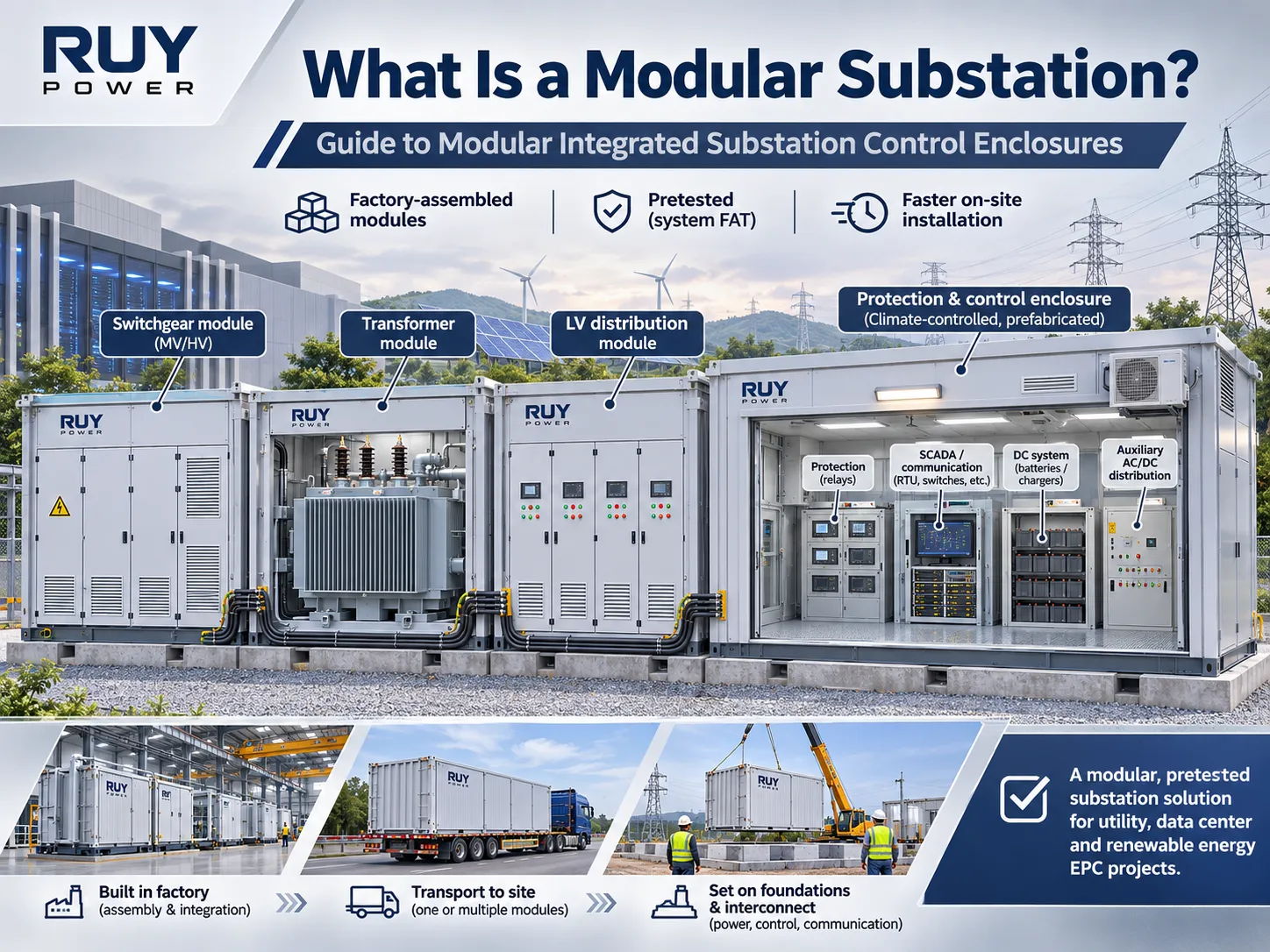
The modular substation is a kind of substation created from a number of modules that are either developed as per a standard design or engineered specifically. Each module is produced in a factory where it is also fitted with the necessary equipment, wires and other facilities. After the factory work is done, the only work to be done on site is the curing of the foundations, installation of the modules, interconnection of the cables or the bus bars for commissioning.
A modular substation includes one or all of the following:
The module with high voltage or medium voltage switchgear including feeding and outgoing feeders, bus coupler, metering. The module may have either a metal creating switchgear or gas insulated switchgear and will be located in its separate enclosure.
The transformer module containing one or more distribution transformer whether on a skid or in an enclosure plus oil containment, if needed.
The low voltage distribution module containing the main switchboard, motor management module and capacitor banks.
The protection and control module including relay panels, substation automation systems and RTU.
The module with the auxiliary systems including HVAC, fire detector, lighting, access control, security system.
The modules may take the shape of buildings, open skids, ISO containers or trailers depending on the site conditions and nature of the installation.
Modular Substation vs Box Type Substation vs E-House
These terms overlap and are often used loosely. The table shows how they are generally used:
| Term | What it usually means | Typical voltage and size | Key standard |
|---|---|---|---|
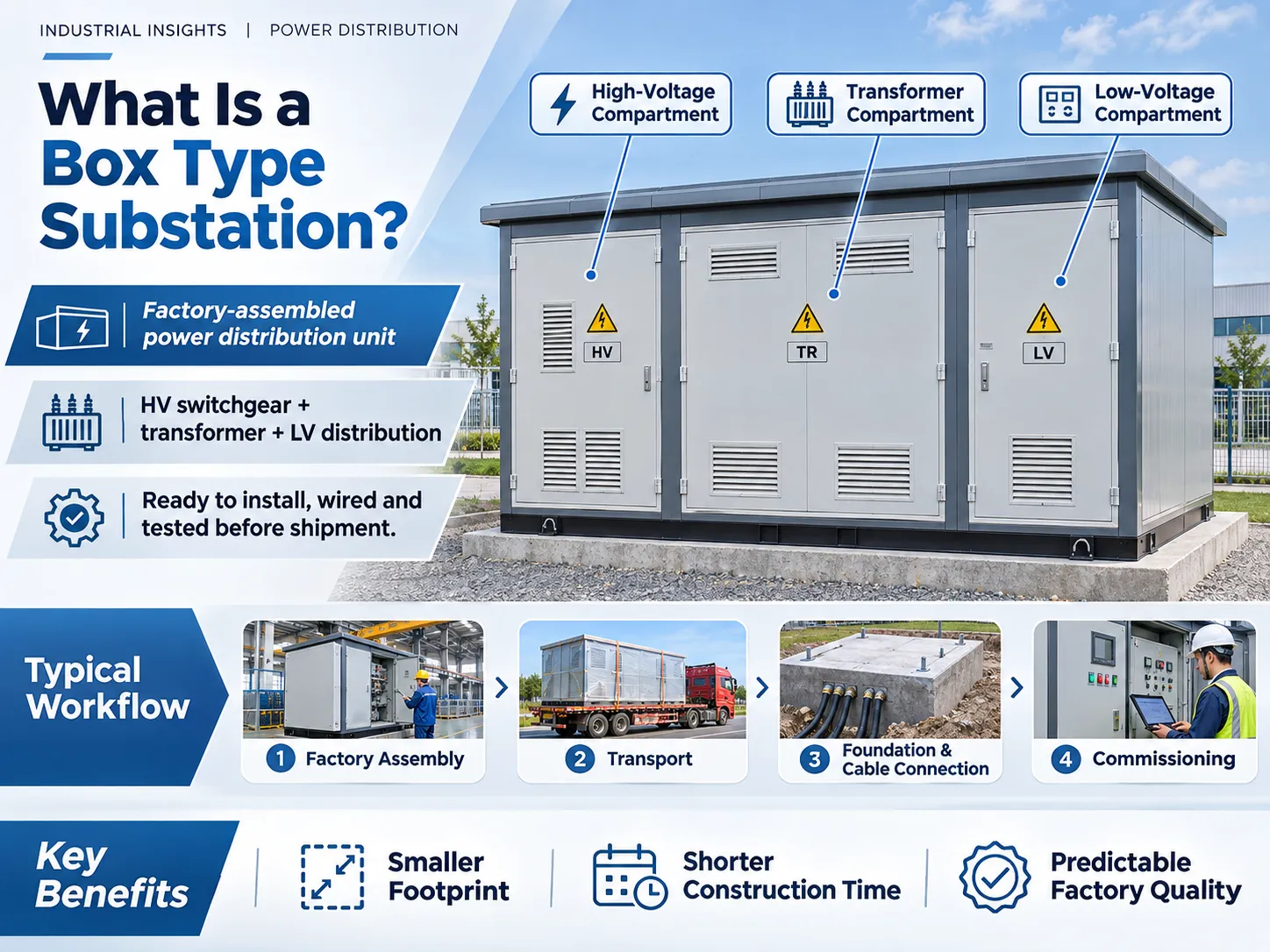
| Box type / prefabricated substation | One compact outdoor unit with MV switchgear, a distribution transformer and an LV board | Up to 40.5 kV; about 100–2500 kVA | IEC 62271-202 (up to 52 kV) |
| E-house | Prefabricated electrical building with switchgear, MCCs, control panels, HVAC and fire systems; transformers usually outside | MV/LV; sized to the plant | Switchgear standards (IEC 62271-200, IEC 61439) plus building codes |
| Skid substation | Transformer and switchgear mounted on structural skids, open or partly enclosed | MV; mining, oil and gas, industry | Equipment standards plus structural design |
| Containerized or mobile substation | Equipment in ISO containers or on trailers for temporary or emergency use | MV to HV | Equipment standards plus transport rules |
| Modular substation | Umbrella term: a substation built from any combination of the above modules | From a single MV unit to an HV substation with several modules | Depends on modules and voltage |
| Substation control enclosure | Prefabricated building for protection, control, communications and DC systems | Any voltage; serves the switchyard | Utility specifications and building codes; IEC 61850 for communications |
In short, a box type substation is one type of modular substation: the smallest and most standardized. A large modular substation can combine several switchgear E-houses, transformer skids and a separate control enclosure.
Modular Integrated Substation Control Enclosures
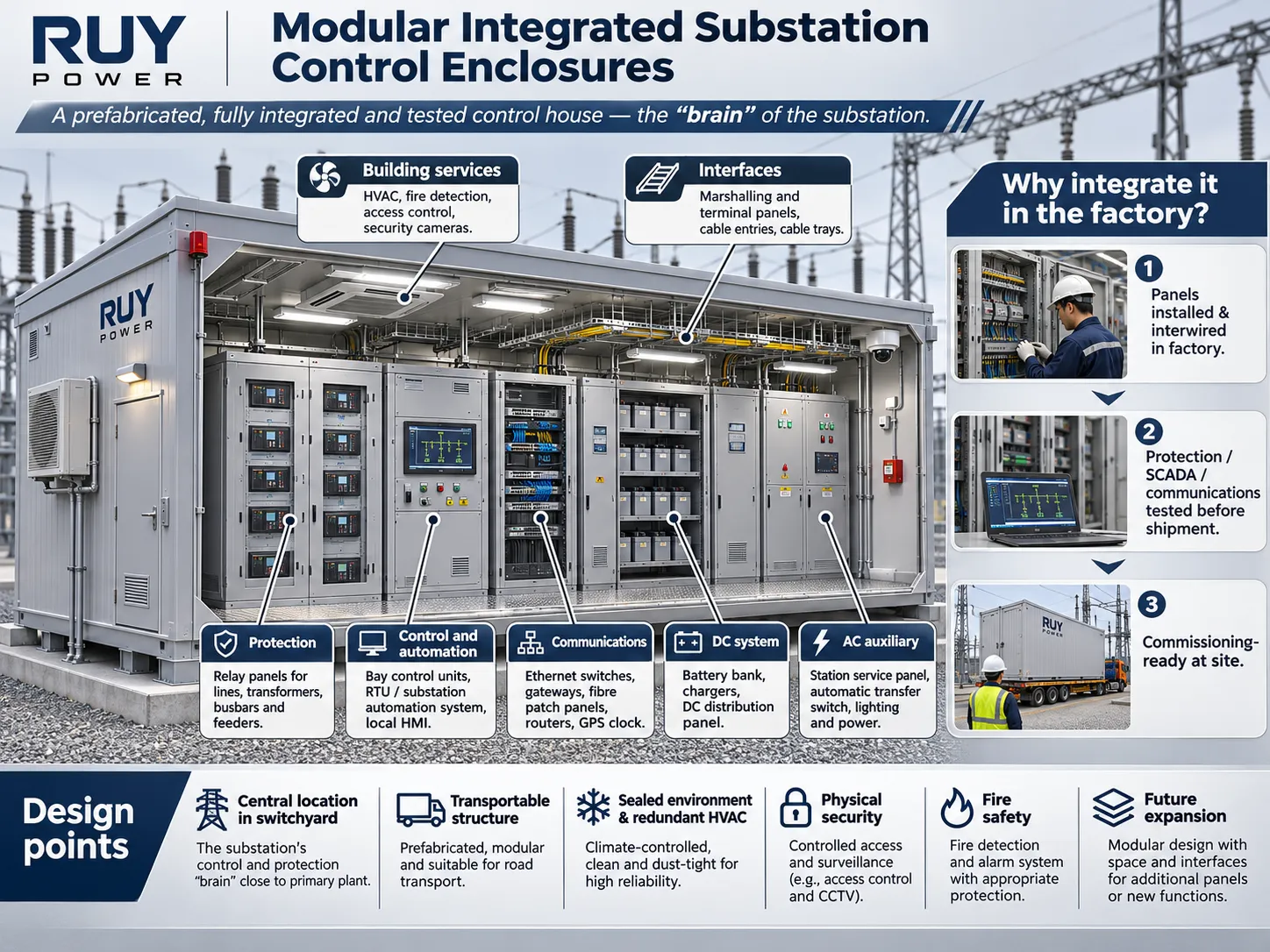
Each substation requires a location for its control centre. In traditional substations, this is the control room which is either inside or next to the yard where the relay determines when to trip the breakers, SCADA monitors the current conditions, and batteries provide power to the relays in case of a loss of power. A substation control enclosure is the prefabricated, modular version of that building.
What goes inside a substation control enclosure?
| System | Equipment | Purpose |
|---|---|---|
| Protection | Relay panels for lines, transformers, busbars and feeders | Detect faults and trip circuit breakers |
| Control and automation | Bay control units, RTU or substation automation system, local HMI | Local and remote operation, interlocking, data collection |
| Communications | Ethernet switches, gateways, fibre patch panels, routers, GPS clock | Link to SCADA and control centre; IEC 61850 or DNP3 networks |
| DC system | Battery bank, chargers, DC distribution panel | Keep protection and breaker tripping working when AC is lost |
| AC auxiliary | Station service panel, automatic transfer switch, lighting and power | Supply all auxiliary loads |
| Building services | HVAC, fire detection, access control, security cameras | Keep electronics within temperature limits and protect the site |
| Interfaces | Marshalling and terminal panels, cable entries, cable trays | Connect field cables from the switchyard |
Why integrate it in the factory?
In a stick-built control house, different panels are brought to the construction site and are subsequently connected with each other through wiring and testing of each panel. On the other hand, in an integrated modular installation, everything is done at the factory:
Installation of panels and everything connected between them is done there and verified.
Security measures, SCADA points, and communication facilities are also tested before the enclosure becomes ready.
HVAC, lighting, and building systems are also introduced during the construction work at the site.
Manufacturers of such enclosures claim that these constructions are “commissioning-ready.” For instance, Hubbell demonstrates that its buildings are produced, tested, and designed for use. At the construction site, the only remaining work that must be accomplished is connecting the cables from the switch house to the marshalling enclosure.
Design points for a control enclosure
- Position: a location in the central part of the switchyard makes control cable connections shorter, which leads to a decrease in cost as well as the voltage difference in the trip circuits.
Design: protects from local wind, snow, and seismic loads, and is further shaped for transportation on the roads; often delivered in several parts.
Waterproofing: no air and water; insulation limits solar gain.
Security: reinforced walls and doors for essential transmission substations in the US, NERC CIP-014 requirements; some cabins are ballistic-proof.
Emergency measures: we have a separate battery room with ventilation, fire detection, and panels being separated.
Key Advantages of Modular Substations
| Advantage | Why it matters |
|---|---|
| Shorter project schedule | Factory work runs in parallel with civil works, so site installation shrinks to weeks instead of months. |
| Controlled quality | Wiring, assembly and testing happen indoors with proper tools, checks and witness tests. |
| Less site risk | Fewer workers on site for less time, less work near energized equipment in brownfield projects. |
| Smaller footprint | Equipment layouts are optimized in the factory; modules can be stacked or arranged tightly. |
| Scalable and relocatable | Add modules as load grows; skid or container units can be moved to another site. |
| Predictable cost | More of the work is fixed-price factory scope, less is exposed to site conditions. |
Modular designs also bring trade-offs. Design decisions must be frozen earlier, transport limits restrict module size, and the work shifts to the factory, so the manufacturer’s capacity and engineering quality become the critical path.
Typical Applications
- Industrial parks and plants: MV switchgear and LV distribution modules that are progressively developed in each stage of production.
Data centers and edge facilities: repeated standardized power modules that perfectly match the stages of the building and the deadlines.
Solar, wind, and battery storage: collector substations that contain switchgear modules and a control enclosure and are built at the same time as the plant.
Utility grid modernization: brownfield substations where the new control enclosure replaces an existing control house with no outages.
Mining and oil and gas: skid or containerized substations that are mobile.
Temporary and emergency supply: mobile substations for outages, construction power, or events.
How Major Suppliers Approach Modular Substations
ABB provides integrated modular solutions such as eHouse systems and skid systems for first distribution. ABB’s eHouses are specially constructed electric rooms fitted with downa/dropping ventilators, fire protection systems, and security systems. Their voltage ratings are tested to capacity not exceeding 40.5 kV (in terms of MV short-term withstand up to 50 kA) as well as internal arc IAC AFLR classification making them compliant with the codes used in data suggestion technology practices and other industrial facilities, such as oil and gas businesses, mining operations, etc. Siemens has a number of its own E-house solutions and custom power supply modules for data centers. Suppliers, like Hubbell, construct complete control and protection buildings with devices at utilities.
Therefore, the joining element is that the modules are manufactured and tested at the factory and installed later. Different modules used may have different extent of scope – from the simple MV module to a full substation with an additional construction for control building.
How to Specify a Modular Substation
- Voltage and capacity: system voltages, transformer ratings, and short-circuit levels on each side.
- Single-line diagram: incoming lines, bus arrangement, number of feeders and future bays.
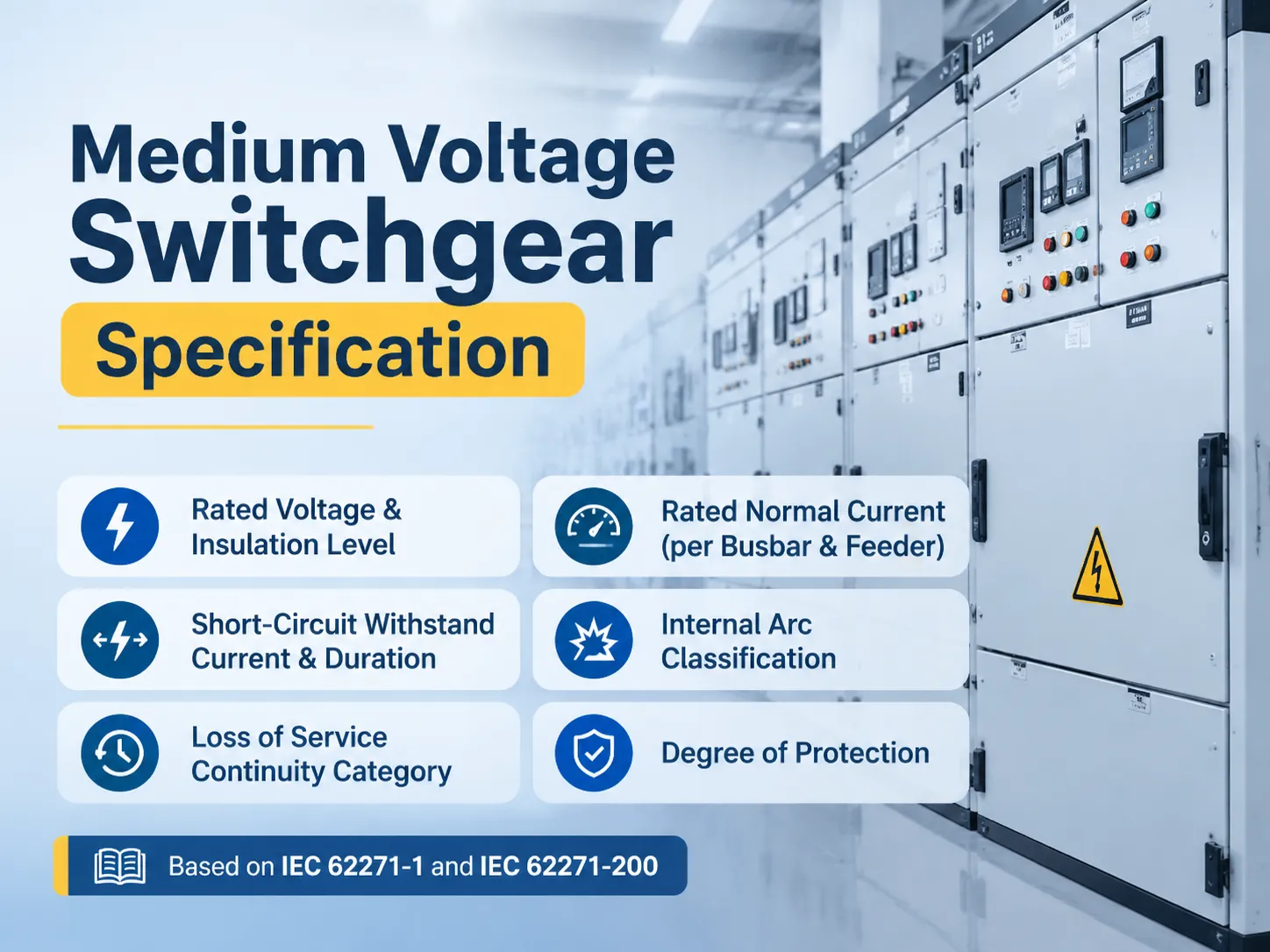
- MV/HV switchgear type: ring main units for simple distribution nodes, or metal-clad circuit-breaker switchgear for industrial and utility substations. State insulation type (air, SF6 or SF6-free) and internal arc classification.
- Protection and control: relay schemes, control philosophy (local, remote or both), communication protocol (IEC 61850, DNP3, Modbus), and SCADA interface.
- DC system: battery voltage and autonomy, charger redundancy.
- Module form: E-house, skid, container or compact outdoor unit; transport limits to the site.
- Environment: ambient temperature range, altitude, dust, salt, seismic zone, IP rating and corrosion protection.
- Building services: HVAC redundancy, fire detection and suppression, security level.
- Testing: factory acceptance test scope, witness points, and site commissioning support.
- Standards: IEC 62271-202 for compact HV/LV prefabricated substations, IEC 62271-200 for MV switchgear, IEC 61439 for LV assemblies, plus local building codes and utility specifications.
RUY Power Modular Substation Solutions
RUY Power manufactures the main building blocks of a medium-voltage modular substation: 12 kV and 40.5 kV metal-clad switchgear, ring main units, low-voltage switchgear including GGD, GCS and MNS boards, GGJ capacitor compensation cabinets, and complete prefabricated substations and combined transformers. Because these products come from one factory, MV and LV modules can be engineered, wired and tested together before shipment. Send your single-line diagram and site conditions, and RUY’s engineers will propose a modular configuration and confirm which parts of the scope RUY supplies directly.
Frequently Asked Questions
What is the difference between a modular substation and a box-type substation?
The box-type substation is one single unit designed to accommodate medium voltage switchgear, distribution transformer and low voltage switchboard in an outdoor environment, commonly rated up to 40.5 kV and about 2500 kVA. On the other hand, modular substation is a more general term that covers any substation made of modules manufactured in factory assembly. It can cover either a single box-type unit or a more complex substation consisting of several switchgear, transformer and control assemblies.
What are modular integrated substation control enclosures?
A substation’s protection apparatus, control and automation mechanisms, communication network, DC batteries and additional AC/DC distribution are all included in prefabricated buildings. These components are factory-produced, wired and pre-installed before being sent directly to the switchyard.
What is the difference between an E-house and a substation control enclosure?
An E-house is used to host electrical devices such as medium voltage (MV) and low voltage (LV) switchgear and motor control panels while a substation control shelter contains protection, control and communication equipment along with the DC system. Certain projects combine the two shelters into a single construction.
Can modular substations be expanded later?
Yes, if expansion is planned. Leave spare feeder positions, busbar extension provisions, spare control panel space, DC capacity and cable entries, and reserve space on site for additional modules.
Are modular substations suitable for outdoor use?
Yes. Enclosures are designed for outdoor installation, with IP ratings, corrosion protection, insulation and HVAC chosen for the site climate. Open skid modules may need additional weather protection.
How long does installation take?
It often takes several months to manufacture and test a substation, depending on scope. After the preparation of the foundation is completed, the installation and connection of modules lasts several days to a couple of weeks, as opposed to several months required for on-site construction of conventional substations.
Conclusion: Build in the Factory, Connect on Site
A modular substation moves the slowest and riskiest work, such as assembly, wiring and testing, from the construction site into the factory. For small distribution nodes, that may mean a single box-type unit. For utility and industrial substations, it can mean switchgear modules, transformer skids and a modular integrated substation control enclosure delivered as one coordinated package. The key to success is specifying early: freeze the single-line diagram, protection and control philosophy, module form and testing scope before manufacturing starts.
Planning a modular substation project? Send RUY Power your single-line diagram, voltage levels, transformer ratings and site conditions. Contact RUY Power.
References
- ABB — Integrated modular solutions (eHouse and skid modules). Ratings, contents and applications.
- Hubbell — Protection and control buildings. Contents, factory integration and testing.
- Commonwealth Associates — The control house: designing a substation’s nerve center. Control house contents, location, security and prefabrication.
- Jaylan Solutions — Substation packages, modular substations and E-houses. Definitions and differences between modular formats.
- Siemens — E-house. Prefabricated electrical buildings.
ABB, Siemens and Hubbell are trademarks of their respective owners. RUY Power is not affiliated with these companies; product information is taken from their public documentation for reference only.