
Whether it is a new residential building, solar farm, or factory extension, all of them require medium voltage input to the grid lowered down to 400 V close to the consumer. Constructing a substation with switch gears and transformer installations entails extensive process of civil engineering and testing. A box type substation brings all of that to site as one tested product.
In this manual, you will learn what consists of a box type substation, how box type substations are rated in accordance with IEC 62271-202 standards, what specifications of transformers installed inside these enclosures are, and what should be taken into account when buying a China box type substation, including how to interpret the Chinese model codes like YB and ZGS.
Quick answer: A box type substation (also called a prefabricated substation, compact substation, kiosk substation or package substation) is a factory-built unit that puts medium-voltage switchgear, a distribution transformer and a low-voltage switchboard in one outdoor enclosure. It receives power at 10–35 kV, steps it down to 400 V or 690 V, and distributes it to the load. There are two main designs. European-style units (YB series in China) have separate HV, transformer and LV compartments. American-style units (ZGS series in China, pad-mounted transformers in North America) put the load-break switch, fuses and transformer in one oil tank. The international product standard is IEC 62271-202 (GB/T 17467 in China). It covers voltages above 1 kV up to 52 kV and defines the rated power, enclosure class and internal arc classification you should specify.
What Is a Box Type Substation?
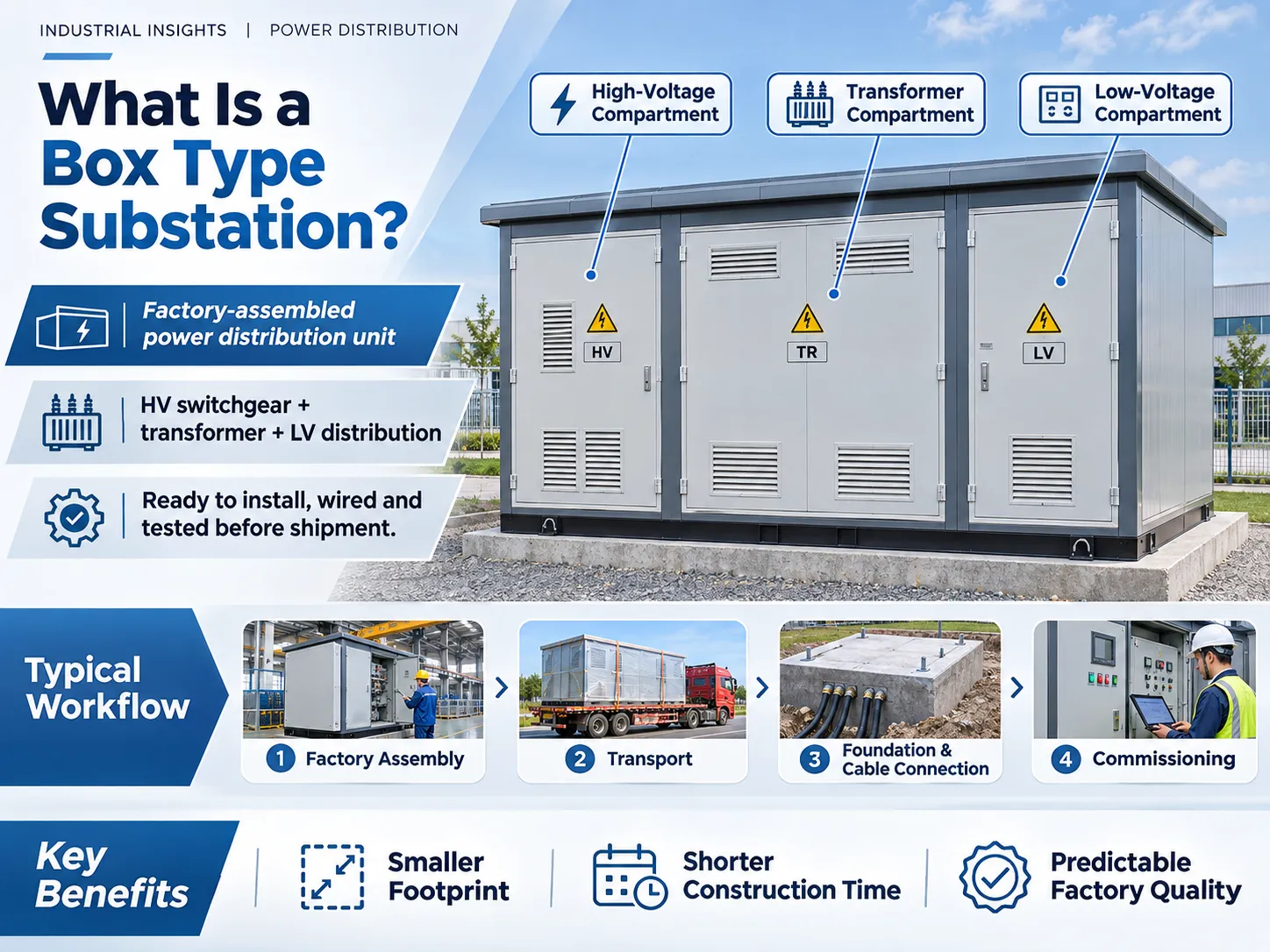
A box type substation is a secondary substation that has been pre-assembled and tested in the factory. According to IEC 62271-202, it is called a “high-voltage/low-voltage prefabricated substation”. This means that the box, as well as the equipment placed inside, go together for testing.
In the case of a conventional substation, the civil works are done first, followed by the switchgear, transformer and low-voltage panels being set up in different buildings. The box type substation has the opposite approach, where the manufacturer takes care of all the installation and testing. All that needs to be done on site is the foundation and the placement of the box type substation.
This way, the construction site is smaller, the construction period is shorter, and the quality of the installation is much higher due to the work being done at the factory. However, the only drawback is that the transformer is inside a box, which requires proper design for heat removal and derating.
What is better: box type substation, compact substation or pad-mounted transformer?
Depending on the market the same equipment may have different names:
Box type substation or “box type transformer” is a term widely used in China and Asia (箱式变电站, 箱变).
Prefabricated substation is a term used in IEC 62271-202.
Compact secondary substation (CSS), compact substation, kiosk or package substation are terms commonly used in Europe, Middle-East and Africa.
Pad-mounted transformer is equivalent term for the North American type designed in accordance with IEEE C57.12.34.
What’s Inside a Box Type Substation?
| Compartment | Typical equipment | Common ratings |
|---|---|---|
| Medium-voltage (HV) compartment | Ring main unit with load-break switches and a fuse-switch or circuit-breaker transformer feeder; surge arresters; earthing switch; optional metering | 12 kV (10/11 kV systems), 24 kV, 40.5 kV (33/35 kV systems) |
| Transformer compartment | Oil-immersed or dry-type distribution transformer, with temperature monitoring and, for oil units, an oil-retention pit or tray | Commonly 100–2500 kVA; up to about 3500 kVA in some designs |
| Low-voltage (LV) compartment | Main incoming ACB or MCCB, outgoing MCCBs or fuse switches, metering, optional capacitor bank for power factor correction | 400 V or 690 V; incomer sized from the transformer full-load current |
| Enclosure and auxiliaries | Steel, aluminium, GRP or concrete housing; natural ventilation louvres or fans; lighting; anti-condensation heaters; door interlocks | IP23 to IP54 depending on design and climate |
The two aspects which matter a lot are actually two. First, an LV compartment turns out to be a miniature switchboard requiring the same level of consideration in terms of busbar rating, short-circuit withstand and cabinet wiring as a standalone LV board. Second, the interlocks connecting the HV switch, the earthing switch and the doors of the compartment are what guarantees safety during operation in crowded areas, so check their performance during the factory acceptance test rather than post-delivery.
European-Style vs American-Style Box Type Substations
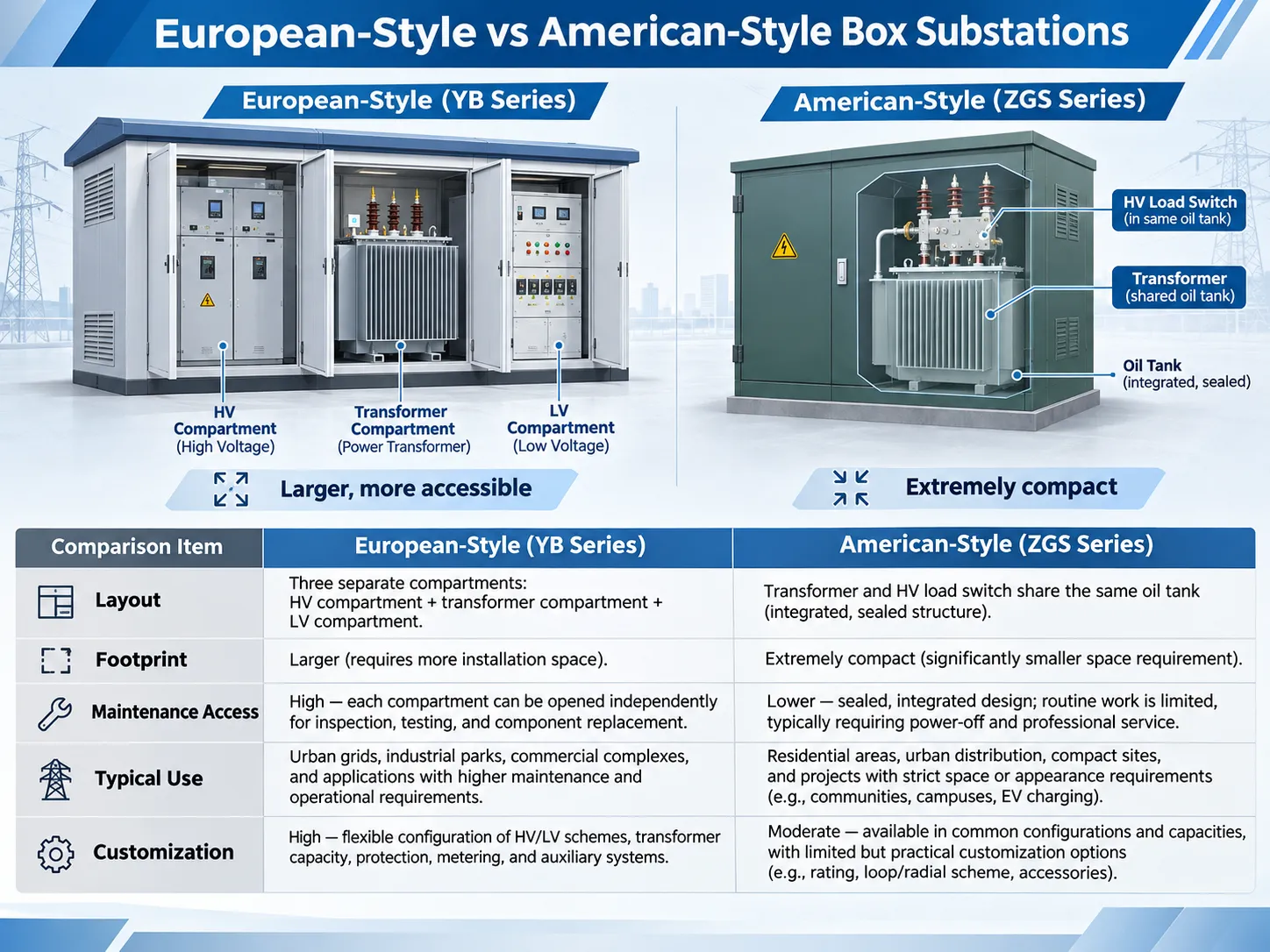
| Feature | European-style (YB series) | American-style (ZGS series / pad-mounted) |
|---|---|---|
| Layout | Separate HV, transformer and LV compartments, arranged in a row or in a “品” (T-shaped) layout | Load-break switch, fuses and transformer core share one oil tank; LV terminals in a front cabinet |
| HV switchgear | Ring main unit (air, SF6 or solid-insulated), with fuse-switch or circuit-breaker protection | Oil-immersed load-break switch, radial or loop-feed type |
| Transformer protection | HV fuses or circuit breaker with relay | Bay-O-Net expulsion fuse in series with a backup current-limiting fuse |
| Transformer type | Oil-immersed or dry-type | Oil-immersed only |
| Footprint | Larger | Very compact, often about one-third of an equivalent European unit |
| Maintenance access | Each compartment accessible; parts can be replaced individually | Sealed tank; a failed switch or fuse holder may mean opening the tank or replacing the unit |
| LV distribution | Flexible: many outgoing feeders, metering, capacitor bank | Limited number of outgoing feeders |
| Typical use | Industrial plants, commercial buildings, utilities needing metering and expansion | Residential estates, street-side and space-limited sites, solar and wind step-up |
The American structures are more economical and compact, but they lack adaptability. The European structures are more expensive and need more room, but they allow easy feeder additions, protection modifications, or replacement of a component. Most utilities opt for European designs for city networks since maintenance issues and reliability are important. Housing developers and photovoltaic installations prefer the American designs because of their price and size.
Radial feed vs loop feed
The given designs can function as either loop (ring) or radial (terminal) feeding system. Radial design is the endpoint of feeder. Loop feeder has two inbound cable entry points and switching that keeps the loop intact and the transformer out of operation. This arrangement allows for a cable failure to be bypassed and the service restored. Whenever the outage involves a large number of clients, loop feed design should be chosen.
How is the Box Type Substation Rated by IEC 62271-202?
IEC 62271-202 is the pertinent standard for prefabricated substations. The third edition was released in June 2022, which took the place of the 2014 version. It applies to cable connected substations rated higher than 1 kV up to 52 kV, up to 60 Hz frequency, and meant to be installed outdoor in public areas. The Chinese equivalent of the standard is GB/T 17467.
As specified in the IEC 62271-202 standard, apart from the ratings for individual items of switchgear and transformer, there are three ratings applicable to the complete substation:
Rated capacity of the substation, defined in the 2022 version as a three-parameter value, means that the power rating of the substation is linked to the testing conditions rather than being taken only from the transformer plate.
Rated enclosure class, defined as extra temperature rise of the transformer compared with exposure in the air. Higher class means more derating of the equipment.
Internal arc classification (IAC), which shows whether people near the substation are protected in case of internal arc fault occurrence. Type A allows access for authorized personnel from the operating side while type B means it is fit for use by the public near the enclosure. IAC-AB is the standard requirement for public installations.
IEC 62271-202 requires type tests which include dielectric tests, temperature rise tests (continuous current), short-time and peak load current tests, mechanical tests and internal arc tests to be performed on the complete assembly rather than just on certain components. When comparing quotations, you need to request the type test report of the complete assembly and see if the ratings, enclosure class and IAC conform to your requirements.
Helpful Guidelines on Transformer Sizing in a Package Substation
The temperature of the transformer inside its case is usually higher when compared to when the transformer is used in open air. The loss of heat generated by the transformer needs to be carried away by ventilation louvers, and there will also be heat absorbed by the enclosure as a result of sunshine. Due to this reason, a transformer with the specifications of 1000kVA working inside a box unit that is improperly ventilated can expect to bring out only 900 kVA of energy and not more than that. In IEC 62271-202, guidance is given for transformer load factors working inside an enclosure. The 2022 edition of this guideline also stated there is a necessity for an annex dedicated to solar radiation implications.
The practical size of the transformer can be calculated by following these steps:
1. Find out the maximum demand in kVA accounting for future expansions in the next 5-10 years.
2. Choose the transformer with an appropriate standard rating. Options are numerous: 630, 800, 1000, 1250, 1600, and 2000 kVA.
3. Photography the department of the substation, its rated power and class of enclosure at the temperature of the design. In hot climates (like The Middle East, Africa, South East Asia), it is better to get the derating facts if the temperature is about 45-50 °C.
4. Define the LV full load current: I = kVA × 1000 / 1.732 × V: for 1000 kVA and at 400 V it will be about 1443 A, which means that both the incomer and busbar must have at least 1600 A rating.
5. Verification of LV short-circuit value is very important, as it depends on the impedance of the transformer: the 1000 kVA with 6% impedance creates about 24 kA at the LV terminals with an infinite source.
Where Box Type Substations Are Used
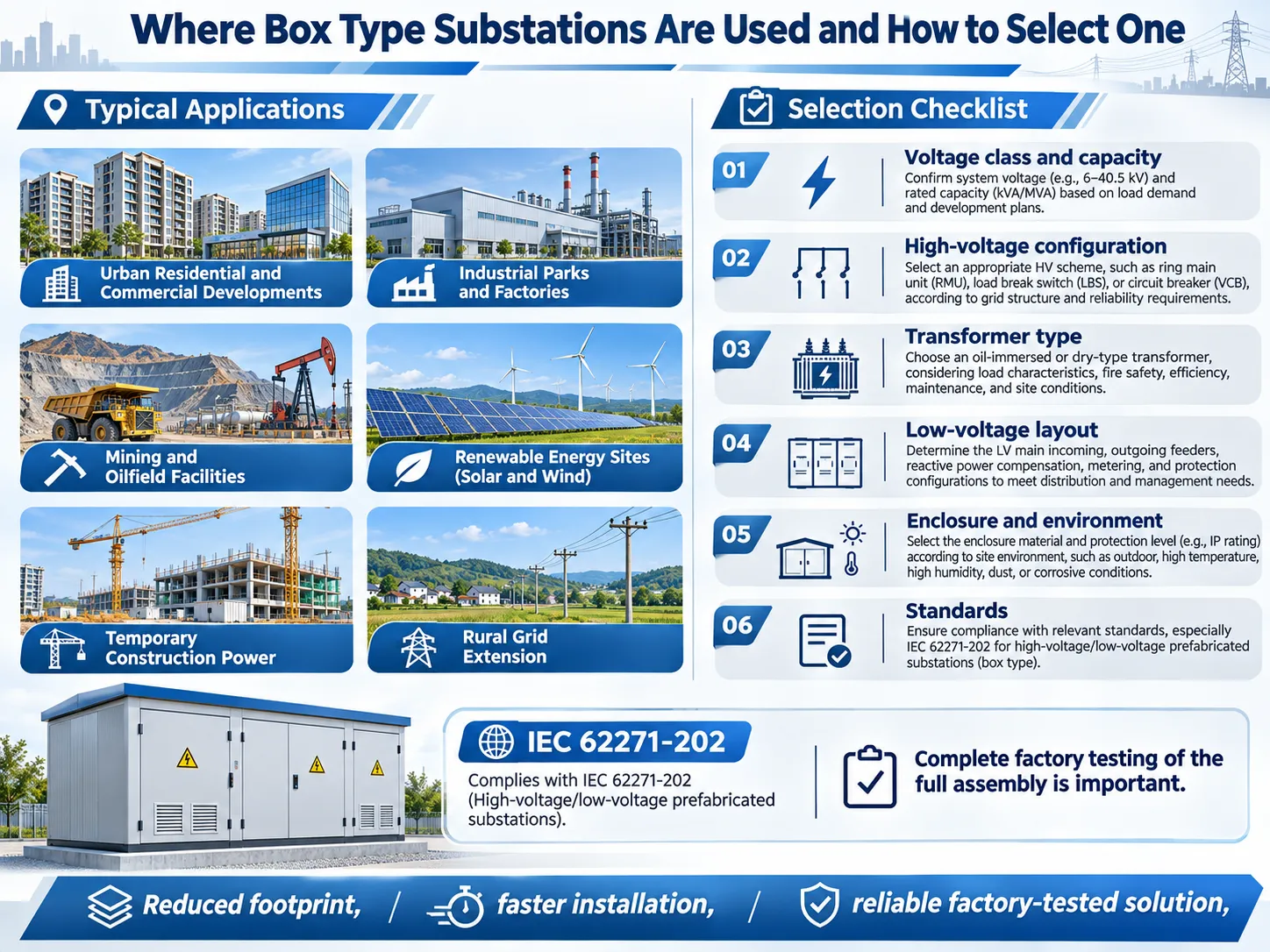
| Application | Typical configuration | What to watch |
|---|---|---|
| Urban residential and commercial | 12 kV loop-feed, 630–1250 kVA, European or American style | Low noise, IAC-AB for public access, compact footprint, appearance |
| Industrial plants and parks | 12–40.5 kV, 1000–2500 kVA, European style with circuit breaker | LV feeder count, power factor correction, future expansion |
| Solar PV plants | Step-up 0.8/35 kV or 0.4/10 kV, often dual-winding transformers | Harmonics, heat load, remote monitoring, transport limits |
| Wind farms | 0.69/35 kV step-up at each turbine | Corrosion protection, vibration, coastal environment |
| Mining and oilfields | Skid-mounted or movable units | Dust, IP rating, relocation, ruggedness |
| Construction and temporary power | American style, small capacity | Quick installation, relocation, rental use |
| Rural grid extension and urban grid upgrades | 12 kV radial or loop-feed, 100–630 kVA | Cost, reliability, utility specification |
Because the unit is enclosed and tested for public locations, it can sit close to the load. This shortens LV cables, reduces voltage drop and losses, and saves copper.
How Major Brands Build Box Type Substations
The compact secondary substations manufactured by ABB’s UniPack serve as a valuable example. ABB refers to them as ready-for-use units incorporating MV switchgear, distribution transformer, LV switchboard along with connections. UniPack-S is made in a steel housing, while UniPack-G is made of GRP in difficult operating conditions. ABB provides the specs of up to 40.5 kV, transformers up to 3500 kVA, short-time rating of MV of up to 25 kA/1 s, IAC-AB 20 kA/1 s according to IEC 62271-202, and not less than IP54 rating. Besides that, ABB has a dry air, SF6-free option available.
The major Chinese manufacturers, like CHINT, offer both options: YBM series European-type complying with IEC 62271-202, used for residential, commercial, solar, wind and energy storage applications. ZGS series combines transformer that CHINT refers to as load-breaking switch, fuse and transformer combined within a tank. North American companies buy the same concept of American-made pad-mounted transformers complying with IEEE C57.12.34.
The trends among the brands are similar – use of eco-friendly switchgear, wider application of remote temperature and load monitoring, application of less loss transformers to comply with energy efficiency requirements along with GRP or concrete enclosures resistant to corrosion or high temperature.
Buying a China Box Type Substation: What to Check
The People’s Republic of China is one of the major producers of box-type substations. The products are widely exported to Asia, Africa, the Middle East, and Latin America. Although prices are competitive, quality and documentation differ from factory to factory. The following points must be checked to ensure a proper comparison of the quotes.
How to read Chinese model codes
| Model code | Meaning | Example |
|---|---|---|
| YB (also YBM, YBW, YBP and other variants) | European-style prefabricated substation (预装式变电站). Letters after YB vary by manufacturer and indicate enclosure, application or layout | YB-12/0.4-1000: 12 kV HV, 0.4 kV LV, 1000 kVA |
| ZGS | American-style combined transformer (组合式变压器), three-phase | ZGS13-H-630/10 |
| Number after ZGS (11, 13, 20 and so on) | Loss-performance generation of the transformer; a higher number generally means lower losses | ZGS13 uses an S13-level transformer |
| Letter after the series number | H = loop feed (环网型); Z = radial or terminal (终端型) | ZGS13-H: loop feed |
| Numbers at the end | Rated capacity in kVA / HV rated voltage in kV | 630/10: 630 kVA, 10 kV |
Naming varies between factories, so confirm the meaning of every letter in writing and attach a datasheet to the purchase order.
Supplier checklist
The following points need to be addressed when buying substation equipment:
1. A test report conducted according to IEC 62271-202 (or GB/T 17467), which includes a summary of tests relevant to the substation (temperature rise, short-time withstand, internal arc) prepared by a lab that is renowned.
2. The equipment rating, enclosure rating and IAC for example IAC-AB 20 kA 1 s should be declared when buying.
3. No-load and load losses of the transformer compared to the country regulations such as EU Ecodesign Regulation 548/2014 or US DOE.
4. The brand name and type of the ring main unit as well as LV circuit breakers and protection relays.
5. The material used to build the enclosure and painting system.
6. Routine test reports of each unit, which should include many tests, such as insulation resistance, power frequency withstand, transformer ratio and loss, functional and locking tests.
7. Details about the shipping dimensions and weight, points of lifting.
8. Availability of documentation, manuals written in English and availability of spare parts.
RUY Power Box Type Substations
RUY Power manufactures European-style prefabricated substations and American-style combined transformers, along with the equipment that goes inside them: ring main units for the MV compartment, low-voltage switchgear for the LV compartment, and the GGJ capacitor compensation cabinet for power factor correction. Because the MV switchgear, LV distribution and enclosure come from one factory, the complete unit can be configured, wired and tested before shipment. Units can be configured for 12 kV and 40.5 kV systems, radial or loop feed, and the climate at site.
Frequently Asked Questions
What is a box type substation?
It is a factory-built unit that combines MV switchgear, a distribution transformer and an LV switchboard in one outdoor enclosure. It steps medium voltage (typically 10–35 kV) down to 400 V or 690 V close to the load.
What is the difference between a box type substation and a traditional substation?
A box substation is manufactured in the factory as a single product which requires only a base and cable connections at the installation site. Unlike a box substation, a conventional substation is constructed on the site and comprises various rooms or yards for the transformer and switchgear, which extends the construction period.
What is the difference between European-style and American-style box substations?
European-designed units consist of separated HV, transformer and LV compartments, which are easier for upkeep and expansion. Units designed in accordance with American principles combine load-break switch, fuses and a transformer into one oil tank enclosure, resulting in smaller and more affordable but less flexible units.
What standard applies to box type substations?
IEC 62271-202 is the international product standard for HV/LV prefabricated substations from 1 kV up to 52 kV. China uses GB/T 17467. In North America, pad-mounted transformers are built to IEEE C57.12.34.
What capacity can a box type substation have?
Most units are 100–2500 kVA. Some designs reach about 3500 kVA. The usable capacity depends on the enclosure class and ambient temperature, so check the derated rating rather than the transformer nameplate alone.
Why buy a box type substation from China?
Chinese manufacturers supply competitive pricing, quick turnaround times, and European and American type designs. Ensure that you obtain complete type test certificates to IEC 62271-202, loss data for transformers that fulfill your local efficiency regulations, and a clear indication of the brand of switchgear and circuit breakers.
How long does installation take?
Once the foundation and cables are ready, placing, connecting and commissioning a box type substation usually takes a few days. A traditional built-on-site substation can take several months.
What maintenance does a box type substation need?
Routine checks of the enclosure, ventilation, seals and LV connections; oil testing for oil-immersed transformers; and periodic testing of the switchgear and protection. See our guide to switchgear maintenance and testing.
Conclusion: Specify the Substation, Not Just the Transformer
A box type substation saves space and construction time because it arrives as one tested product. To get the full benefit, specify it as a substation: choose European or American style and radial or loop feed, state the rated power, enclosure class and IAC to IEC 62271-202, size the transformer for the enclosure and the site climate, and ask for type test reports on the complete design. When buying a China box type substation, add model-code confirmation, loss data and documentation to that checklist, and quotations become directly comparable.
Request a Box Type Substation Quotation
Send RUY Power your HV voltage, transformer capacity, radial or loop feed, LV feeder list, installation site and climate, and any utility specification. Our engineers will recommend a European-style or American-style configuration and provide drawings and a quotation. Contact RUY Power.
References
- IEC 62271-202:2022 (Ed. 3.0), preview. Scope, changes from the 2014 edition, rated power, enclosure class and internal arc classification.
- ABB — UniPack compact secondary substations. Ratings, enclosure variants and IAC classification.
- CHINT — ZGS combined transformer. American-style box substation with switch, fuse and transformer in one tank.
- CHINT — YBM(P) prefabricated substation. European-style units to IEC 62271-202 for building and renewable applications.
- IEEE C57.12.34. Requirements for pad-mounted, compartmental-type three-phase distribution transformers.
ABB, UniPack, CHINT and Bay-O-Net are trademarks of their respective owners. RUY Power is not affiliated with these companies; product information is taken from their public documentation for reference only.