
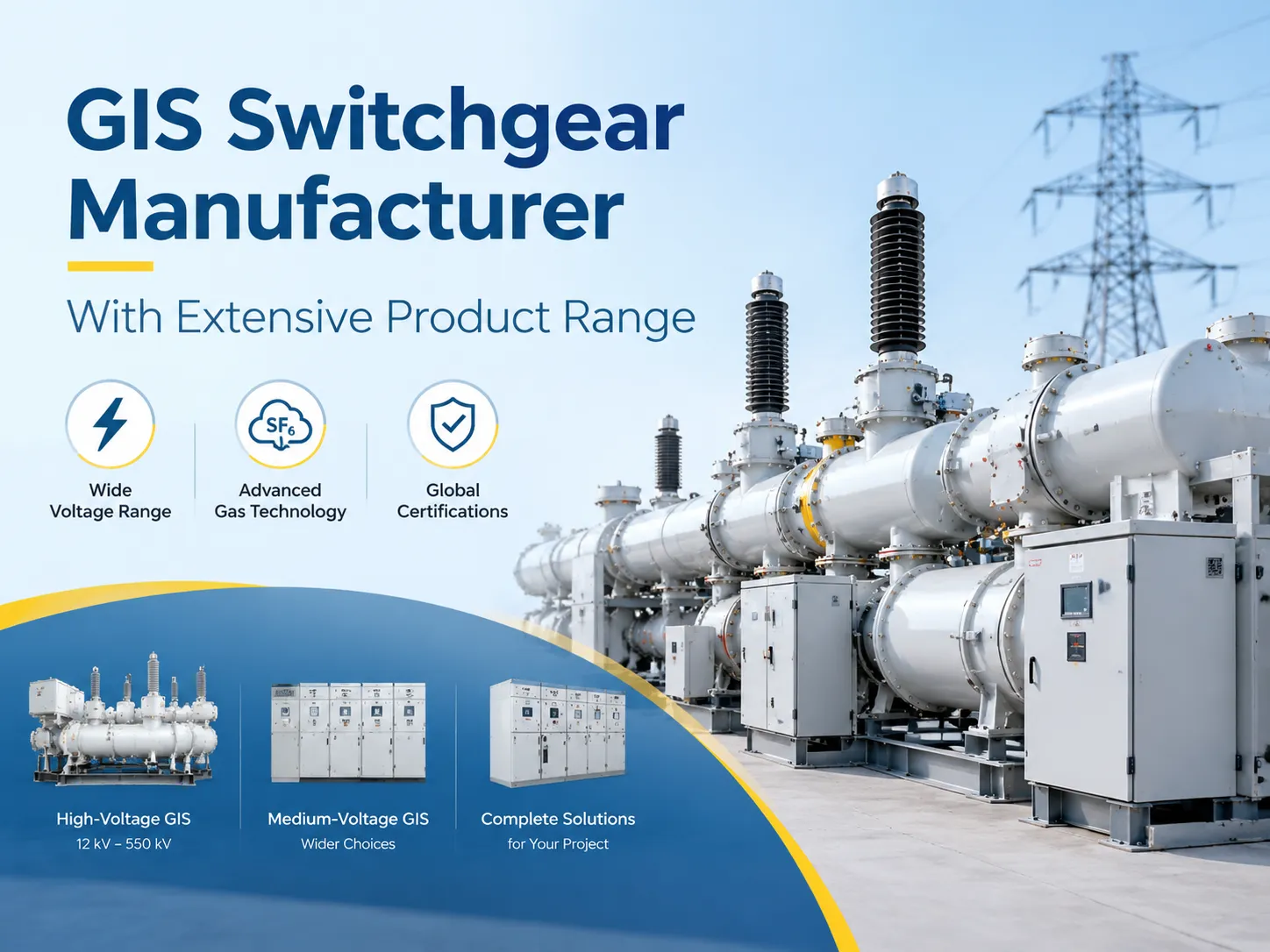
In the case of gas-insulated switchgear systems, you’ll find that there are only a few manufacturers at the top of the list and many at the bottom. This difference is not just about quality. It has to do with voltage level and gas technology used, as well as the amount of money that goes into the nameplate. In this article, I’ve put together information for those who are looking for a GIS switchgear manufacturer that offers the best solution for their project.
Short response: A few European and Japanese companies – Siemens Energy, Hitachi Energy, ABB, Mitsubishi Electric, GE Vernova and Schneider Electric – lead in high voltage GIS development. Chinese companies such as Pinggao, Xi’an XD, Sieyuan, Shandong Taikai and CHINT are already producing potential equipment from 12kV to 550kV with significantly lower pricing, while medium voltage GIS options are even more varied. The optimal solution comes from a company with matching voltage range, gas technology and quality assurance rather than from the most prestigious name.
What GIS is, and when it beats air-insulated gear
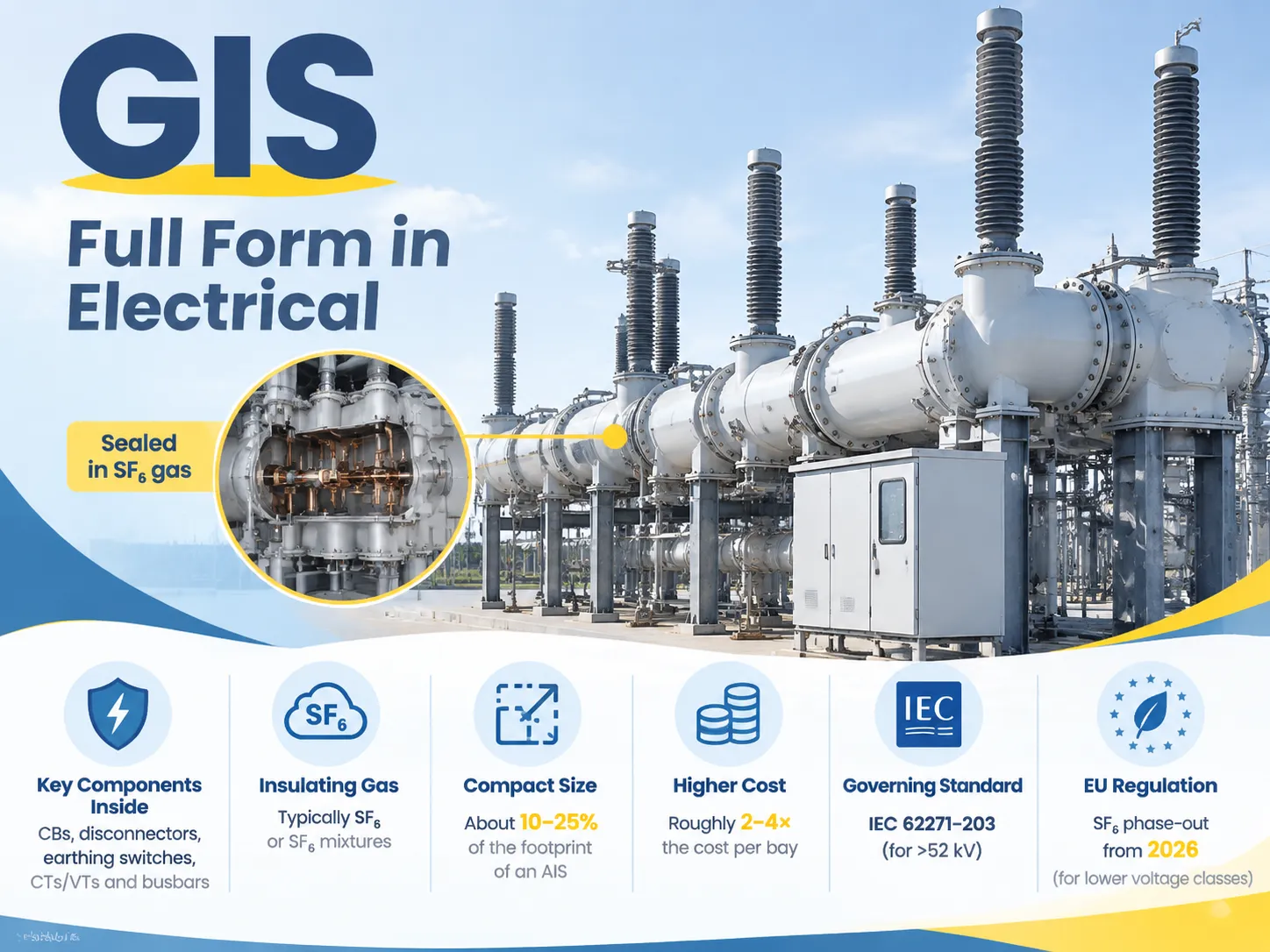
Gas-insulated switchgear encases the area containing the busbars, circuit breakers, disconnectors, and instrument transformers within a sealed metal casing filled with an insulating gas. Air-insulated switchgear, on the other hand, employs air and space for the same task. This unique difference is what separates all of the rest.
A typical GIS installation requires only 10% to 25% of the surface area that is considered appropriate for air-insulated switchgear. Because GIS is sealed, neither salt spray nor dust nor humidity nor pollution affects it: it is no wonder that it is popular in coastal, desert, and highly polluted m. Maintenance intervals often reach as long as 20 years and more, as nothing is exposed to deterioration. What has to be taken into consideration is the higher cost and complexity of operation of the technology, since gas-insulated switchgear is costlier and requires careful handling of gas and monitoring of operations, as well as special training for maintenance personnel.
It is advisable to become familiar with the relevant standards before approaching any supplier. IEC 62271-203 deals with gas-insulated switchgear providing more than 52 kV. IEC 62271-200 is related to switchgear providing less than 52 kV, which is typical of medium voltage gas-insulated equipment. If the supplier refuses to let you know the type of the tests that were performed for the equipment you are interested in, regard this as a warning sign.
Who the main GIS manufacturers actually are
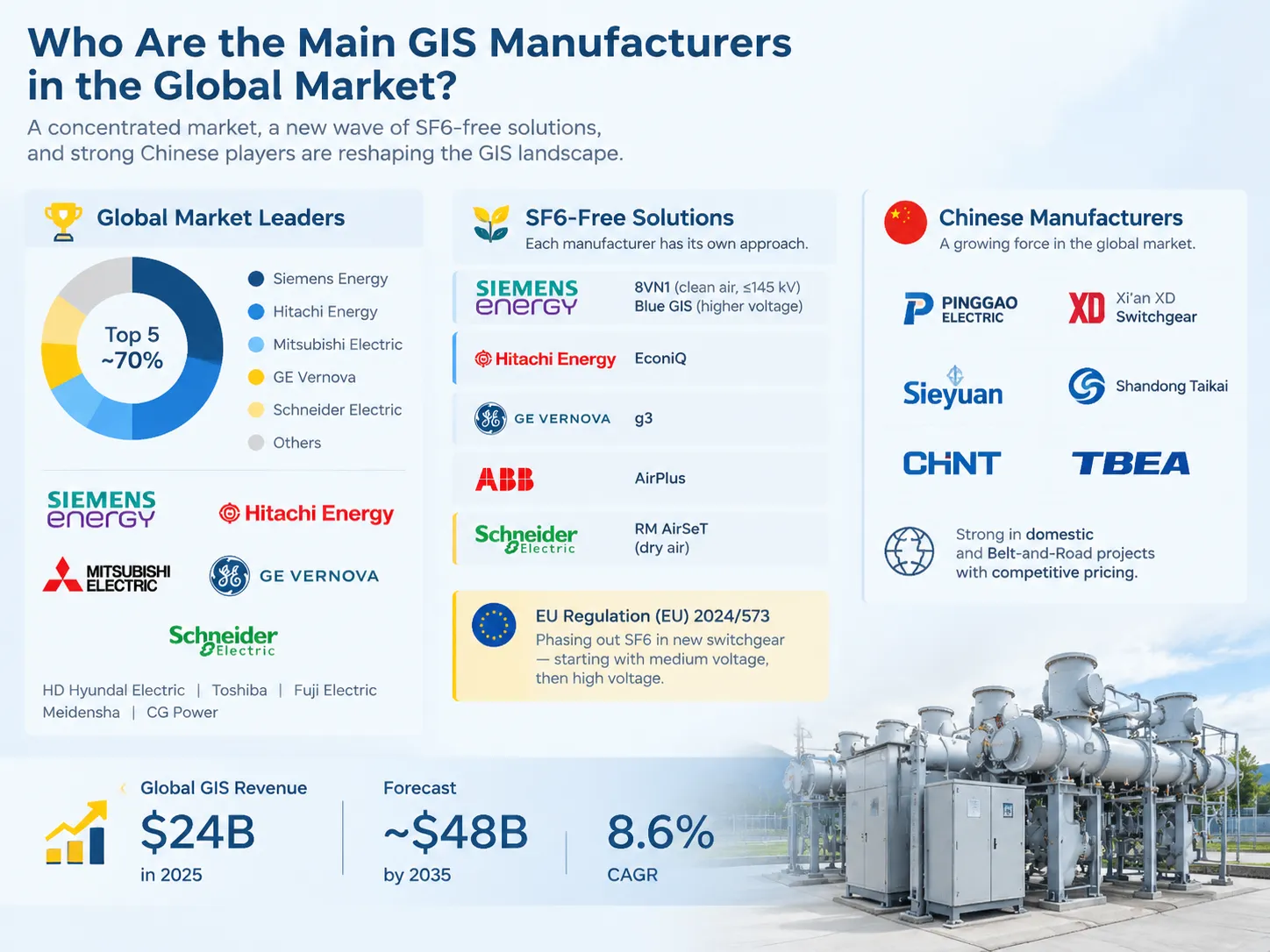
The high-voltage GIS market is dominated by a few companies. Siemens Energy and Hitachi Energy are the largest two companies who own a significant share of the market and are followed by Mitsubishi Electric, GE Vernova and Schneider Electric. Also, there are other companies in the market such as HD Hyundai Electric, Toshiba, Fuji Electric, Meidensha and CG Power.
All companies have their unique solution for the issue with SF6. Siemens Energy manufactures their clean-air 8VN1 product line and produces blue GIS technologies for larger voltage levels. Hitachi Energy has introduced EconiQ, GE Vernova is using g3, ABB developed AirPlus and Schneider Electric decided to use dry air for its RM AirSeT. This is crucial, as the EU’s new F-gas regulation directly forbids the use of SF6 in any equipment with time, beginning with medium-voltage equipment and affecting high voltage levels. Any supplier of GIS technologies with no product lines excluding SF6 is losing a portion of the market in Europe.
Then there is China, which is larger than many buyers think. Pinggao Electric, Xi’an XD Switchgear, Sieyuan Electric, Shandong Taikai, CHINT, TBEA are on the market and offer their products to the range of medium- and high-voltage equipment and dominate local as well as countries “in the chains of the initiative”. Their logic is simple: they provide products with similar IEC ratings and mechanical quality but a much lower price that nobody can offer in Europe and Japan. The amount of global revenue reaches USD 24 billion by now with the plan to reach almost double by 2035 (due to the forecast of 8.6%).
What an “extensive product range” really looks like
The term “wide range” might not contain precise meaning when it appears on a brochure. If you want to actually assess it, focus on five different aspects.
- Range of included voltage classes. Does the supplier include your voltage class with a regular product or is it something special? A combination of 12 kV and 40.5 kV is a standard offer of manufacturers in the medium-voltage category and as for voltages above 145 kV, it is a higher category altogether.
- Range of different types of busbars. What models do you find in the product line? The answer will be “Incomer, outgoing, bus coupler, bus riser, metering and transformer feeder”. The full range of equipment includes all types in one series.
- Type of technology used. SF6 gas, clean air or fluoronitrile mixture. The technology of gas will define the status of the equipment in the EU in 5 years.
- Range of parameters provided. The examples include rated current, resistance to short circuit, internal arc classification, degree of protection and the extent of partitioning.
- Type of equipment used for control. Intelligent devices, telecom capabilities, control equipment featuring partial discharge sensors are no longer considered as optional.
A good example of a genuinely wide line is the KYN61-40.5Z armored removable AC metal-enclosed switchgear — a 40.5 kV withdrawable design that handles transformer feeders, incomers and bus sections from the same family, which is exactly the kind of coverage that keeps a substation build simple.
RUY Power: broad product range, real price advantage
Thus, with the following information, it will be up to the reader to be critical when they read on and to compare the provided figures.
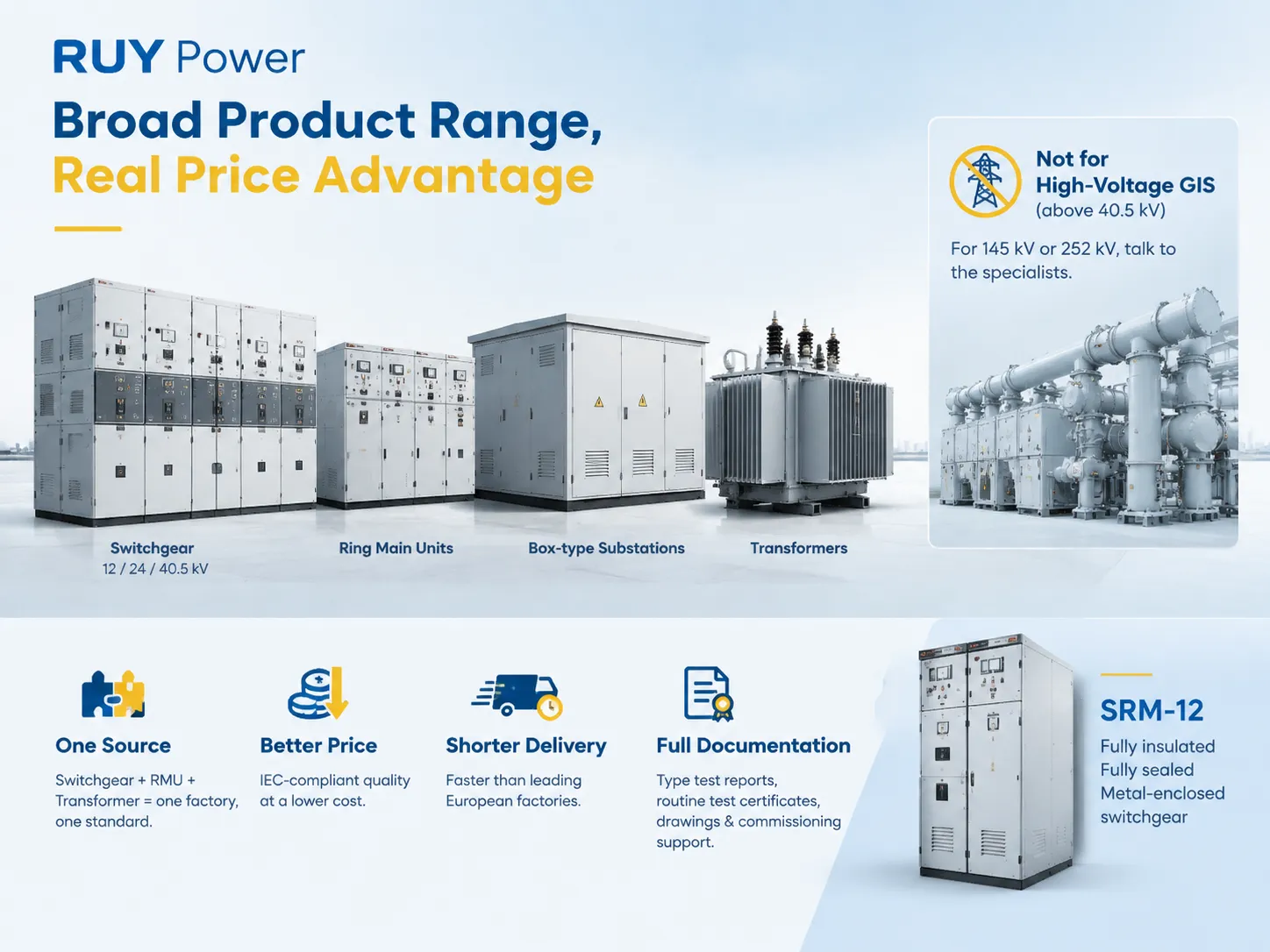
RUY Power manufactures complete interlocking systems in medium and low voltage fields 12kV, 24kV and 40.5 kV switchgears, ring units, metal enclosed and armor cabinets, box substation in transformers. That is a great selection, and one of the practical advantages is that one can get a complete package in one place: the switchgear, the RUM and the transformer are made by one company based on one drawing with one input standard. For buyers who acted for months in looking for the input between several vendors, this fact is already worth something.
We are honest about the pricing policy of ours: RUY is not a European tier one brand and does not try to be one. What we provide are the devices made in accordance with IEC standard but at much lower prices and delivery time compared to big European factories, stating that they are ISO compliant. In case of reference distribution substation equipment, RUM or factory project, this difference is definitely significant and can make the project financially successful.
We do not provide products above 40.5 kV level GIS level. If your project is about 145 or 252 kV gas insulated switchgear, it is better to contact the relevant specialists in this area. It is better to be honest in announcing this. If you are working in the medium-voltage range, the SRM-12 fully insulated, fully sealed metal-enclosed switchgear is a fair illustration of what that range looks like in practice.
How to shortlist a GIS manufacturer
Focus on evidence rather than reputation when writing your shortlist. Here’s what differentiates a legitimate manufacturer from merely an intermediary with an attractive website.
- Request type test reports, and not design reports. The actual type test certificates must be demanded, along with the name of the laboratory that has issued them.
- Acceptance by various internationally recognized laboratories such as KEMA, CESI, XIHARI, KERI and other leading laboratories makes sense. A certificate by an unknown laboratory regarding some design that “might be” subject to testing has absolutely no value whatsoever.
- Internal arc classification. If a supplier cannot indicate the IAC parameters, it means that internal arc testing has not been performed. The IAC A FLR rating is what you should look up on the parameters for personnel safety.
- Gas impact rate. An old unit of circuit breaker loses about 1% of its gas charge annually because of leakage. The newer sealed units are ten times better. The provider should be able to give you that information.
- Factory audit. Visit the factory or send a representative to check how good the busbars are manufactured, how gas is filled up, how routine tests are performed, and how clean the assembly line is. You will be able to resort to any number of emails as you wish but nothing could replace two hours spent at the factory.
- Reference projects. Real ones, with names and voltage class which is similar to yours. Completed and working, not “in progress.”
- Spares, gas handling, and field training. GIS means long-term relations. Get confirmation on the fact that after-sales spare parts provision, gas handling required, and field training will be performed.
If you want to see how a factory answers these questions rather than take my word for it, the capability breakdown on our manufacturing page covers the production and test equipment we actually run. Judge it on that basis.
Matching the manufacturer to your project
One should recognize that there is no “best manufacturer” as there is only “best fit manufacturer”. So goes the decision-making process.
- Tight urban setting or indoor footprint, coastal or polluted setting implies that GIS-type equipment makes great financial sense. Selecting a medium-voltage company with all IEC type tests holds the secret key, which is why competition between China and Europe is ruthless in this respect.
- Sufficient space, remote site, cost constraints call for the installation of air-insulated switchgear. Do not make a mistake of choosing GIS equipment just on the basis of its modern appearance.
- European project with a sustainability agenda calls for the specification of an SF6-free gas for installation purposes. Keep the timelines in line with commissioning date of the project.
- High-voltage installations with voltages starting from 145 kV mean working only with tier-one suppliers and keeping in mind expenses related to that. Roughly, the cost of 145 kV GIS bay will cost you anywhere between USD 60,000 to 150,000, depending on voltage rating and scope, while the costs of 252 kV GIS bays will get even higher. Hence, the numbers provided should be treated as indicative ones only and not regarded as quotes.
- Local content or private-label requirement means that your focus should be on manufacturer that specializes in OEM activities rather than merely tolerating them.
On that last point, if your business is assembling or rebranding switchgear rather than specifying it for one site, the OEM and private-label route changes the shortlist completely — the detail is on our OEM and ODM page.
Ask for references, not brochures
The most valuable action you can take prior to entering into a GIS contract is to review case studies. This should not consist of the showreel featured on the website, but rather the actual project list along with the voltage class, commissioning date, and a contact person to reach out to. Companies engaged in the design and manufacture of real substations will be willing to furnish this information, as this is the best argument in their favor.
Ours are on the project case page, organised by application. Check your own area and compare it with theirs; see if the comparison is adequate. If it is not, and your project is unusual or high voltage, a clear “no” will benefit you more than an ambiguous “yes.”
Frequently asked questions
What does GIS stand for in switchgear?
Gas-insulated switchgear operates by having all of the conductors encased in a sealed metal enclosure that contains an insulating gas, which has historically been SF6, but is now commonly clean air or a fluoronitrile mixture.
Who are the largest GIS switchgear manufacturers?
Siemens Energy, Hitachi Energy, ABB, Mitsubishi Electric, GE Vernova and Schneider Electric are regarded as the leaders in the high-voltage industry. Following closely behind them are HD Hyundai Electric, Toshiba, Fuji Electric and CG Power. In China, the top players are Pinggao Electric, Xi’an XD, Sieyuan Electric, Shandong Taikai, CHINT and TBEA, which are now exporting products within most voltage categories.
Is SF6 switchgear being phased out?
The high-voltage industry has leading companies such as Siemens Energy, Hitachi Energy, ABB, Mitsubishi Electric, GE Vernova and Schneider Electric. The next group of companies is HD Hyundai Electric, Toshiba, Fuji Electric and CG Power. In China, the top companies in high-voltage industry are Pinggao Electric, Xi’an XD, Sieyuan Electric, Shandong Taikai, CHINT and TBEA, which have already started exporting products of several voltage categories.
How much does GIS switchgear cost?
The pricing structure is very different and can vary a lot depending on different voltage classes and also bay configurations. In rough terms, a 12 kV Geographic Identifier System bay or regional infrastructure concept originates from around $6000 – $20,000; for the 40.5 kV bays the figure is somewhere in the vicinity of $15,000 – $40,000; for the 145 kV bays it can reach around the figure of $60,000 +. Both the number of units and variety of means of protection, monitoring facilities as well as technology play a significant role in determining the final amount. It is advisable to ask for a quote for a specific project.
What is the difference between GIS and air-insulated switchgear?
GIS uses gases under pressure for insulation and arc quenching within a sealed compartment, which makes it compact, resistant to external contamination, and low-maintenance. Conversely, the air-insulated switchgear is dependent on air and physical distance, making it larger in size, fairly inexpensive, and easy to maintain but quite vulnerable to pollution and the environment.
References
- IEC 62271-203 — Gas-insulated metal-enclosed switchgear for rated voltages above 52 kV
- European Commission — Fluorinated greenhouse gases and the F-gas Regulation
- Siemens Energy — product offerings, including high-voltage switchgear
- Hitachi Energy — products and solutions, including EconiQ SF6-free switchgear
- Mitsubishi Electric — Gas-insulated switchgear and power distribution systems
- CHINT — Medium and low-voltage switchgear range
Conclusion
The GIS switchgear market features two markedly different extremes. On the one hand, only a selection of European and Japanese manufacturers are vying for space on the market, focusing on gas technology and long-established credentials. You pay accordingly. Down below are the Chinese manufacturers such as RUY Power, supplying the IEC-compliant medium voltage equipment at prices that change the entire financial picture of a distribution project.
It all comes down to your voltage class, gas requirements, and budget. If you are dealing with voltage between 12 kV and 40.5 kV and want a wide range of products at fair price, then that is our part of the market — ring main units, metal-clad, armored switchgear, container substation and transformer in one place. Just tell us your voltage, your bay layout, and your site specifics, and we will tell you plainly whether we can do it.