
GIS stands for Gas Insulated Switchgear, and this is an obvious answer to the actual question that may arise in the mind of an average person seeing this abbreviation. However, in practice, GIS can have two different definitions, and this distinction may be significant in terms of documentation or conducting tender meetings. This article aims to provide the definition of GIS, a brief description of the unit itself, an explanation of the reason why engineers many times refer to GIS even though it is more expensive than other similar solutions, information about the application of the technology, its disadvantages, its price, and a piece of advice on how to find a reliable supplier of this equipment.
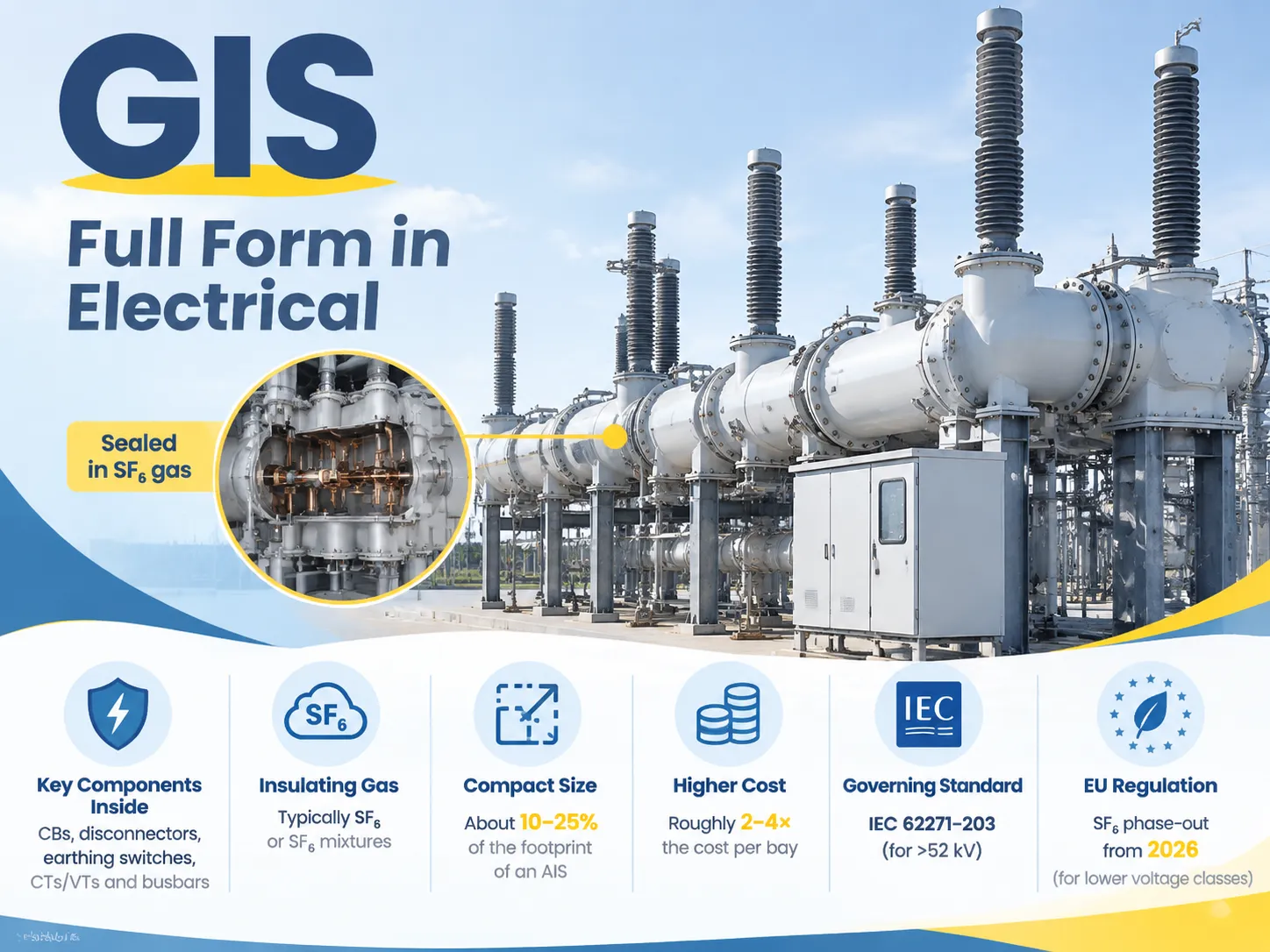
GIS stands for gas-insulated switchgear, a type of switchgear made up of environment-friendly solutions relating to electrical engineering. Essentially, it consists of various electrical devices such as circuit breakers, disconnectors, earthing switches, transformers, and busbars. All the apparent components operate in the surrounding of the insulated shell where the live conductors are located. In practice, the most common gases employed are SF6 or its combinations, but presently there are some alternatives available that do not contain SF6. GIS technologies require less than a quarter of the installation space required by air-insulated switchgear technologies, but they are two to four times more expensive in every bay. The basic standard applied to gas-insulated switchgear is IEC 62271-203 which can be applied to the technologies operating on voltage of more than 52 kV. In the EU, the new F-gas regulation started banning the use of SF6 in the new electrical devices starting from the year 2026 for the devices of lower voltage.
What GIS Stands For in Electrical
In electrical engineering, GIS stands for Gas Insulated Switchgear. Sometimes, you can see it written as “gas insulated switchgear” and the IEC also formulates it as gas insulated metal enclosed switchgear which is more precise, because it specifies the defining factor of the design.
The next meaning the Gas Insulated Substation is quite common, meaning a full substation made of gas-insulated switchgear components instead of single switchgear unit. In this case GIS is a facility, not a product. Hence if someone says “the project consists of two GIS buildings” it implies substations, while “we require twelve GIS bays” means switchgears. Usually it is easy to distinguish, but it’s worth saying that these two terms do not mean the same.
The key principle here is very simple. In traditional air insulation switchgears (AIS), safety between live conductors and between the conductor and ground relies on air – its dielectric strength is around 1-3 kV/mm in normal conditions. SF6 has 2 to 3 times greater strength, which means that at certain pressure it is possible to create gas insulated compartment that is much smaller than the one created with air.
You can use the same approach when speaking of medium voltage. Equipment in this family, like this fully insulated, fully sealed metal-enclosed switchgear, seals the primary circuit inside a grounded enclosure so that no live part is exposed and no external contamination reaches the insulation. That is the central idea of GIS, whether it’s a 12 kV ring main unit or a 400 kV substation bay.
What’s Actually Inside a GIS
A gas-insulated bay has all the primary components that you would find in an outdoor substation, only differently arranged and installed.
- The busbars (the strips that carry current between the bays) are located in a sealed separate compartment.
- The circuit breakers, which usually fall under the category of puffer or self-blast types of circuit breakers, have their interruptors constructed in a way that allows the arc products to be contained.
- The disconnector switches, as well as the earthing switches, which would ensure safety and isolation during maintenance work.
- The current transformers, predominantly of toroidal type in which the primary conductor is wrapped around the current transformer as opposed to the other two types classified as wound or bar-primary CT.
- The voltage transformers that are compactly constructed.
- The surge arresters that would ensure safety while maintaining the application’s requirements.
- The gas zones, which gets neglected in budgeting discussions and brings unpleasant surprises later.
- The enclosure, control, and expansion joints that normally include metal materials such as aluminum and stainless steel while ensuring safety from a single faulty section causing the outage of the entire installation.
In the engineering genius behind gounselation, you observe two important design particulars. The first particular is that your enclosure is compartmentalized, meaning that there are sections such as busbar, switch, and cable that have distinct gas and pressure monitoring.
GIS vs. AIS: The Real Trade-Off
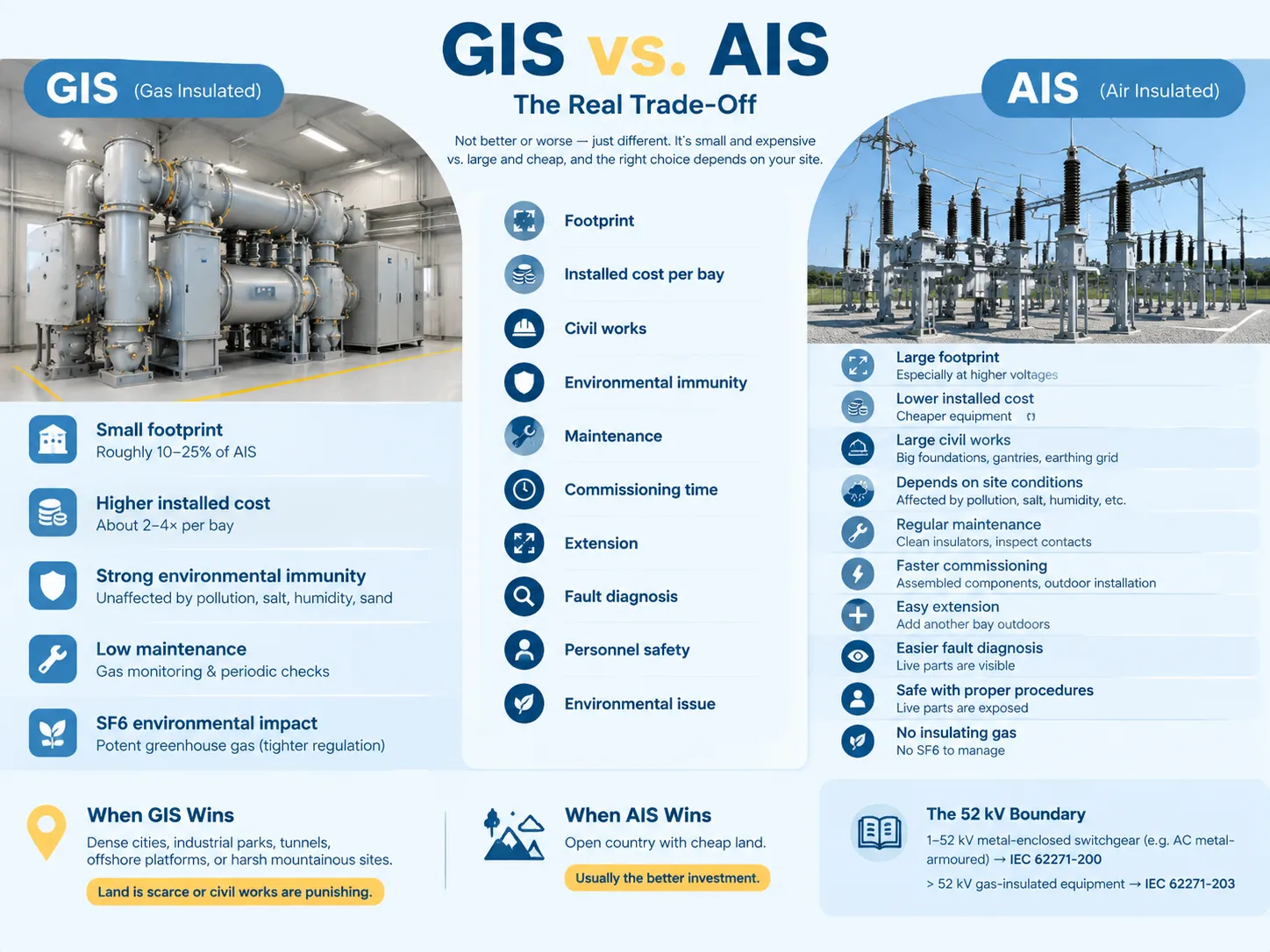
It’s not a comparison of “better or worse” but “small and expensive” versus “large and cheap”, and the answer really depends on the location.
| Factor | GIS (gas insulated) | AIS (air insulated) |
|---|---|---|
| Footprint | Roughly 10–25% of an equivalent AIS layout | Large, especially at higher voltages where clearances grow fast |
| Installed cost per bay | Roughly 2–4 times an equivalent AIS bay | The cheaper option on equipment cost alone |
| Civil works | Small building or compact foundation; far less ground preparation | Large concrete foundations, gantries, heavy earthing grid |
| Environmental immunity | Unaffected by pollution, salt spray, humidity, sand and wildlife | Insulation performance depends on site conditions |
| Maintenance | Low; mostly gas monitoring and periodic checks | Regular cleaning of insulators, contact inspection on live-adjacent equipment |
| Commissioning time | Longer; assembly is precise and cleanliness is critical | Faster; components arrive assembled and go up in the open |
| Extension | Difficult once the building and gas zones are fixed | Straightforward; add another bay outdoors |
| Fault diagnosis | Harder; problems are hidden, so condition monitoring matters more | Easier; you can see almost everything |
| Personnel safety | High; all live parts enclosed and the enclosure earthed | Safe with correct clearances and procedures, but live parts are exposed |
| Environmental issue | SF6 is a potent greenhouse gas and regulation is tightening | No insulating gas to manage |
The location is usually the determining factor in such cases. For instance, in the case of a dense downtown area with no spare land, a tunnel, an offshore platform, or a mountain location where civil construction is very difficult, GIS will be the most cost-effective option even though it has more expensive equipment. Otherwise, it would have required land that is impossible to buy and foundations which are too expensive.
It’s worth knowing where the boundary sits between the two families, because installations below 52 kV get described differently in the standards. Medium-voltage metal-enclosed switchgear in the 1–52 kV band — including air-insulated, metal-armoured designs like this AC metal-armoured switchgear — is covered by IEC 62271-200, while gas-insulated equipment above 52 kV falls under IEC 62271-203. The distinction is not cosmetic; it changes the type tests, the ratings you’ll be quoted, and the documentation a supplier owes you.
GIS Circuit Breakers and the Other Components
The term “GIS circuit breaker” is often used by people searching for it as a specific product. However, this is untrue because a circuit breaker of GIS is just a gas-insulated circuit breaker, which is the biggest component in the bay.
Almost all of them are made using SF6 self-blast or puffer design. When the interrupter is open, the arc is drawn in SF6 in a pressurised state, where the gas’s electronegative characteristics — the molecules obtain the free electron capturing and consequently form negative ions. The main function of SF6 lies in it being the industry standard for both insulation and arc extinction.
The ratings of transmission GIS breakers operate in a range of 1,250 A and 4,000A continuous current with short-circuit breaking capacity in a scope of 31.5 to 63 kA with 145kV and more at a higher voltage. Medium-voltage gas-insulated models have a rating between 630 A and 3150 A with breaking capacity of 20 to 40 kA.
There are two practical points: First of all, GIS breakers have a long maintenance-free operation time — more than 20 years or 10,000 operations, whichever is earlier, because the contacts are kept in the clean dry gas instead of air or oil. Secondly, in case GIS breaker requires repair, it should be repaired by specialists with a local representative who is able to handle the gas being used. This is really expensive and makes it necessary to rely on the local cost of the gas and equipment offered by the supplier rather than a price.
Where GIS Gets Used
The uses form a familiar pattern: whenever land is insufficient, conditions are harsh, or it is essential to prioritize the costs of equipment over other factors.
- Substations in urban areas and city centers will require alternate sites that do not exist.
- Outdoor installations and underground substations in commercial buildings, hospitals, data centers and metro systems.
- Offshore installations and platforms near the coast, where sea winds filled with salt require water-insulated equipment with land measured in square meters.
- Energy plants (wind, solar), especially the onshore ones affected by cold, humidity, and dust, along with offshore substations.
- Power plants usually cut into caves of rocks where outdoor switchyards would be unsustainable.
- Factories (steel, chemical, cement) that operate in hostile conditions that would not allow the use of AIS.
- Rail and metro traction systems we have also where installation is made into tunnels and buildings.
- High-voltage transmission stations where the gas-insulated substation system takes the place of the outdoor switchyard.
There is a tendency that makes GIS the technology of choice in the majority of cases – the decision for using GIS technology is often made due to limitations of the site rather than the fact that GIS is the better choice. Almost each GIS project can be connected to a specific factor(such as building, tunnel, coastline, etc.) inspiring the creators not to choose AIS, if there are more positive constraints; if such limitations are not present, the wrong technology for the budget would be considered.
Some of these sectors have enough in common to justify looking at them together, and the sector-by-sector applications — from utility distribution through industrial and renewable generation — are collected in this overview of where switchgear and transformer equipment is applied across industries if you want to see how the same equipment gets configured differently for each one.
The SF6 Problem, and What’s Replacing It
At present, this is a primary concern in modern technology, and a buyer investing in a 40-year asset must be aware of it.
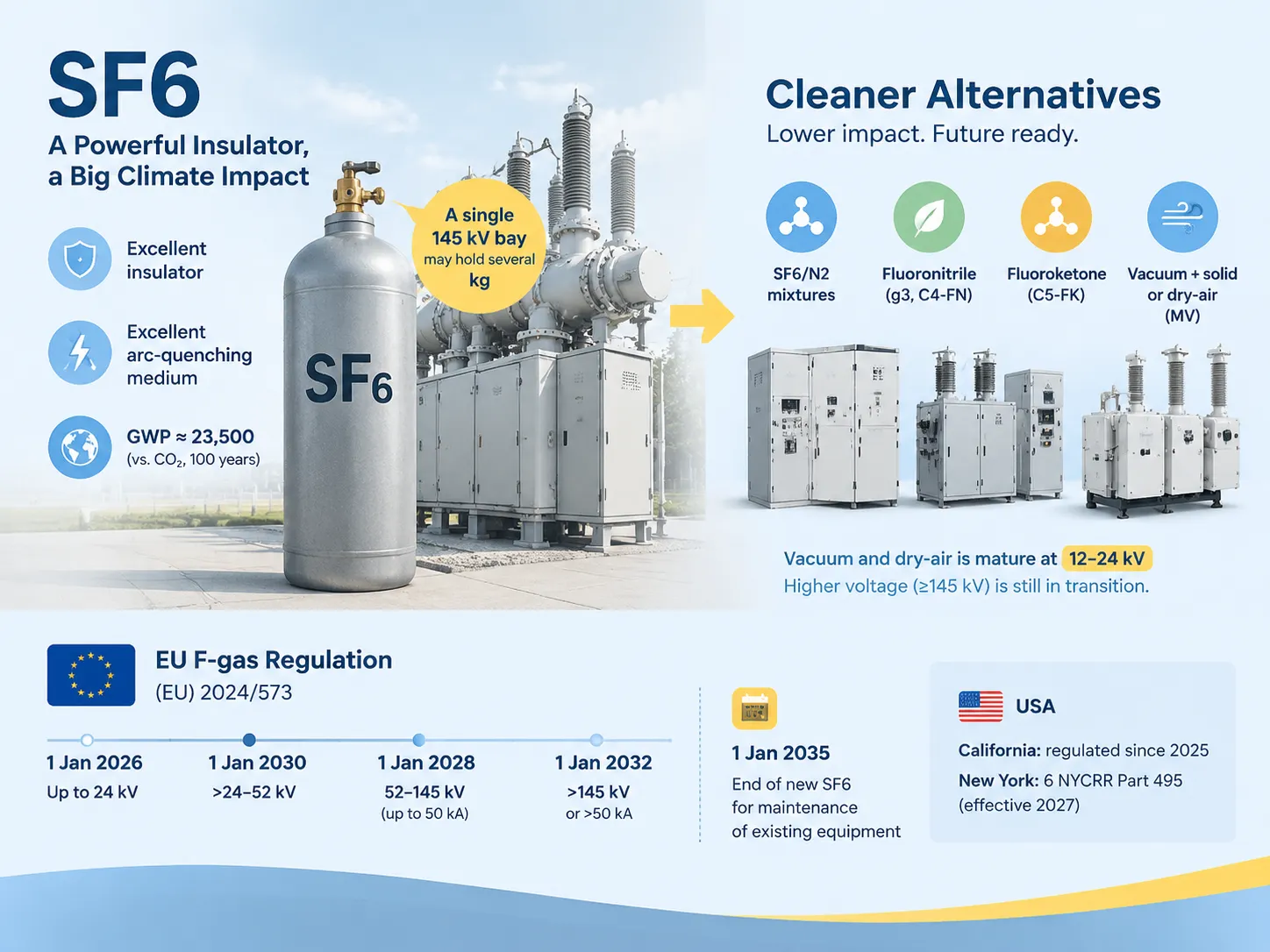
SF6 gas is a fantastic insulator and primitive in terms of arch-quenching performance. Yet it stands tall among the most dangerous greenhouse gases captured by the Kyoto Protocol. Its global warming potential was estimated to be about 23,500 times that of CO2 in the AR5 timescale. It will take about 25,200 times compared to CO2 under the AR6 scale. In a single 145 kV GIS bay, there is a way to have a few kilograms of it. In thousands of such bays, its cumulative weight can be astounding even though modern GIS have a very small gas leakage of less than 0.5% per year if comparing with more than 1% which was observed in the past.
Whatever the situation, regulation made its move. The F-gas regulations of the EU were updated and published in February 2024.
| Voltage class | Date from which new SF6 equipment is no longer placed on the market (EU) |
|---|---|
| Up to 24 kV | 1 January 2026 |
| Above 24 kV up to 52 kV | 1 January 2030 |
| 52 kV up to 145 kV with breaking capacity up to 50 kA | 1 January 2028 |
| Above 145 kV, or breaking capacity above 50 kA | 1 January 2032 |
The regulation that will come into power on January 1st in 2035 involves ceasing to use new SF6 in the process of maintaining the existing equipment, which impacts the market of refilling significantly. Starting from 2025 California has adopted SF6 regulation for gas-insulated devices while the rules concerning 6 NYCRR Part 495 will come into force in New York in 2027.
The solutions that have been already launched on the market involve SF6/N2 mixtures, which allow cutting back its usage though not eradicating it, fluoronitrile mixtures more frequently known under the g3 trade name (due to certain C4-FN base), fluoroketone systems (based on C5-FK), and pursuing the option of using vacuum switching with solid or dry air insulators which means that no gas would be used. For the applications with the voltage level of 12-24 kV the application of this solution is already widespread, the applications with the voltage of 145 kV and higher are still undergoing the transition process, hence taking into account the specifications made today will determine the compliance period for the equipment. If you are formulating a tender in Europe, be sure to include the requirements concerning F-gas in the specifications instead of realizing their importance at the handover stage only.
What GIS Costs
Pricing can depend on voltage class, bay structure, breaking ability and the maker but the essence of the number stays the same.
| Item | Typical range | Notes |
|---|---|---|
| Medium-voltage gas-insulated bay or ring main unit (12–24 kV) | USD 3,000–$15,000 per bay | Compact, factory-assembled, common in secondary distribution |
| High-voltage GIS bay (up to 145 kV) | USD 30,000–$80,000 per bay | Depends heavily on breaking capacity and CT/VT content |
| Extra-high-voltage GIS bay (above 145 kV) | USD 80,000–$250,000+ per bay | Steep curve as voltage class rises |
| GIS versus AIS, equipment only | 2–4× the AIS cost | The headline gap most buyers focus on |
| GIS versus AIS, total installed | Often within 10–30% of each other | Once land, foundations and civil works are included |
| GIS substation building | USD 200–$800 per m² | Highly site-specific; includes ventilation and gas detection |
| Annual maintenance | Low, but specialist | Gas monitoring, density checks, periodic partial discharge testing |
The important point is the fifth line. Clients observe prices and see that GIS is 2-4 times higher than AIS, making them conclude GIS is too expensive. However, they don’t take into account that the price is not all; it’s necessary to consider the price of land, foundations, gantries, grounding, the fact that ais requires longer construction and regular cleaning of insulators.
Where the compactness pays off at medium voltage is in the packaged, factory-finished formats. A fully insulated ring main unit, for example, replaces what would previously have been a small outdoor switchyard with a single sealed enclosure that needs no weather protection, no separate building and no insulator maintenance — which is exactly the calculation that makes gas-insulated and fully sealed designs attractive in refurbishment projects.
Choosing a GIS Supplier
Considering the fact that GIS is expensive area with long service life and minimal need to be maintained, careful supplier selection is more important than with simpler devices. Here is what you should make sure of before you sign the contract.
- Obtain type test reports, not just compliance certificates. For the equipment operating under voltages above 52 kV, you should ask for the IEC 62271-203 type tests referring to insulation strength, short circuit performance, thermal performance and internal arc test. Compliance certificates stating that the equipment is manufactured in accordance with the standard cannot substitute the type tests.
- Internal arc classification. According to the requirements of the IEC 62271-203, there should be internal arc classification that reflects the accessibility class of the installation as well as the duration of the arc. Ask for IAC A FLR or other similar device that follows the requirements of your installation.
- Gas supply / service. Ask who supplies the gas, what company is responsible for leak detection and other processes. In remote installation cases this can significantly affect voltage restoration.
- Condition monitoring support. Use the opportunity and make sure that partial discharge and gas density sensors can be easily installed beforehand rather than trying to do this later on.
- F-gas compliance requirements. You need to know what type of gas is being used, the leak rate and what supplier will do in case the regulations tighten.
- Location-extension studies. Think about how the installation might be extended in the future. Although adding a new station after the switch is implemented may be possible, it is not the best solution.
- Local references. Make sure there are similar installations of the required design at particular voltage level in a comparable situation with references available.
It is also important to be aware of the lines of responsibility. The equipment is provided by the manufacturer; the design, construction and commissioning is done by contractors.Getting that boundary explicit early avoids the classic argument later, and it’s the kind of scope question a supplier’s own service and support arrangements should be able to answer precisely, in writing, with names and response times.
FAQ
What is GIS in an electrical system?
In electrical engineering, GIS refers to the switchgear arrangement with primary equipment entirely housed inside of a grounded metal enclosure filled with insulating gas, mostly SF6 or SF6 mixtures. Such insulating gas supplies the required dielectric strength, which would otherwise be provided by air, giving GIS systems the benefit of significantly reduced physical spacing. As a result, GIS switchgear installation occupies only 10% to 25% of installation area needed for air insulated switchgear. Moreover, GIS systems are highly reliable and resistant to environmental impacts, making them the first choice for areas where land might be insufficient or outer space may be unfavorable for conventional outdoor switchyards.
What does GIS stand for in electrical?
GIS is an abbreviation for Gas Insulated Switchgear. The term has also been used for Gas Insulated Substation which refers to a whole substation which is built around gas-insulated equipment rather than just one switchgear assembly. According to IEC, this is gas-insulated metal-enclosed switchgear and the standard IEC 62271-203 applies to it for 52 kV voltage levels or higher and the metal-enclosed switchgear standards like IEC 62271-200 are applicable for voltages below 52 kV. The same abbreviation can also refer to other expressions in different industries; for example, Geographic Information System, etc.
What does GIS stand for?
In electrical engineering, most frequently, Gas Insulated Switchgear and Geographic Information System in software and mapping are considered. There are also some other definitions: Guaranteed Income Supplement (a Canadian aid), General Insurance Scheme and Geographic Information Science, Grid Information System, etc. Only the electrical meaning works in the context of substation or switchgear specifications. If a document states SF6, gas zones, bays or earthing switches in combination with abbreviations, it is the switchgear term.
What is a GIS circuit breaker?
A circuit breaker that is utilized in a gas-insulated switchgear bay is known as a GIS circuit breaker. In terms of its function, it operates similarly to any other high-voltage circuit breaker since it is responsible for breaking and making the load current and fault current. The breaker is located in a compartment that is sealed, and this gas is used both as insulation and as an arc-extinguishing medium. This gas mitigates the problem of arcing by efficiently holding electrons thus enabling the breaker to be compact in construction. The transmission voltage level circuit breakers are rated at a range going up to 4,000 A with breaking ratings at around 31.5 to 63 kA at a voltage of 145 kV. The circuit breakers normally need no maintenance.
Why is GIS used instead of AIS?
As a result of space and environment. A GIS device will take approximately one-tenth to one-quarter of area occupied by a comparable conventional air-insulated substation, which clearly matters when land is unaccessible or expensive – in cities, tunnels, offshore platforms, factories, mountainous territories. GIS is also protected from external contamination, since nothing from outside: salt mist, dust, moisture, pollution, animals can affect anything due to the sealing. The maintenance is much lower as there are no insulators to maintain and the contacts are a connection within the sealed environment. The disadvantages refer to the higher cost for the equipment, more complicated installation, more difficult troubleshooting and the ecological aspect of the insulating gas.
Is GIS being phased out?
The gas is phasing out, while technology is evolving. According to the 2024/573 revision of the EU’s F-Gas Regulation, there is a phased withdrawal of SF6 from new switchgear: below 24 kV in January 2026, between 52 and 145 kV at up to 50 kA in January 2028, above 24 kV below 52 kV in January 2030, and above 145 kV or 50 kA in January 2032. From January 2035, new SF6 will not be permitted in maintaining existing equipment. In the US, California has imposed regulations since 2025 while New York started doing so in 2027. The gas-insulated switchgear is not going away, just SF6 is being phased out, which will be replaced by devices that use fluoronitriles, fluoroketones, SF6/N2 mixture, and vacuum with dry air.
References
- IEC 62271-203 — Gas-insulated metal-enclosed switchgear for rated voltages above 52 kV — the governing equipment standard
- European Commission — Fluorinated greenhouse gases — regulation (EU) 2024/573 and the SF6 phase-out schedule
- US EPA — Greenhouse Gas Reporting Program — reporting requirements covering SF6 and other fluorinated gases
- Siemens Energy — industry initiative to reduce F-gases — background on SF6-free switchgear development
- Hitachi Energy — high-voltage switchgear and substation technology
- ABB — medium and high-voltage switchgear product information
Conclusion
GIS represents the Gas Insulated Switchgear, although it may also refer to just the gas-insulated substation, describing the entire facility in which the live parts are placed under a sealed, earthen metal enclosure; and using a gas with a dielectric strength greater than air has shrunk the entire installation by a factor of about four to ten.
They provide a trade-off between occupyspace, operational and environmental durability, low maintenance, and high personnel safety. However, it costs some money up front, along with flexibility for the future, which is going to be more expensive, not easy for fault-finding, and cause some problems regarding the greenhouse gases for which the regulators are now trying to solve some deadlines: 24 kV by 2026 import, 52-145 kV up to 2028; and for the certain higher classes, by 2032 in the EU.
Also, if you happen to have space, cheap land, and climate that isn’t too harsh, air-insulated switchgear will do the job at a fraction of that price, leaving you with a bit of cash for something else. If you happen to be in the city centre, below ground, in an industrial area, on the coast or on an offshore oil rig, then the investment calculation swings the other way and suddenly it is gas-insulated equipment which ceases to hold a premium status and moves to prudent qualifications. Know your voltage class, and your gas, ensure they can provide good type test evidence to withstand in compliance with IEC 62271-203, and indicate who will service that gear in 15 years time. Those three questions should typically dictate whether your asset will be a 40-year leasehold or whether it will become a liability for you upon delinquency of use.