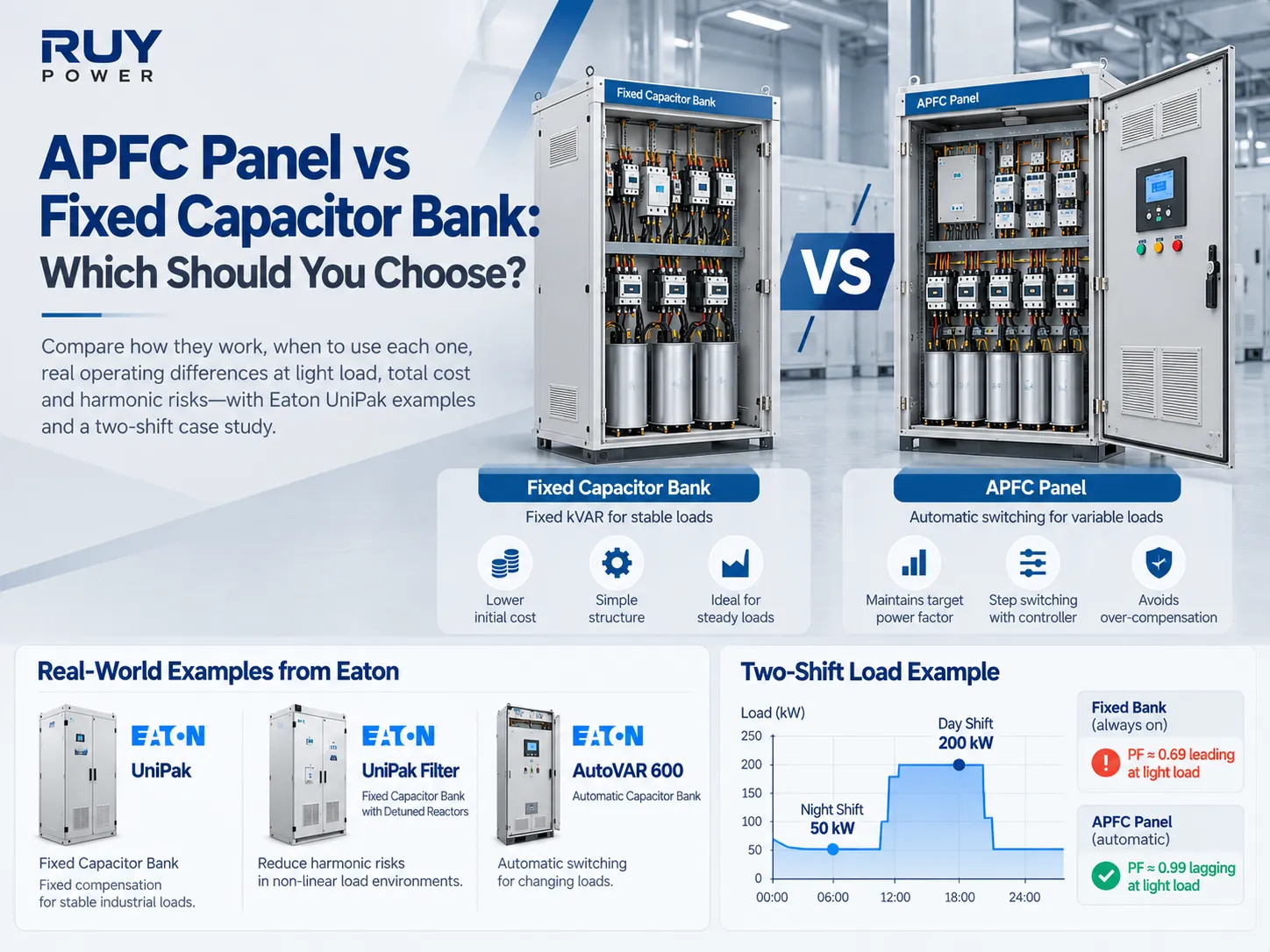

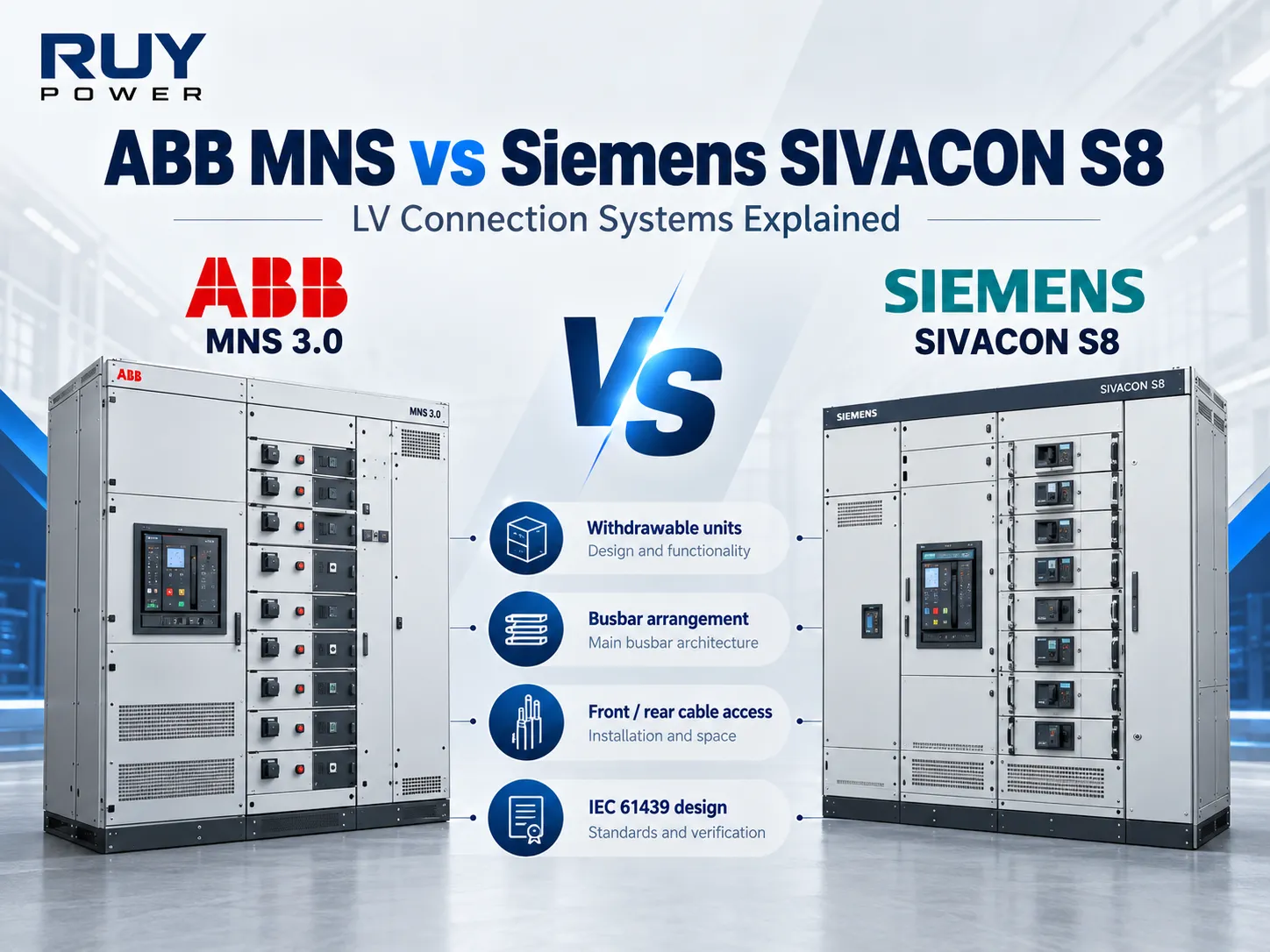
When it comes to low-voltage switchgear tenders, two names stand out repeatedly: ABB MNS vs Siemens SIVACON S8. Both types of low-voltage switchgear have the same modular design and type-verified low voltage switchgear systems with ratings of up to 690V. Both have fixed, plug-in and withdrawable unit types of operation. Both brands are used in process plants, data centers, utilities as well as large buildings. They may look very similar on the technical data sheet, however, both systems are designed differently in terms of the busbar layout, the cabling points, the working principle of withdrawal unit and use of arc testing.
This article provides a comparison of ABB MNS and Siemens SIVACON S8 by taking a more engineering perspective. It uses ABB MNS 3.0 and the newest Siemens SIVACON S8 designs for comparison. It describes how connection of devices is ensured in each one of them, as well as what changes in IEC internal-arc guidelines are implemented from 2026. Besides, a selection matrix is given which might help you in deciding before making requests for quotations.
Quick answer: ABB MNS 3.0 and Siemens SIVACON S8 are both IEC 61439-verified LV switchgear systems for up to 690 V, with fixed, plug-in and withdrawable units and internal separation up to Form 4. Siemens publishes the higher main-busbar short-circuit rating (up to 150 kA for 1 s, 330 kA peak, main busbar up to 7010 A). ABB lists MNS up to 7300 A (MNS Rear) and 120 kA on its website, while the MNS 3.0 technical catalogue gives Icw up to 100 kA. MNS is built on a 25 mm module grid with very compact withdrawable units (up to 36 small modules per compartment), which suits dense motor control centres. SIVACON S8 offers a wide set of mounting designs and four main-busbar positions, which gives flexibility in room layout. Choose by fault level, room layout and access, MCC density, existing installed base and local service, not by brand name.
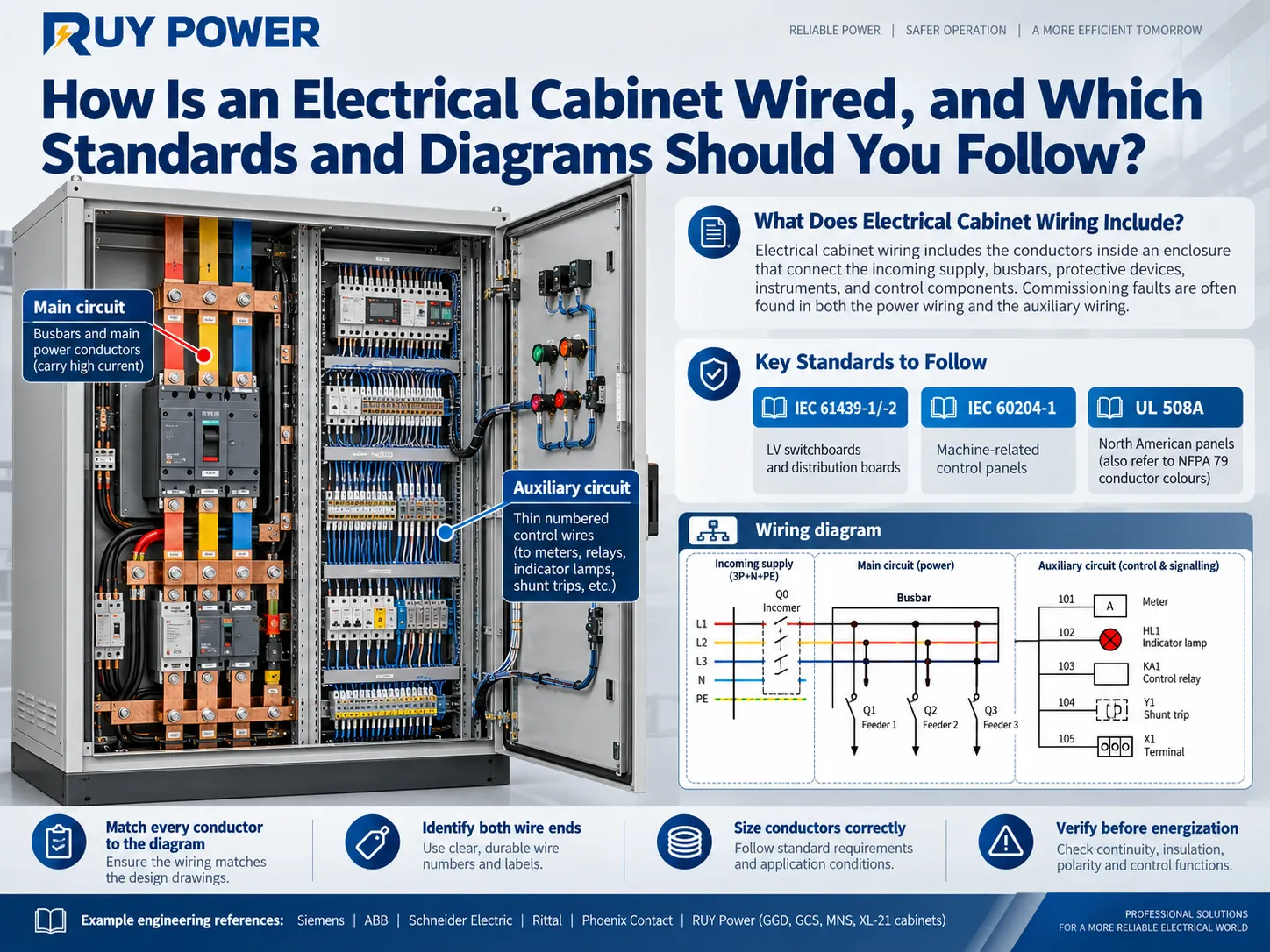
For the basics of what happens inside any LV cabinet, see our guide to electrical cabinet wiring.
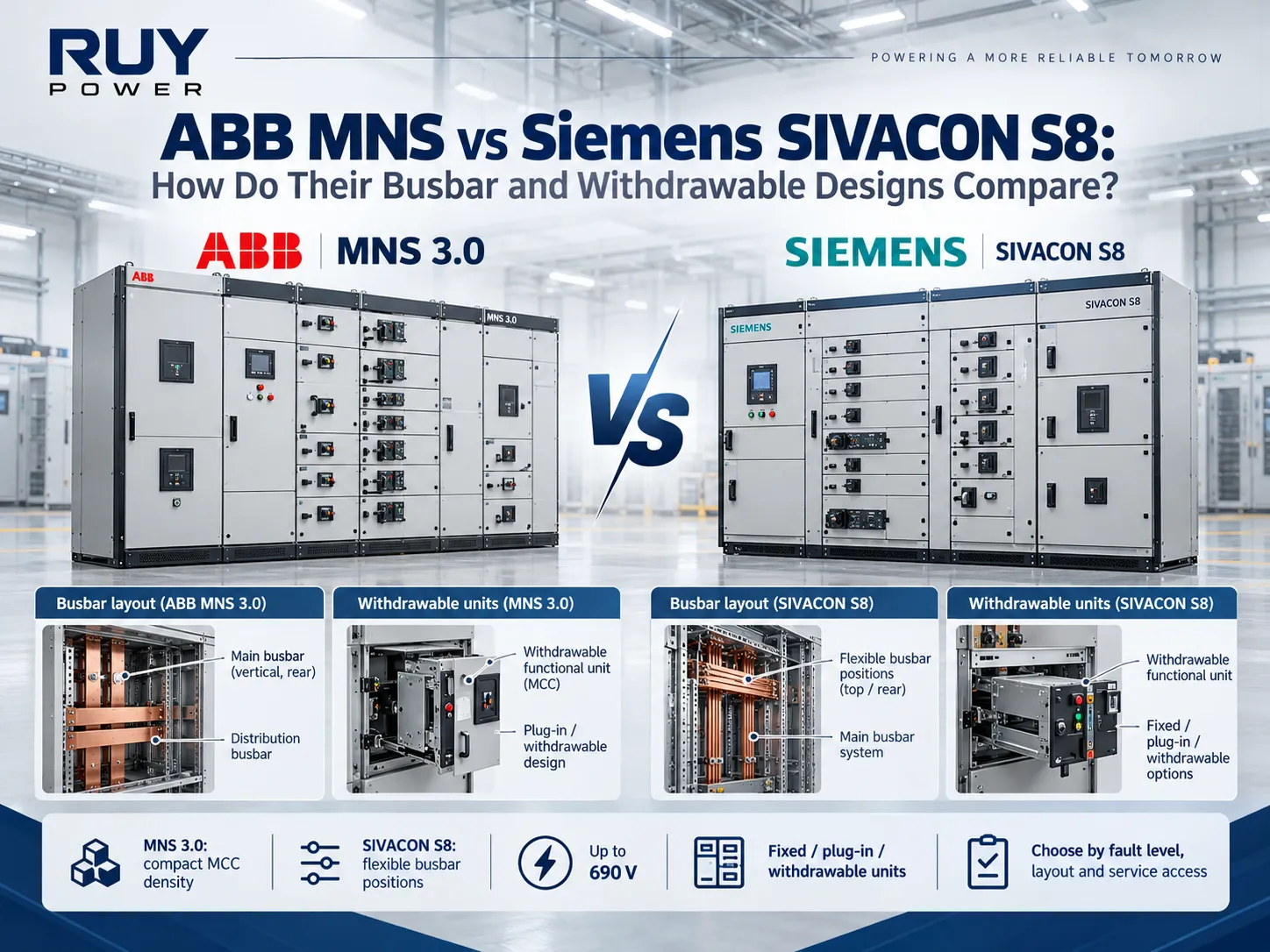
ABB MNS vs Siemens SIVACON S8: Technical Comparison
The table gives a comparison of the highest published values. It should be noted that the peak value may not always be available from one cubicle at the same time. A combination of rear busbar usage, cooling enclosure and proper mounting design may be required to achieve the maximum value, which makes it essential to confirm the design verification information for the specific offered layout.
| Item | ABB MNS 3.0 | Siemens SIVACON S8 |
|---|---|---|
| Rated operational voltage Ue | Up to 690 V AC (750 V DC depending on equipment) | Up to 690 V |
| Rated insulation voltage Ui | Up to 1000 V AC | 1000 V |
| Main busbar rated current | MNS Front up to 6300 A; MNS Rear up to 7300 A (ABB website). MNS 3.0 catalogue: up to 6300 A | Up to 7010 A (rear position, ventilated); up to 6300 A (top position, ventilated) |
| Main busbar short-circuit rating | Up to 120 kA (ABB website); Icw up to 100 kA, Ipk up to 220 kA (MNS 3.0 catalogue) | Icw up to 150 kA for 1 s; Ipk up to 330 kA |
| Distribution (vertical) busbar | Up to 2000 A, Icw up to 100 kA | Up to 1720 A (1400 mm² profile bar, ventilated), Icw up to 100 kA |
| Functional units | Fixed, plug-in, withdrawable | Fixed, plug-in, withdrawable |
| Internal separation | Up to Form 4 | Form 1 to Form 4b (Form 4b Type 7 possible in circuit-breaker design) |
| Internal arc verification | Tested to IEC TR 61641, criteria 1–7, up to 690 V / 100 kA / 300 ms | Arc testing to IEC TR 61641 |
| Degree of protection | Up to IP54 | Up to IP43 ventilated; IP54 non-ventilated; up to IK10 |
| Design verification | IEC 61439-1/-2 | IEC 61439-2 |
| Module grid | E = 25 mm; withdrawable modules 8E/4 and 8E/2 up to 24E | Small withdrawable units 1/4 or 1/2 width; normal units from 100 mm height |
According to the website of ABB for its products and MNS 3.0 technical catalogue while Siemens SIVACON S8 Technical Planning Information 2025 cites ABB does not provide the time factor for its 120 kA figure hence ask for Icw with its timed rating from ABB in writing.
What Is ABB MNS 3.0?
ABB MNS is a modular low-voltage switchgear platform by ABB used for both power distribution and motor control. According to the company, there are around two million MNS panels installed all over the world. The current version of MNS is called MNS 3.0 and every compartment is manufactured using standard components based on a 25mm standard. MNS has a standard height of 2200mm and the available widths range from 400mm to 1200mm.
MNS has a very important characteristic that makes it unique: its module density. The equipment compartment is able to accommodate 36 small 8E/4 withdrawable modules, thus making it very easy to change them, according to ABB – the entire process takes less than a minute and no tools are required. A special multifunctional separation wall separates the busbar from the equipment compartment, preventing the transfer of arc between the phases or from the busbar to the equipment.
ABB MNS Front vs MNS Rear Connection
The front or rear access option for the MNS determines how the equipment is installed in the building.
MNS Front: a busbar is positioned at the back of the section so that it acts separately from the cable chamber, which is at the side of the equipment chamber. Both operations (and cable termination) are done from the front, which allows this type of installation to be placed against the wall.
MNS Rear: the busbar is placed above other equipment, with the cable chamber positioned at the back. One can relate that working with the units is done from the front, whereas access to the terminals is realized from behind. To comply with other conditions stated in MNS Rear documents, this type of installation does not allow the unit to be fixed against the wall.
ABB MNS 3.0 vs MNS iS
MNS iS is ABB’s sophisticated motor management center developed on the MNS framework. Unlike traditional CTs, actuators linked with independent relays and conventional control, each detachable power unit has a sensor component which tracks current, voltage, and temperature. The MControl module is responsible for providing protection and control, the MLink connects to the plant management system (Profibus DP, Profinet, Modbus RTU/TCP), and the MView allows local web access. Control and power wiring are arranged in different compartments. MNS iS for ABB MNS MCC minimizes internal wiring and enables fast module replacement. A traditional MNS 3.0 MCC, however, would be a better choice for the facility which utilizes classical motor starters and employs its PLC in the operations.
What Is Siemens SIVACON S8?
SIVACON S8 is a product of Siemens and is a low voltage switchboard for electric energy distribution and engine management. Its great advantage is the rich selection of designs that can be combined in one switchboard. In the 2025 planning manual it is stated:
Design of circuit-breaker switchgear with air circuit breakers up to 6300A or with circuit breakers of type 3VA;
Universal switchgear design with the possibility of using withdrawn, fixed or plug-in devices (cable connectors up to 630 A);
Design of special switchgear elements with plug-in or remote switch disconnectors;
Design characteristics with the front assembly.
Design of frequency converter with the output power of up to 132 kW;
Design for reactive power compensation with the total power of up to 500 kvar.
Such devices as cubicles measure 2000 or 2200 mm by height and from 200 to 1400 mm by width. The cubicles can be 500, 600 or 800 mm in terms of single-front depth, and 1000 or 1200 mm in terms of double-front depth.
SIVACON S8 Busbar Configurations
A main busbar might often be positioned in the top, rear-top, rear-bottom, or at times in a combination of these two locations. The actual positioning of the busbar can play an important role in determining the rating and footprint of the busbar. According to the data for 2025, a busbar positioned at the top can reach the rating of 6300A (ventilated) whereas a busbar at the back can perform at 7010A, and a rear busbar board of 4000A rating can be built in a single front of depth of just 600mm. A double front arrangement of a rear busbar will require a depth of 1000mm for 4000A or 1200mm for 7010A. In terms of the universal mounting design, the busbar will have to fit into a cubicle of 600mm width when cables are connected at the back of the cubicle and that of 1000mm or 1200mm when connected from the front side.
Fixed-Mounted vs Withdrawable Design
The fixed feeder type is more economically viable and works best for circuits that are seldom modified. If they are designed with the universal mounting system, the withdrawable feeders conform to Form 3b or 4b, and it is possible to replace them without switching off the system. In the Siemens withdrawal configuration, moving the contacts shifts the feed into the appropriate connected, tested and disconnected places with the compartment door closed. At the same time the protection level is retained in all three positions, while the operating error protection bars contact movement in live mode.
Busbar and Cabinet Connection: Key Design Differences
This is where an LV switchgear comparison becomes practical. Ratings tell you whether a system can carry the load; connection design tells you whether it fits the room and how it will be maintained.
Main Busbar Arrangement and Expansion
| Question | ABB MNS 3.0 | Siemens SIVACON S8 |
|---|---|---|
| Where is the main busbar? | Rear of the section (front access) or top compartment (rear access); dual upper and lower bars for 6300 A rear access | Top, rear-top, rear-bottom, or both rear positions |
| How is it separated? | Multifunction wall between busbar and equipment compartment | Separation according to the chosen form; busbar compartment per mounting design |
| Typical depth for the highest rating | 1200 mm (rear access, 6300 A) | 800 mm single-front, 1200 mm double-front (rear busbar, 7010 A) |
| Wall mounting possible? | Yes with front/side access; no with rear access | Yes with front connection; double-front and rear-connection layouts need rear clearance |
Both systems are designed so that sections can be added later. In practice, extension is easiest when the end cubicles are ordered with busbar extension provisions and the busbar rating is chosen for future load, not only today’s load.
Front vs Rear Cable Access
Front access allows for installation in tight electrical rooms and locations against walls. Because the cable box takes up width, however, a circuit board with multiple outgoing feeds must be longer. Just as rear access divides the work area from electrical cable work, it can provide more bending area for the cable itself, but requires additional spacing for rear access and a larger overall size of the building.
Withdrawable Power and Auxiliary Contacts
For withdrawable switchgear, what matters is what happens to the main circuit and to the control circuit in each position. ABB documents this precisely for its small MNS modules (8E/4 and 8E/2):
| MNS module position | Main contacts | Control contacts |
|---|---|---|
| ON | Closed | Connected; module locked |
| OFF | Disconnected | Connected; module locked |
| TEST | Disconnected | Connected; module locked; up to 3 padlocks |
| MOVE | Disconnected | Disconnected |
| ISOLATED | Disconnected; module drawn out 30 mm to meet the isolating distance | Disconnected; up to 3 padlocks |
The role of TEST is crucial when it comes to commissioning. The operator will be able to send start/stop and interlocking commands without the requirement of the motor being in operation since the control (control circuit) is powered even though the power circuit is not yet closed. According to the documentation provided by the company ABB, primary contacts might last 1000 insertions.
The company Siemens has three places for its withdrawable device (connected position, test position and disconnected position). There is an optional position switch supplying signals such as ‘feeder available’ and position test to the system. The unit can have as many as 40 auxiliary contacts on it with a capacity of 6A at 250V or 10A at 250V for a normal unit.
From here, it follows that it is important to obtain from both suppliers information concerning the appropriate contact sequence of the unit you will buy, and the number of auxiliary contacts available and whether the position signal would be sent to the DCS.
Safety, Internal Separation and Arc Protection
The two systems confirm to the requirements of IEC 61439 and are Form 4 compliant. This means that the busbars, each distinct functional unit and the terminals for external conductors are located in different compartments. Each terminal configuration is designated by an identifying letter and, in the UK, by BS EN 61439-2 “type” number. According to Siemens, Form 4b Type 7 is suitable for application in circuit breaker designs.
However, the data published regarding internal arc is different. According to ABB, the MNS 3.0 system has been tested to IEC TR 61641 requirements full up to 690 V, 100 kA and 300 ms, thus confirming compliance with categories 1 to 5 of personal protection according to IEC 61641, as well as categories 6 and 7. ABB documentation, such as MNS Rear Guide and MNS IS Guide states that the internal arc protection has been tested at 400 V/100 kA and 690 V/65 kA for 300 ms duration. Siemens states that SIVACON S8 is arc-tested to IEC TR 61641, providing IEC TS 63107 in its relevant documentation too.
What changed in 2026: IEC TS 61641:2026
On August 18, 2026, the IEC published IEC TS 61641:2026, thus replacing IEC TR 61641:2014 and IEC TS 63107:2020. The document introduced a new approach to the combination of passive and active protection mechanisms by creating a framework for both (mechanical design features such as barriers, locks, pressure relief), as well as active arc fault mitigation systems. It also established a concept of “arcing class zones” and involved classifying the assembly protection based on two levels.
From the user standpoint, this means two implications. First of all, the existing arc test reports, conducted according to the IEC TR 61641 remain authentic allows users to understand how this design was tested after the introduction of new specifications defining which document and what level of protection is necessary. Secondly, in case of comparing proposals, it is highly advisable to ask all suppliers which document the arc test reports are based on and the various parameters as voltage, current, time of its passing. A test of 100 kA at 690 V differs greatly from the one of 65 kA at 690 V.
Digital Monitoring and Motor Control Integration
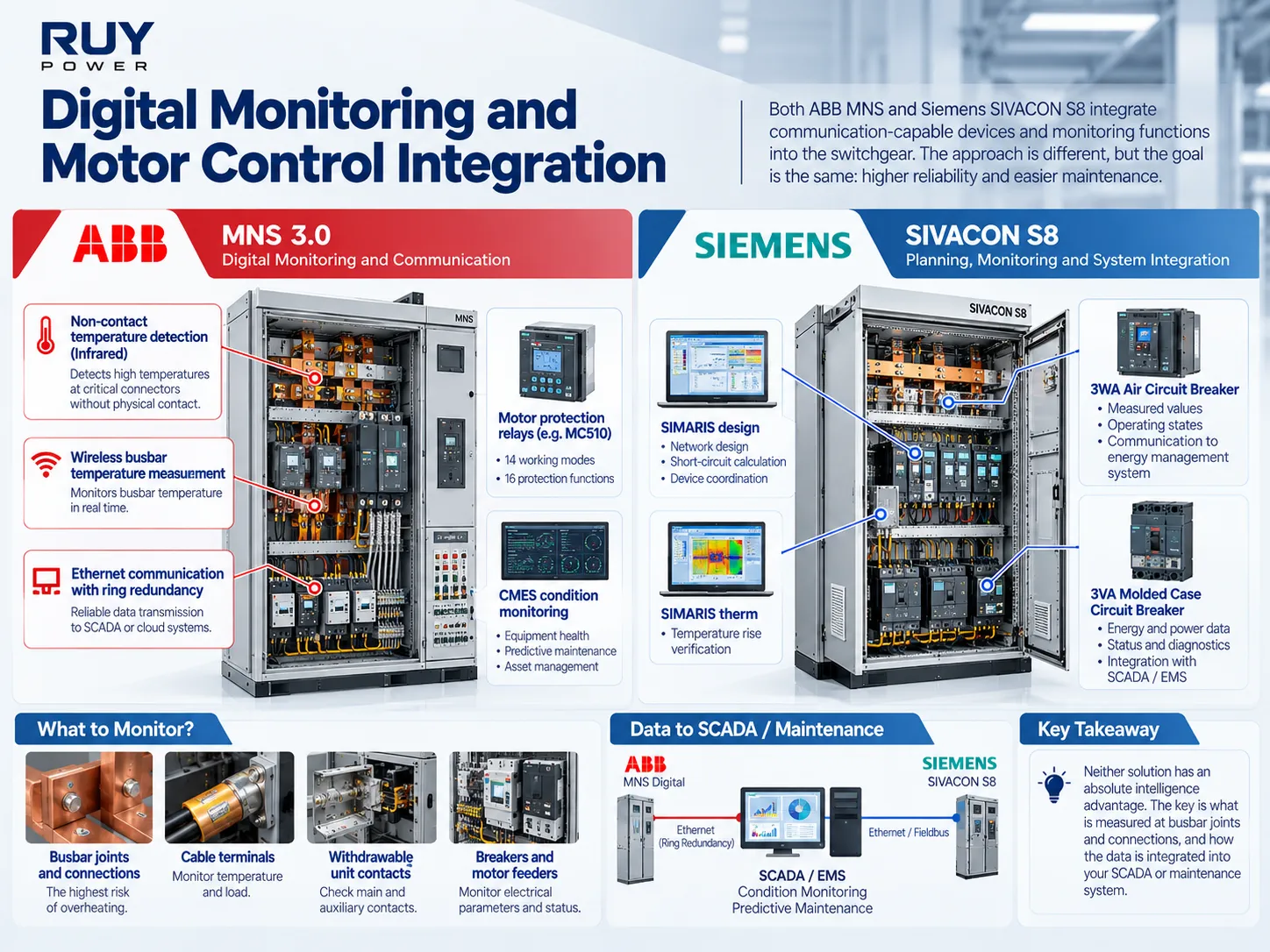
MNS Digital by ABB implements communication solutions and sensing devices directly into the equipment. The features include non-contact temperature detection system working on infrared principles in the case of connectors, wireless temperature measurement for busbars and Ethernet communication with the possibility of ring redundancy. Various motor protection relays are available, with MC510 model being capable of 14 different working modes and 16 protection functions. Additionally, ABB’s CMES solution provides condition monitoring for predictive maintenance purposes.
Siemens on its side navigates towards planning and incorporation of the communication-capable devices into the board. To perform network design as well as short-circuit calculations SIMARIS design software is used, while SIMARIS therm provides temperature rise verification. In SIVACON S8, 3WA air circuit breakers and 3VA MCCBs supply data on measured values and states to the energy management system.
In general, neither solution has any intelligence advantage. The real question you should ask is what exactly is being measured by each system at busbar joints and connections, the hottest points in any board, and how the measurement will be sent to SCADA or maintenance.
Which System Fits Your Industrial Project?
| Project situation | What to compare first |
|---|---|
| Chemical plant or continuous-process MCC | Withdrawable module density, TEST position behaviour, internal separation, time to replace a module, MCC intelligence (MNS iS or conventional) |
| Data centre main LV board | Busbar rating and future expansion, Icw against the calculated fault level, arc-fault protection level, temperature monitoring |
| Space-limited electrical room | Busbar position, front vs rear access, cubicle depth, need for a rear aisle |
| High fault-level industrial network | Icw and its duration, Ipk, and whether the ratings apply to the configuration actually quoted |
| Plant with an existing ABB or Siemens installed base | Compatibility of modules and spares, authorized panel builders, local service |
| General industrial distribution on a tight budget | Valid IEC 61439 design verification, total cost, lead time, site support, and whether a branded system is required by the end user |
Both systems cover all these situations. The matrix shows what to examine first, not which brand wins.
What All Things Should Buyers Compare?
1.The IEC 61439 design verification documentation for the specific configuration, including temperature rise calculations and short circuit calculations.
2.Icw time and Ipk for the busbars, including the main busbar and the auxiliary busbars.
3.Arc fault test report: which document it relates to, what is voltage, duration, current and what is the limit used?
4.What form of separation for incoming and outgoing feeders – is it double or single separation?
5.Busbar arrangement, cable entry (top or bottom) and access from front or back compared with room layout.
6.Withdrawable unit position, number of auxiliary contacts and signal positioning.
7.Digital features, and communication protocols needed for the control system.
8.Who manufactured the board – the owner, authorized panel builder or the third party and who carries out the verification?
9.Price, delivery time, spare parts and local support.
For maintenance after delivery, see our guide to switchgear maintenance and testing.
How Does RUY Power’s MNS-Style Switchgear Differ?
“MNS” is also widely used in China as the name of a type of withdrawable LV switchgear developed with reference to the ABB MNS structure. RUY Power’s MNS low-voltage withdrawable switchgear is one of these. It is a RUY design with its own ratings. It is not an ABB product, it is not built under ABB licence, and ABB’s verification documents do not apply to it.
| Item | RUY Power MNS (published values) |
|---|---|
| Rated operational voltage | 400 / 660 V |
| Rated insulation voltage | 660 / 1000 V |
| Horizontal main busbar | Up to 5000 A; Icw 50 / 65 / 80 kA (1 s); Ipk 105 / 140 / 176 kA |
| Vertical busbar | Up to 1000 A; Icw 50 kA; Ipk 105 kA |
| Degree of protection | IP30 (IP40 on request) |
| System | Three-phase five-wire; standardized modules with mechanical interlocks |
| Standards stated | GB 7251.1, IEC 60439 |
In reality, RUY’s MNS applies to conventional industrial electrical distribution and motor controlling up to 5000 A and 80 kA. With regard to the boundaries of the specification therein, the necessity for the Chinese assembly at a reasonably low-cost or at a short lead time makes it the alternative to the branded solution. Not suitable in the cases when the phrase ABB or Siemens appears in the specifications; when the ratings are above 5000 A or 80 kA; in the instances when the internal-arc test report is required. RUY also builds GCS withdrawable switchgear (up to 5000 A, 50/80 kA) and GGD fixed-type switchgear for simpler distribution boards.
ABB MNS 4.0 and the Future of LV Switchgear
ABB has introduced MNS 4.0 as its upcoming platform, which is expected to be launched in the year 2027. According to ABB, several key features of MNS 4.0 will include intelligent condition monitoring capabilities, built-in security features, reduced dimensions of the platform, and a modular and flexible design. The technical data provided on the website of ABB includes 4000 Amperes rated current capacity (further versions will have larger ratings), 65 kA fault level, 415 V AC voltage rating, IP43 resistance to moisture and compliance with standard IEC 61439-1/-2.
It is worth noting that certain considerations must be taken into account. Features of MNS 4.0 cannot be considered for preparing a quotation for MNS 3.0, additionally it should be mentioned that the ratings of MNS 4.0 models are lower than the ratings of MNS3.0 models and this means that large marshalling cabinets will be operating on the basis of MNS 3.0 or similar systems for some time. However, the general tendency in the industry is obvious: more sensors in sensitive zones, larger volume of information, and more attention to security issues as switchboards become part of plants management systems.
Frequently Asked Questions
What is the difference between ABB MNS and Siemens SIVACON S8?
Both are voltage switchgear systems that have been IEC 61439-certified, up to 690 volts. SIVACON S8 has a different short-circuit protection when it comes to main busbars (150 kA for a second) with four positions of the busbars and various mounting options while MNS is based upon a modern 25 mm grid and very compact withdrawal units.
What is ABB MNS 3.0?
ABB has released the latest version of its LV switchgear and motor control centre platform – MNS 3.0. It includes models with both front and rear access. The platform has a modular design that offers adjustable modules ranging between 8E/4 to 24E and is certified in accordance with the IEC 61439-1/-2 standards.
What is the difference between ABB MNS 3.0 and MNS iS?
MNS 3.0 is regarded as the standard switchgear and motor control center platform being used today. The product MNS iS is an intelligent MCC, which utilizes sensor modules in place of traditional CTs. MNS iS product also uses an MControl unit for control and protection purposes, MLink for connection to Ethernet or fieldbus, and separate compartments for power and control cables.
What is the maximum current of Siemens SIVACON S8?
The main busbar is rated up to 7010 A with a rear busbar position in a ventilated enclosure, and up to 6300 A with a top busbar. The short-time withstand current is up to 150 kA for 1 s.
Where can I find the Siemens SIVACON S8 catalogue?
Siemens distributes the SIVACON S8 Technical Planning Information guide through its Industrial Support website. The manual covers busbar specifications, mounting techniques, size, and segmentation options. Always use the most recent version of the document since the specifications and formats might be different between versions.
Is ABB MNS a withdrawable switchgear?
MNS system has module types which could be withdrawable, plug-in or fixed. The withdrawable modules are equipped with defined ON, OFF, TEST, MOVE and ISOLATED positions with the control circuit being connected in TEST position.
Is Chinese MNS switchgear the same as ABB MNS?
MNS switchgear made in China by companies like RUY Power is based on the patented layout of ABB MNS, manufactured by independent companies that have their own ratings and certificates. It should be compared by their own documents, not the ABB ones.
Conclusion: Choose by Engineering Requirements, Not Brand Alone
There is hardly a one-size-fits-all answer to the question of ABB MNS versus Siemens SIVACON S8. The SIVACON S8 is known for its high published short circuit rating and an extremely flexible busbar and mounting system. The ABB MNS is known for its good modular density for motor control and a highly detailed withdrawable contact sequence. It is recommended to evaluate the fault level requirements for the given project as well as the setup of the room, the separation type, evidence of the failures, the digital requirements and the possibility of servicing.
Request a Quotation for MNS-Type or GCS Switchgear
Send RUY Power your single-line diagram, prospective short-circuit current, busbar rating, separation form and room layout. Our engineers will check whether an MNS or GCS configuration meets the requirement and tell you clearly where it does not. Contact RUY Power.
References
- ABB — MNS low-voltage switchgear. MNS family overview, MNS Front and MNS Rear ratings, MNS Digital.
- ABB — MNS 3.0 Low Voltage Switchgear Technical Info. Busbar ratings, module sizes, withdrawable positions, arc test data.
- ABB — MNS Rear System Guide. Rear-access layout, cable compartment and separation forms.
- ABB — MNS iS System Guide. Intelligent MCC architecture and ratings.
- ABB — MNS 4.0. Next-generation platform, availability and launch ratings.
- Siemens — SIVACON S8 Technical Planning Information (2025). Busbar positions and ratings, mounting designs, withdrawable units, dimensions.
- IEC TS 61641:2026. Internal arc-fault protection of LV assemblies in accordance with the IEC 61439 series.
ABB, MNS and MNS iS are trademarks of ABB. Siemens, SIVACON, SIMARIS, 3WA and 3VA are trademarks of Siemens AG. RUY Power is not affiliated with ABB or Siemens. Product information is taken from their public documentation for comparison only and may change; always confirm against the latest manufacturer data.