
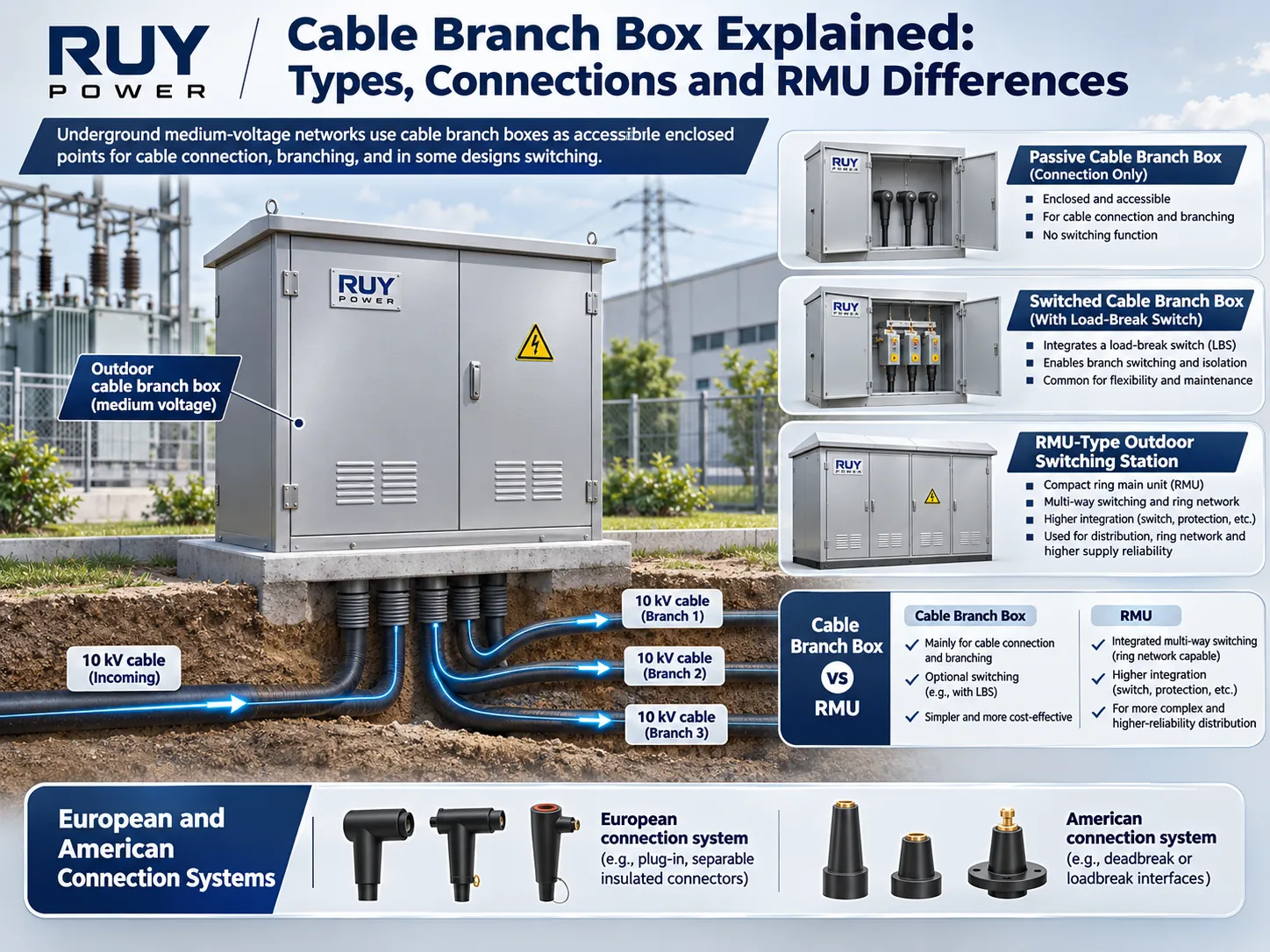
Underground medium voltage networks are hardly ever linear. A 10kV cable emanates from the substation and travels towards various transformers, buildings or ring main units in its way. In such a network, all splices along various branches have to be made in a joint pit, which makes it difficult to monitor or repair the network. The cable branch box overcomes the problem by allowing various cables to converge in one place and connect, branch, and, in certain designs, switch.
Nevertheless, the name is applied to very different types of equipment. Some cable branch boxes are just insulated connection points without any switching capabilities. On the other hand, there are cable branch boxes with load-break switches or functioning like miniature switching stations installed outdoors. The guide describes the working principles of high voltage cable branch boxes, three major types of this equipment, and compares with ring main units and American electrical connection systems.
Short answer: A cable distribution box can be regarded as an outdoor enclosure used in medium voltage electrical networks of 12 kV to 40.5 kV range. The main purpose of the branch box is to provide the means of connecting one input cable with many output cables. One of the basic designs has no switches at all and makes use of insulated bushings and separable connectors to connect the cables without isolation. In contrast to the basic designs, switched variants incorporate load break switches. In some cases, branch boxes can be equipped with fuses and circuit breakers, which allows for a resemblance to a ring main unit.
How Does a Cable Branch Box Work?
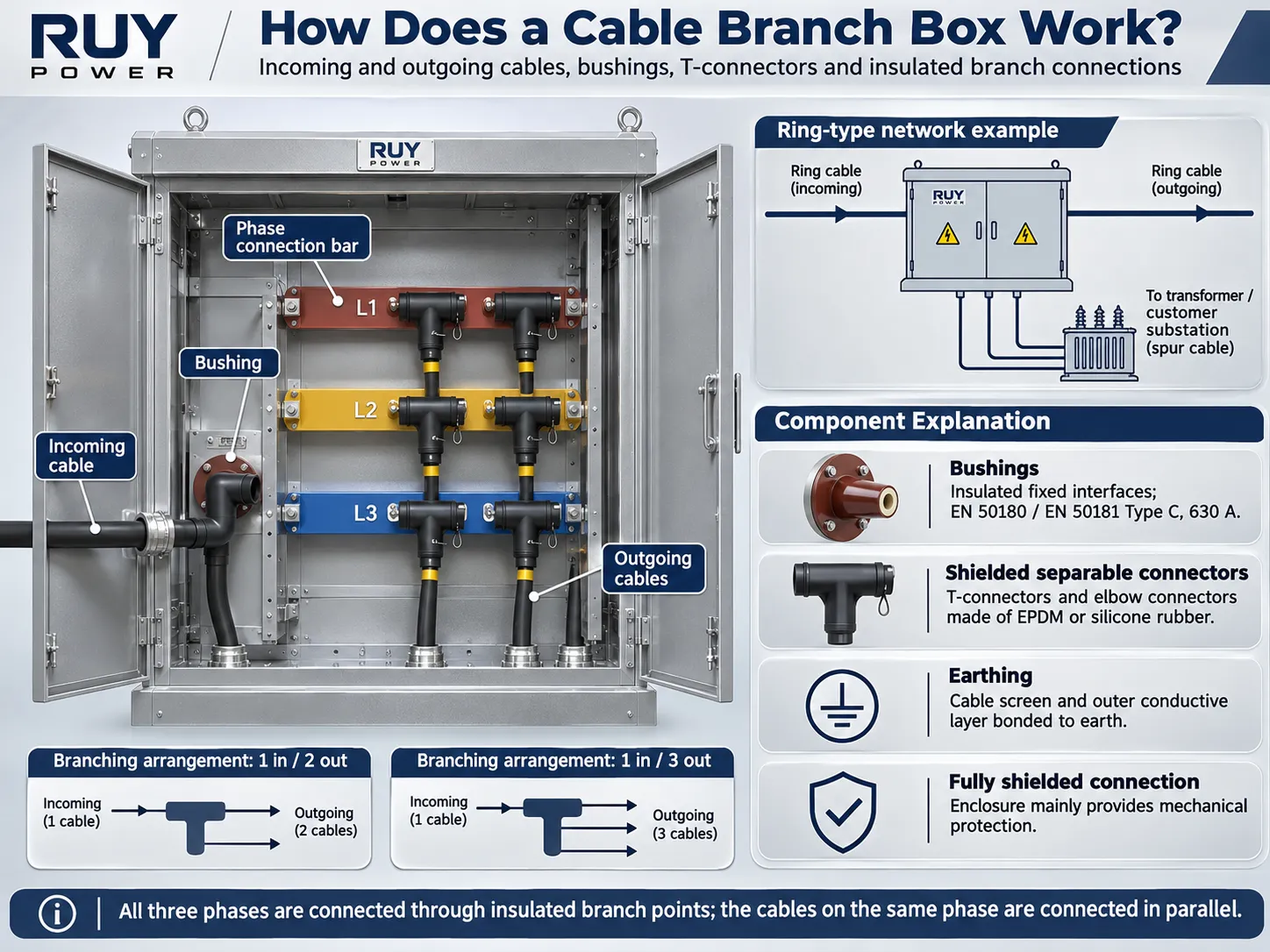
An incoming cable and several outgoing cables
Inside a branch box, each of the three phases is equipped with a connection bar and base, where incoming and outgoing cables are connected. The incoming cable is connected to one of the bushings while the outgoing cables are connected to the other bushings. Thus, in the same phase bar and all cables connected through this bar are in parallel and may have different configurations among which are the one input−two output or one input−three output options.
In ring-type networks, a branch box is often fitted along with a branch where the ring cable is close to load points. Ring cables enter and leave the branch box through two bushings while one or more spur cables are connected to transformers or customer substations.
Bushings, T-connectors, and insulation materials
Modern branch boxes consist of insulated components:
Bushings: insulated connections which serve as fixed interface. In European product lines, standard product lines are used for the bushings with regard to international standards EN 50180/EN 50181 type C rated for 630 A bolted connections.
Shielded separable connectors: T-shaped and elbow-shaped connectors out of EPDM or silicone rubber and possess outer conductive sheath which is grounded at the outer layer of the cable.
Earthing: the shielding of the cable and connector outer layer is connected to the earthing system.
The connection is fully shielded as the enclosure mainly protects the connection from mechanical breaking.
Three Types of Cable Branch Boxes
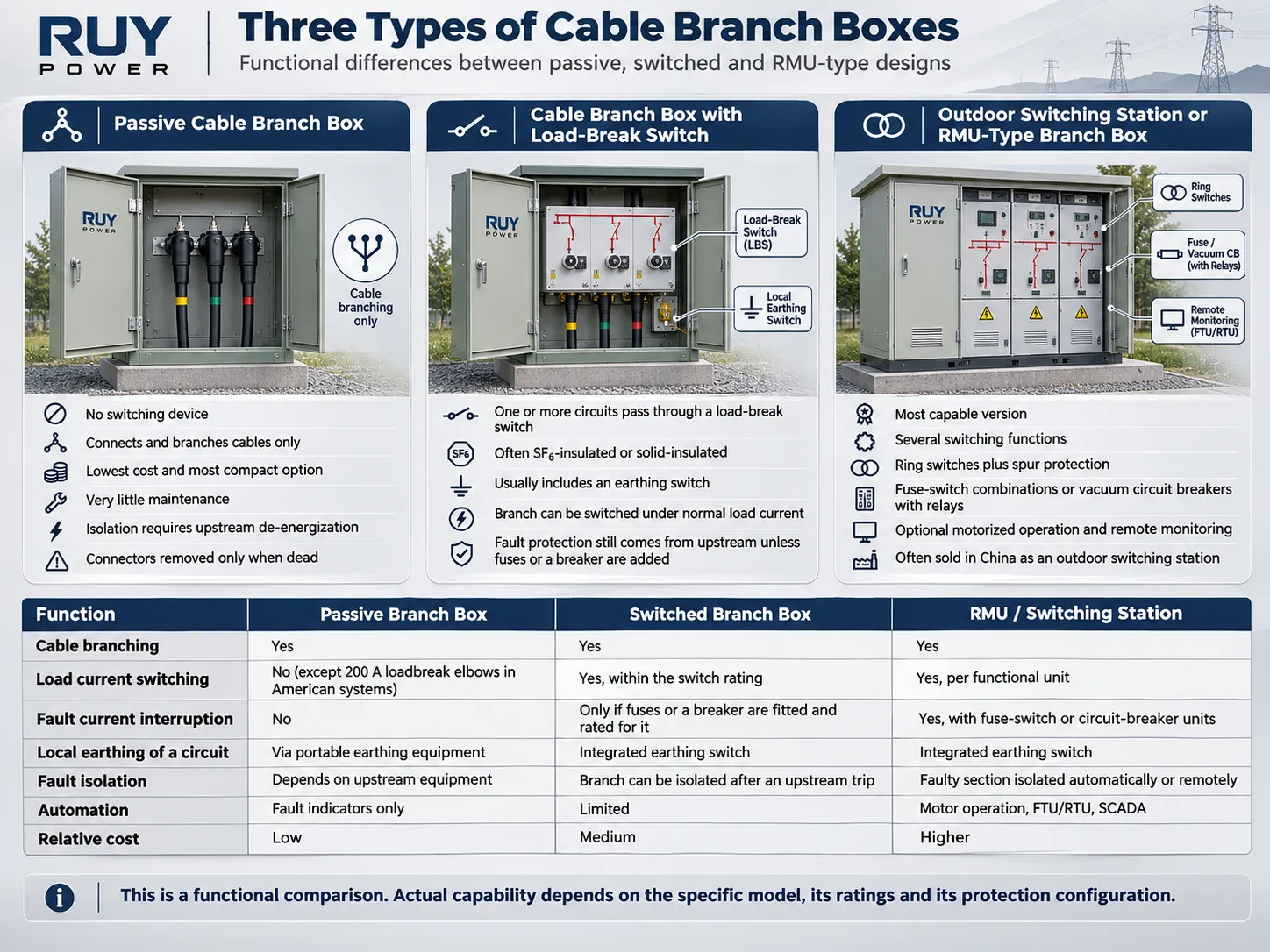
Passive cable branch box
Passively configured distribution box doesn’t have any devices for circuit switching, but just connections and cable branchings. Its cost is the lowest and it is the smallest distribution box that needs little maintenance. The drawback of the passive distribution box is that any operation with the distribution box, including disconnecting a service cable, always demands a shut down of power from a switch located upstream. Then, only after disconnection from the power supply, the cable connectors may be taken off.
Cable branch box with load-break switch
There might be one or more electrical circuits passing through a load-break switch which is properly insulated. Often a load-break switches also has an earthing switch. This allows the operator to make an electrical circuit live or dead if needed without going back to the substation. However, the load-break switch alone cannot break short circuits. Protection against short circuits still comes from higher voltage side unless fuses or breakers are installed.
Outdoor switching station or RMU-type branch box
The most advanced model functions much like an outdoor ring main unit housed in a branch-box enclosure. It is capable of several switching functions: load-break switches for the ring, fuse-switch combinations, or vacuum circuit breakers with relays for the branches, as well as optional automated and monitored functionality. It is commonly marketed in China under the name outdoor switching station.
| Function | Passive branch box | Switched branch box | RMU / switching station |
|---|---|---|---|
| Cable branching | Yes | Yes | Yes |
| Load current switching | No (except 200 A loadbreak elbows in American systems) | Yes, within the switch rating | Yes, per functional unit |
| Fault current interruption | No | Only if fuses or a breaker are fitted and rated for it | Yes, with fuse-switch or circuit-breaker units |
| Local earthing of a circuit | Via portable earthing equipment | Integrated earthing switch | Integrated earthing switch |
| Fault isolation | Depends on upstream equipment | Branch can be isolated after an upstream trip | Faulty section isolated automatically or remotely |
| Automation | Fault indicators only | Limited | Motor operation, FTU/RTU, SCADA |
| Relative cost | Low | Medium | Higher |
This is a functional comparison. Actual capability depends on the specific model, its ratings and its protection configuration.
RMU versus Cable Box: Major Differences
Function is the key difference between these two, not appearance. RMU (ring main unit) is a power switching system and switchgear covered by the IEC 62271-200 standard, which allows switching, isolating, and protecting the circuits. On the other hand, a cable branch box does not perform these functions as it is simply used for connection. There is also a third type called a switched cable branch box which features some buffering capabilities.
In practice:
You can always opt for a passive branch box where there are cables to be divided and very little operation is to take place such as in case of a branch supplying a number of transformers with switchgear of their own.
You can choose a switched branch box if the crew is going to work with separate branches working autonomously.
Alternatively, when it comes to applying the RMU or switching unit, it enables protecting transformers, sectionizing faulty cables automatically or remote control.
Opting for a passive box where switching is actually required will just result in prolonging outages and more trips for switching. An RMU applied to a case requiring the use of a passive box will result in more expenses and increase maintenance requirements.
12kV Cable Branch Box: Typical Specifications
| Parameter | Typical values |
|---|---|
| Rated voltage | 12 kV (10/11 kV systems), 24 kV (20 kV systems), 40.5 kV (35 kV systems) |
| Rated current of busbar and bushings | 630 A (European), 200 A loadbreak or 600 A deadbreak (American) |
| Short-time withstand current | Typically 20 kA for 3 s or 25 kA for 2 s for a 12kV cable branch box; must match the network fault level |
| Number of ways | 1-2, 1-3, 1-4, up to 8 or more outgoing |
| Cable size | Typically 35–400 mm² copper or aluminium, single-core or three-core |
| Enclosure | Stainless steel, coated mild steel or GRP; IP33 to IP54 |
| Options | Fault passage indicators, voltage indicators, surge arresters, heaters, padlocks |
European vs American Cable Branch Connections
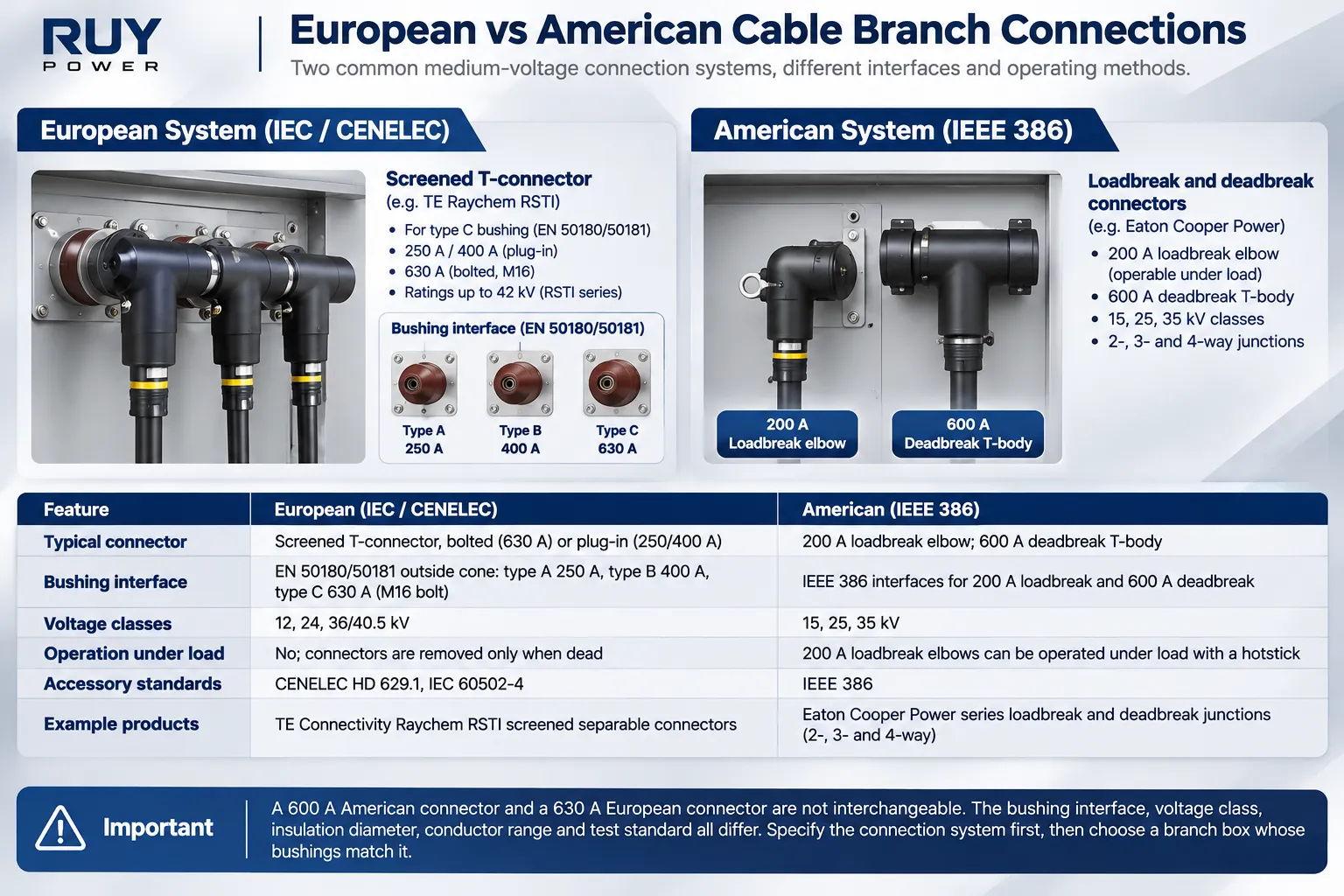
The connection system decides which cable accessories fit the box and how the box is operated.
| Feature | European (IEC / CENELEC) | American (IEEE 386) |
|---|---|---|
| Typical connector | Screened T-connector, bolted (630 A) or plug-in (250/400 A) | 200 A loadbreak elbow; 600 A deadbreak T-body |
| Bushing interface | EN 50180/50181 outside cone: type A 250 A, type B 400 A, type C 630 A (M16 bolt) | IEEE 386 interfaces for 200 A loadbreak and 600 A deadbreak |
| Voltage classes | 12, 24, 36/40.5 kV | 15, 25, 35 kV |
| Operation under load | No; connectors are removed only when dead | 200 A loadbreak elbows can be operated under load with a hotstick |
| Accessory standards | CENELEC HD 629.1, IEC 60502-4 | IEEE 386 |
| Example products | TE Connectivity Raychem RSTI screened separable connectors | Eaton Cooper Power series loadbreak and deadbreak junctions (2-, 3- and 4-way) |
One point to keep in mind is that just because a connector has 600 A capacity in the US and 630 A in Europe does not mean that they could be used interchangeably since the designs are completely different because of the bushing interface, voltage class, insulation diameter, conductor range and testing standards, etc. It is important to identify which system of connectors you are using before choosing a junction box with bushings for this system.
An example of how such connections are made in the US is the Cooper Power series from Eaton. It is an entire family of connectors that do not require a junction box with busbars in it. Eaton mentions that it has designed its connectors in accordance with IEEE 386 standard and made them compatible with connectors from other producers. The European counterparts of Eaton connectors are TE’s Raychem RSTI connectors. These connectors fit into type C bushings matching the parameters of EN 50180/50181 in terms of ratings of up to 42 kV and 1250 A.
Where Are Cable Branch Boxes Used?
- In urban low-voltage network distribution systems wherein ring feeders supply numerous building substations;
In residential developments that require the connection of several box-type substations or transformers located on pads;
In the sectors of industry and commerce where utilities are supplied to a number of clients;
In infrastructures that include airports, ports, railways, and tunnels;
In solar and wind collection networks where medium voltage cables are connected or separated between interchangers;
In projects that involve the conversion of overhead cables to underground systems, where new cables require recognition points.
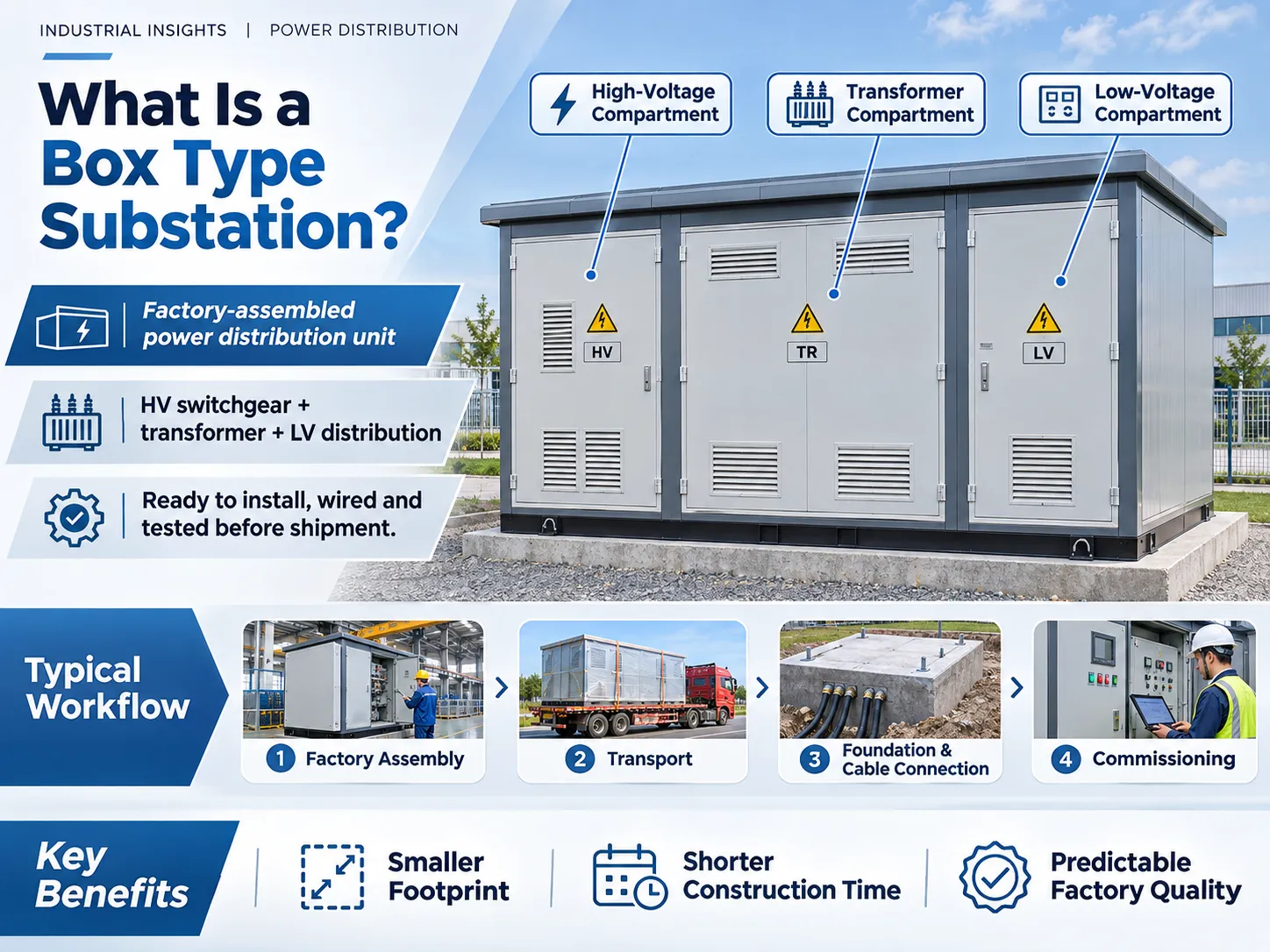
For the transformer end of these networks, see our guide to the box type substation.
Standards and Safety Requirements
No single standard is titled “cable branch box”, so check which standard applies to each part:
| Standard | What it applies to |
|---|---|
| IEC 60502-4 | Test requirements for accessories (terminations and connectors) for MV power cables |
| CENELEC HD 629.1 | European test requirements for MV cable accessories, including screened separable connectors |
| EN 50180 / EN 50181 | Bushing dimensions and interfaces for European outside-cone connections |
| IEC 62271-200 | Metal-enclosed switchgear; applies to switched branch boxes and RMU-type units within its scope, including internal arc classification |
| IEEE 386 | Separable insulated connector systems for 15–35 kV class American networks |
| IEC 62271-202 | Prefabricated substations. It does not cover a plain cable branch box and should not be quoted as its certification |
For switched units, ask for type test reports to IEC 62271-200, including short-time withstand current and, for units in public places, internal arc classification. For passive units, ask for type test reports of the bushings and connectors and the short-time rating of the complete busbar assembly.
How to Pick a Cable Branching Box for Your Project
1. Function: passive, switched, or RMU type. Determine if you require on-site switching, grounding, protection, or automation.
2. Voltage and fault level: rated voltage and short-time withstand current and its duration must match the system.
3. Number of ways: you should determine the total number of the incoming and outgoing cables, including at least one spare way for the future.
4. Connection system: European 630A T-connectors or U.S. 200/600A connectors; type of bushings and which type and size of cable.
5. Accessories: who delivers T-connectors and elbows, and whether they are type-tested with the bushings.
6. Enclosure: type of material, IP code, way of protection against corrosion.
7. Monitoring: indications about the fault appearance, and about power presence if the utility is using distribution automation.
8. Installation: the arrangement of the foundation and cable trench, radius of the cable bending in the box, and operating clearance.
RUY Power DFW-12 vs DWF-12 Cable Branch Boxes
RUY Power offers both ends of the range in its cable distribution box category:
| Item | DFW□-12 cable branch box / outdoor switching station | DWF-12 outdoor AC cable distribution box |
|---|---|---|
| Function | Switched: SF6-insulated switchgear with optional load-break switch and protection configurations | Cable connection, branching and insulation |
| Rated voltage | 12 / 24 kV | 12 kV |
| Rated current | 630 A | 630 A |
| Outgoing circuits | Up to 8 | Per configuration |
| Connection | Cable connection to switchgear bushings | Prefabricated cable connectors on bushings |
| Enclosure | Outdoor | Outdoor, double-door, IP33 |
| Best for | Nodes that need switching, isolation and earthing on site | Simple branching where switching is done upstream |
Choose the DWF-12 for straightforward cable branching at low cost. Choose the DFW□-12 where crews need to switch and earth branches locally. For larger switching nodes, RUY also supplies ring main units. Send your single-line diagram and cable list, and RUY will confirm the configuration, connection system and type test documents for your project.
Frequently Asked Questions
What is a cable branch box used for?
It connects one incoming medium-voltage cable to two or more outgoing cables in underground or outdoor distribution networks, giving an accessible point for branching, testing and future extension.
Is a cable branch box the same as a junction box?
Not typically. In general terms, “junction box” refers to a small enclosure with low voltage specifically intended for electrical wire junctions. Cable branch box refers to a medium voltage utility equipment rated between 12 kV and 40.5 kV and equipped with shielded terminals, busbars and sometimes circuit breakers.
What is the difference between a cable branch box and an RMU?
A passive branch cable box’s sole function is to connect and branch cables, while an RMU acts mostly like switchgear as it can switch, isolate, earth, and protect circuits. Switched branch boxes may add some of those functions; hence the difference in function would depend on the specific model of the switched branch box used.
Does a cable branch box contain a circuit breaker?
A passive branch box does not. Switched versions usually contain load-break switches, and outdoor switching station types can be configured with fuse-switch units or vacuum circuit breakers.
What is the typical voltage of a high voltage cable branch box?
Common ratings are 12 kV for 10/11 kV networks, 24 kV for 20 kV networks and 40.5 kV for 35 kV networks. American-style equipment uses 15, 25 and 35 kV classes.
Can a cable branch box be installed outdoors?
Yes, most are designed for outdoor use. Check the IP rating, enclosure material and corrosion protection, the foundation and cable entry sealing, and condensation control for the site climate.
Choosing the Right Cable Branch Configuration
A cable branch box can be a simple connection point or a small switching station. The right choice starts with function: decide whether you only need to branch cables, or also need to switch, earth or protect them. Then match the voltage, fault level, number of ways and connection system to the network. With those points fixed, comparing quotations becomes straightforward.
To specify a cable distribution box for your network, send RUY Power your voltage, fault level, number of ways, cable sizes and connection standard. Contact RUY Power.
References
- Eaton Cooper Power series — MV connectors specifier’s guide (5–35 kV). 200 A loadbreak and 600 A deadbreak systems, multi-way junctions, IEEE 386 interfaces.
- TE Connectivity — Raychem RSTI screened separable connectors. Connectors for EN 50180/50181 type C bushings, CENELEC HD 629.1.
- IEEE 386. Separable insulated connector systems for power distribution systems above 600 V.
- IEC 60502-4, IEC 62271-200 and EN 50180/EN 50181. Cable accessories, metal-enclosed switchgear and bushing interfaces.
Eaton, Cooper Power, TE Connectivity, Raychem and RSTI are trademarks of their respective owners. RUY Power is not affiliated with these companies; product information is taken from their public documentation for reference only.