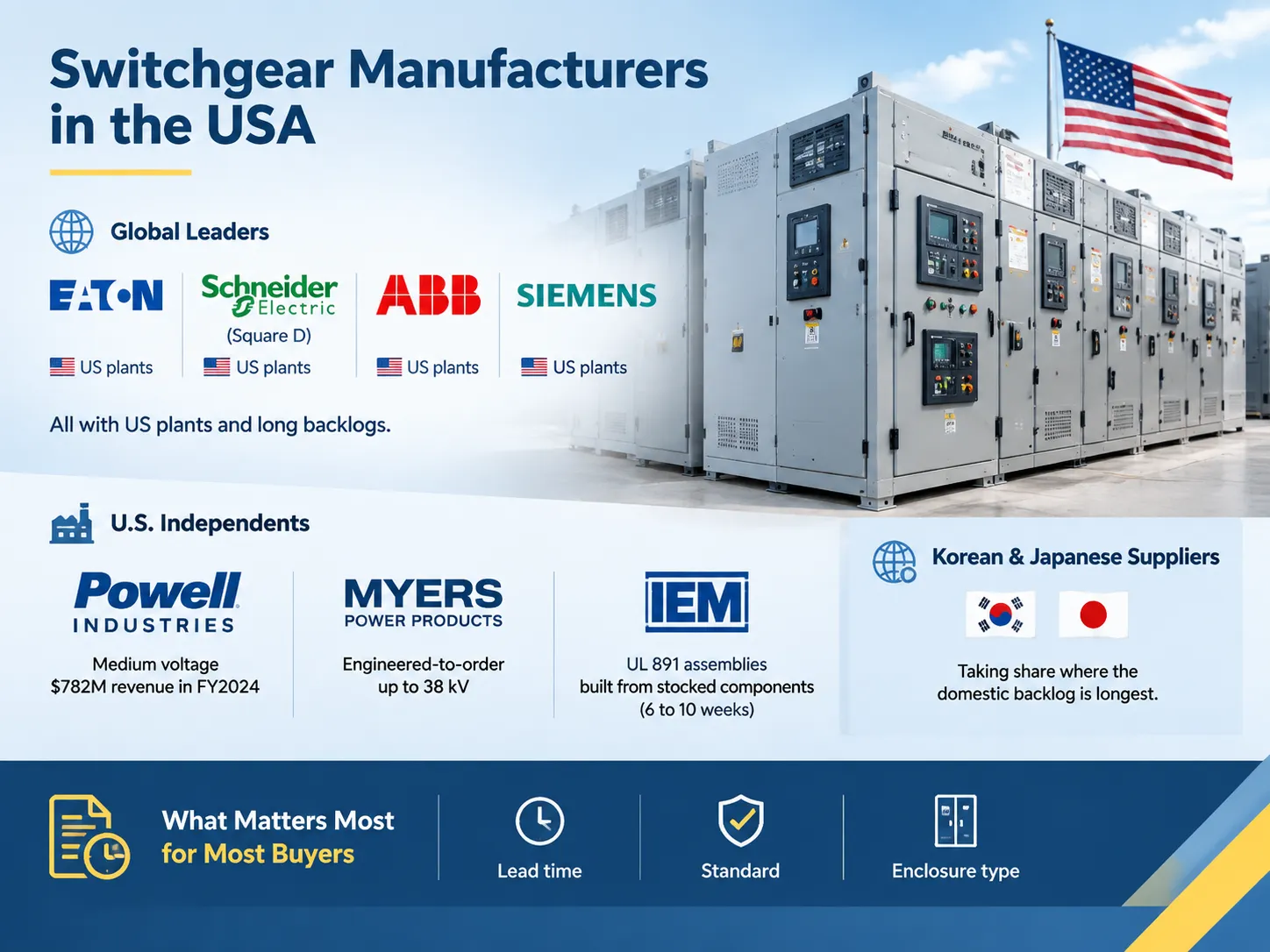

Powell is among the intriguing players in the North American switching industry since it does not produce anything by itself. It only provides engineered packages to its clients, meaning that the business provides custom-designed solutions that are used by clients whose production cannot stop. This fact explains why its prices, delivery times, and the type of projects won by Powell is what they are.
The remaining part of the article covers the whole range, focuses on Houston base, presents figures about the company’s business, as well as briefs about the service department and the point when one stops paying attention to the company.
In short: Powell.com is not used by the manufacturer of switchgear. Powell Industries, located in Houston, is the website people are looking for. The website is powellind.com and the stock is traded on NASDAQ as POWL. Powell Industries specializes in medium voltage switchgear and has a revenue for the financial year 2025 of $1.1 billion dollars with around 3,100 employees and 50% of sales being accounted for by oil, gas and petrochemical industries.

Powell.com, Powell Industries, and What You Actually Reach
In case you typed powell.com thinking that the Houston manufacturer is the right website, you have ended up typing a non-existing domain. The manufacturer has a public website at powellind.com while other information for investors can be found on another site. This is important because when inquiries are made by buyers about the vendor page they may end up in the distributor page or another similar valve company and provide incorrect data for a tender.
You are looking for Powell Industries, Inc. that is a company that was founded in 1947 by William E. Powell. It is located at 8550 Mosley Road in Houston, Texas and has been listed as early as in the 1960s. The current chairman, president and CEO is Brett A. Cope while he is a Powell family member, thus being their largest shareholder at about 18% of shares.
The ownership structure plays an important role when it comes to risk assessment because the situation of a company which is owned solely by a founder is far different from the one where the owner uses leverage.
What Powell Industries Actually Builds
The portfolio is categorized into four categories, and not all of them have the same levels of significance.
- Integrated power control room substations and electrical houses. It is the most popular category of products that makes the company rely on the oil and gas sector for its earnings. The E-house can be described as a system within a building that consists of switchgear, motor control, variable relays, HVAC, and fire detection. It is manufactured in the form of a factory-made module and is particularly helpful in building oil refineries or LNG terminals as it allows saving time and reducing the amount of on-site construction work. The buyer virtually purchases a building, and not just a switchboard.
- Switchgear and control gear. An array of traditional and arc-resistant medium voltage switchgear. Products from this range can be combined with generator control). The advantage of arc-resistant equipment is that it contains premises built specifically to prevent operator injuries during work with such equipment.
- Motor control centers and low voltage distribution. An array of NEMA-type MCCs with modern overload protection, bus ducts, and switchgear. It covers a large variety of implementation setups and applications in the industry.
- Medium voltage circuit breakers and aftermarket. An array of vacuum circuit breakers and after-market components such as breaking parts and retrofitting systems for existing lines.
The Houston Base and the Manufacturing Footprint
Houston is the center of gravity and the location helps to understand the customer mix. It is the engineering capital of the Gulf Coast refining and petrochemical corridor and Powell was raised inside that supply chain. It is a commercial benefit to be close to those EPC contractors that create such facilities, which cannot be achieved otherwise.
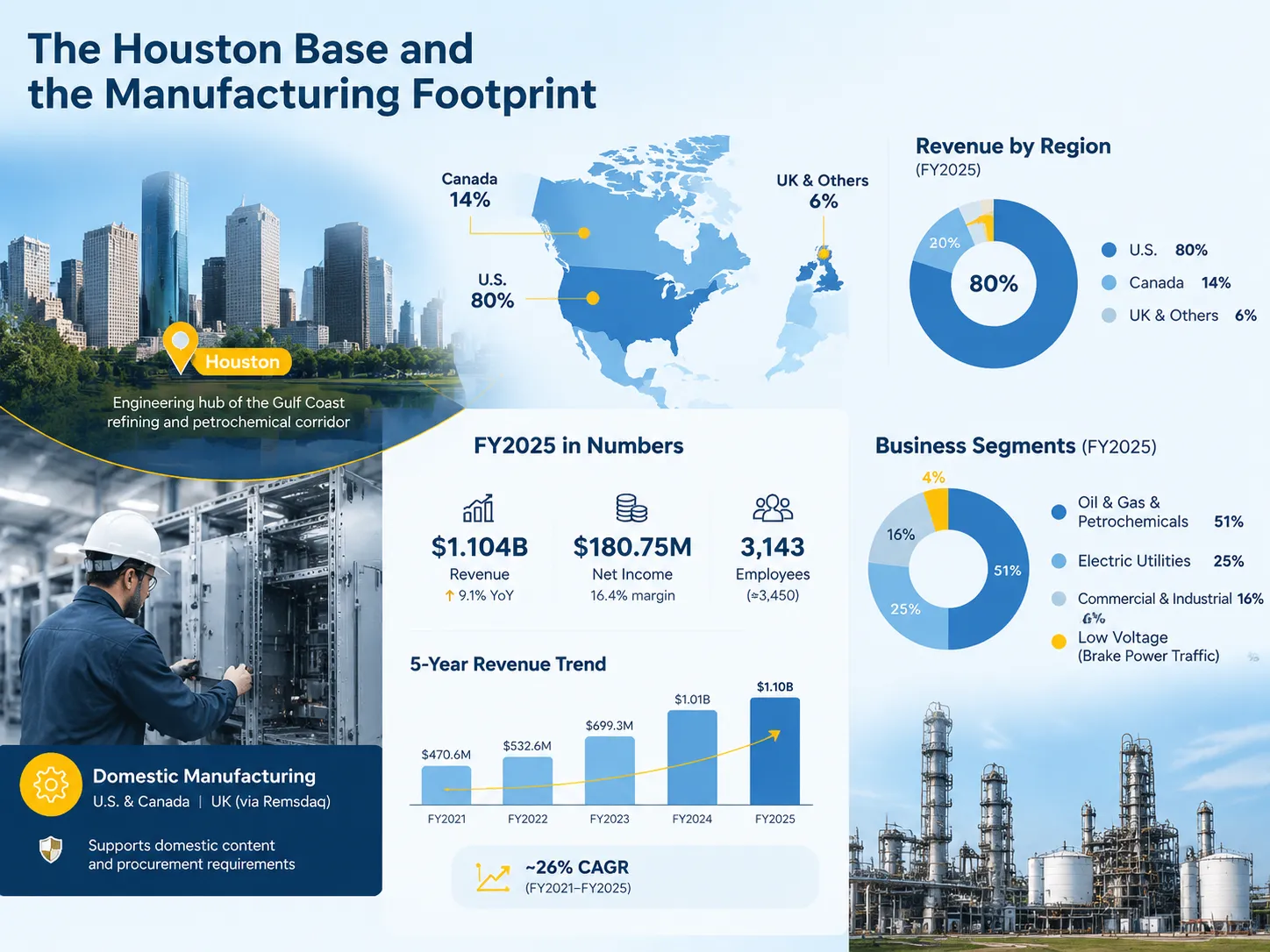
There is manufacturing in the US and Canada and some coverage in the UK with the help of the acquisition of Remsdaq, which added the monitoring and control hardware to the group. The revenue by regions in FY2025 was approximately 80 percent of the US, 14 percent of Canada, 6 percent of the UK and other countries, and the number of employees was similar, too.
A practical aspect for the buyer is that Powell is a supplier with domestic content in a market where this element is now an important point in procurement requirements not only preferences. Utilities and other projects are now asking where the steel is cut and who welded it. If you want to see how a Chinese factory organises the same work, this look at the manufacturing process behind LV and MV assemblies is a useful comparison, because the sequence is similar and the certification burden is not.
FY2025 in Numbers, and What They Signal
The revenue for the fiscal year ending September 2025 stood at $1.104 billion, representing an increase of 9.1% from the prior year’s $1.01 billion, along with a net income of $180.75 million, thus providing a net income margin of roughly 16.4%. The employee numbers at the end of FY2025 stood at 3,143 and slightly more than that 3,450, thus suggesting an increase in the employee figures right after the FY2025.
The five-year figures help to make sense of the changing figures: $470.6 million in FY2021, $532.6 million in FY2022, $699.3 million in FY2023, $1.01 billion in FY2024, and $1.10 billion FY2525 which translates into a yearly compound growth of roughly 26% owing to the grid investments, along with the LNG and data centre development but not through the market share expansion because of market saturation.
The third quarter of FY2026 registered $311.7 million, which represents an increase of 8.9% from the previous year, so one can conclude that the growth trajectory moving forward was preserved. The 16% profit margin gives insight into the business model used which is not based on cheapest offers for space. Custom engineering and package integrations make the business earn margins that come through commodity assembly models.
The sector breakdown for FY2025 includes 51% of the businesses from oil and gas and petrochemicals, 25% from electric utilities and 16% from commercial and industrial sectors, though the share of low voltage brake power traffic is also estimated at 4%. One may interpret this breakdown as a descriptive risk profile since half of the established business is estimated to be dependent on capex developments in the hydrocarbons sector, which tends to be cyclical, while quarter of the revenues come from utility expenditures, the segment of the electrical market that is the strongest at the period.
Services Beyond the Equipment
It is in the services division that the majority of repeated purchases are made and which is not emphasised enough when it comes to choosing suppliers.
Field services include checking, installation, start-up, upgrade and maintenance performed by the original company. Spare parts, replacing circuit breakers and similar details can prolong the service life of equipment for decades to come. Remote monitoring and diagnostics highly enhanced with the Remsdaq deal allow customers to have regular feedback on the operational efficiency of the totally packaged switchgear.
When a plant runs with the technology of thirty years, it becomes more relevant to choose a supplier that can both inform about the state of a cabinet already in the company and provide the necessary components.That capability is what after-sales support for complete switchgear is meant to look like, and it is the first thing to test in any supplier evaluation, because a vendor who cannot identify your existing equipment cannot support it.
Where Powell Fits, and Where It Does Not
Powell has been winning projects where the electrical works are along the critical path, and the cost of slippage is more than the cost of the equipment. LNG plants, refinery expansions, sites of mines, depots of data center, traction substations. There, a factory-prepared E-house is valuable, as labor at the site is scarce.
This model does not fit three usual requests. First is an ordinary commercial building needing a few LV distributing boards. Second is a small industrial extension that can use a regular panel. Third is a budget-sensitive project where the standards allow the use of IEC equipment and the purchaser is not required to meet the domestic obligation. In these cases, the custom engineeering technology becomes redundant, and the same amount spent at another project can provide for much bigger output. The medium-voltage distribution projects that a factory-direct supplier typically handles are a good illustration of that boundary: real engineering, but scoped to standard configurations.
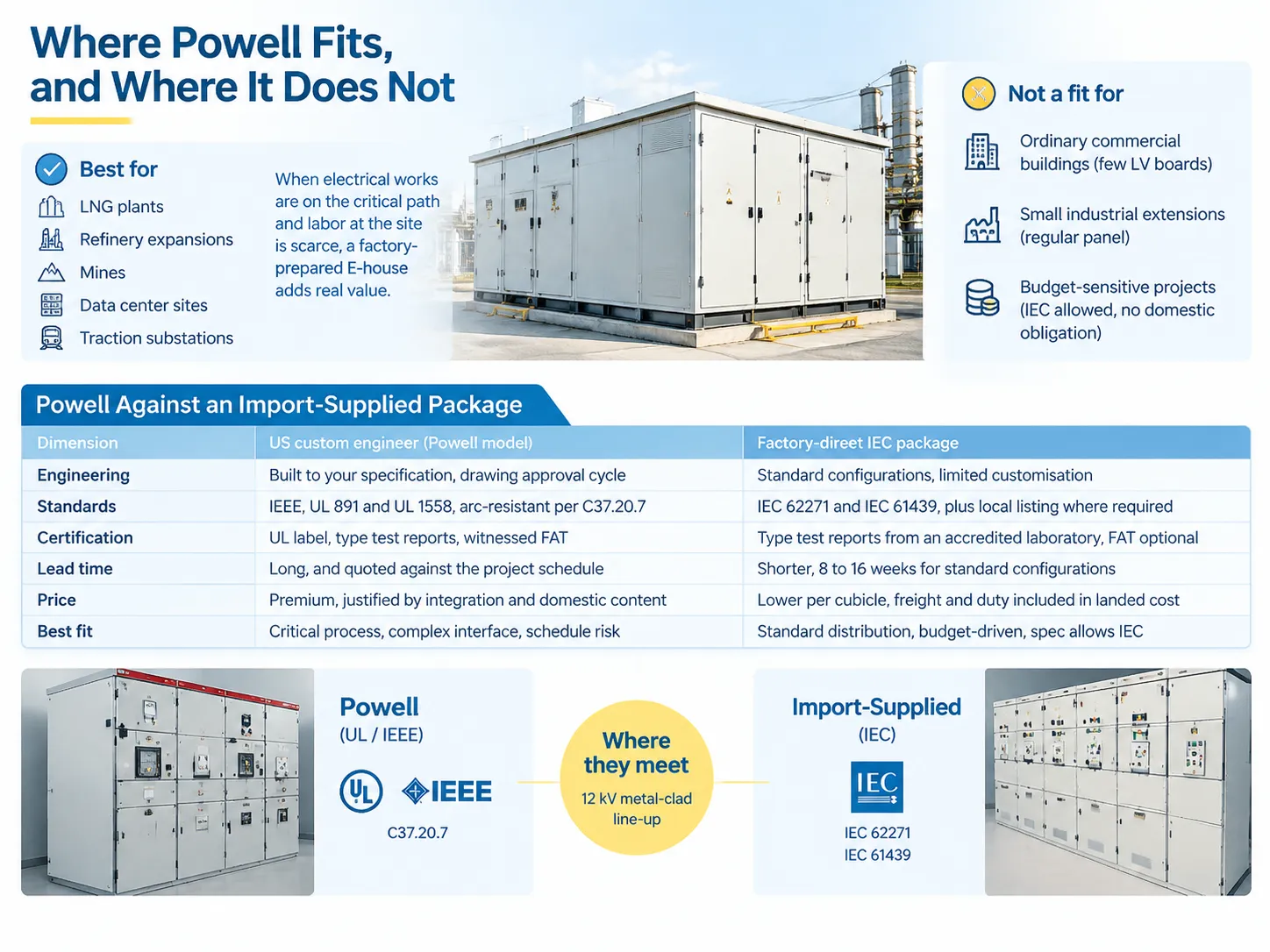
Powell Against an Import-Supplied Package
This comparison is worth making honestly, because most buyers will end up choosing between the two.
| Dimension | US custom engineer (Powell model) | Factory-direct IEC package |
|---|---|---|
| Engineering | Built to your specification, drawing approval cycle | Standard configurations, limited customisation |
| Standards | IEEE, UL 891 and UL 1558, arc-resistant per C37.20.7 | IEC 62271 and IEC 61439, plus local listing where required |
| Certification | UL label, type test reports, witnessed FAT | Type test reports from an accredited laboratory, FAT optional |
| Lead time | Long, and quoted against the project schedule | Shorter, 8 to 16 weeks for standard configurations |
| Price | Premium, justified by integration and domestic content | Lower per cubicle, freight and duty included in landed cost |
| Best fit | Critical process, complex interface, schedule risk | Standard distribution, budget-driven, spec allows IEC |
Where the two meet is in the metal-clad medium-voltage segment. A 12 kV metal-clad line-up built to IEC practice, such as this KYN28 metal-armored switchgear, does the same electrical job as a C37.20.7 line-up for a buyer whose network is IEC-based. The product will lack a UL certification; it won’t adhere to any of the standards for US utility interconnections. Whether this is a significant issue or not will depend entirely on where the installation takes place with respect to those standards. The determination of this question is left to the specifier.
How to Evaluate a Supplier Like This in a Tender
There are five important questions that distinguish between a genuine engineered-package provider and a trading company simply having a website.
You should inquire about the last three projects of similar complexity, including the technical contact of the customer and obtaining their permission to make a call. Request information about the parts of the package that are manufactured in-house as well as what is procured externally since a company involved solely in assembly is reliant on the lead times of other suppliers. Inquire about the type test report regarding the specified rating and not the entire family. Inquire about the name of person who signed the sketches and their engineering credentials. Finally, ask about what takes place over the first ninety days after the equipment is powered and in all written form including response times.A supplier who can produce custom drawings and a documented handover is a different animal from one who cannot, and the difference shows up in OEM and ODM arrangements where the buyer’s name goes on the door.
FAQ
Is Powell Industries a switchgear manufacturer or an integrator?
Each has a tendency towards integration. It makes switchgear, control equipment, motor control centers and circuit breakers, and integrates them into E-houses and substations equipped with protectors, air conditioning and fire protection systems. The completed product is the package.
Why is Powell so exposed to oil and gas?
This is because it developed to serve the Gulf Coast refining and petrochemical corridor and its E-house design fits large process facilities. In FY2025 the revenues came from 51% oil, gas & petrochemical, 25% electric utility, and 16% commercial & other industries. This high concentration is a plus during boom times and a downside during tough periods.
Does Powell make residential or light commercial panelboards?
Not as the emphasis. The spectrum is centered on the distribution of medium voltage, equipment of arc-proof control devices, and MCCs plus integrated substations for utilities and industries. A residence or a little store is served from an entirely different level in the marketplace.
What is an E-house and why does it cost more than a switchroom?
An electrical house is a structure where electrical components such as switchgear, protective systems, HVAC systems, and fire alarms have been pre-assembled and tested by a manufacturer. It is more expensive than traditional equipment because it involves the expense of constructing a building and providing all the required integrations and tests. However, it usually costs less than the labor needed to install the traditional equipment at the site, which is why it is favored in projects with tight deadlines.
Can an IEC switchgear package be used in the United States?
It is applicable if the utility interconnection standard and the authority having jurisdiction allow it, and normally not for the utility-owned distribution network. IEC equipment is widely used by industrial plants equipped with their own MV networks and in projects for export orientation. In the case of the US utility interface, the specification usually references UL and IEEE.
References
- Powell Industries — Company and Product Information
- NEMA — Low Voltage Distribution Equipment
- UL Solutions — Switchgear and Switchboard Certification
- U.S. Energy Information Administration — Today in Energy
- Hitachi Energy — Switchgear and Grid Integration
Conclusion
Powell is the answer to the specific question of who can produce a critical power package, manufacture it in the United States, test it in a factory and back it up for thirty years. In this case, the premium paid is for schedule reliability and domestic sourcing, and that’s usually a reasonable price to pay.
If the question is who can deliver a standard medium voltage or low voltage assembly to IEC specifications at a competitive landed price, then buyers can get much more capacity somewhere else for the same money. Identify the question being asked before sending out an RFQ because the two supplier lists do not overlap at all.