
The term switchgear may be defined as “the device that allows electricity to be switched,” which is like saying that brakes can be described as “the device that makes a car stop.” This definition does not seem to be incorrect but, at the same time, it does not convey any sense either. Indeed, the device performs the functions assigned to it and if any of four components does not perform well, switchgear may become an obscure cabinet with nothing in it that may meet the requirements of the site.
The present article describes the way switchgear works, how it performs all its functions within mere milliseconds, the differences in insulation types, and how to interpret the specifications.
Briefly, the electrical switchgear helps with piercing concerning electrical circuits which can be turned off and on under normal duration. They also serve their purpose of being functional in breaking fault currents before they damage people and electrical supplies. As part of the electrical circuit installation, the electrical purpose serves as an isolation point for any operation or even details regarding the entire system.
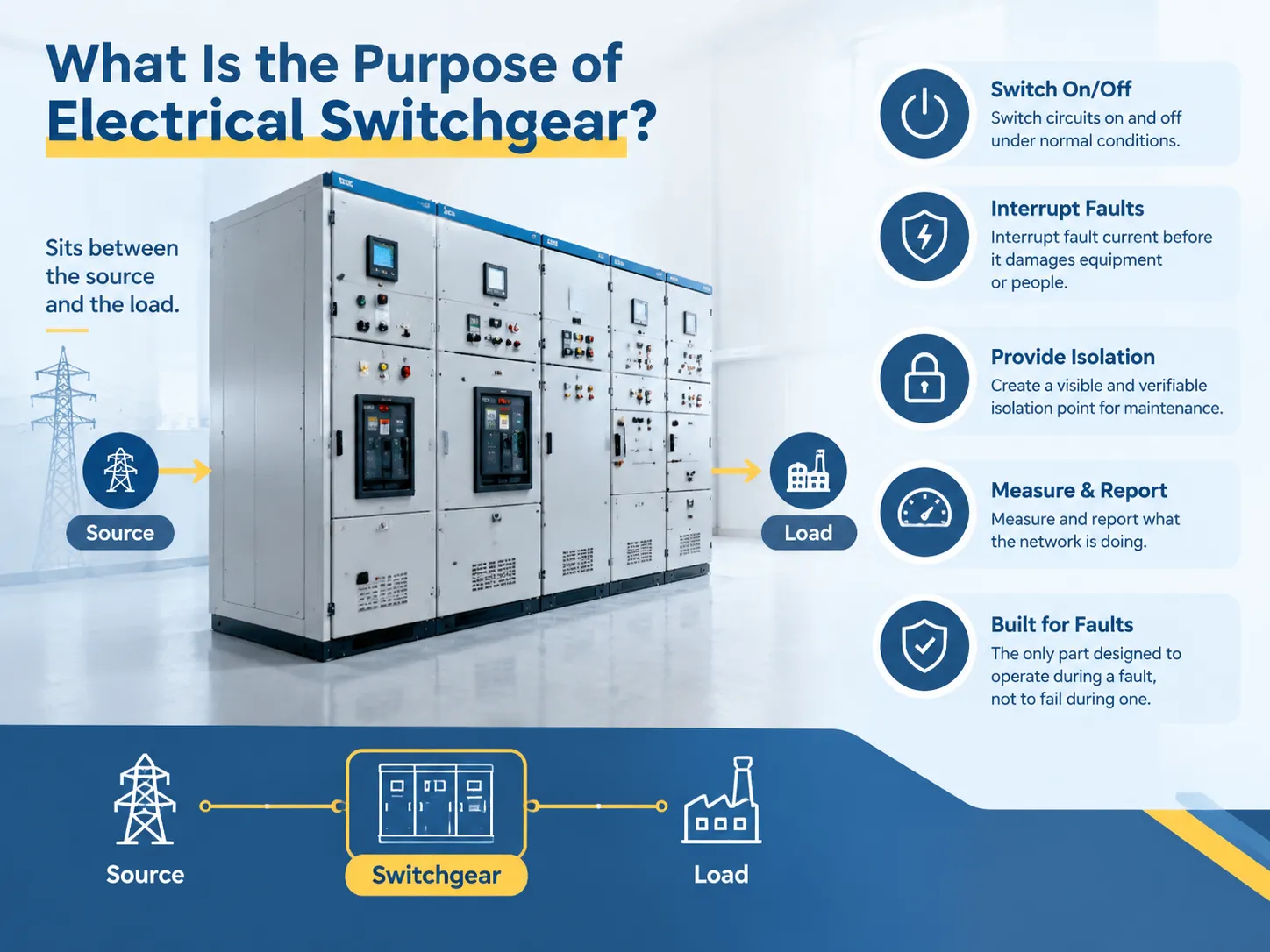
The Purpose in One Sentence, Then in Five Functions
Switchgear comprises a well-defined grouping of circuit breakers, isolators, earthing devices, busbars, measurement transformers, and relay protection fitted inside one enclosure, usually made of metal, which earthed. It is generally used for controlling, protection, and isolation of electrical components.
| Function | What it means in practice | What fails without it |
|---|---|---|
| Switching | Making and breaking load current for reconfiguration, load transfer and planned work | Every change needs a shutdown |
| Protection | Detecting overcurrent, short circuit, earth fault and voltage excursion, then tripping | A single fault cascades upstream |
| Isolation | A visible break plus an earth, so a person can work safely | Maintenance depends on a label |
| Metering | Measuring V, A, kW, kWh, power factor and harmonics | Billing and load management become guesswork |
| Monitoring and control | Status, alarms and remote operation via SCADA | Faults are found by the customer, not the operator |
Take note that an original function is directly related to normal functioning. In addition, other functions have been established in case the situation goes wrong. Therefore, the switchgear will help to determine the extent of damage provoked by that situation.
How It Actually Interrupts a Fault
In one way or the other, clearing process takes dozens of milliseconds and works every time!
With the faults, current reaches 10 to 50 times the normal current values and arrives after a few milliseconds. Current transformer finds out this current and sends it to a numerical protection relay. The relay compares current values with values received from coordination studies. If it identifies any parameters exceeding the limit – it activates the trip coil of the circuit breaker.
The circuit breaker operates on the energy stored in the spring system or hydraulic or pneumatic unit to operate circuit breaker and separate contacts. An electrical arc appears in the moment of contacts separation; the arc is the main problem of the whole mechanism, as it has to be extinguished before contacts destruct.
The clearing time is equal to the time when a fault actually occurs plus arc extinction time, which accounts for 30-60 milliseconds for voltage equipment of medium class. However, it is not considered a market parameter; transformer damage and short circuit withstand capacity are determined with the help of this parameter, which means equipment having clearing time equal to 100 milliseconds will experience much higher thermal stress compared to the one with 50 milliseconds of clearing time.
The Four Things in Every Cubicle
- Circuit breaker: a tool that breaks a circuit. It could be either a vacuum interrupter at medium voltage or a vacuum at low voltage or a technology like vacuum or SF6 at high voltage.
- Conductor bars: electrical bars that serve as a frame and accordingly a dimension needed will depend on the constant current and forces reached in case of the short circuit occurrence.
- Instrument transformers: fill in electrical circuit in such a way that convert 630 A to either 1 A or 5 A and at the same time measure the voltage at 11 kV and down to 110 V level.
- Protective relays: the working layer. Modern relays are able to keep information about faults and communicate with each other through the use of the Modbus protocol.
Moreover, the following components make this system functional and again safe: disconnectors providing visible breaking, grounding switches that allow proving that the circuit is dead; shutters shutting off the active components when the breaker is turned off, and mechanical locks preventing one to perform dangerous works.
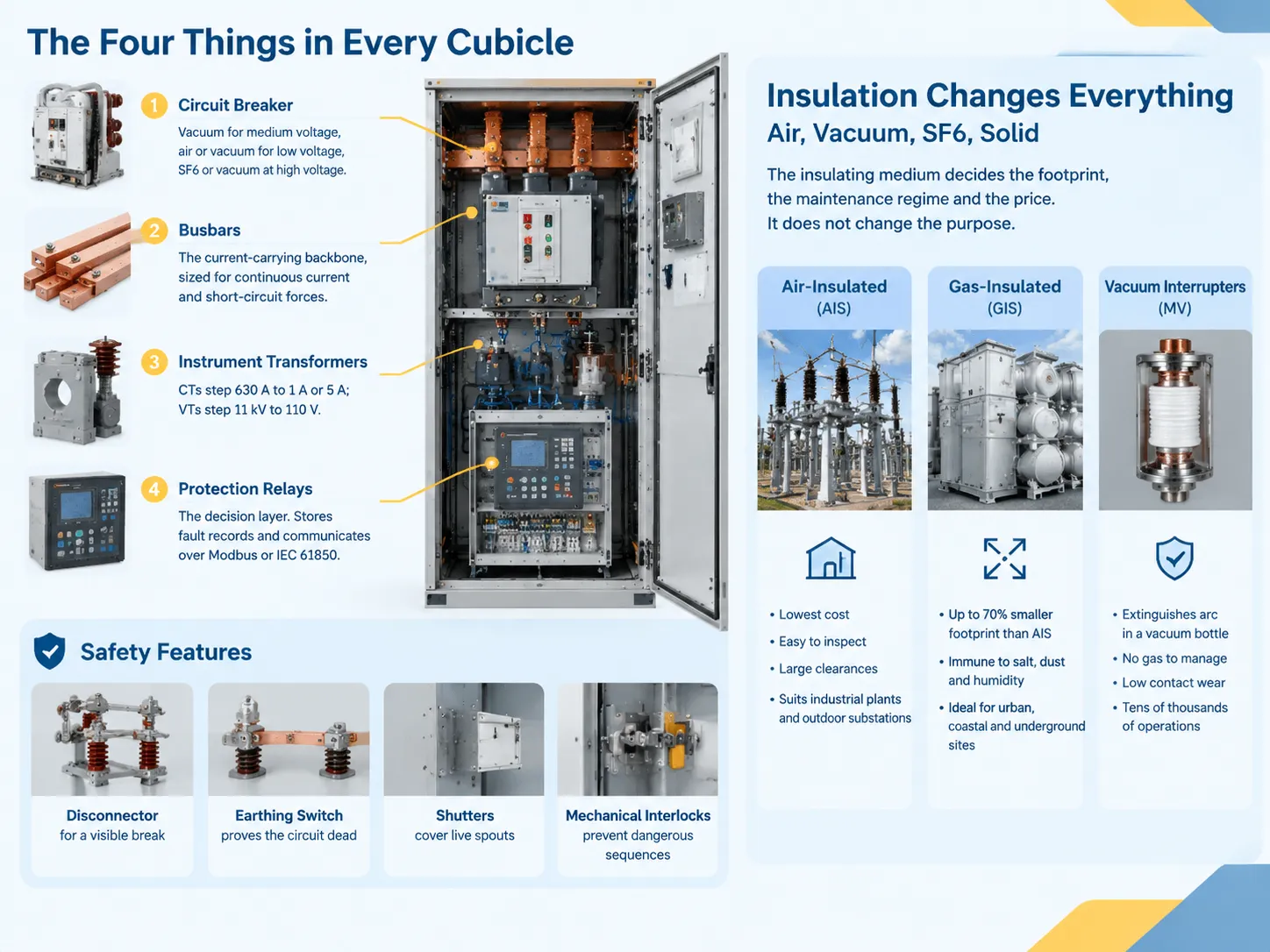
Insulation Changes Everything: Air, Vacuum, SF6, Solid
The type of insulating material influences the size, frequency of servicing and cost of the device nevertheless, the function remains unchanged.
When talking about the air-insulated equipment (AIS), we can say that it is the cheapest type and the easiest to find faults in. The type of toothed gear faces no problems with manoeuvrability since there are no issues with space provisions and can therefore be used in power generation stations and open circuit substations.
Gas-insulated equipment (GIS) uses SF6 in closed chambers which leads to a 70% smaller area of the equipment compared to AIS. Besides that, GIS is independent of the weather (snow, wetness, salt dust) and can either be built in a metropolitan substation or a coastal or underground installation. However, this technology also requires a sealed gas chamber and monitoring of that gas.
Vacuum tubes are used for medium voltage circuit breakers and interruptors. Arc is cut in vacuum container where monitoring of gas or maintenance is not required and wear of contacts is minimized.
Solid insulation means that living parts are insulated with epoxy and thus does not require SF6 and allows making compact maintenance-free devices. It is the choice where gas is unwanted and space is tight; this is what the SRM-12 fully insulated switchgear is built around.
Metal-Clad, Metal-Enclosed, and Why the Difference Is Safety
Two different assembly systems may look the same through the front view but have different performance characteristics in case of fault.
- Metal-enclosed means that the assembly has live components placed inside grounded metal containers. It could happen that the internal compartments are not isolated from each other. Thus, the fault can affect other compartments easily.
- Metal-clad means that each functional unit is located inside its own insulated metal compartment (circuit breaker, bus-bar, cable, and low-voltage control). In this case, the fault can be contained in the compartment where it happened while the rest of the assembly continues working.
There are three classifications defining the safety features of the assembly that can be found in any technical documentation provided.
- IAC (internal arc classification) describes an assembly subjected to IEC 62271-200 test to confirm that the heat and pressure of the internal arc do not come out of accessible faces of the assembly. The suffix plays a role too. For instance, AFLR indicates that all side faces are protected.
- LSC (loss of service continuity) is marked with LSC2B that informs about possible maintenance of the assembly without switching it off and the accessibility of the compartment with cables.
- Interlocks. Five necessary interlocks: the breaker might not be racked in or racked out when closed; earthing switch cannot close the circuit which is still live; the breaker might not be shut down and earthing switch closed at the same time; the compartment cannot be open in case of life circuit; and the earthing switch cannot be closed until the compartment is open or in the earthing position.
Thus, metal-clad construction with those interlocks is exactly what hospitals, data centers, and chemical enterprises require and the price difference is the cost of the construction itself.A KYN28-12Z metal-armoured switchgear is an example of the arrangement: drawout breaker, segregated compartments, interlocked shutters.
What the Purpose Becomes in Different Installations
While the five functions remain consistent, their importance differs.
- Utility distribution. Ring main units lead the way in this case since the main goal is to disconnect a faulty section from everyone else as fast as possible. The key issue here is definitely load switching and fault isolation rather than meter accuracy.
- Industrial facilities. Motor control is the main emphasis Switchgear needs to be compatible with motor protection, withstand high start-up currents and operate in a dusty and hot environment. Uptime is more important than beauty.
- Data centers. The idea is to maintain continuity. The LSC2B and plenty of other features with high busbar rating, double feeding and very quick switching and metering to distribute the power among users.
- Renewable energy. Collection substations must have switching capabilities for an erratic source and fault settings which will work correctly when the inverter is the fault maker, instead of the grid.
- Urban grid upgrades and retrofitting. The limitation is the size of the equipment and the downtime rather than the price.Compact and solid-insulated designs win because they fit into an existing building and can be installed in a short shutdown, which is the pattern described in these urban grid upgrading applications.
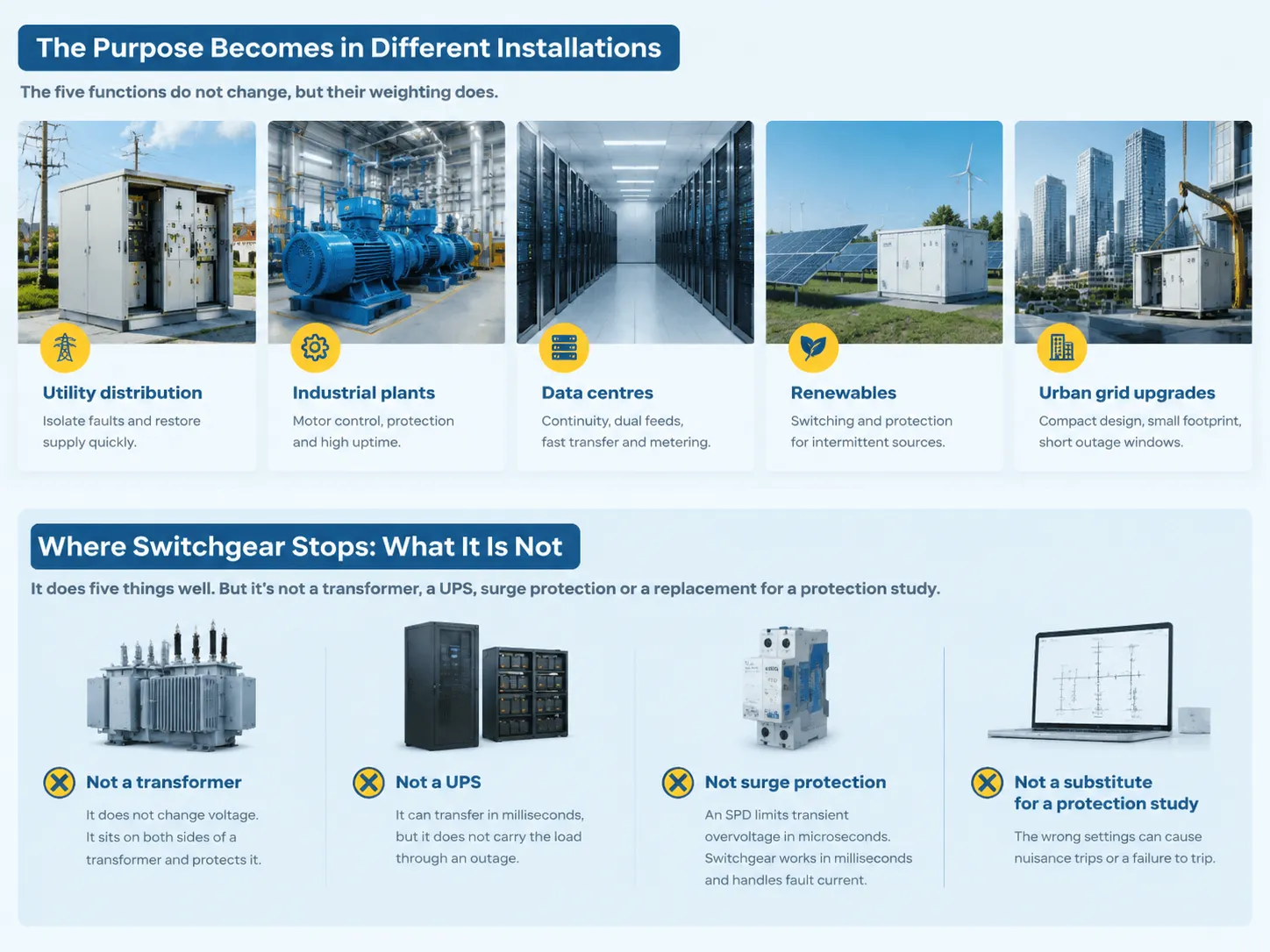
Where Switchgear Stops: What It Is Not
Customers frequently make the mistake of expecting switchgear to fulfil three functions for which it is not designed.
- First of all, switchgear is not a transformer. Its sole purpose is not to change voltage, but rather keep the transformer safe from all kinds of trouble.
- Secondly, switchgear does not work as uninterruptible power supply. While switchgear can switch between sources in a matter of tens of milliseconds by applying an automatic transfer scheme, it can’t carry the load during blackout.
- Lastly, switchgear does not provide surge protection. Unlike specific surge protection devices that limit transient overvoltage in microseconds, switchgear works in milliseconds and is designed to handle current of standard frequency.
Moreover, switchgear should not be viewed as a substitute for a protection study. In case you have the best circuit breaker with wrong settings you will still be in trouble because it will trip the fault that could have been cleared by a smaller device or fail to trip the fault in the first place.
Reading a Switchgear Specification
| Parameter | Typical 12 kV class | Why it is asked for |
|---|---|---|
| Rated voltage | 12 kV (24 kV, 40.5 kV also common) | Must exceed the system’s highest voltage |
| Rated current | 630 A to 4,000 A | Sets the busbar and conductor sizing |
| Short-circuit breaking current | 20 kA to 40 kA for 3 s | Must exceed the fault level at that point |
| Internal arc classification | AFL or AFLR | Personnel protection during a fault |
| Degree of protection | IP4X indoor to IP54 outdoor | Dust, water and vermin |
| Service continuity | LSC2B for critical sites | Maintenance without a busbar outage |
| Standards | IEC 62271-200; IEC 61439 for LV assemblies | Type-tested, not just claimed |
The figure of short circuit current is the one which is most often understood incorrectly by customers; it is not the feature of the switchgear itself but of the fault level at that point in the grid. A 20 kA cabinet when the fault level is 31.5 kA is not a good offer, it is a time bomb. Low-voltage assemblies follow a different route, and the withdrawable arrangement in this MNS low-voltage withdrawable switchgear shows how the same logic scales down to 400 V.
What RUY Builds
We produce medium voltage switchgear which ranges from 12 kV up to 40.5 kV as well as low voltage switchgear with 400 V and includes fully sealed and fully insulated types, metal clad and metal enclosed conductors, ring main units, and pre-constructed substations. The scope of our production is connected with the electricity supplying companies and industries, mining, oil industry, retrofitting of existing substations, and many other areas.
The major advantage of the collaboration with the manufacturing company rather than trading organization is that it allows us to alter the designs. That is what our OEM and ODM programme exists for, and it matters most on retrofit projects where nothing on the market fits the room as built.
What we will not do is supply an assembly to a fault level it cannot break, or ship a unit without type test evidence for the ratings on the nameplate.
What Goes Wrong in Service
Failures of switchgear do not happen due to poor design; they occur because of the surrounding elements and the methods employed in case of repair.
- Moisture and dirt. Condensation on insulators helps to build up electrical shorting paths. Heaters, IP rate and sealing have been created with the purpose of dealing with melted ice on insulators and being disconnected for the sake of energy efficiency has started problems before it was actually needed.
- Interlocks which were overcome on purpose. Maintenance workers tend to look for alternatives to working with the mandatory element and then they either forget the right way to make the system functional in the future.
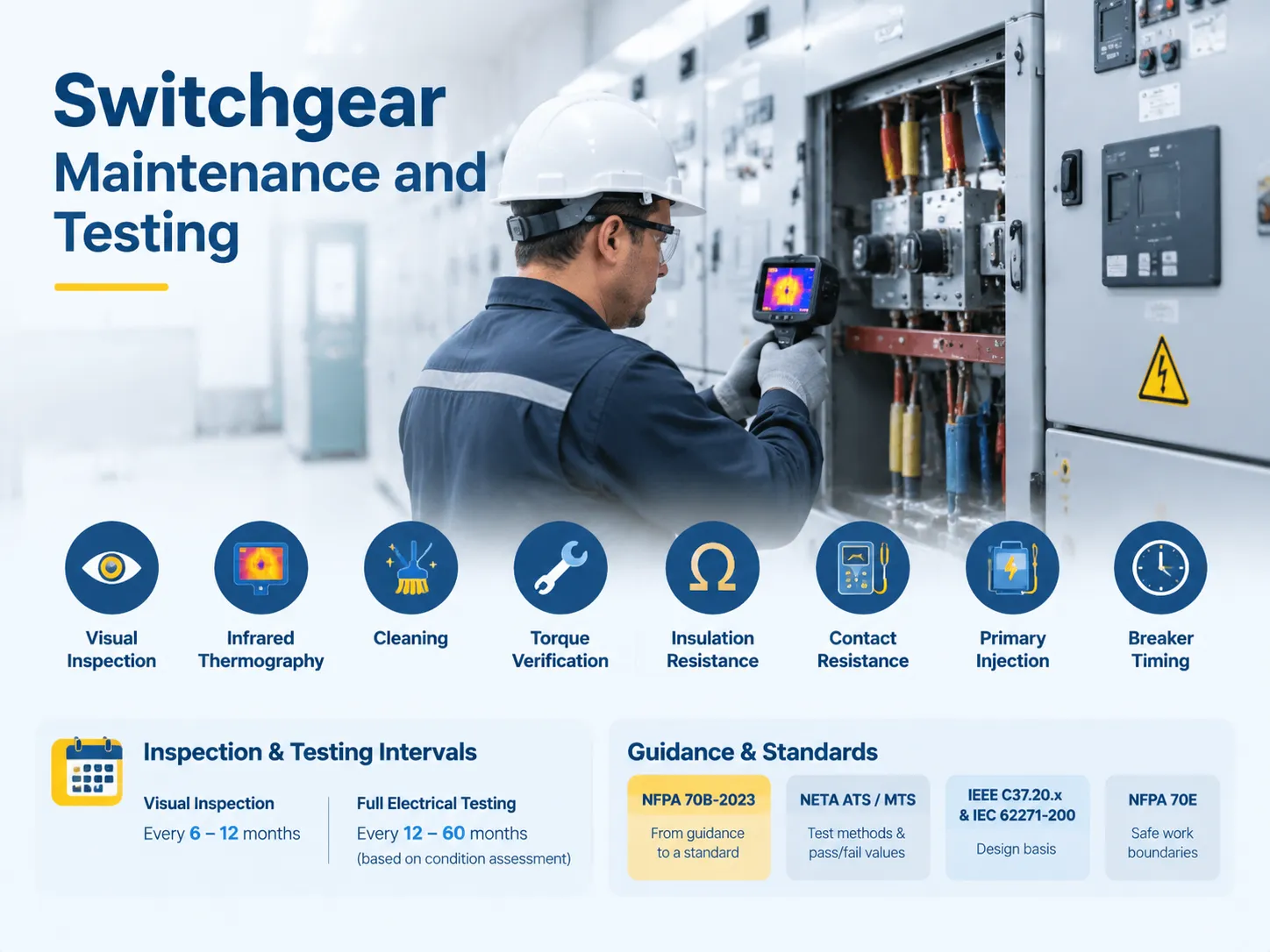
- Partial discharge. Certain faults may happen long before becoming real defects. Monitoring should be conducted on a regular basis, but fixing a defect would require only a couple of twists of a screwdriver.
- Changes in wiring setup. Relay or software changes should be followed by an update of relevant studies or you will experience either false tripping or no tripping at all.
FAQ
What is the purpose of electrical switchgear in one sentence?
Switching, protecting, isolating, measuring and monitoring of the electrical circuits allow the control of the power during normal operation and control of the fault before any equipment or person gets harmed.
Is switchgear the same as a circuit breaker?
No, circuit breaker is just a single part of the switchgear assembly. Switchgear is a complete integrated system including circuit breakers, busbars, isolators, earthing switches, measuring transformers, relays, enclosure and interlocks.
Why is switchgear needed if the circuit already has fuses?
Fuses clear faults from time to time and need replacing, and it cannot be tried or adjusted. Switchgear can be used repeatedly, its settings can be harmonized with those of the entire network, and it can indicate isolation in a clear way and remotely. Fuses are still useful for small electrical installations, however, they should not be considered the main safety tool for a given installation.
What is the difference between switchgear and a distribution board?
Function and scale. Distribution board is a low voltage assembly of miniature breakers supplying end circuits. Switchgear is the upstream assembly that controls and secures the distribution board, usually at medium voltage, through the use of instrument transformers, protection relays and the ability to isolate a whole segment.
References
- GW Electric — How Switchgear Works and Types of Switchgear
- Ormazabal — Switchgear: What It Is and What Elements Compose It
- ABB — Medium-Voltage Switchgear and Protection
- Siemens Energy — Gas-Insulated and Air-Insulated Switchgear
- Hitachi Energy — Switchgear and Substation Automation
Conclusion
The function of switchgear is not only to help in the work of circuit breakers. Rather, its major function is the control over electrical equipment in a factory in a way that electrical equipment can work according to certain standards and can limit any electric fault.
Give us the information about the system voltage, calculated fault level, continuous current, and whether the responded site is suitable for a busbar trip during malfunction. We shall provide a proper solution with specifications.