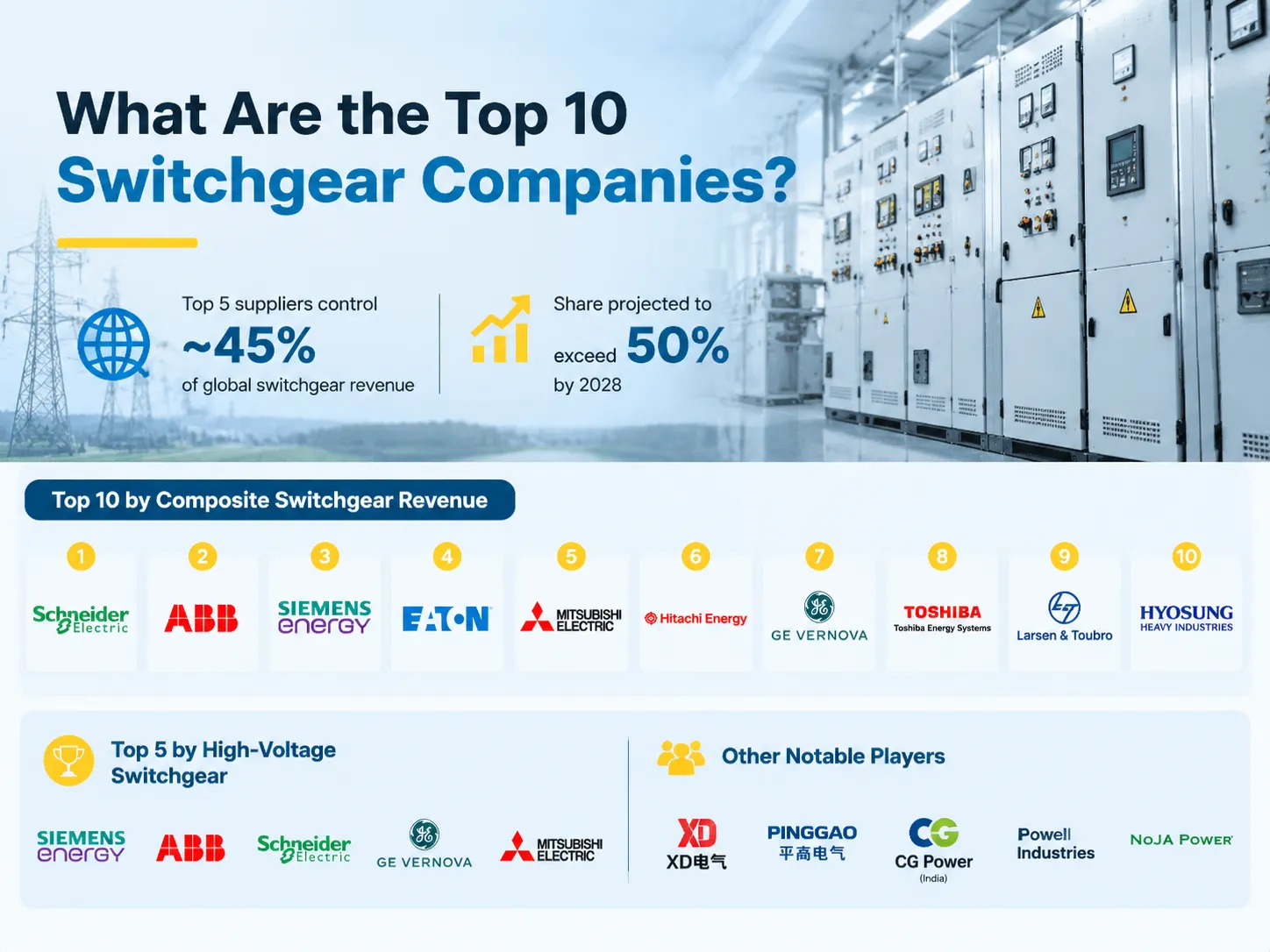

The “Top 10” suppliers of GIS switchgear each serve as a silent benchmark. They can be classified according to their revenues, which may provide one angle of view, and, depending on their share in the voltage levels they deal with, installed bays, SF6-free technology, manufacturing according to design (versus catalog sales), they can be ranked differently again. Nevertheless, it may be said that the manufacturers mentioned have created their logos and can be said to have achieved the coverage of the voltage levels at which these companies operate.
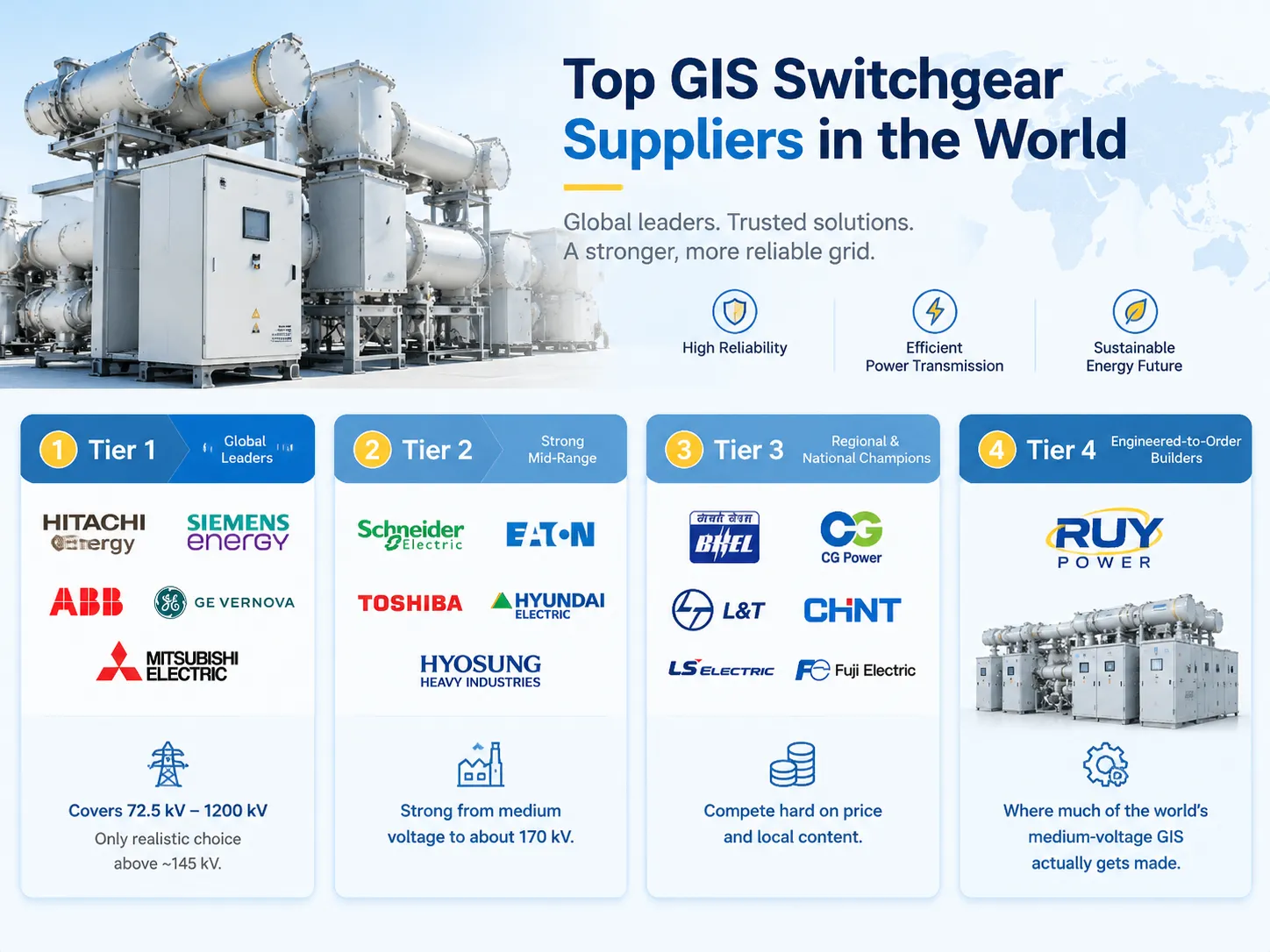
Brief reply: The worldwide GIS provide landscape is divided into four grades. Level one includes Hitachi Energy, Siemens Energy, ABB, GE Vernova and Mitsubishi Electric, since they cover a range between 72.5 kV and 1200 kV, thus making them the only valid options to be covered above a voltage of about 145 kV. The second level includes Schneider Electric, Eaton, Toshiba, Hyundai Electric and Hyosung Heavy Industries, all of which are active in the sector of medium voltage production range of up to around 170 kV. The third level consists of bigger companies, namely BHEL, CG Power, L&T, CHINT, LS Electric and Fuji Electric, which are focused on price and local content competition. Level four is made up of companies that offer customization of designs, thus being a place where most of medium voltage GIS production occurs, such as RUY Power.
What Counts as GIS, and Where It Sits
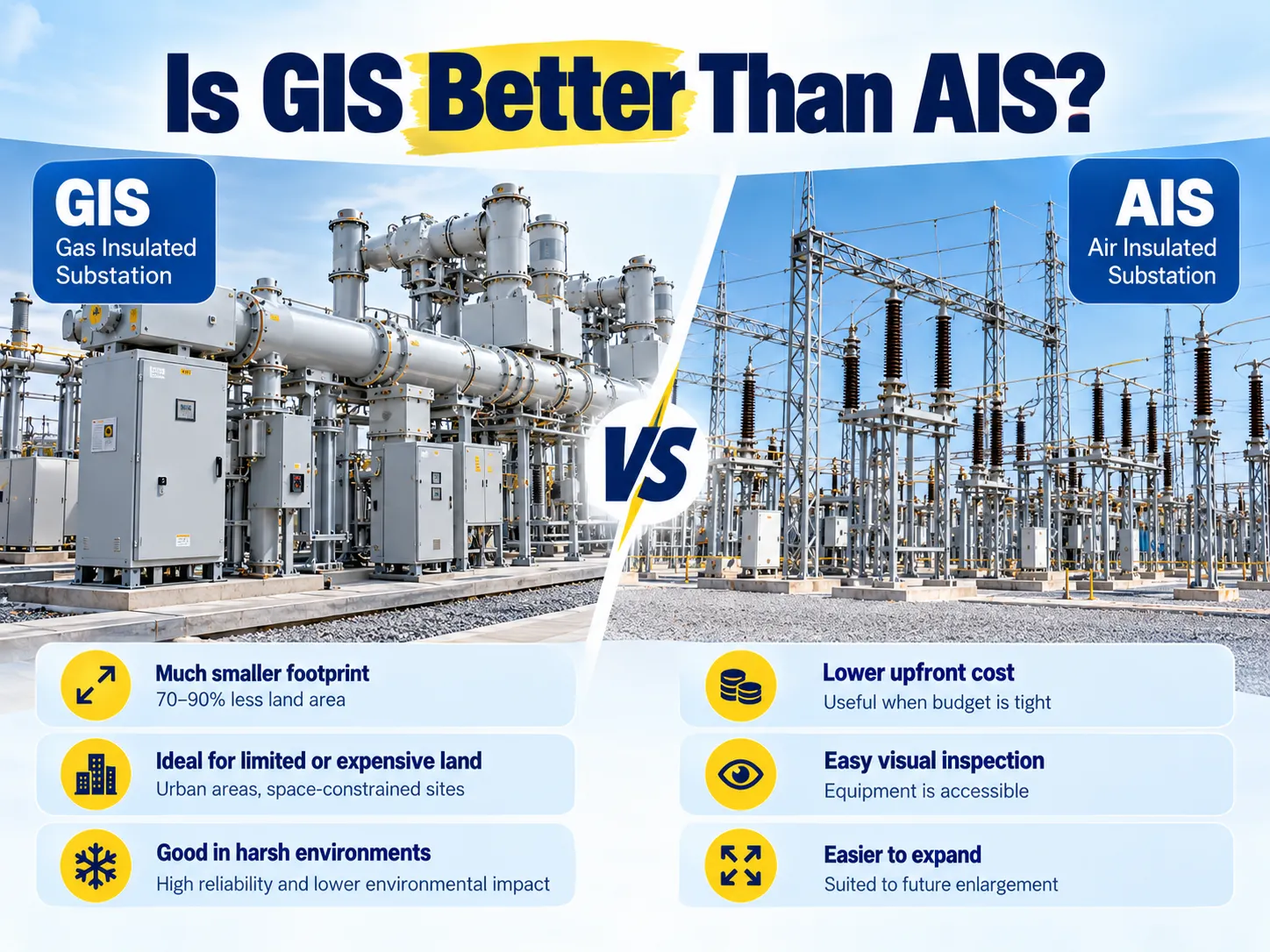
Gas-insulated switchgear consists of circuit breakers, disconnectors, busbars and instrument transformers inside grounded metallic housing which is filled with either the gas sulphur hexafluoride or some other insulating gas. The use of SF6 has approximately 3 times the dielectric strength compared to air enabling far more compact assembly of connections.
It is this feature that defines the way sizes differ. The standard size of a 230 kV AIS substation is 400-600 m2, while for the same GIS solution it is only 40-80 m2. Overall, the smaller installation takes 10-30% of the land compared to an AIS substation. Besides, it is less exposed to dust, sea salt, moisture, pollution and animals and insects. Therefore, the technology is usually used in places where space is limited, like urban, coastal or desert areas, as well as critical installations like data centers, hospitals and subways.
This compactness has its price, with GIS equipment being about 1.3 to 1.8 times more expensive than an equivalent AIS solution. As per various sources, people believe that the cost premium can be from 30% to 60%.
Tier One: The Global High and Extra-High Voltage Suppliers
Above 145 kV, the competition is intense. There are just five companies that possess the required type test credentials, manufacturing capability, and engineering skills to regularly deliver EHV GIS solutions.
Hitachi Energy — Zurich, Switzerland
The market offers the deepest portfolio of GIS technology covering the voltage range from 72.5 kV up to 1200 kV and developed based on over 50 years of experience of the former ABB Power Grid. The EconiQ technology is the most commercially successful SF6-free technology in action: delivery of the 550 kV SF6-free GIS for State Grid of China has been completed; the first 550 kV fully SF6-free order has been placed by Chubu Electric Power Grid in Japan in March 2026; and an order for 1100 kV GIS for Nanchang UHV substation has been received in October 2025. The company has also openly announced its next multi-billion dollar expansion of grid equipment capacity in multiple regions.
Best fit: utility transmission and EHV substations, renewables integration and wherever the requirement is to cut SF6 consumption.
Siemens Energy — Munich, Germany
Using environmentally-friendly insulation instead of gas. The Blue GIS line employs vacuum switching technology as an insulation medium and covers voltage levels from 72.5 kV to 550 kV. The portfolio includes the 8VM3-1 and 8DQ1 lines. Implementation capabilities of such a solution comprise the F-gas-free 110 kV gas insulated switchgear provided to Stahlwerke Feralpi in 2024 and the LIFE Blue project announced in February 2026 which aims to create and test emissions-free 420 kV AC gas insulated switchgear. In the medium voltage range, the 8DJH and NXPLUS C solutions are often selected for use in power supply networks.
Best candidate: Utility companies of Europe that need to comply with F-gas regulations, high voltage substations, projects where the goal is to go entirely gas-free.
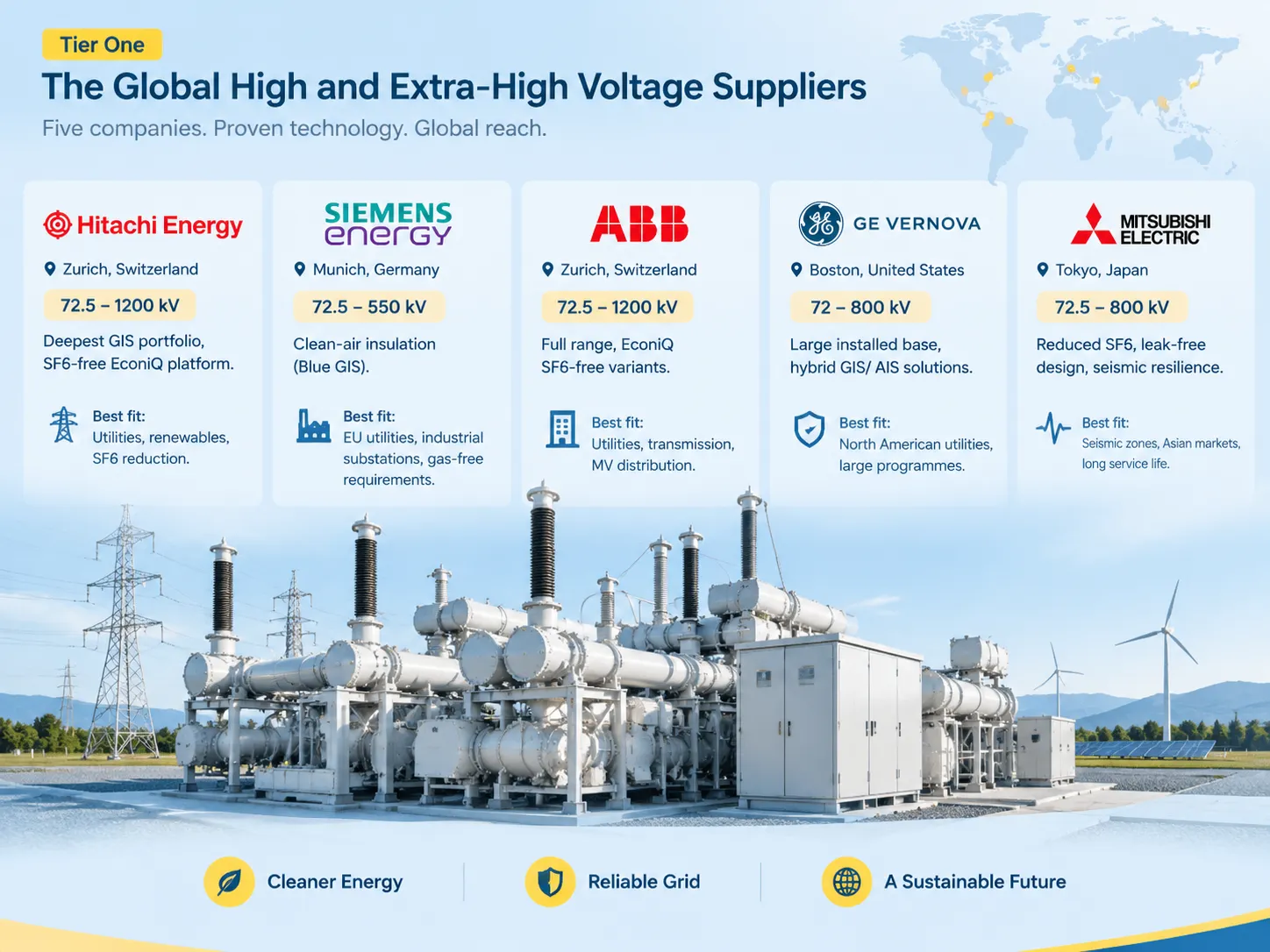
ABB — Zurich, Switzerland
A complete GIS range of 72.5kV to 1200kV with EconiQ SF6-free variants, particularly strong medium-voltage position via Electrification of the UniGear ZS1 and the dry-air PrimeGear TX45 platform, which is regarded as the SF6-free flag bearer.
Best-fit: utilities and transmission networks looking for compact, proven designs; and MV distribution opting for a dry-air type design.
GE Vernova — Boston, United States
The legacy of Grid Solutions contributed to the development of both full and hybrid GIS in the range of 72 kV to 800kV including the B105 series of equipment. Statistics show that over 14000 GIS bays are in operation all over the world, which is a good sign for the customers who plan their long-term projects. Furthermore, the company has developed technology that does not use SF6 on the voltage level of 245 kV for the modernization of substations under the influence of environmental regulations.
This is applicable to utility projects in North America and hybrid versions of solutions involving GIS bus sections and normal (air-insulated) technology.
Mitsubishi Electric (MEPPI) — Tokyo, Japan
GIS operates voltage levels ranging from 72.5 kV to 800 kV. The company has a history in utility applications that goes back several decades, which proves their capability in areas such as ecological emissions and area-resistant design. This attribute is particularly important for those countries that are seismically active as operating GIS is better than operating AIS in those areas. The latest announcement also mentions the increase in the production capacity of electricity equipment at home.
Most applicable markets: seismic zones, Asian electricity companies, transmission and distribution substations, which need to operate for a long time.
Tier Two: Strong from Medium Voltage to Transmission Class
These suppliers cover the voltage bands where most GIS bays are actually sold, and several compete directly with tier one at the top of that range.
| Company | HQ | GIS reach | Known for |
|---|---|---|---|
| Schneider Electric | Rueil-Malmaison, France | Medium voltage to 36 kV primary distribution | RM6, SM6, Premset and GM AirSeT SF6-free MV; 2SIS shielded solid insulation; EcoStruxure digital layer |
| Eaton | Dublin, Ireland | Medium voltage | Power Xpert XGIS; Xiria and Xiria E, the latter using dried air instead of SF6; strong North American base |
| Toshiba Energy Systems & Solutions | Tokyo, Japan | High voltage, transmission class | HV GIS including mobile GIS variants for transmission infrastructure |
| Hyundai Electric & Energy Systems | Seoul, South Korea | Medium and high voltage | HV GIS for global utility and industrial projects; large-scale infrastructure integration |
| Hyosung Heavy Industries | Seoul, South Korea | Medium and high voltage | Growing global position; publicly reported GIS contracts around USD 264 million in August 2025; North American capacity expansion |
The tendency here reflects that different alternatives exist in this section concerning the gas technology. Schneider transformed its MV line to air and solid insulations while Eaton offered a dried-air variant in addition to conventional gas technology. The Korean and Japanese manufacturers utilized the proven concepts of SF6 while at the same time minimized the gas volume and increased leak rates, which is reasonable in cases of the low regulatory pressure in the market combined with prioritization of technology that had been utilized for several decades.
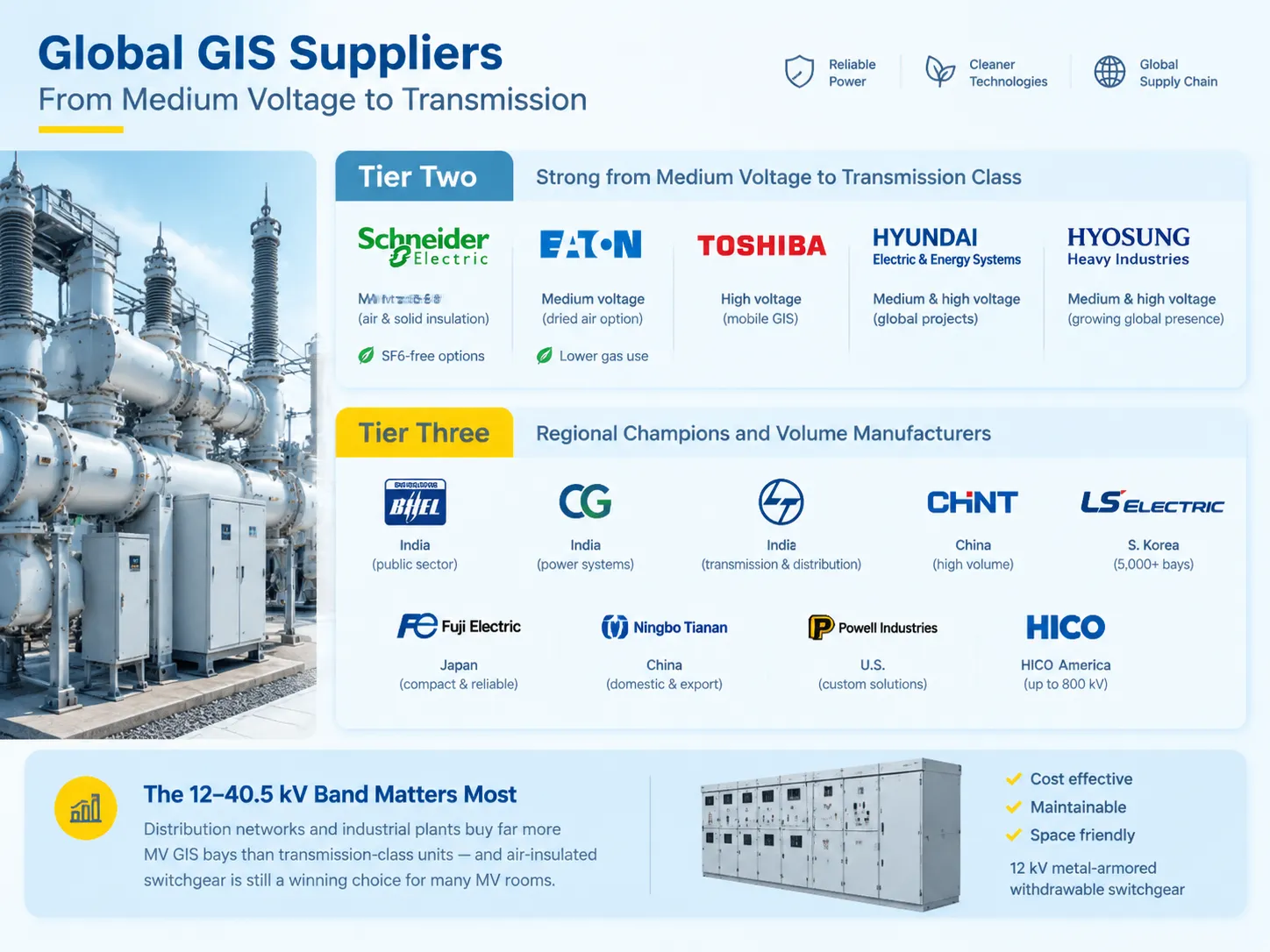
Tier Three: Regional Champions and Volume Manufacturers
Alongside the international companies are the champions and great-volume producers on the national level. They have enormous influence in their local markets, as well as on growing markets making export decisions based on cost and local contents.
- BHEL (New Delhi, India) – state-run manufacturer of GIS for local and export electrical engineering projects.
- CG Power and Industrial Solutions (Mumbai, India) – the company produces medium voltage GIS and high-voltage GIS as part of the wider electrical engineering portfolio.
- Larsen & Toubro (Mumbai, India) – GIS producer via its power transmission and distribution division to be used in large projects.
- CHINT Group (Wenzhou/Shanghai, China) – huge company offering MV switches and LV assemblages with Noark Electric in the USA.
- LS ELECTRIC (Anyang, South Korea) – air-insulated GIS and some more MV technologies.
- Fuji Electric (Tokyo, Japan) – manufacturer of phase-separated and three-phase GIS.
- Ningbo Tianan (Ningbo, China) – producer of local and international GIS products.
- Powell Industries (Houston, USA) – makes custom changes to GIS for utility and industrial purposes.
- HICO America (Pittsburgh, USA) – manufacturer of SF6 GIS for North American and world markets.
What makes this group successful commercially is its coverage of the 12 kV to 40.5 kV range which is where so many bays are being sold. A distribution company or an industrial facility may buy 50 medium-voltage GIS bays against every delivery of transmission level equipment, and these calculations are the secret of success of regional companies.
In addition, this is the range where air-insulated solution continues to win because numerous medium voltage rooms still have room and clients prefer equipment which can be opened and checked by their own electricians. A 12 kV metal-armored withdrawable switchgear assembly is the standard form of that answer, and it competes on cost and maintainability rather than on footprint.
Tier Four: Engineered-to-Order Builders
The world’s medium-voltage GIS market is largely distinct from the traditional model of obtaining products straight from the list of brands. Rather, what happens is that a supplier produces the equipment precisely as per customer requirements, undergoing a quality check and dispatch with the required design being provided. The client then gets the ability to define the equipment specifications precisely and is not limited to the nearest product configuration available on the catalogue.
A true build-to-spec manufacturer is distinguished by three capabilities that are missing in trading firms: the actual manufacturing and assembly processes employed in making the enclosure, busbar, and switch mechanism; the ability to conduct type testing via in-house laboratories making sure that each batch is made according to quality specifications; and the overall ability to read the diagram and produce the bay instead of simply filling the order.
RUY Power sits here, and it is worth being specific about what that means and what it does not. The sealed MV gas-insulated end of the range is covered by a 12 kV fully insulated, fully sealed metal-enclosed switchgear unit — a compact ring main unit configuration for the small substations, pad-mounted installations and renewable interconnections that make up most medium-voltage work. Alongside it sits a solid-insulated alternative for buyers who want a sealed, compact design with no gas to monitor.
RUY, however, lacks a high-voltage GIS line which is above the voltage level of 40.5 kV. There is neither 145 kV nor 550 kV offerings and any projects which require any of those high-voltage levels shall have to go with the tier-one suppliers. It is always easier being honest about what is possible instead of pretending.
What a GIS Quotation Should Contain
The quotations listed can only be compared when they answer similar questions, which are those that bring about numbers.
- Voltage class plus rated current. The actual figure being offered not as a range but in terms of a specific rating with a type test certificate.
- Gas or insulation medium and leakage. Volume of SF6, guaranteed annual leakage and monitoring of that leakage as well as the plan for completing the life cycle of the product.
- Classification of internal arc. The IAC class obtained from tests and list of accessories which was taken into account especially the pressure relief and venting.
- The degree of protection and material of enclosure. The rating IP and the type of tank being either stainless mass or coated steel.
- Items included in functional unit. Number of circuit breakers, disconnectors, grounding switches and instrumentation transformers included in one functional unit and whether protective relays can be included or not.
- Standards and certifications. The compliance with IEC 62271 series with respective number of certificates and possible local approvals needed for the project.
- Delivery, commissioning and training. The price of gas handling equipment and certified specialists is included even when they are acquired separately.
- Idle modules and lead time. If the unit is sealed and has twelve weeks of lead time of spare parts it means the operational risk needs to be established.
Leaving out two of these elements may be easy but it will be extremely costly. Internal arc classification is a safety parameter that does not appear in the official price list. And the gas handling requirement is where the cost of the low price is hidden as the tools and training needed for accessing GIS compartment are expensive and they are not always included in the offer or paid separately.
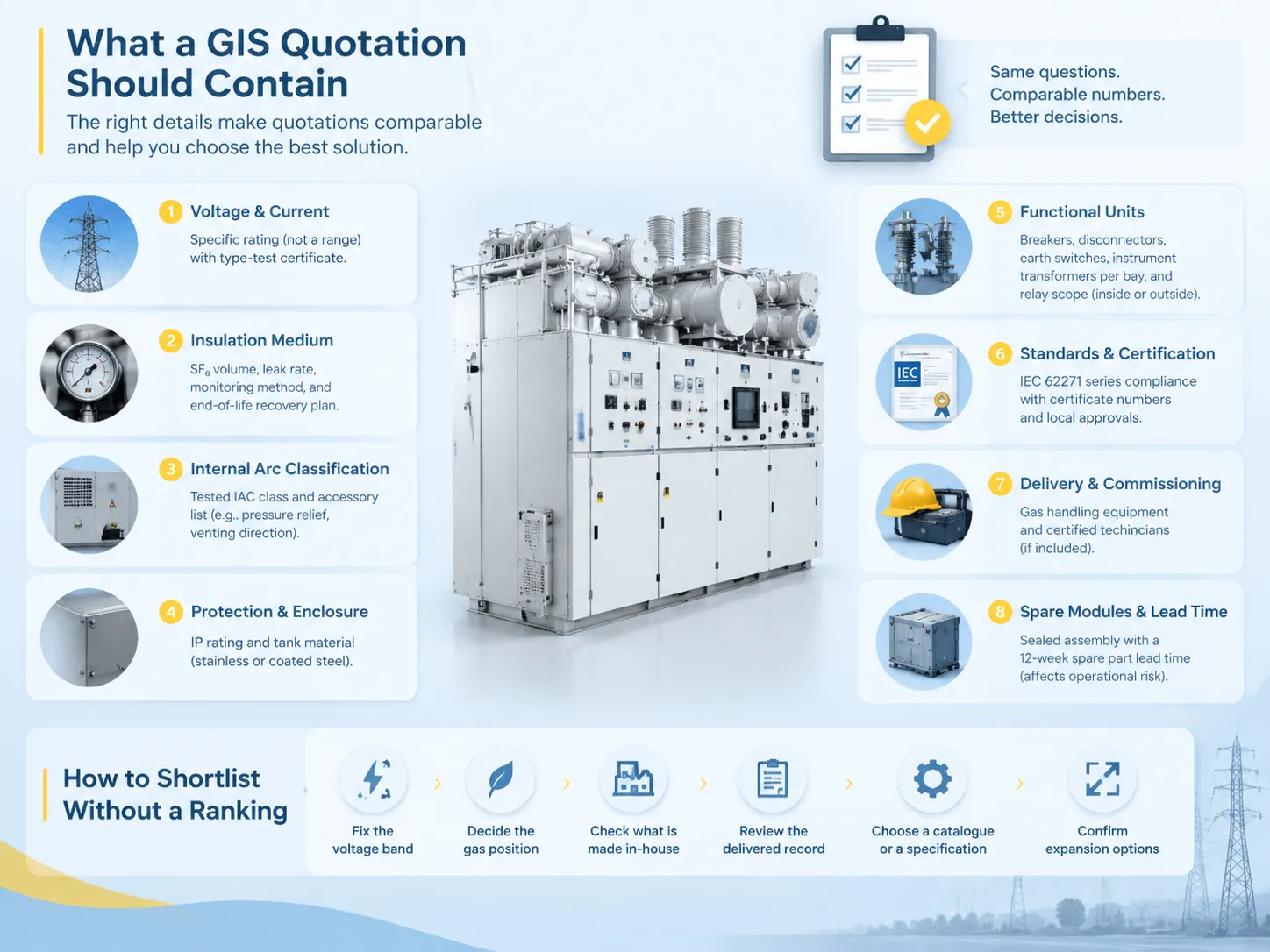
How to Shortlist Without a Ranking
The ranking indicates the question you likely did not ask. The shortlisting indicates the one you asked.
- First, you need to establish voltage limits. Companies that operate above the threshold of 145 kV are five in number. Companies operating below 40.5 kV are many, and there are tangible price competition in this area.
- Be sure to clarify the position regarding gas before calling for tenders. You can eliminate most participants and save the time of everyone if, for example, the user or the regulatory body requires dielectric materials free of SF6.
- Find out what is produced in-house. Request addresses of the plants, type-test reports for the required configuration, and names of the test labs.
- Pay attention to the performed vehicles. A brief analysis of the performed projects shows more as regards the delivered HV switchgear applications of all voltage levels and configurations than any statement on company potential, as a real problem of each project is line-out on what is created.
- Decide whether it is a catalogue or specification that you want. In case the site is of the rather peculiar nature, a manufacturer who builds based on a drawing will outperform a brand producing a standard bay even if the technical specifications are equal.
- Ask questions regarding possible expansions. Medium-voltage GIS modules can be very compact because the layout is fixed during production. As a result, later expansion can be approved only if planned.
Where the Medium-Voltage Market Goes Next
Every level has three trend lines running through it.
- Gas is going away. Hitachi Energy’s EconiQ, Siemens’s Blue GIS, and Schneider’s AirSeT are all substituting SF6 with clean air, sealing vacuum, or solid dielectric. ABB’s PrimeGear TX45 does the same for medium voltage by using dry air instead. In Europe, it is driven by the regulations and in many other parts of the world, customer demands, and it has shifted from tests to actual orders.
- Digital is becoming more of a norm than an option. Communication based on IEC 61850, measures of gas pressure, partial discharge, and mechanical operation are all being introduced into standard assignments. If a GIS bay is not able to report its status, it is becoming maintenance risk.
- The medium-voltage space is where the action is happening. Thanks to facilities such as renewable energy stations, urban distribution, data centres, and factories, the volume of low-voltage switchgear is larger than that of high-voltage equipment. It is also the segment where the question of who actually builds the equipment stops being academic: the depth that matters is whether a supplier controls switchgear manufacturing from HV and MV complete sets through to low voltage assemblies, because that is what determines whether a non-standard bay can be built at all.
FAQ
What are the top 10 switchgear companies in the world?
According to global portfolio scope and documented reach, the eleven most often mentioned companies are Hitachi energy, Siemens energy, ABB, GE Vernova, Mitsubishi electric, Schneider electric, Eaton, Toshiba energy systems & solutions, Hyundai electric & energy systems, and Hyosung heavy industries. However, rivals like BHEL, CG Power, L&T, CHINT, LS Electric, Fuji electric, and Powell Industries maintain a solid regional and segment position which a global ranking fails to recognize
Who is the largest switchgear manufacturer?
For GIS systems in the high and extra-high voltage segments, Hitachi Energy as well as Siemens Energy are the organizations that have the most comprehensive documented portfolios and the newest settings involving the use of SF6 gas. To find out the total amount of the switchgear, taking into account the type of voltage assemblies that must be taken into account, it is necessary first to choose the method of calculation.
Who is the leading company in the switchgear market?
No one company stands out as the leader in the category since the category encompasses both the 12 kV distribution ring main units and the 1200 kV GIS and there is no single player that leads both. The question you should ask is which company is in the lead in your region and in the voltage category you are interested in and specific criteria you have — pricing, SF6 positioning, number of bays delivered to you, etc.
Which company is best for switchgear?
You have to find a vendor that meets your voltage range and certifications, whose type-test documentation fits your application, and whose delivery period matches your schedule. This means a Tier 1 world supplier in the range above 145 kV. In the case of voltages in the 12–40.5 kV range, which is used by most substations, it is likely a company that specializes in custom equipment manufacturing and can produce the switchgear equipment according to your specification as illustrated in the one-line diagram rather than selling you what they have at the warehouse, in addition to being able to supply you with customized switchgear equipment under the OEM or ODM conditions if you need your own brand and specifications.
References
- Hitachi Energy — GIS portfolio from 72.5 kV to 1200 kV and EconiQ SF6-free technology
- Siemens Energy — Blue GIS clean-air insulated switchgear and F-gas-free substation projects
- ABB — high-voltage GIS ranges and PrimeGear TX45 dry-air medium-voltage platform
- GE Vernova — Grid Solutions GIS and hybrid switchgear portfolio
- Mitsubishi Electric — high-voltage GIS, cubicle-type MV GIS and seismic-resistant designs
- Schneider Electric — Premset and GM AirSeT medium-voltage GIS and 2SIS solid insulation
- Eaton — Power Xpert XGIS and Xiria medium-voltage switchgear platforms
- International Electrotechnical Commission — IEC 62271 series, covering high-voltage switchgear, controlgear and GIS assemblies
Conclusion
It is easy to identify the top manufacturers of GIS switchgear; however, ranking them in accordance with certain criteria makes the situation more complicated. Only five companies are capable of supplying GIS switchgear operating at voltages above 145 kV, and the application of the SF6-free policy limits the list of the companies even further. Below 40.5 kV, where most of the switchgears are produced, the leading companies have been winning the price war, offering tailoring solutions that meet the specifications of the clients. It is in this sphere that RUY Power and other companies can offer their portfolio of 12 kV sealed switchgear and insulated switchgears complying with the requirements of the industry. In order to find the right supplier, it is necessary to define the voltage, type of gas to be used and submit testing reports.