
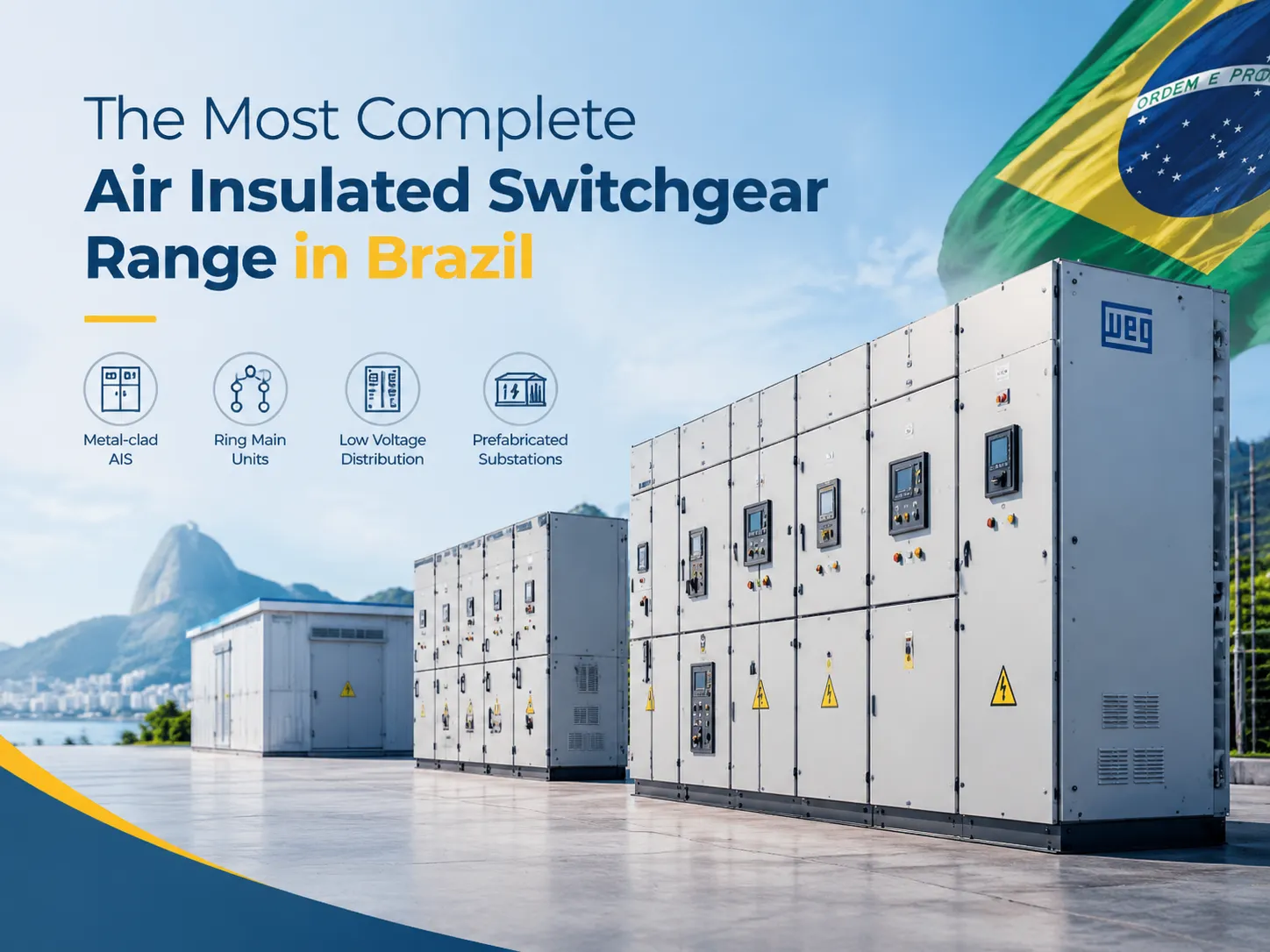
Brazil is the biggest producer of switchgear in Latin America and there is a predominance of air insulated rather than gas insulated medium voltage equipment being used in the country. As a result, there exist two separate swings in terms of the market: on one hand, there are multinational companies that assemble equipment and components imported from abroad for utility purposes, while on the other hand, there is a clustering of local companies who comply with ABNT requirements and are characterized by shorter supply/delivery chains. This guide examines what air insulated switchgear is from a Brazilian perspective, the companies producing it, the complete range connected with it, and the way of assessing suppliers in operation.
To be quick: Air-insulated switchgear uses ambient air for insulation. It is manufactured following the ABNT NBR IEC 62271-200 international standard and works with voltages up to 52kV, which turns out to be useful for practically all Brazilian medium voltage applications at 13.8kV and 34.5kV. One manufacturer cannot be called “the most complete” in all fields. WEG is the biggest local manufacturer, while Schneider Electric, ABB, and Siemens Energy are in the leading positions on the global market. They are supported by Romagnole and Nansen on the utility and metering fronts. If a buyer needs the complete spectrum of equipment – from metal-clad AIS to low-voltage distribution and pre-fabricated substations – he or she will find RUY Power’s assortment rather reasonable for the price range, but at the same time the issue of brand presence and local customer support should be judiciously addressed.
What “Air Insulated Switchgear” Means in Brazil
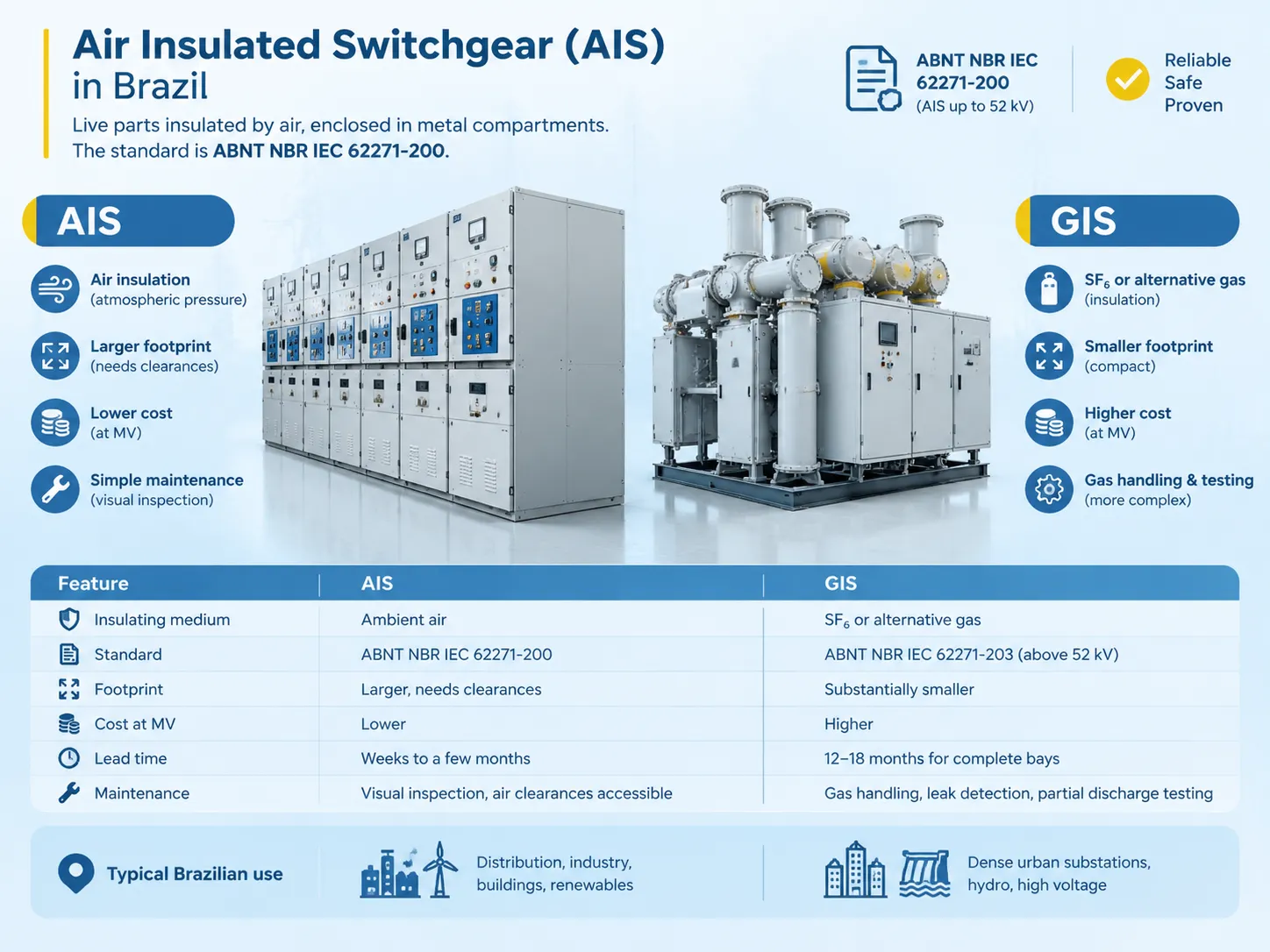
AIS is a technology in which the live components are insulated with air under normal atmospheric pressure rather than with sulfur hexafluoride (SF6) or other gasses or solid insulators. The compartments are enclosed with metal while the busbars and cable connections remain in the air, and from there, the necessary dimensions and clearances could be determined.
ABNT NBR IEC 62271-200 is the national standard, which regulates the factory assembled metal enclosed switchgear and control gear systems having the voltage level above 1kV up to and including 52kV. The standard has been a direct adoption of International Electric Commission(IEC) 62271-200 and has replaced the national standard NBR 6979 which has already contained large number of IEC standards. There are three companion standards which appear in almost every Brazilian standard in this direction and these are ABNT NBR IEC 60694 which is applicable for common standards and switching device control mechanisms, ABNT NBR 14039 which is for the medium voltage installations in the range from 1.0 to 36.2 kV and ABNT NBR IEC 62271-1 which is applicable for general rated characteristics.
There are two classifications which can be used to address most of the technical issues. The loss of service continuity category LSC2A or LSC2B defines whether the busbars are energized while opening a single functional unit which allows for the maintenance of one feeder without switching off the whole board. The internal arcing category indicated by IAC or the operation type indicates which sides of the housing have been tested for internal arcing faults by type tests. It is widely used by Brazilian utilities.
| Property | Air insulated (AIS) | Gas insulated (GIS) |
|---|---|---|
| Insulating medium | Ambient air | SF6 or alternative gas |
| Standard | ABNT NBR IEC 62271-200 | ABNT NBR IEC 62271-203 (above 52 kV) |
| Footprint | Larger, needs clearances | Substantially smaller |
| Cost at MV | Lower | Higher |
| Lead time | Weeks to a few months | 12–18 months for complete bays |
| Maintenance | Visual inspection, air clearances accessible | Gas handling, leak detection, partial discharge testing |
| Typical Brazilian use | Distribution, industry, buildings, renewables | Dense urban substations, hydro, high voltage |
The Brazilian Voltage Classes You Will Actually Specify
When compared to the IEC catalog, Brazilian medium voltage volumes are limited. In this respect, two values appear quite frequently in practice, namely, at 13.8 kV and 4.16 kV.
The former one can be referred to as the workhorse of the industry. This voltage level is available at all Brazilian energy companies, making most drawings at this level with approved voltage of 15 kV on the switchgear nameplate. In the meantime, the latter voltage has mostly been used in older plants with significant motor direct supply in the medium range. Recently, 34.5 kV appears to be used in connection to major industrial installations or renewables, with equipment rated at 38 kV. The older levels of 2.4 kV, 3.3/3.45 kV, and 6.6/6.9 kV are still being installed, but it is not possible to see them in application in new projects.
| Operating voltage (kV) | Rated voltage Ur (kV) | Power-frequency withstand (kV) | Lightning impulse (kV) |
|---|---|---|---|
| 4.16 | 4.76 | 19 | 60 |
| 13.8 | 15 | 36 | 95 |
| 23.0 | 27 | 60 | 125 |
| 34.5 | 38 | 80 | 150 |
Two environmental conditions included in utility specifications are useful to be incorporated in any Brazilian inquiry: the enclosure’s minimum IP2X protection and a maximum altitude of 1,000 meters with ambient temperatures between −5 °C and +40 °C. Above this altitude the insulation should be derated, which is currently a problem for Minas Gerais and southern highlands.
The Brazilian AIS Landscape: Domestic Manufacturers
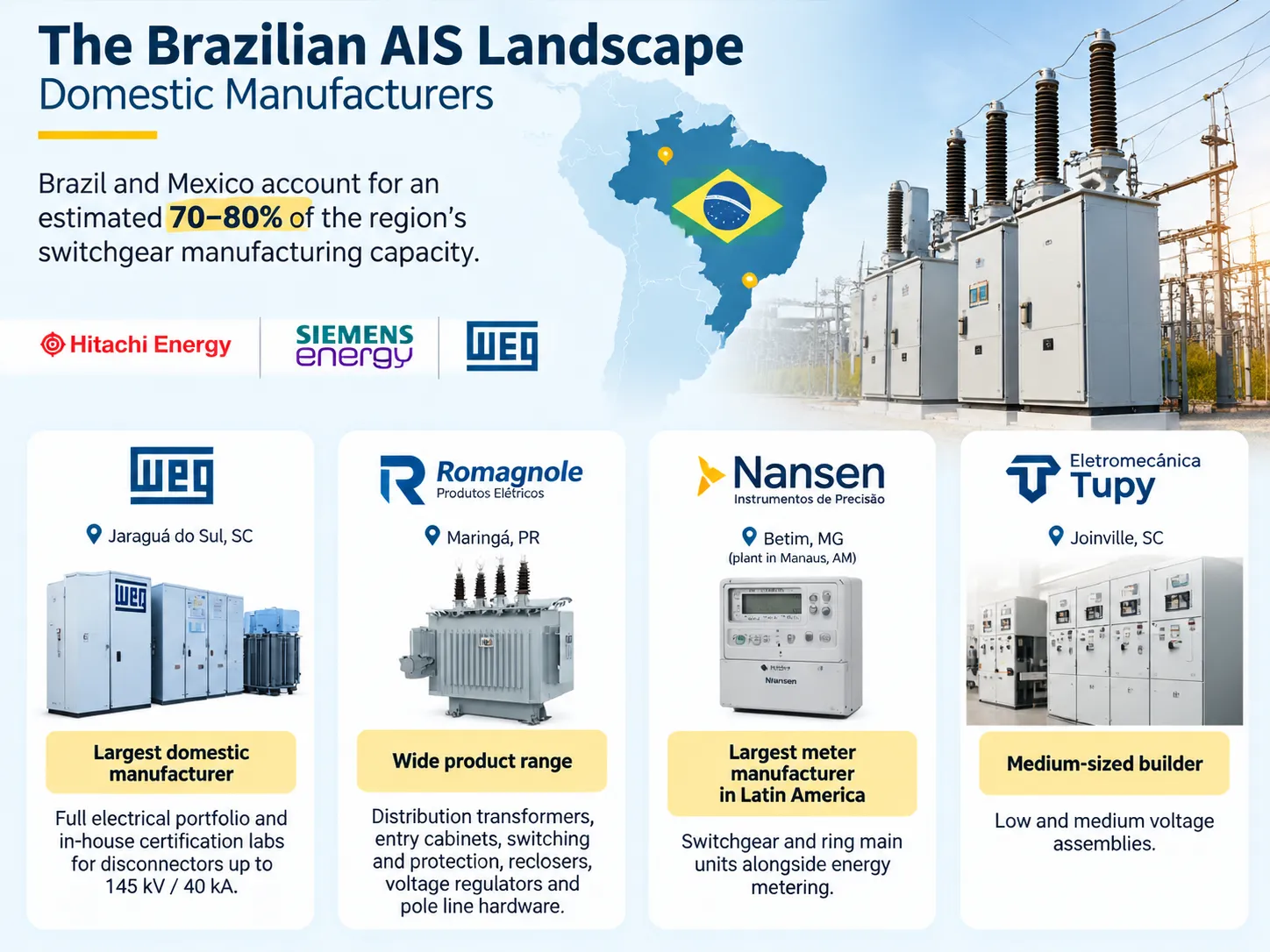
Manufacturing facilities operated by Hitachi Energy, Siemens Energy, and WEG are located in Brazil, where together they represent a proportion of the estimated 70 to 80% of the regional capacity for switchgear manufacturing. The local companies are very few.
| Manufacturer | Headquarters | Position | Notable strengths |
|---|---|---|---|
| WEG S.A. | Jaraguá do Sul, SC | Largest domestic electrical equipment manufacturer, founded 1961 | Full electrical portfolio — switchgear, transformers, substations, motors, automation; only national manufacturer with in-house certification labs for disconnectors up to 145 kV / 40 kA |
| Romagnole Produtos Elétricos | Maringá, PR | Operating since 1962, one of the largest Brazilian electrical manufacturers | Distribution and power transformers, entry cabinets and metering, switching and protection, reclosers, voltage regulators, pole line hardware |
| Nansen Instrumentos de Precisão | Betim, MG (plant in Manaus, AM) | Founded 1937, 95 years in operation | Switchgear and ring main units alongside energy metering; largest meter manufacturer in Latin America |
| Eletromecânica Tupy | Joinville, SC | Medium-sized panel and switchgear builder | Low and medium voltage assemblies |
WEG deserves mention when it comes to key testing capability. The ability to execute certification tests at national laboratories duly accredited represents a real timing advantage on any Brazilian project and indicates the distinction between a national manufacturer and an assembler. The size of the company is equally important to mention: R$40.8 billion of revenues at the end of 2025, about 59% of which will come from exporters.
Multinational Plants and What They Add
Hitachi Energy, Siemens Energy, Schneider Electric, GE Vernova, ABB, Eaton, Legrand, Toshiba do Brasil, and Mitsubishi Electric do Brasil are all active in Brazil, with many of them being engaged in local manufacturing and assembly. Their offerings in terms of AIS are, by and large, more focused on their digital protection as well as control integration capabilities, in the area of type-tested arc-rated assemblies, in addition to their aftermarket service networks for large utility fleets.
In comparison to other regions, the situation is not one related to technology but to the structure. The overall picture for local manufacturing is complicated by the fact that most of the time, it is based on the materials imported from other countries. In this case, the imported switchgear constitutes approximately 65%–75% of the complete value of the switches in local manufacturing (circuit breakers, bushings, protection relays and enclosures all count). Moreover, the import tariffs on the equipment under HS codes 853720, 853630 and 853710 in Brazil are considered rather high (varying between 12 and 18 percent), as well as logistics and currency hedging issues.
Who Is “the Most Complete”?
The plain truth is that a scope is required before a question can be answered, with the three common definitions providing three different outcomes.
When it comes to global revenue share, Schneider Electric, ABB, Siemens Energy and Hitachi Energy are leaders. The five largest suppliers are estimated to account for 46-52% of the revenue from the medium voltage switchgear industry, with ABB usually in the range of 11–14% and Schneider in the range of 10–13% according to various analyst estimates. ABB and Hitachi Energy win in the gas-insulated high voltage equipment market, while Schneider has an advantage in distribution network and digital solutions.
By measuring the size of the Brazilian market, WEG is the most prominent manufacturer in the country, while Romagnole and Nansen also have a significant market share in the utility and related categories.
When considering the number of products offered by a single supplier, an exporter like RUY Power can come out on top. The right question to ask a procurement engineer is not who is the biggest manufacturer, but rather who can deliver the entire bill of materials, without having to subcontract half of what is needed at a reasonable margin.
What a Complete AIS Range Actually Contains
“Complete” can be quantified. If a vendor is handling a medium voltage distribution project from start to finish, then it should be in position to provide the regarding items all from one location following ABNT NBR IEC 62271-200.
- Primary metal-clad switchgear — 12 kV or 40.5 kV withdrawable vacuum circuit breaker panels, either single or double busbar arrangement and meeting requirements of either LSC 2A/PI or LSC2B/PM features.
- Ring main units — compact and extensible type and also the one preferred by the utility and having special arrangement for metering cubicle.
- Circuit breakers and isolators — installed either indoors or outdoors.
- Measuring transformers — current transformers and voltage transformers according to ABNT NBR 6856 standards.
- Protection and controlling devices — including relays, interlocks, and the auxiliary circuits tested according to clause of ABNT NBR IEC60694.
- Low voltage distribution — LV panels fed from the MV switchgear at voltage levels mainly at 0.4 kV.
- Ready-made and compact substations where both MV apparatus and transformer are shipped as one unit.
RUY Power’s product structure maps onto that list directly. Primary metal-clad AIS is covered at both voltage classes — the KYN28-12(Z) metal-armored withdrawable switchgear for 12 kV applications and the KYN61-40.5(Z) for 40.5 kV.
For the smaller MV rooms, pad-mounted substations and renewable interconnections popular in Brazilian industry, the compact distribution sector uses the HXGN15-12 metal-armored ring main unit. Above and below it are the low voltage switchboards, capacitor compensation cabinets and PV grid-linked cabinets
Certification and Tests to Demand
In Brazil this is the moment of separating the grain from the chaff, because while a specification may appear to be valid on paper its implementation may turn out to be woefully lacking.
| Requirement | Standard | What to ask for |
|---|---|---|
| Type tests on the assembly | ABNT NBR IEC 62271-200 | Type test certificates from a recognised laboratory, not a manufacturer’s declaration |
| Routine tests per unit | ABNT NBR IEC 62271-200 | Dielectric tests on the main circuit, auxiliary and control circuit tests, main circuit resistance, mechanical operation, earthing switch and interlock strength |
| Circuit breakers | IEC 62271-100 / ABNT NBR IEC | Test report for the specific breaker model |
| Instrument transformers | ABNT NBR 6856 | Ratio and accuracy class test certificates |
| Paint and coating | ABNT NBR 11003, NBR 10443 | Adhesion and dry film thickness |
| Material certification | EN 10204 3.1 | Mill test certificates traceable to the heat numbers |
| Electrical safety on site | NR-10 | Supplier documentation supporting the operator’s NR-10 obligations |
All of these are executed as part of the production flow, which is why the manufacturing process itself is worth auditing rather than just the certificate folder. Our switchgear manufacturing process describes the stage-by-stage sequence from sheet metal fabrication through assembly, wiring and routine testing, so a buyer can see where each test sits.
How to Choose a Supplier
A practical sequence of operations for a Brazilian multilevel voltage project, based on the elimination of rework that each stage can take.
- Fix electrical specifications first. The rated voltage and insulation levels, busbar current, short-circuit withstand current and time, LSC category and internal arc classification must be specified first. No bid would have any value without specifying those.
- Confirm the utility connection. When the local power utility is supplying the board, their RECON or equivalent act should define the dimension of the metering compartment, its sealing, locking and access. You need to get these requirements into the inquiry, not the change order.
- Request type testing proofs rather than promotional achievements. Having a document that indicates the type of assembly and arc classification is more informative than the data sheet.
- Distinguish between equipment and service provision. Switchgear factories produce machinery only. Protection settings, schemes and installation engineering belong to systems integrator or designing bureau.
- Get landed cost pricing instead of FOB cost. Add tariffs which vary from 12 to 18% according to HS 853720, transport, insurance, currency exposure and local service.
- Crosscheck references in the same equipment category. Supplier experienced in 13.8 kV distribution may not have records in 34.5 kV equipment.
- Clarify spare parts and document scope. Wiring diagrams, type test reports, normative documents and spare part list should be stated in the contract.
Reference projects are the fastest sanity check on all of the above, and this selection of delivered switchgear and substation projects shows the equipment classes and voltage levels already in service rather than the ones in the brochure.
Where RUY Power Fits
RUY Power specializes in making the complete switchgear of medium and low voltage as well as ready-made substations and transformers. Their focus is clearly on the product line, including the KYN28 and KYN61 series of metal-clad switchgear, and the HXGN type of ring main units, and also the low voltage switchboard chargers, capacitor compensators, and PV enclosures, as well as the dry-type and oil-filled transformers. What the company does not do, however, is design the construction, or the installation, as these are to be done by the design organization. It is better to leave such complex and easy tasks to other specialists than to take this duty upon itself when working on a project with a real commissioning phase.Now let’s review the theoretical benefits of using the MV switchgear, the LV switchboard, and the transformer and plant, with purchasing all these items from one supplier.
The practical advantages in this situation are two-fold: availability and price. Firstly, purchasing all equipment at once reduces the interface risks with three different suppliers because each of them will point to the scope of another vendor. Secondly, since manufacturing operations are in China, the price is usually much lower than Brazilian or European plants that make the same level of equipment (and this factor is the most important one on many multi-units distribution projects). The corresponding disadvantage is the lack of well-known brands and after-sales services in Brazil, which is quite important in the utility industry where companies prefer reliable suppliers. For OEM and private-label programmes where the equipment will carry a local partner’s nameplate, the OEM and ODM capability covers documentation, labelling and configuration changes.
Price Bands and Lead Times
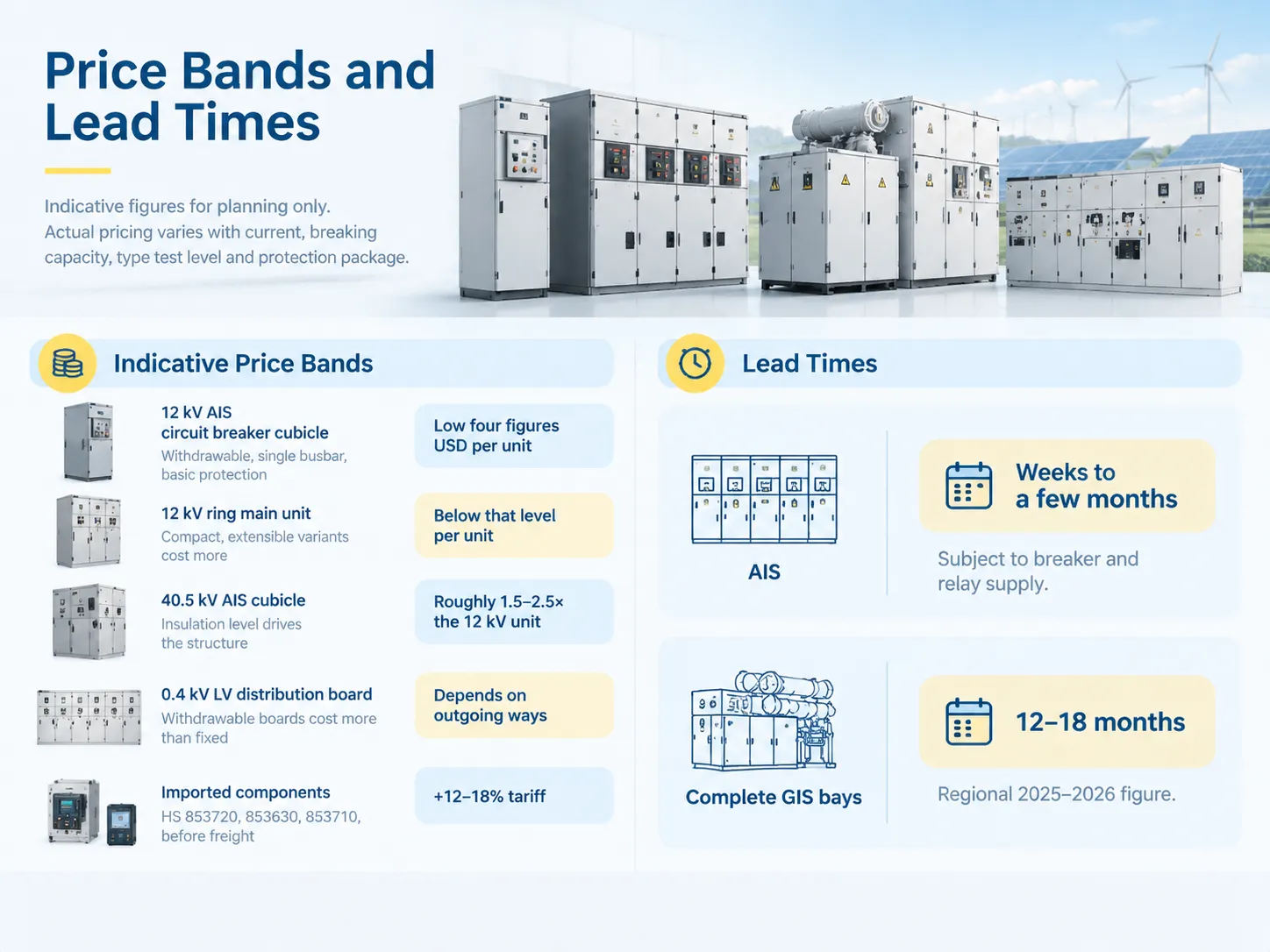
The numbers mentioned below are for planning purposes only because various factors like busbar current, breaking capacity, type test standards, and protection package affect the number more than anything else. These numbers should be perceived as order of magnitude rather than quotations. Ring main unit series is where the economics of the full range are visible because it is the product that most Brazilian industrial and commercial projects ask for in bulk, not individually. The same HXGN15-12 metal-armored ring main unit that appears in the range list above is the standard answer for a compact MV room, a pad-mounted substation or a renewable interconnection, and pricing it alongside the primary switchgear and the low voltage board is exactly the comparison that removes interface risk between three suppliers.
| Item | Indicative band | Notes |
|---|---|---|
| 12 kV AIS circuit breaker cubicle | Low four figures USD per unit | Withdrawable, single busbar, basic protection |
| 12 kV ring main unit | Below that level per unit | Compact, extensible variants cost more |
| 40.5 kV AIS cubicle | Roughly 1.5–2.5× the 12 kV unit | Insulation level drives the structure |
| 0.4 kV LV distribution board | Depends on outgoing ways | Withdrawable boards cost more than fixed |
| Imported components | +12–18% tariff | HS 853720, 853630, 853710, before freight |
| Lead time, AIS | Weeks to a few months | Subject to breaker and relay supply |
| Lead time, complete GIS bays | 12–18 months | Regional 2025–2026 figure |
FAQ
Who is the biggest manufacturer of switchgear?
It is dependent on the criteria used in measurement. In terms of total switchgear revenue, Schneider Electric, ABB and Siemens Energy are the leading companies, followed by Eaton, Mitsubishi Electric and Hitachi Energy. In total, the top five companies make between 46% and 52% of total medium voltage switchgear.ABB and Hitachi Energy take leading positions in high voltage gas insulated equipment. In particular, in Brazil, WEG is the leading domestic manufacturer, with Romagnole and Nansen being strong competitors in utility sectors.
Who is the leading company in the switchgear market?
The biggest name for switchgear revenue is Schneider Electric, followed closely by ABB, which is especially strong in digital switchgear and medium voltage distribution. This is important to note since being a global leader does not ensure the same effect on Brazilian medium voltage distribution projects, where local content, tariff-related risks, metering rules, and post-sale support play a much bigger role than overall market share.
What is an air insulated switchgear?
It is switchgear and the controlgear assembly made of solid material and manufactured in factories where ambient air provides insulation between live parts as well as between live parts and earth. The medium voltage design conforms to IEC 62271-200 standards and is implemented in Brazil with the title of ABNT NBR IEC 62271-200. AIS is much cheaper than gas insulated switchgear and easier to inspect. However, it requires more space and greater clearances.
Who manufactures medium voltage switchgear?
Worldwide: Some of the most key international companies include ABB, Schneider Electric, Siemens Energy, Hitachi Energy, Eaton, GE Vernova, Mitsubishi Electric, Toshiba, Ormazabal, Lucy Electric and CG Power. In Brazil: Among Brazilian producers we have WEG, Romagnole, Nansen, Eletromecânica Tupy, as well as local branches of Hitachi Energy, Siemens Energy and Schneider Electric. Integrators have access to the voltages produced by exporting companies like RUY Power at a far lower landed price than those charged for local and European products with similar characteristics.
Is AIS or GIS better for Brazilian projects?
In most cases of medium-voltage applications in Brazil at the nominal voltages of 13.8 kV and 34.5 kV, air-insulated substations (AIS) are a better choice due to their lower costs, reduced installation time, and air clearances, which allow the maintenance crew to perform their work without gas handling equipment. GIS emerges as the preferred technology when the area is limited, being installed in tight urban locations or at voltage levels over 52 kV, when air insulation is more economically unfavorable.
References
- ABNT — Brazilian National Standards Body (ABNT NBR IEC 62271-200, NBR 14039)
- International Electrotechnical Commission — IEC 62271 series, high-voltage switchgear and controlgear
- IEC Webstore — IEC 62271-203, gas-insulated metal-enclosed switchgear for rated voltages above 52 kV
- IndexBox — Brazil Air Insulated Switchgear Market Analysis
- Nansen — company history and product lines (switchgear, ring main units, metering)
- WEG — electrical equipment, switchgear and substation solutions
Conclusion
According to the local standards for medium voltage equipment in Brazil, manufacturers of air-insulated switchgear complying with the standards ABNT NBR IEC 62271-200 are the first option. It is important to mention that 13.8 kV is the voltage option we often refer to. Unfortunately, there is no universal leader in manufacturing — that is, there are companies leading on the local market or in the general market, but the producers of the largest quantity of the air-insulated switchgears are usually not the famous companies.
There are three aspects to bear in mind while analyzing the work. First of all, make sure that the design documentation states the electric requirements and metering needs of the utility. Secondly, require demand type test certificates for this very assembly range instead of general declarations. Finally, calculate the final cost that includes all the 12-18% tariffs in case of importing components.
If the three aspects are properly understood, the choice between a local manufacturer and an exporter will be easy.