
On the same day, an equal number of switching devices costing $12,500 and $46,000 appeared on the desk simultaneously. They are both rated at 600 amps and sold to the same construction site, but the difference in their prices is not due to the actions of any of the suppliers. The two prices meant for the same type of device used in the same building do not differ because of salespeople or profit margin factors. These prices are for different types of equipment, and for an understanding of what four parameters led to the existence of the price difference, thorough comparative analysis of the offers is needed.
The sections in the text below follow the phases of the purchasing process: understanding the specification in question, analyzing how much different types of switchboards cost in different regions, and explaining why the suppliers charge different prices for the same device. The last point of the analysis is very important as choosing an inexpensive piece of equipment that cannot serve its purpose can lead to serious financial losses.
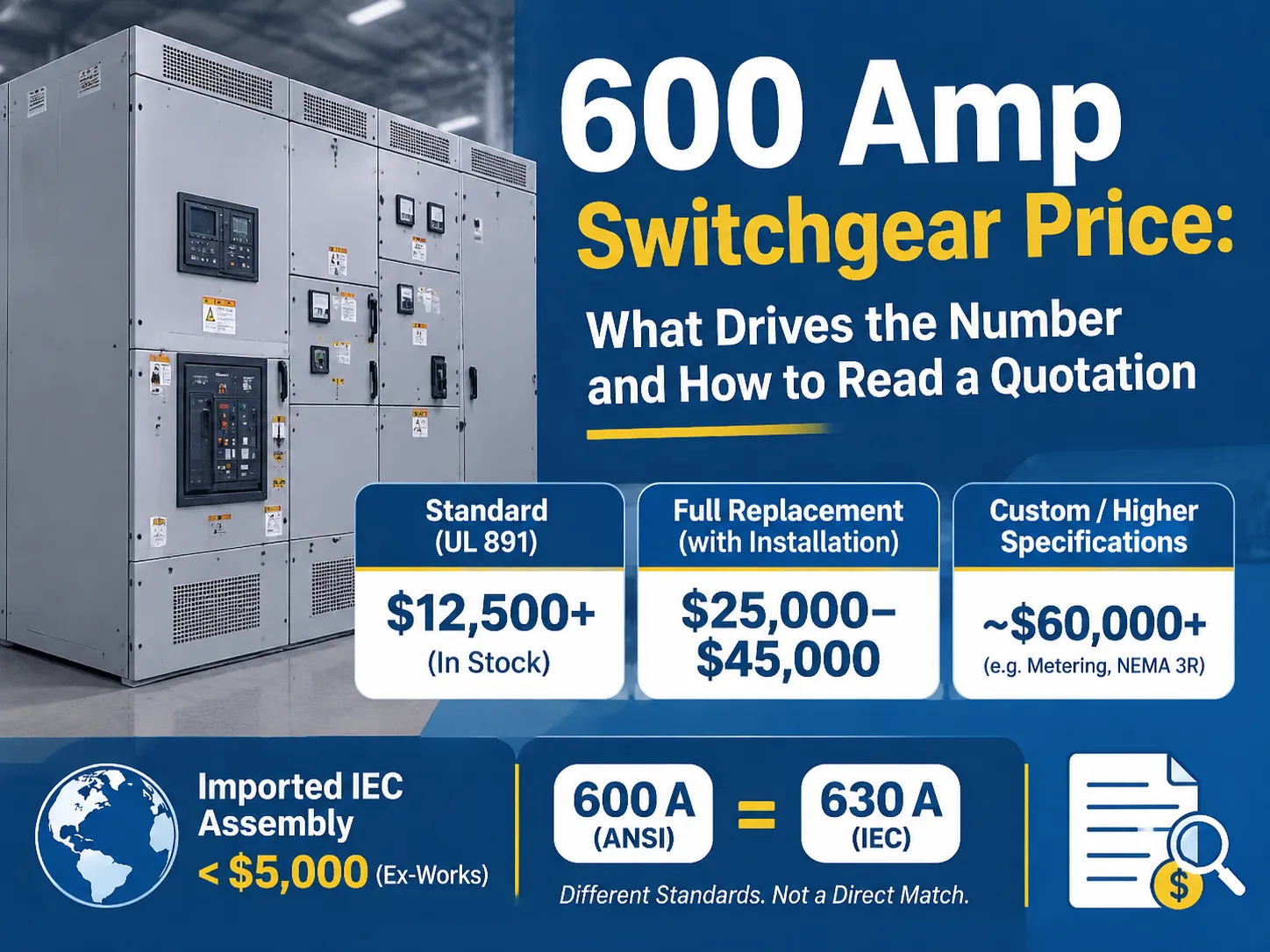
According to a standard equipment price-list in North America, a 600A switchgear system costs around $12,500. In case of any repairs, the cost to replace is around $25,000-45,000. Products with customized features start from $60,000. The same equipment that is made accordingly to IEC standards can actually cost just $4,000-12,000, depending on the equipment type and put on it functional characteristics. Note that 600A rating is for ANSI, while IEC designation is 630 A. The lead time for an available equipment is estimated to take 3-5 days. For customized products, this time period will be about 8-16 weeks and for an imported equipment – 12-20 weeks.
What 600 A Switchgear Is and Where It Sits in a Service
Service size, not product category, is what 600 amps is. It is the current a commercial building draws when its connected load is a couple of hundred kVA. For example, it can be a medium office, a store with refrigeration or a workshop with welders, or a small hotel. The equipment that carries this current is placed just next to the utility transformer and has to fulfil both utility and building requirements.
There are three different families of products sold at this rating, and the term switchboard is often used interchangeably with low voltage switchgear and distribution board (or cabinet) although it is not correct. A switchboard consists of circuit breakers and switches mounted on a bus, it is accessible from the front, and it conforms to UL 891 standard in North America. Low voltage switchgear is an arrangement of devices in separate compartments protected by UL 1558 standard while a distribution board (cabinet) is a small assembly, usually with molded case circuit breakers inside rather than serving as an entrance of the service.
When considering the products on the market outside North America, IEC 61439-1 and -2 standards should be taken into account, as those standards refer to assemblies instead of separate product categories. Moreover, the Form of separation numbers (1-4) are used instead of distinguishing between switchboards and switchgear, and that explains the differences in quotations despite the same current and fault ratings.
The Main Price Bands, From In-Stock Board to Custom Lineup
The numbers provided below represent equipment only and are in the year 2026 American dollars and based on the North American markets. The reason behind this process is more important than the actual figures since the same four decisions create the same four bands all over the place.
| Configuration | Indicative price | What you are buying |
|---|---|---|
| In-stock 600 A service entrance switchboard, UL 891, main lug | From $12,500 | Standard lineup, 3 to 5 day delivery |
| Custom 600 A switchboard, main breaker, metering | $18,000 to $32,000 | Engineered to a drawing, EUSERC compliant, 8 to 16 weeks |
| 600 A replacement project, equipment plus installation | $25,000 to $45,000 | Removal, new gear, labour, commissioning, downtime |
| 600 A with 65 kA rating, NEMA 3R, Form 4 | $40,000 to $65,000 | Higher fault certification, outdoor enclosure, compartmentalisation |
| Imported IEC assembly, 630 A, ex works Asia | $1,500 to $5,000 | Bare assembly, IEC 61439, no UL listing, documentation to be arranged |
The final row is neither an error nor a fraudulent product. It is a different type of regulatory product. An IEC 61439 assembly manufactured as per the Chinese or European design can indeed be sound but may not work on the North American Job site because the regulatory authority will require a UL 891 listing or a field evaluation which can cost thousands of dollars and may take weeks to complete. For a project that has a fixed opening date, this line of business is rarely feasible.
The largest part of the market sits between those two extremes, and it is where configuration matters most. A low voltage complete switchgear assembly in the GCS format is normally quoted against a feeder schedule, not against a kVA figure, which is why two quotations for the same 600 A service can differ by $10,000 before a single device changes.
On the other end of the scale, a 600 A assembly is small. Medium voltage gear with a rating of 15 kV and five breakers starts at around U.S. $90,000 for the gear itself, which is why readers may sometimes be tempted to “solve” a capacity problem at low voltage when the appropriate action would be to provide a new service.
Price by Type: Switchboard, Switchgear, MCC and Distribution Cabinet
The same 600 A can be delivered in four packages with four prices, and the difference is serviceability, not capacity.
| Type | 600 A equipment price | When it is the right choice |
|---|---|---|
| Switchboard, UL 891, main lug, fixed devices | $12,500 to $22,000 | Service entrance, single point of isolation, modest fault level |
| Switchboard with main breaker and metering | $18,000 to $32,000 | Tenant metering, utility requirements, selective main protection |
| Low voltage switchgear, UL 1558, compartmentalised | $35,000 to $70,000 | Continuous process, hospital, data centre, live-adjacent maintenance |
| Motor control centre, 600 A bus | $30,000 to $90,000 | Grouped motor starters with a common 600 A horizontal bus |
| IEC 61439 assembly, Form 2 to 4, 630 A | $4,000 to $18,000 ex works | Markets where IEC assemblies are accepted |
Motor control units are a good example, because here the fact that it is a 600 A bus does not matter. What matters is the quantity and type of starters, with 600 A MCC with twelve DOL starters and 600 A MCC with forty frequency drives having completely different budgets despite having the same amperage. Inquire anything about MCCs, and you will find a question about the feeder schedule, not about the bus amperage.
Distribution cabinet row was left out of the table on purpose, as at 600 A it is an unusual item. Distribution cabinets in the range of 100 to 400 A are cheap and regularly used. In such cases, one usually ends up spending less on a switchboard than adapting a cabinet to the required amperage.The fixed low voltage switchgear in the GGD format is the type most often quoted when a buyer asks for a cabinet at this rating, and it is a switchgear assembly, not a distribution board.
Price by Country: What the Same 630 A Costs in Six Markets
The importance of country seems to surpass that of brand when taking into account the factor of certification and manpower weight in the overall price. The prices shown below are the indicative prices of equipment used in Form 2 assembly with the main breaker, indicated in US dollars, converted to 2026 rates.
| Market | Standard | Typical equipment price | What sets the level |
|---|---|---|---|
| United States | UL 891 / UL 1558 | $18,000 to $45,000 | Listing, EUSERC, high labour, local panel shop margin |
| United Kingdom | BS EN 61439 | $8,000 to $18,000 | No UL equivalent needed, competitive panel shop market |
| Germany, France, Benelux | IEC 61439, CE | $9,000 to $20,000 | Engineering hours, type tested assemblies, documentation |
| Australia, New Zealand | AS/NZS 61439 | $10,000 to $22,000 | Small market, high labour, compliance marking |
| Middle East | IEC 61439, project spec | $5,000 to $14,000 | Imported assemblies, utility approvals, consultant specification |
| China, Southeast Asia | IEC 61439, GB 7251 | $2,000 to $8,000 | Local manufacturing, no third-country listing, freight excluded |
Comparison of the United States and other countries has little effect on quality. In the United States, UL 891 and various types of certification are done by skilled labor at a labor cost that is several times more than the Asian one. In Europe, panels have passed engineering and certification tests but do not have to be certified by American standards. Chinese companies do not have any type of listing at all, allowing them to offer prices that are much lower than Americans.
The comparison of countries is valid only when it is evaluated under similar conditions, which is rarely the case. When quoting an export price, freight, insurance, taxes, and evaluation must not be included— this can double the actual cost of landing the goods. Moreover, the cost of freight and insurance may amount to 8% to 15% of the total sum whereas custom duties vary from 0% to 12% and evaluation may cost thousands.
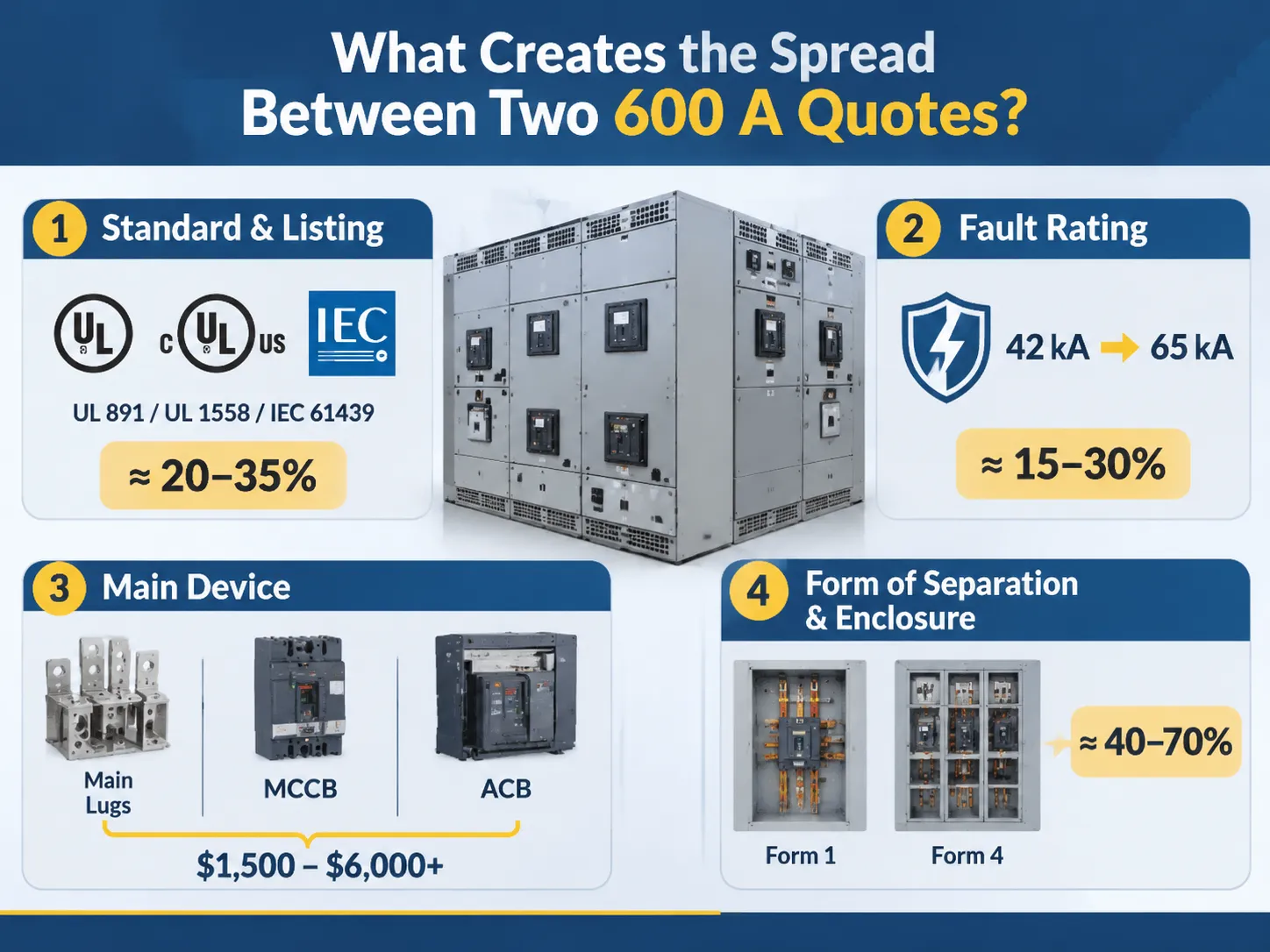
What Creates the Spread Between Two Suppliers at the Same Rating
- The listing. UL 891 refers to switchboards while UL 1558 refers to low voltage switchgear. Then, in addition, the international markets have sustainability standards encapsulated in IEC 61439-1 and -2. A listed product brings one more expense which relates to testing at the first instance, but in contrast to the subsequent use, the expenses are either way from 20 to 35 percent from total cost. Besides, such certification is very important, as no alternation can take place in the process of inspection.
- The fault rating. Moving from 42 kA fault rating to 65 kA results in various changes to the cross section of the busbars, bracing layout, and battery design. Prepare additional 15 to 30 percent for this change. This item is particularly crucial because the mistake of specifying inappropriate fault rating tends to be made quite often. Generally, such ratings fall under responsibilities designated to those who don’t have anything to do with it.
- The main device. Main lugs are the cheapest variant available and provide no disconnect feature. The main case breaker adds anywhere from $1,500 to $6,000 depending on its frame and rating. Main air circuit breaker taking into consideration a trip unit costs a lot more, while insulated models fall in the middle price range. The difference is not just in the money, but also in the different levels in terms of ease of operation.
- The form of separation. Form 1 has no barriers, while Form 4 separates busbars and terminals into distinct compartments with access limited to a particular compartment only during the repair or routine operations. Form 4 will add an average of 40 to 70 percent to the total cost.
- Withdrawable versus fixed. Fixed assembly means that one has to bolt everything in place while in the case of withdrawable assembly the whole mechanism is placed on a carriage, which makes it retractable. The difference in costs adds up to 25 to 45 percent depending on the rating. The withdrawable switchgear in the MNS format exists for exactly that reason, and it is the right answer for a continuous process, not for a workshop.
- Outgoing configuration of devices. This is the component that affects the most but receives the least attention. A 600 A panelboard with only six outgoing circuits is a totally different apparatus than the same panelboard with twenty-four circuits, as the circuit breakers alone may represent half of the total expenses for the equipment. A bid that gives only the overall price and does not present an outgoing schedule of feeders is not a price, it is an estimation.
Why Two Manufacturers Quote Differently for the Same 600 A
Beyond specification, there are four crucial structural differences that explain the considerable gap between two respected suppliers.
- The brand of the breaker used in the assembly. A panel shop that builds on a tier-one platform incurs higher costs for component parts that need to be borne by the customer as opposed to a manufacturer building with its own breakers and/or cheap regional brand. In this case, there is no guarantee that one option is better than the other, but the level of service and spare parts availability is different with the time of performance measured over a period of ten years, not upon acquisition.
- It comes down to engineering. In order to carry out work on single-line diagrams, fault current calculation, and discrimination verification, the panel shop needs to spend at least two weeks of its time. A price quoting shop does not spend time doing this work and this is the expense worth making.
- It comes to the factory structure. A factory that manufactures the box, bar, and assembly in the same premises enjoys lower costs compared to a panel shop that purchases three modules from different manufacturers. Therefore, a price obtained from a factory complying with the IEC standards beats a domestic shop price by considerable margin even prior to labor costs being accounted for.
- The fourth aspect concerns the manufacturer’s documentation. A company that issues routine tests, the as-built drawings and detailed type test information is obviously incurring costs which the company issuing only delivery notes is avoiding. When it comes to a service entrance, the documentation is what the inspector asks for, which makes it absolutely necessary even if it is not required as part of a purchase order.
Lead Time Is Part of the Price
There are multiple routes available for the same job that are evaluated based on both cost and time. The timeline should serve as cost line because in many projects, rental services of cranes, electricians, etc., shall be booked before ordering necessary equipment.
- In stock domestically. It takes from three to five days to receive a simple model which may involve extra costs along with the costs of storage. When it is necessary to replace broken equipment by an identical one, this is usually the only option that enables to keep the facility run.
- Custom-made domestic production. A time needed to produce the equipment may vary from eight to sixteen weeks due to the shop backlog and time required for preparing and submitting preliminary information. The drawing will be developed based on your requirements, however, you will have to pay for professional services.
- Import. It usually takes from twelve to twenty weeks to produce the equipment due to production and transportation time needed as well as time spent for custom clearance. The imports are cheaper, however, the phases last longer and the saving on price is not always beneficial for the project with a strict launch date.
The last point requires a straightforward explanation. In case the project is initiated in ten weeks, such equipment as import cranes is not considered to be cheaper since it delays the whole process giving discount for such delay. In case the project time is longer, it is better to invest in equipment service review to eliminate potential issues which may arise at the very beginning of import.
Installation, Commissioning and the Costs Outside the Gear
The cost of the equipment is just one-half of the story. In the case of the 600-amp service, the work surrounding it might be more than the cost of equipment itself whereas access to the location is by far the most complicated aspect of the installation.
There are to hours of labour for simple replacement tasks and the labour expenses go up if cables have to modified for the new placement. There are also costs of installation of the cables, because in case of the 600-amp service a huge copper cable is used and it requires special tools. Utility coordination and disconnect/reconnect are also on the list of expenses.
Out of all the services that are typically listed above only commissioning is usually skipped, but this service is the one most frequently checked by inspectors.
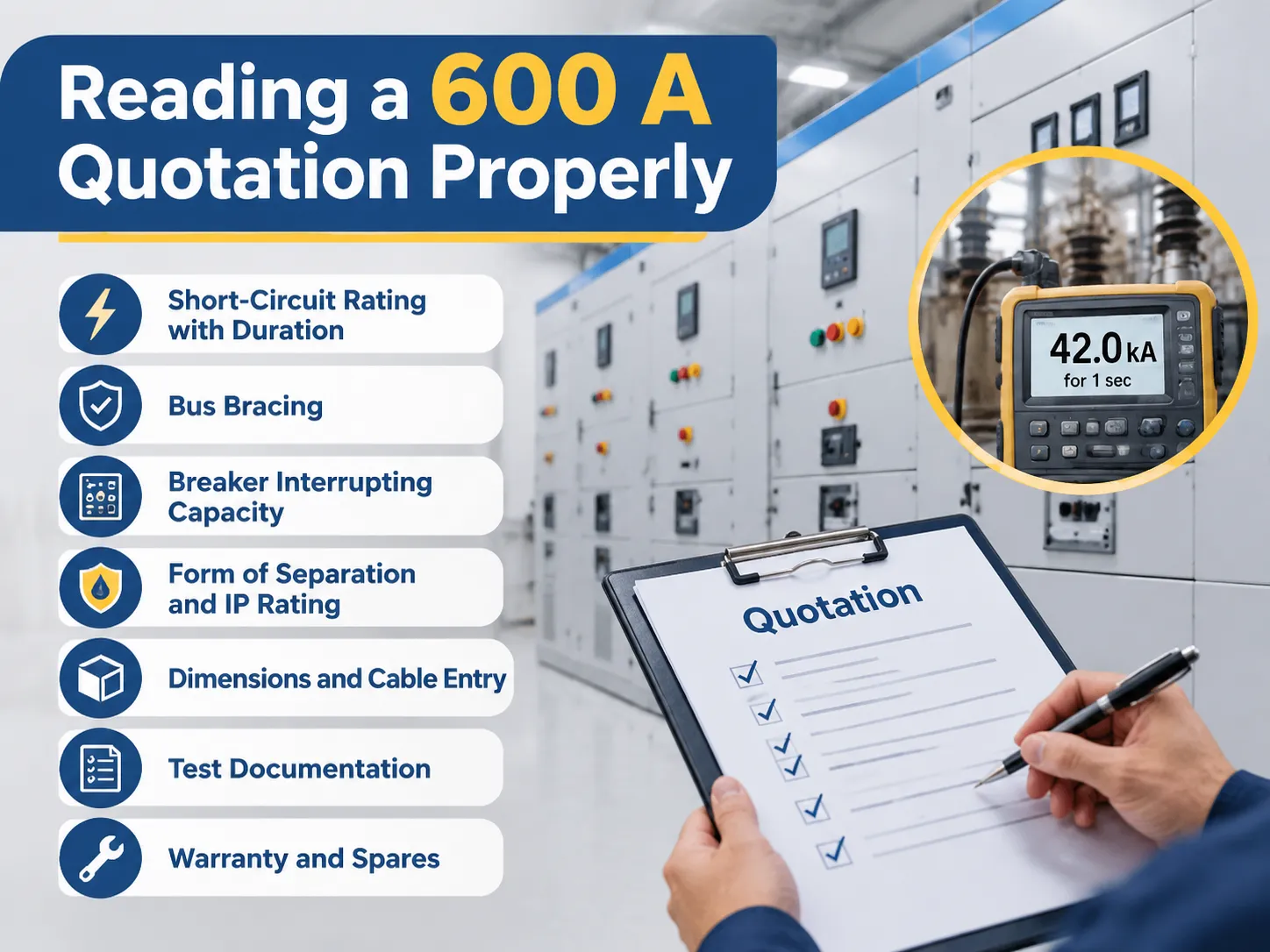
Reading a 600 A Quotation Properly
Seven items differentiate a similar quote from one being requested. Never forget to obtain all seven in writing, and the one that has not been provided can be treated as a question, not an omission.
- Break down the short circuit rating with time duration. “42 kA” is not a rating, and “42 kA for 1 second” is. Ensure that it is greater than the fault level calculated at the service location, not the nameplate of the utility transformer, as these two numbers vary since the impedance of the service cable is taken into account.
- Bus bracing. It’s expressed in kA and it has to be greater than short circuit rating. If the design is rated below the breaking capacity, it will still operate mechanically without breaking under load.
- AIC of a circuit breaker. Every outgoing device has its own AIC. A board rated at 42 kA connected with branch circuit breakers rated at 10 kA will be considered at the level of branch of 10 kA, whereas its label will remain unchanged.
- The classification and IP rating. Form 1 to 4, IP31 to IP54. These two values can expect the maintenance more precisely than the brand can do this.
- Dimensions and cable entry. Whether it is from the top or below and also the actual footprint including the swing of the door and clearance for service. Line up that does not match the room is a change order with a four-week lead time.
- Test documentation. It includes maintenance report for each unit as well as the reference to the type test. For UL it includes file number as it is the first question of the inspector.
- Warranty and spare parts. Normal is 2 years and negotiable is 5 years when buying in bulk. It is worth asking for the price of the spare breakers at the moment of the order, since purchasing them afterward is there likely to cost more and take longer.
The industrial energy infrastructure projects we have delivered show what those seven items look like on a real single line diagram, which is more useful than a brochure when the question is whether a supplier has built this before.
Where RUY Fits
We create low voltage circuits with currents from the 630 A scope and higher: GCS, GCK, MNS, and GGD types, which can be fixed or removable, based on IEC 61439 standards and with fault levels of at least 50 kA depending on the case. Being the manufacturer, we can configure our products to your diagram instead of offering you some products and waiting for you to choose one from our products’ catalog.
As for the price, the truth is that we have a manufacturing cost structure rather than that of a panel shop, and this fact is reflected in the quote for any project that uses IEC equipment. If a project needs a UL 891 certification, we know we are not the supplier in this case and do not hesitate to say that at once.
What we can offer, however, is our expertise. If our customers send us the fault level, circuit diagram, and separation form, we process this information and send them a quote. The device is quoted separately, as well as the bus and the outgoing circuits. That how the customers learn that the highest number in their order is usually the price of the outgoing circuit breakers, not the product.
For a project that needs the full low voltage distribution scope, the range of low voltage and medium voltage assemblies covers switchgear, distribution cabinets, capacitor compensation and prefabricated substations, which means one interface for the electrical room instead of four.
FAQ
How much does 600 amp switchgear cost?
In the US, the price for a ready-set 600 A UL 891 service entrance switchboard is around $12,500. For a customized switchboard with a main breaker and the metering features, the standard price can range from $18,000 to $32,000, while for installing a completely new device, one should be ready to pay between $25,000 to $45,000. Costs of a service entrance switchboard equipped with higher fault rating specifications and Form 4 segregation can total up to $65,000. The prices in other countries for the same capacity switchboard follow the IEC 61439 standards and may cost from $4,000 to $18,000 depending on the location of installation and fault level.
Why is 600 A a standard rating when IEC uses 630 A?
North America’s unique development has resulted in its use of 400, 600, 800, and 1200 A, while IEC has adopted 630, 800, 1000, and 1250 A. The difference of 5% is perfectly within the manufacturing tolerance and therefore a 630 A IEC equipment can easily be utilized in the place of an equipment with the rating of 600 A. There is only one thing that cannot be changed, namely certification, which is the source of the contradiction since running a 630 A IEC equipment is not the same thing as using a 600 A UL 891 unit.
Why is imported switchgear so much cheaper?
There are three explanations for the differences and one is the cost of labour. There is no UL listing or EUSERC compliance charges; the cost of labour is far less than it is in North America and there is less paper work involved. Once shipping, duties and onsite evaluation are taken into account, the total disparity is reduced although it is a whopping 40-60%. The application of this difference to a specific case depends on the existence or absence of IEC installations.
Does a higher fault rating cost much more?
When upgrading from 42 kA to 65 kA, the assembly charging is expected to rise by 15 to 30 percent. The reason for this is that the cross-section of the busbar and supports and structures for the circuit breaker often need changes in the enclosure if used at a certain level. The specification is the one which is usually underestimated because the equipment installed in the end may not be changed at the later time.
How long does 600 A switchgear take to arrive?
The lead time ranges from three to five business days for a standard switchboard in stock, from eight to sixteen weeks for a special switchboard, and from twelve to twenty weeks for an import switchboard. The duration to coordinate utility connections, and inspections, should also be included in any service entrance modification process since equipment arrival does not mean that it is already functional.
References
- UL Solutions — UL 891 Switchboards and UL 1558 Switchgear
- NEMA — Low Voltage Distribution Equipment Standards
- Hitachi Energy — Low and Medium Voltage Switchgear
- Siemens Energy — Power Distribution Equipment
- GE Vernova — Electrical Distribution and Protection
Conclusion
The cost of a 600 A switchboard can either be $12500 or $46000. One must consider all four components that are crucial in making this comparison: the specifics of the listing, the fault rating, the primary component and the separation type.
The first step is to know the fault rating before looking at the quotations as this is the very piece of information that can never be identified while buying other switchboard parts. Then, you must decide if you want to purchase the equipment or the service as it will significantly influence the plans and costs involved in the whole process. Everything else in the quotation is subject to negotiation, and the supplier that can offer all four components without asking for them is very likely to be shortlisted as a potential supplier in the end.