
Across the globe, the terminology of “switchgear” (or the term your supplier refers to it) varies from one country to another depending on the type of equipment, from the point of view of its placement in the electrical distribution network. There is nothing wrong in using a term, these are words that are region-specific. However, choosing the wrong region-specific term while selecting the proper equipment could lead to receiving wrong items from the supplier.
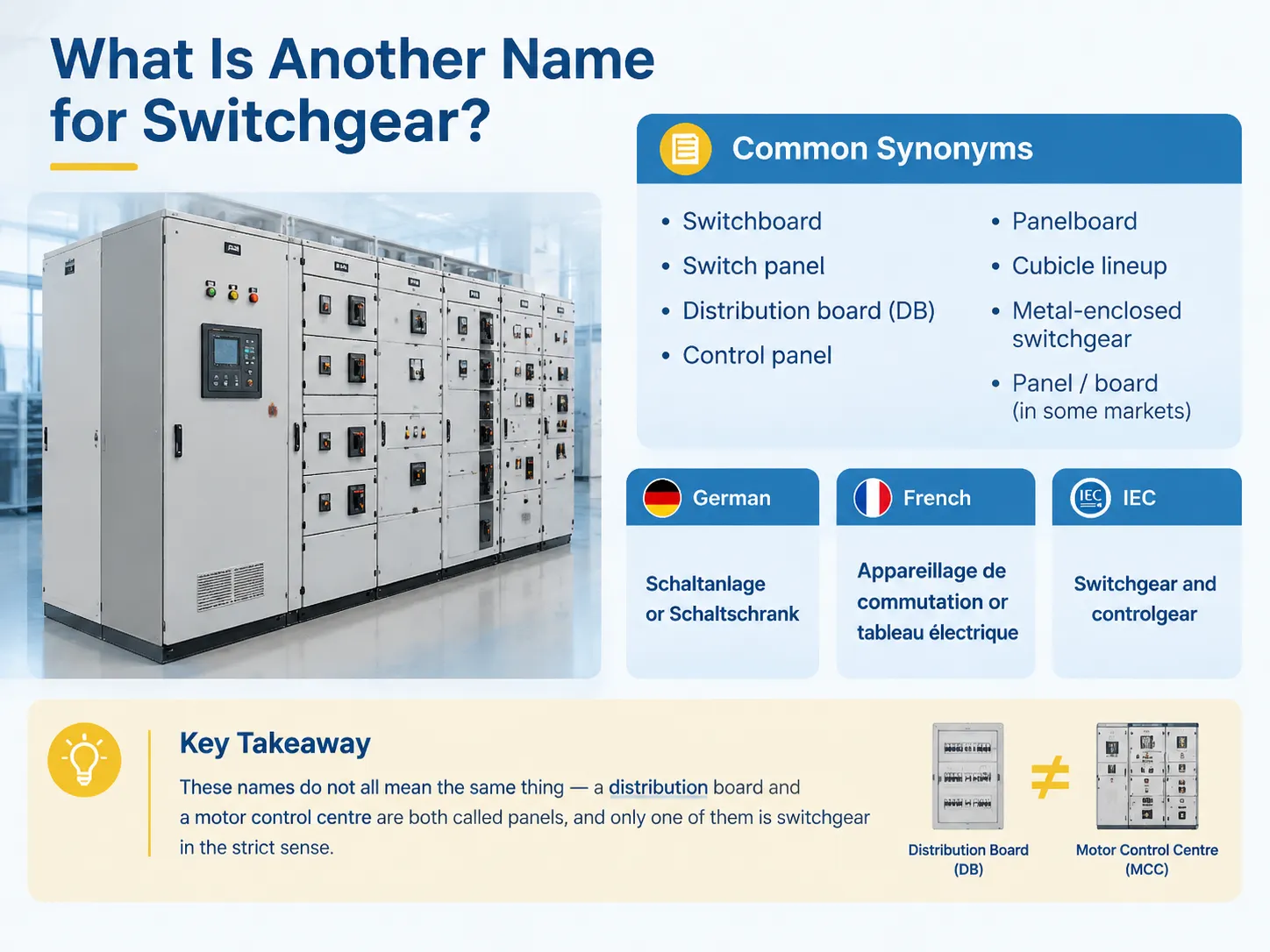
A variety of terms can be used to denote switchgear including switchboard, switch panel, control panel, distribution board (DB), metal-enclosed switchgear, cubical panel etc. In addition, it can be just referred to as panel or board in some regions. In Germany, they use the term Schaltanlage or Schaltschrank for switchgear while in France it is called appareillage de commutation or tableau électrique. The IEC has a term for switchgear and controlgear. However, it should be borne in mind that not all the terms have the same meaning. Thus, for instance distribution board may be referred to as panel typically. It is essential to mention the fact that distribution board does not mean switchgear.
What the standards actually call it
IEC 6113 involves switchgear and controlgear, which both have to be taken into account. The term switchgear refers to the assembly that switches and protects, while controlgear refers to the assembly that measures, controls and indicates. A motor starter counts as controlgear. A distribution board that comprises breakers counts as switchgear. Most people take it to mean both things.
Below 1000 V the whole vocabulary compresses into one product family: fixed complete switchgear such as the GGD fixed-type LV switchgear is what most people picture when they hear the word.Two additional standards that flanking it when you see a drawing and need to be aware of are IEC 61439, which applies to low-voltage switchgear and controlgear combine, and ASME C37.20, which are for metal-enclosed switchgear in the United States, where classified enclosures use the NEMA Type system, leading to the emergence of terms such as NEMA Type 1, Type 3R and Type 12.
In India, there is also a more compact terminology that does not appear in other markets, such as SWGR for switchgear, LT and HT panel for low and high voltage panels and feeder panels. An “HT panel” immediately indicates that it constitutes a medium voltage level within the context of its use, which does not happen with any other English expression.
The names in other languages
| Country | Term used | Notes |
|---|---|---|
| United Kingdom | switchgear, switchboard, consumer unit | “Switchboard” for the assembly, “consumer unit” for the domestic version |
| United States | switchgear, panelboard, switchboard, metal-clad | Panelboard is the UL 891 term; metal-clad is the ASME C37.20 term |
| Germany | Schaltanlage, Schaltschrank, Verteiler, Unterverteilung | Unterverteilung literally means sub-distribution and is a defined term |
| France | appareillage de commutation, tableau électrique, armoire de distribution | TGBT is the common label for the main LV board |
| Italy | quadro elettrico, quadro di distribuzione | Quadro also covers control panels |
| Spain, Portugal | cuadro de distribución, cuadro eléctrico | Cuadro general de distribución for the main board |
| India | SWGR, LT panel, HT panel, feeder panel | The most compressed terminology in common use |
| China | 开关柜 (switch cabinet), 配电箱 (distribution box), 配电室 (switchroom) | Low-voltage boards are typically 配电箱 or 低压配电柜, exported as LV distribution cabinet |
| Hong Kong, Taiwan | switchroom, switchboard panel, distribution board | Chinese-language practice follows the mainland vocabulary closely |
| Middle East, Southeast Asia | MDB, main distribution board; panel, DB | Most EPC documents are in English regardless of local language |
Translating between the rows is straightforward once you know that the Chinese 开关柜 covers the whole family while 配电箱 is the small end of it, and that the European tableau and the Chinese 配电柜 are much closer than a literal translation suggests. An export pack using the GCS low-voltage complete switchgear arrives in English documentation as an LV distribution cabinet, which is why the same project can carry two different names on two different drawings.
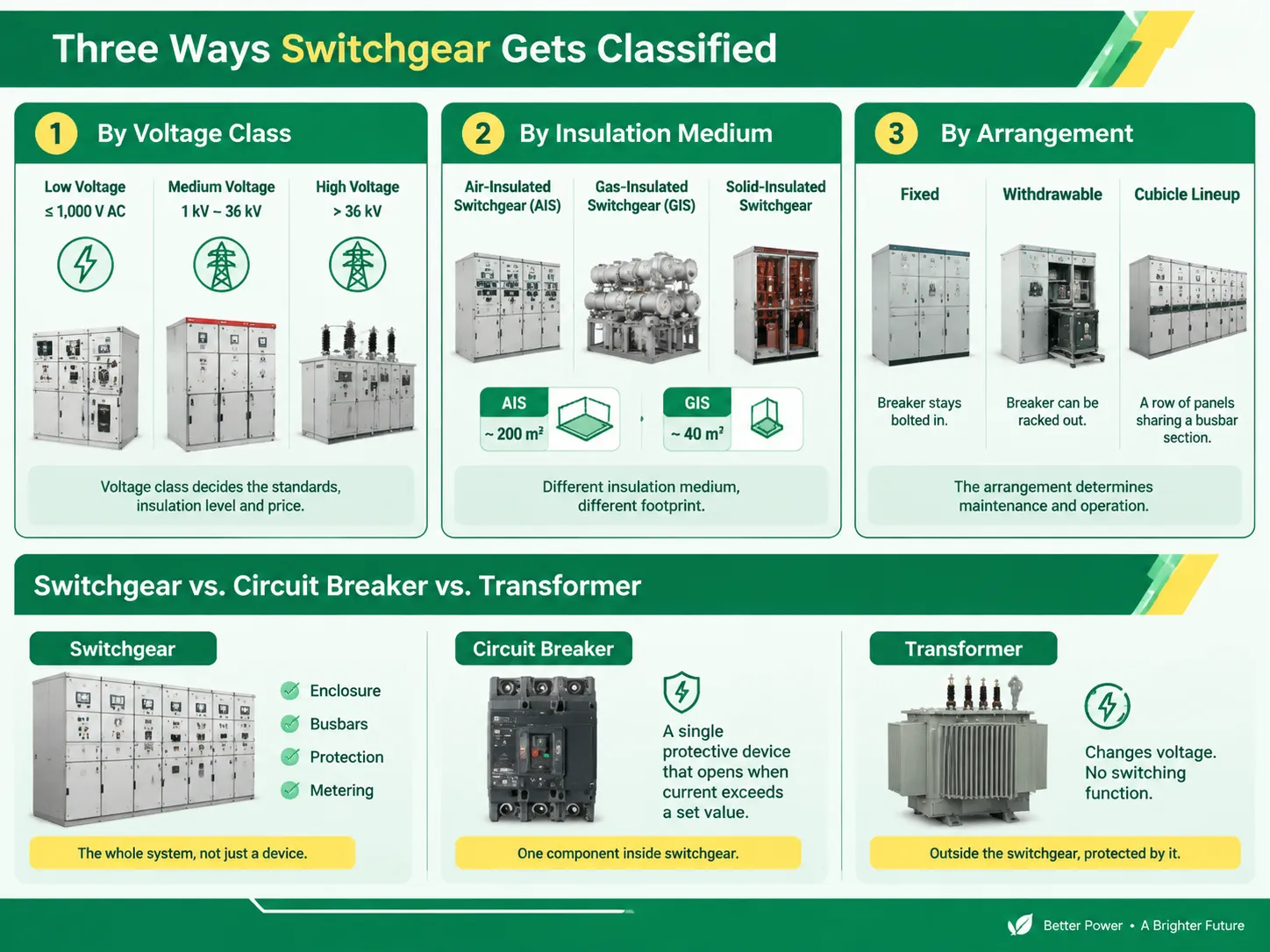
Three ways it gets classified
There are three valid forms of answering question, namely “three types”, but people tend to mix everything up.
- By voltage class. Low voltage is anything less than 1,000 volts, medium voltage is from 1 to approximately 36 kilovolts and high voltage is more than that. This is the classification that most buyers refer to, and it is the one that stipulates standards, insulation levels and pricing.
- By insulation medium. Air-insulated switchgear, gas-insulated switchgear (GIS: usually SF6 or any other gas), solid-insulated switchgear. In gas-insulated switchgear, conductors are enclosed in pressurised metals with gas acting as an insulator. In air-insulated switchgear, conductors are mounted on ceramics or epoxy supports. This is why there is a difference between the sizing of 40 square metres and 200 square metres for the same workload discussed in our article.
- By arrangement. Fixed, withdrawable and cubicle arrangement. In fixed configuration, the circuit breaker stays attached and you have to de-energise everything to work on it. In withdrawable configuration, which has been dominating in industrial places, circuit breaker can be removed with a help of a trolley. In cubicle arrangement, there are several of such panels connected to a single busbar.
RUY has entered the market in all three categories, which makes the terminology here rather straightforward. On the low voltage side, there is fixed configuration represented by the GGD series and withdrawable configuration represented by GCK series.At medium voltage, the KYN28-12Z air-insulated metal-armored switchgear is a withdrawable metal-clad lineup in the AIS family, and the ring main unit is the same voltage class configured as a compact sealed distribution ring, not a lineup.
Switchgear is not a circuit breaker, and it is not a transformer
People sometimes confuse these three products, thinking that they mean the same concept but, in reality, all three are totally different items.
The circuit breaker is only one element of the protective system. The circuit breaker works by detecting current and turning the circuit off if the current exceeds the preset limit. As in a relay being part of a transformer, the circuit breaker is one part of the total switchgear system. When the supplier uses the term “breaker of 60 amps”, they are referred to the device itself, while when it mentions “switchgear of 60A”, it means a complete assembly of everything, from current supply components to end devices of current.
The transformer converts voltage. This device does not perform switching at all and is installed outside the switchgear, being protected from it. Generally, a transformer supplies the incomer breaker at the electricity switchboard, meaning that in one location there are two machines operating.
Three more devices are referred to wrongly. An MCC controller means a control element combined with the contactor and overload, with the system referring to the motors, not the building. Distribution board within the UK means a low-voltage distribution board and a system that supplies light or small commercial premises. Control panel stands for HMI and PLC box for a specific machine or process near the switchgear.
What RUY supplies under those names
When a buyer creates specification, the practical issue is what name the supplier will provide a quote against? RUY’s different products are, however, available in all voltage classes as well as just names.
Low-voltage fixed complete switchgear is the GGD fixed-type family, and the withdrawable equivalent, such as the GCK withdrawable complete switchgear, is where you go when maintenance has to happen without dropping the whole board. Both products have the features listed including the coordination of protection schemes and Busbar capacity and short-circuit current withstand.
At medium voltages, we should look at the KYN28-12Z series that includes products such as the HXGN15-12 and HXGN17-12, ring mains units, and fully-insulated versions of KYN28-12Z as well as air-insulated switchgears for 40.5 kV products for the 33 kV class. It is important to notice that the company does not manufacture switchgears for voltages higher than 40.5 kV so it can be very useful in power industry bidding to know about this specification before starting the bidding process since it is better to know this beforehand than figure it out later.
FAQ
What is a switchgear in electrical terms?
A grouping of electrical equipment and protective apparatus with the related bus duct, enclosures and circuitry that can both break current flow and eliminate faults. According to IEC, switchgear points to switchgear and controlgear: switchgear for the purpose of switching and protection, controlgear for measuring and control. An example of a package includes incoming circuit, multiple bus ducts, outgoing circuits with protective devices, and measuring circuits.
What are the three types of switchgear?
There are three distinct answers. In terms of voltage, we can have: low voltage, up to 1000 V; medium voltage, 1 to 36 kV; high voltage, above that. As far as insulation is concerned, there can be air-insulated, gas-insulated, and solid-insulated types. In terms of arrangement, there can be fixed, retractable, and cubicle ones. And the nature of the document will depend on the context, meaning that a specification that states “three types” without specifying the axis that has been applied is technically meaningless.
Is a switchgear the same as a breaker?
No. The breaker forms part of a switchgear unit. A switchgear rated at 400 A may have a 400 A incomer breaker but the busbars would be rated higher. The system can have hundreds of individual devices for outgoing circuits too. Thus, when a quote mentions “switchgear”, it is referring to the overall system while in the case of “breaker”; it would mean a component only.
Is a switchgear the same as a transformer?
No, nor are they in the same family of products. While transformer deals with voltage change, switchgear deals with switching and protection. They are together installed in the same substation with switchgear protecting the transformer on low voltage side, and neither of them is substitutable — what comes in a delivery of distribution substation package illustrates the divisions. They arrive on the same base, hence the delivery of the substation is referred to as a single package and not as two pieces of equipment.
References
- International Electrotechnical Commission — IEC 6113 switchgear terminology, IEC 61439 low-voltage assemblies
- ASME — C37.20 metal-enclosed switchgear standard
- NEMA — enclosure type ratings and switchgear standards
- ABB — global switchgear terminology and LV/MV product ranges
- Hager — switchgear and distribution board product naming
- Legrand — distribution board and enclosure terminology across European markets
Conclusion
Nine different words mean “Switchgear,” but none of them probably qualify as Switchgear. The use made of Switchgear forms part of its diversity. The Switchboard in London is similar to the one in Chicago called a Panelboard; yet, the one in Dublin does not fall under the category of Control Panel, the type found in Workshops.Make sure that you always refer to Voltage Class, System, and Standards as well as local terminology included in your description. A Supplier from anywhere in the world understands the document, which states: “1000 V Withdrawable Air Insulated Line-up according to IEC 61439;” but nobody can understand any document that only mentions “Panel.”